
If you're building or deploying large language models, you know that keeping them aligned is a moving target. These five resources offer distinct approaches to steering model behavior—from pretraining to post-training—so you can pick the right fit for your stack.
The Landscape of AI Alignment and Steering
AI alignment has evolved from a niche research topic to a practical engineering challenge. As models grow more capable, ensuring they behave as intended becomes harder. Traditional fine-tuning is expensive and time-consuming, so researchers and enterprises are turning to lightweight steering methods that adjust model behavior without full retraining. This space is crowded with academic papers, open-source toolkits, and enterprise solutions, each with its own trade-offs. Understanding the differences helps you choose the right approach for your use case, whether you're a researcher, a developer, or an enterprise architect.
How We Evaluated These Tools
We looked at each tool's approach to alignment, its ease of integration, the depth of documentation, and its practical applicability. We also considered the credibility of the creators and the community support behind each project. Each tool stands out in its own way: some excel in research depth, others in production readiness, and some in sheer innovation. Our goal is to give you a clear picture of what each offers so you can decide which fits your needs.
Here's a quick snapshot of the five tools we're covering, each with its primary focus and best use case.
| Provider | Best For |
|---|---|
| Alignment Pretraining (AI Alignment Forum) | Researchers seeking foundational alignment methods |
| Orion Reblitz-Richardson | PyTorch developers embedding alignment into training |
| IBM AI Steerability 360 | Enterprises needing customizable LLM steering pipelines |
| NVIDIA SteerLM | Developers using NVIDIA NeMo for runtime steering |
| AlignEZ | Researchers exploring low-cost alignment via embedding editing |
Deep Dive: The Five Tools
#1 Alignment Pretraining (AI Alignment Forum)
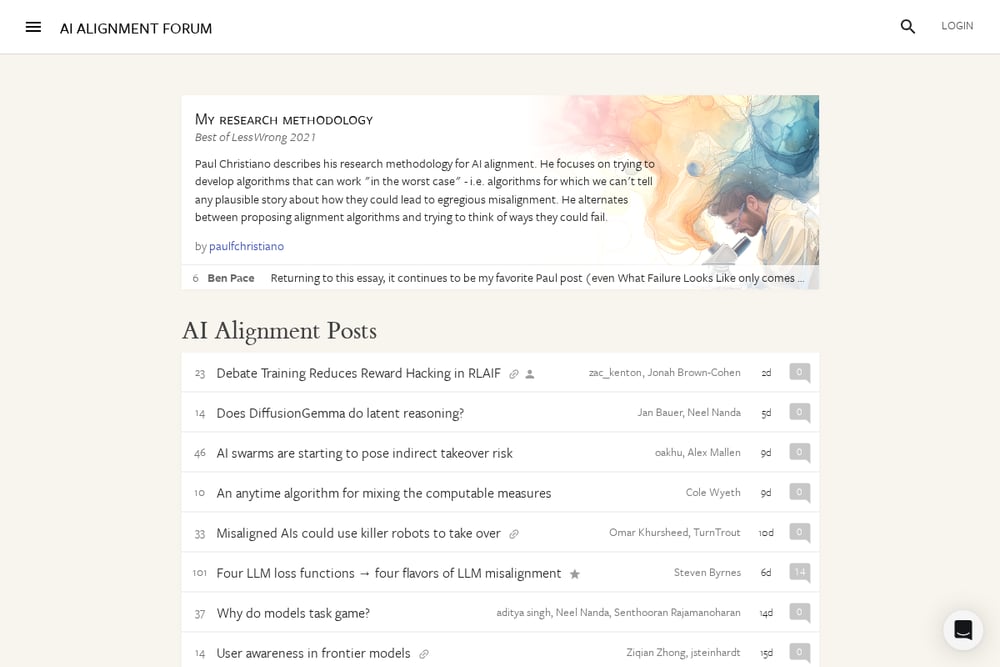 A screenshot of the AI Alignment Forum website.
This approach, highlighted in a recent AI Alignment Forum post, focuses on embedding alignment during pretraining by training models on data that demonstrates good behavior. The post summarizes a paper showing that this method dramatically reduces misalignment, even after post-training. It's a paradigm shift from patching alignment later to building it in from the start. The forum post provides a comprehensive survey of related work, making it a valuable resource for researchers. If you're interested in the theoretical foundations and latest research, this is a must-read. The discussion also links to seminal papers and ongoing debates in the alignment community.
#2 Orion Reblitz-Richardson
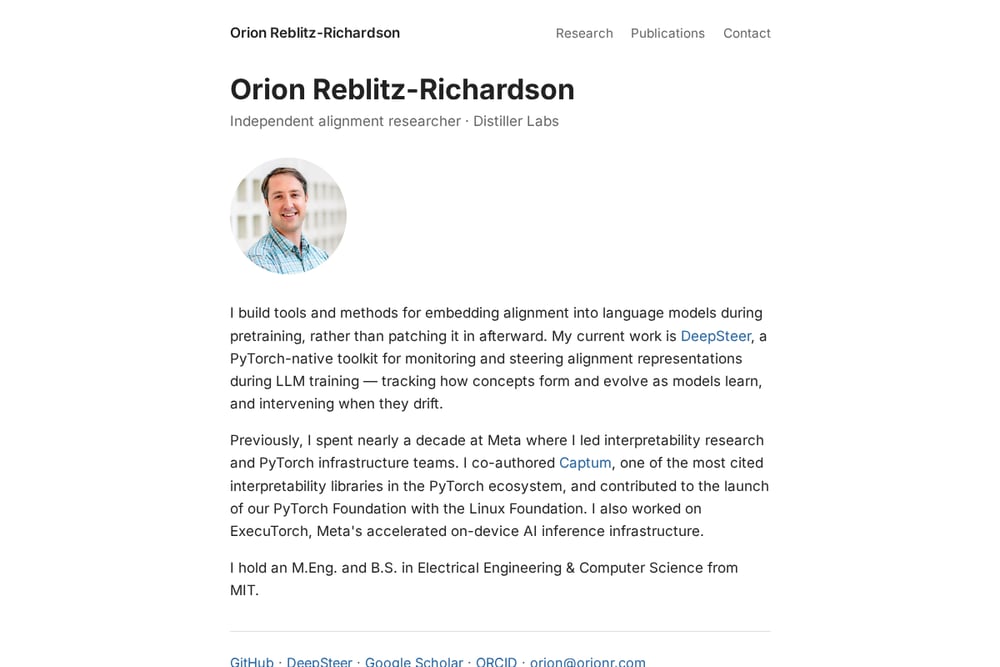 A screenshot of the Orion Reblitz-Richardson website.
Orion Reblitz-Richardson is an independent alignment researcher with a decade of experience at Meta, where he co-authored Captum and contributed to PyTorch's growth. His current work, DeepSteer, is a PyTorch-native toolkit for monitoring and steering alignment representations during LLM training. It lets you track how concepts form and evolve as models learn, and intervene when they drift. This is a hands-on tool for developers who want to integrate alignment directly into their training pipelines. His background in interpretability and infrastructure gives DeepSteer a practical edge. If you're working with PyTorch and want granular control over alignment, this is worth exploring.
#3 IBM AI Steerability 360
 A screenshot of the IBM Research website.
IBM's AI Steerability 360 toolkit offers a suite of algorithms that act like dials to tweak an LLM's outputs at different stages of generation. It provides a framework for combining these algorithms into steering pipelines that can be systematically evaluated. This is designed for enterprise users who need broad control over model behavior without the cost of fine-tuning. The toolkit is part of IBM's broader AI risk management suite, which includes the AI Risk Atlas Nexus and In-Context Explainability 360. It's a robust option for organizations that need to customize LLMs for specific tasks while maintaining safety. The LEGO-like approach to combining steering methods is particularly innovative.
#4 NVIDIA SteerLM
 A screenshot of the NVIDIA NeMo Framework documentation.
NVIDIA's SteerLM is a method for model alignment that allows you to steer LLMs during inference by conditioning on attributes like helpfulness and safety. It's integrated into the NeMo Framework, making it accessible for developers already using NVIDIA's ecosystem. The method involves training the model to understand attribute labels, which then lets you control outputs at runtime. This is a practical approach for production environments where you need to adjust model behavior on the fly. The documentation is thorough, though it's part of an archived version of the NeMo guide, so you'll need to check for the latest updates. If you're using NeMo, this is a natural fit.
#5 AlignEZ
 A screenshot of the AlignEZ arXiv page.
AlignEZ is a cost-effective alignment method that uses self-generated preferences to steer LLMs. It identifies an alignment subspace in the model's representation and edits embeddings to remove harmful components and boost helpful ones. This approach is lightweight and doesn't require extensive fine-tuning, making it accessible for smaller teams. The paper provides theoretical analysis and experiments showing improvements in alignment and multi-objective control. It's a research-focused tool, but the code is available on arXiv, so you can experiment with it. If you're looking for a low-cost way to align models, this is a promising option.
How to Choose the Right Alignment Tool
Start by considering your technical stack and expertise. If you're a PyTorch user, DeepSteer offers native integration and deep control. For enterprise deployments, IBM's AISteer360 provides a comprehensive pipeline framework. If you're already using NVIDIA's NeMo, SteerLM is a seamless addition. For research and experimentation, AlignEZ and Alignment Pretraining offer cutting-edge methods. Also, think about whether you need runtime steering or pretraining integration. Finally, evaluate the level of community support and documentation—some tools are more mature than others. Your choice should align with your team's skills and your project's specific requirements.
Automating Alignment Workflows
Automation can streamline the alignment process. For instance, you can set up a pipeline that uses DeepSteer to monitor alignment metrics during training and automatically trigger interventions when drift is detected. Similarly, IBM's AISteer360 allows you to build and test steering pipelines that can be automated for different tasks. NVIDIA's SteerLM can be integrated into inference servers to adjust behavior based on user feedback automatically. By automating these steps, you can maintain alignment without constant manual oversight, freeing your team to focus on other aspects of model development.
Bringing It All Together
The field of AI alignment is rapidly evolving, and these five tools represent a spectrum of approaches—from pretraining to post-training, from research to production. Each has its strengths, and the best choice depends on your specific needs. Whether you're a researcher pushing the boundaries or an engineer deploying models at scale, there's a tool here that can help you keep your LLMs on track. As the industry moves toward more proactive alignment, staying informed about these innovations is crucial. Explore them, experiment, and find what works for you.