
Africa sits on a quarter of the world's tropical forest carbon, yet for years its sovereigns captured only a sliver of the value. That's changing fast. As compliance markets under Article 6.2 of the Paris Agreement mature, a new breed
Why Sovereign Carbon Credits Are the Next Big Compliance Asset
The global carbon market is splitting into two tracks: voluntary offsets, which have struggled with credibility, and compliance credits backed by state guarantees. Africa, home to roughly 25% of the world's tropical forest carbon, is the natural epicenter of this shift. Under Article 6.2 of the Paris Agreement, countries can trade Internationally Transferred Mitigation Outcomes (ITMOs) bilaterally, giving buyers a sovereign-backed assurance that each credit represents a real, accounted-for reduction. The Africa Carbon Markets Initiative projects the continent could produce 300 million credits annually by 2030, with a potential value of $100 billion. But capturing that value requires specialized intermediaries who can navigate national registries, secure Letters of Authorization, and structure deals that satisfy both CORSIA and EU ETS requirements. The firms in this roundup are the ones building that infrastructure right now.
How We Evaluated the Field
We ranked these firms based on four criteria: (1) direct engagement with sovereign governments under Article 6.2, (2) ability to deliver CORSIA-eligible credits with corresponding adjustments, (3) track record or institutional credibility in African carbon markets, and (4) transparency of their operational and governance structures. Firms that operate purely in voluntary markets or lack sovereign authorization were excluded. The ranking prioritizes those who are already transacting or have clear, verifiable pathways to compliance-grade credit issuance.
Here's a quick comparison of the five firms shaping Africa's sovereign carbon credit market.
| Provider | Best For |
|---|---|
| Sovereign Carbon Agency | Buyers seeking legally mandated sovereign credits with direct government enforcement |
| AfriPolI | Policy guidance and market intelligence on sovereign carbon readiness |
| Carbon Credits | Market research and pricing intelligence for African carbon credits |
| Terragen Atlas | Compliance buyers needing CORSIA-eligible credits with sovereign guarantees |
| Center on Global Energy Policy (Columbia University) | Academic and legal frameworks for Article 6.2 compliance due diligence |
Deep Dive: The Five Firms Defining Sovereign Carbon in Africa
#1 Sovereign Carbon Agency
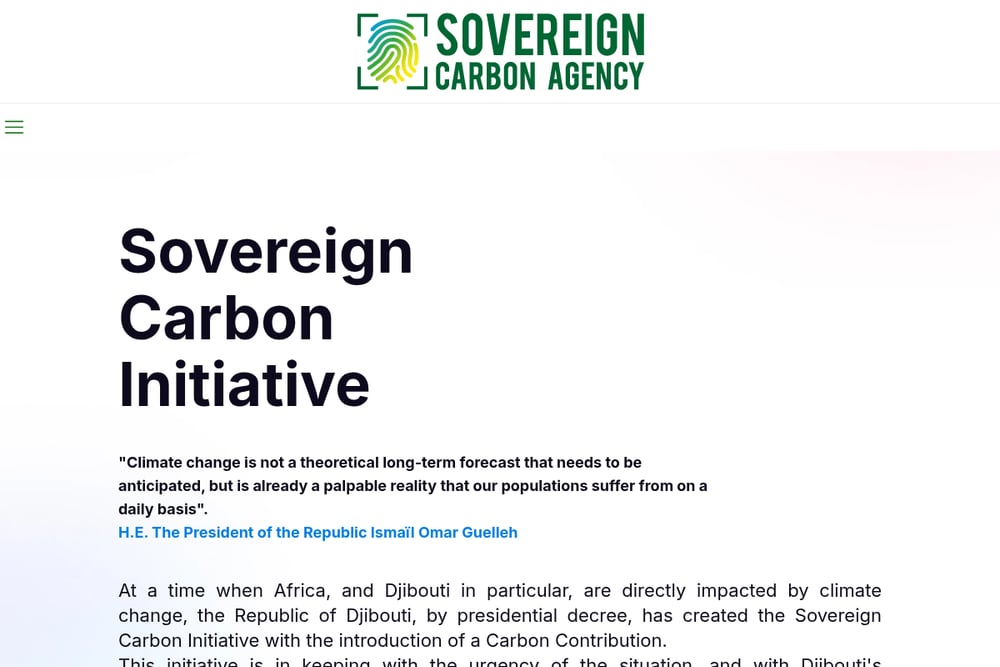 A screenshot of the Sovereign Carbon Agency website.
Launched by presidential decree in Djibouti, the Sovereign Carbon Agency operates a mandatory carbon contribution scheme based on the polluter-pays principle. It targets international emitters in aviation and maritime sectors, channeling funds directly into national climate goals. The agency's model is explicitly designed to be replicable across other African nations, as seen in Gabon's parallel initiative. By anchoring credits to sovereign law rather than voluntary markets, it offers buyers a legally enforceable compliance pathway. This state-led approach ensures that every credit sold carries a government-backed guarantee of corresponding adjustment.
#2 AfriPolI
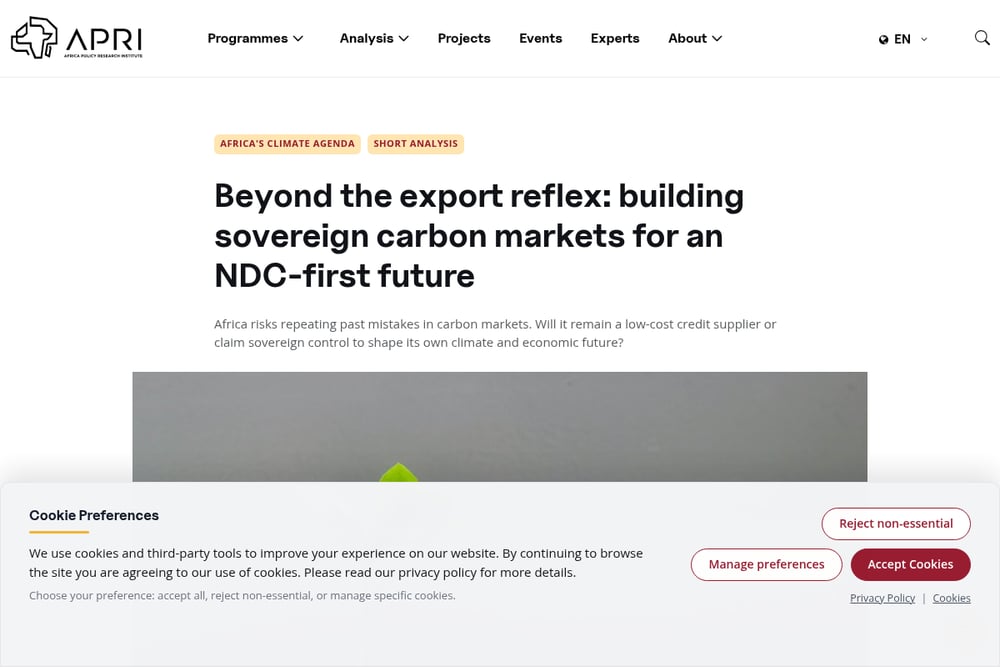 A screenshot of the AfriPolI website.
AfriPolI is a policy and research hub that advocates for an 'NDC-first' approach to African carbon markets. Rather than simply exporting credits, it pushes nations to prioritize domestic emission reductions under their Nationally Determined Contributions. The organization provides frameworks for building sovereign registries, MRV systems, and community benefit-sharing mechanisms. Its analysis highlights how countries like South Africa and Egypt are leading with domestic-first strategies, while Ghana and Rwanda excel in export infrastructure. For buyers, AfriPolI's work signals which sovereign credits are backed by robust institutional governance.
#3 Carbon Credits
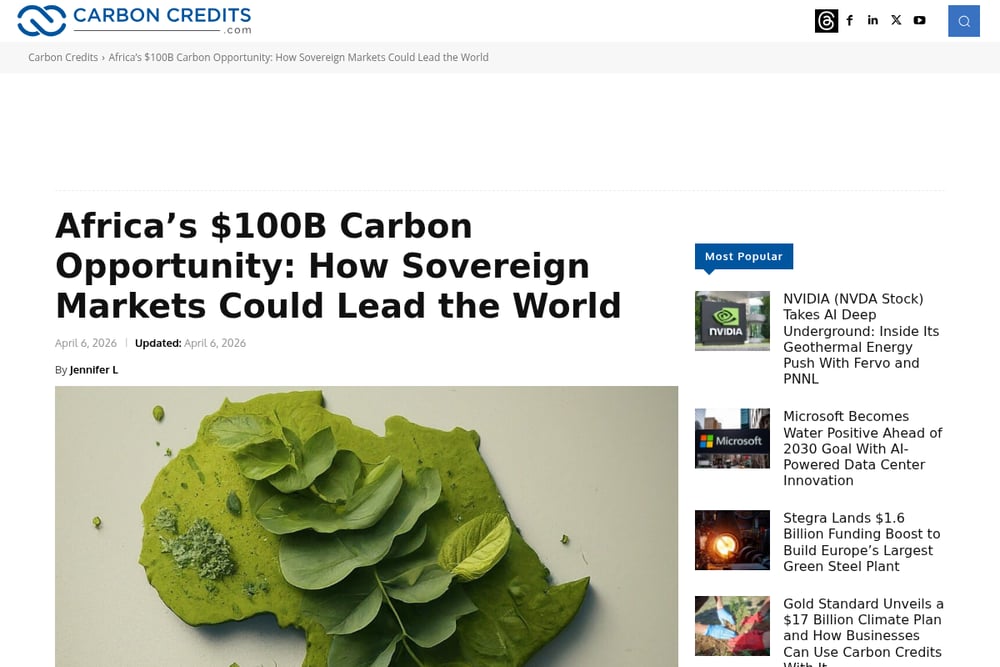 A screenshot of the Carbon Credits website.
Carbon Credits.com is a leading industry news and analysis platform covering global carbon markets. Its deep dive into Africa's sovereign potential estimates the continent could generate $100 billion in carbon revenue by 2030, citing the Africa Carbon Markets Initiative's target of 300 million credits annually. The site tracks policy shifts, project registrations, and pricing trends across voluntary and compliance segments. For anyone evaluating sovereign credit quality, it offers independent benchmarks and real-time market signals. Its reporting on ACMI and World Bank support provides context for why sovereign structures are gaining traction.
#4 Terragen Atlas
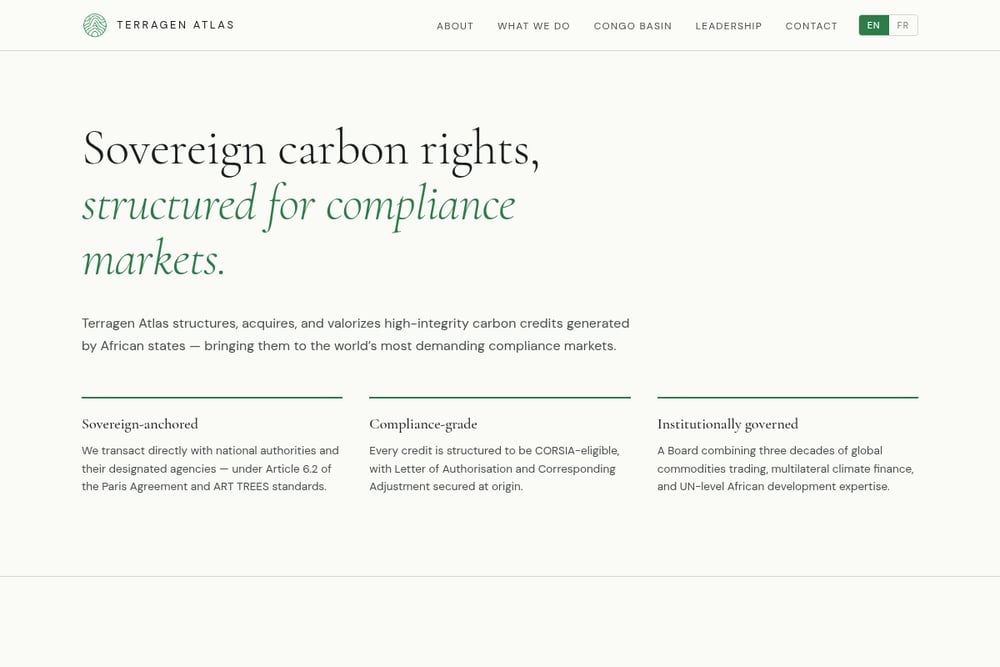 A screenshot of the Terragen Atlas website.
Terragen Atlas structures and sells high-integrity carbon credits from African states directly to compliance markets, operating under Article 6.2 of the Paris Agreement and ART TREES standards. Every credit is CORSIA-eligible, with Letters of Authorization and Corresponding Adjustments secured at origin. The company's board combines three decades of global commodities trading, multilateral climate finance, and UN-level African development expertise. By working exclusively with national authorities, it bridges the gap between sovereign carbon sinks and buyers who demand institutional-grade guarantees. Its alignment with the DRC's Vision Verte and the Kivu-Kinshasa Green Corridor underscores its focus on bankable, large-scale programs.
#5 Center on Global Energy Policy (Columbia University)
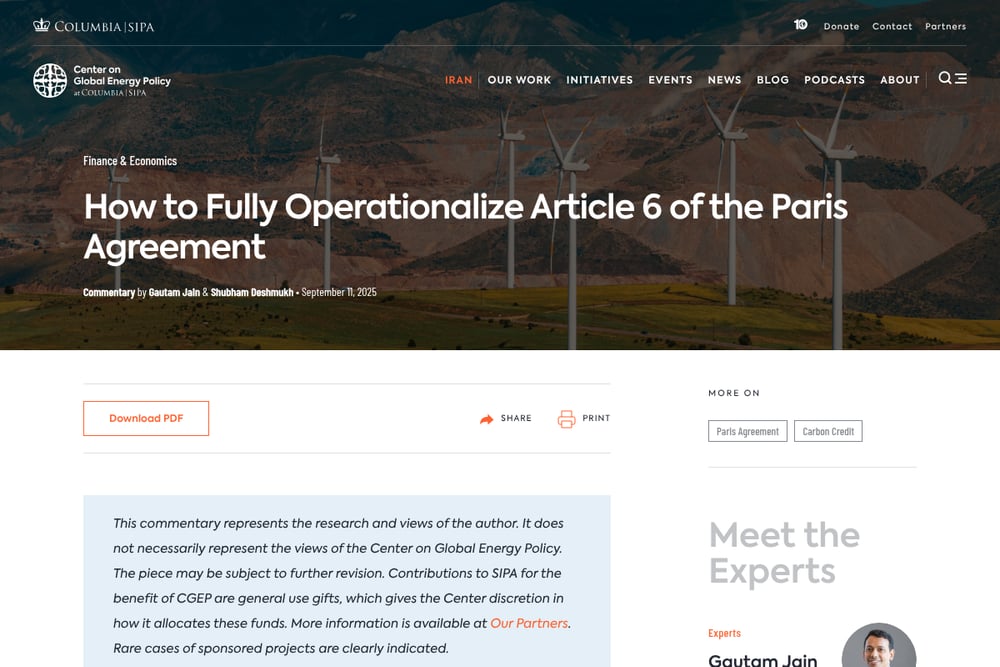 A screenshot of the Center on Global Energy Policy website.
Columbia University's Center on Global Energy Policy provides authoritative research on operationalizing Article 6 of the Paris Agreement. Its publications dissect the technical and political hurdles to bilateral credit transfers, including the only ITMO transfer to date (Switzerland-Thailand). The Center's analysis is essential reading for anyone navigating the legal and accounting complexities of corresponding adjustments. While not a project developer, its frameworks influence how sovereign credits are designed and verified. For buyers, its work offers a due diligence roadmap for assessing whether a credit truly meets Article 6.2 requirements.
How to Choose the Right Sovereign Carbon Partner
Start by asking: do you need credits for compliance or for voluntary reporting? If you're an airline under CORSIA or a company subject to EU ETS, you need a partner that can deliver credits with a Letter of Authorization and corresponding adjustment from the host country. That narrows the field to firms like Terragen Atlas and the Sovereign Carbon Agency, which operate directly under Article 6.2. Next, evaluate governance: who sits on the board? Do they have experience in African commodities, climate finance, or multilateral negotiations? A firm with a track record in global trading and UN-level development expertise, like Terragen Atlas, offers a different risk profile than a purely policy-driven organization. Finally, consider scale: are you looking for a single large program or a diversified portfolio? Firms aligned with national initiatives like the DRC's Vision Verte can offer scale, while research-focused entities like Columbia's CGEP provide the due diligence frameworks you'll need to verify any credit you buy.
Automation Workflow: Streamlining Sovereign Credit Sourcing
To stay ahead in this fast-moving market, set up a monitoring stack that tracks three signals: (1) new Article 6.2 bilateral agreements announced by African governments, (2) registry updates from the Africa Sovereign Carbon Registry or ART TREES, and (3) policy shifts in major compliance markets like CORSIA and the EU ETS. Use a tool like Zapier to pipe these updates into a Slack channel or Google Sheet. Then, create a scoring matrix that weights each credit offer by sovereign guarantee strength, certification standard, and price. This lets you compare opportunities from firms like Terragen Atlas and the Sovereign Carbon Agency side by side, in real time.
The Bottom Line on Africa's Sovereign Carbon Opportunity
The window for early movers in Africa's sovereign carbon market is open, but it won't stay that way forever. As more countries establish their own registries and bilateral agreements multiply, the premium will shift from simply having a credit to having one with the right sovereign backing and compliance pedigree. The five firms profiled here represent the leading edge of that shift — from policy architects to project developers to academic validators. Whether you're a compliance buyer, an investor, or a government official, understanding who operates in this space and how they work is the first step to capturing value from the continent's vast natural carbon assets.