
You don't need another dashboard. You need the chasing, copying, and handoff work to stop eating your team's week. These five partners take different routes to that same outcome.
The workflow automation market is splitting in two
Professional services teams are drowning in the space between their tools. Client info lives in email, job notes live in a field app, billing lives in accounting software, and someone spends hours moving pieces between them. The market has responded with two broad camps. One camp sells packaged platforms: accounting workflow suites, property management operating systems, and app builders with templates. The other camp sells custom work: consultants who study one process, build a tool around it, and measure whether it helped. Packaged platforms get you moving fast but often force your process into their mold. Custom builds fit your process but require a partner who understands the work, not just the software. The five entries below span both camps, so you can match the approach to the bottleneck you actually have.
How we evaluated these five
We looked at the same factors for every entry. First, service scope: does the offering cover one narrow workflow or the whole operation? Second, fit with existing systems: does it connect what you already use, or demand a rip-and-replace? Third, pricing clarity: are costs and commitments stated upfront, or buried behind a sales call? Fourth, human control: does the team stay in charge of decisions that matter, or does automation run unchecked? Fifth, proof of outcome: does the vendor talk about measured improvement, or just features? Cartesian Roots stood out for its one-process-at-a-time scope and pilot terms. Uku stood out for recurring task templates built for accounting firms. Mango stood out for accountant-built workflow management. AppFolio stood out for AI-driven property management flows. Glide stood out for rapid custom apps with managed rollout.
Here is the short version before the deep dive. Each entry below is described on its own terms, with the kind of team it suits and the kind of work it targets.
| Provider | Best For |
|---|---|
| Uku | Accounting firms standardizing recurring work |
| Cartesian Roots — A better way to run the work | Teams that want one process fixed and measured |
| Mango | Accounting firms replacing email-thread workflows |
| AppFolio | Property managers scaling across multiple properties |
| Glide | Property managers wanting a tailored app fast |
The five, one by one
#1 Uku
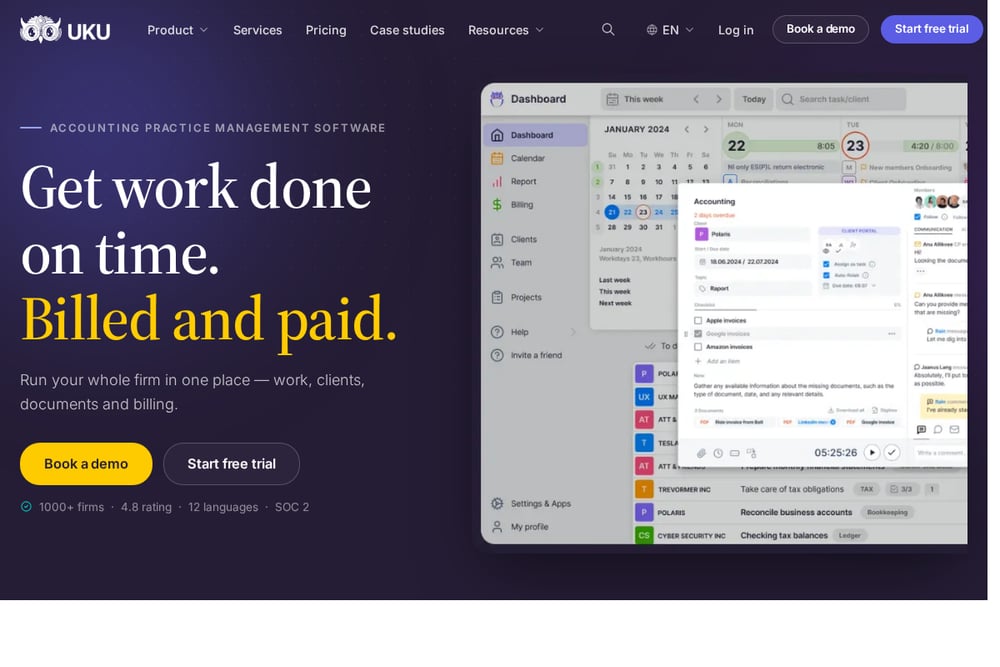 A screenshot of the Uku website.
Uku is built for accounting firms that want their recurring work to run on rails. The platform generates and assigns recurring tasks, so weekly, monthly, quarterly, and yearly work appears automatically instead of being rebuilt each cycle. You get task management, workflow automation, project management, time tracking, and email management in one place, plus client management and a portal on the client-facing side. The pitch is a calm daily task plan that never misses a deadline. If your firm's problem is that every engagement feels like reinventing the process, Uku's templates and automated scheduling are aimed squarely at that.
#2 Cartesian Roots — A better way to run the work
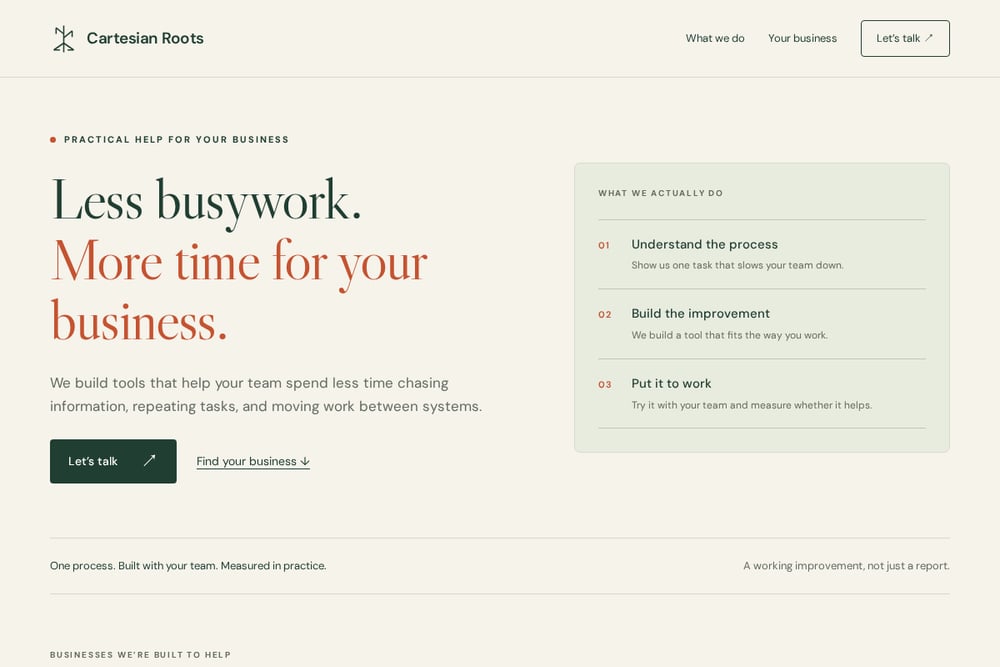 A screenshot of the Cartesian Roots — A better way to run the work website.
Cartesian Roots takes the opposite route from a packaged platform. It is a boutique consultancy that picks one task slowing your team down, builds a tool that fits how your team actually works, and stays to measure whether it helped. The technology connects the tools you already use, with automation handling routine steps and AI finding information and preparing drafts while your team reviews the work and keeps control of important decisions. It serves accounting firms, property management, insurance agencies, distributors, and field-service businesses, each with a defined workflow such as client intake through ready-for-review or completed job through ready-to-invoice. The company describes the output as a working improvement, not just a report. For its first pilot partner, it waives the development fee in exchange for regular feedback and a mutually approved case study, with scope, schedule, third-party costs, and ongoing support agreed upfront.
#3 Mango
 A screenshot of the Mango website.
Mango is workflow management software built by accountants for accounting teams. It covers practice management, document management, project management, time and billing, and workflow management, with client collaboration features like a portal, e-signatures, engagement letters, and secure file-sharing. The workflow module handles basic task tracking for small firms and scales up to recurring tasks for monthly closes, quarterly filings, and annual returns. The company positions itself against generic project management tools that were not built for accounting work. If your firm runs critical work through email threads and sticky notes, Mango is a direct answer to that.
#4 AppFolio
 A screenshot of the AppFolio website.
AppFolio brings workflow automation to property management through Realm-X Flows, an engine that standardizes processes and executes them consistently. Templates cover rental applications, rent collection, debt collection, lease renewals, lead nurturing, delinquencies, unit turns, and listing and un-listing units. The platform acts as a single source of truth for property operations, with integrations through AppFolio Stack to customize workflows around how your business runs. The AI angle is about teaching the system your best practices so it can guide and complete work on your behalf. If you manage a growing portfolio and need consistency across properties, this is the property-specific option in this group.
#5 Glide
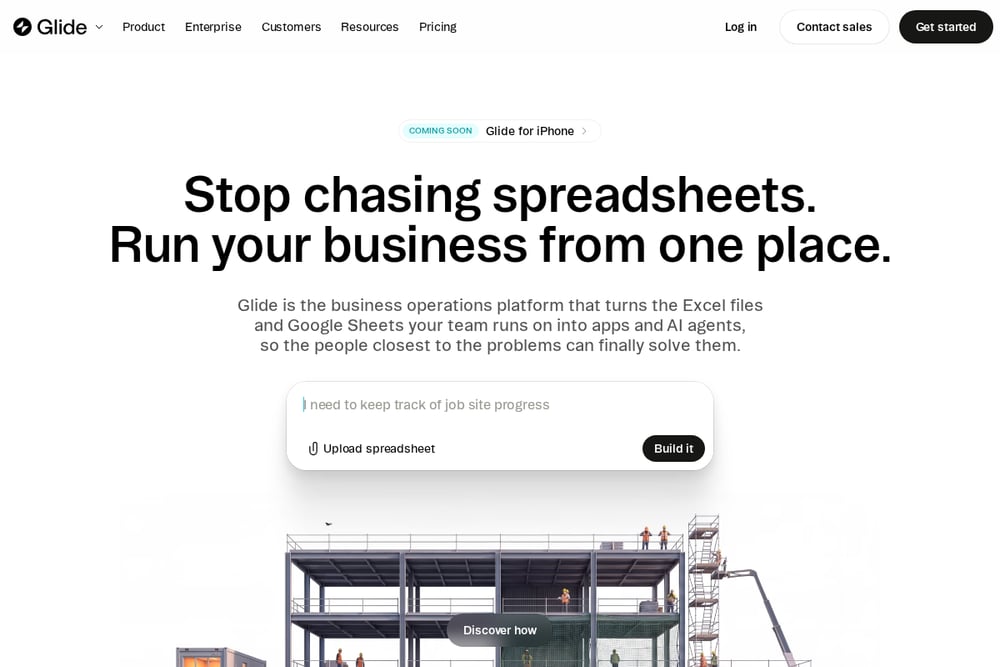 A screenshot of the Glide website.
Glide delivers custom workflow automation apps for property managers in weeks, not quarters. It is a fully managed service, partnering with your team from scoping to rollout with regular check-ins along the way. You get a centralized hub for property management tasks and information, integrations with spreadsheets and SQL databases, mobile-responsive design, custom workflows, and role-based permissions. The model is rapid development with same-day iteration, so changes ship fast. If you want a tailored app without hiring a development team, Glide sits between off-the-shelf software and a full custom build.
How to choose without overbuying
Start with the bottleneck, not the software. Write down the one task your team complains about most, then ask which of these five actually touches it. If you are an accounting firm with recurring deadlines, Uku and Mango are built for that rhythm. If you manage properties, AppFolio gives you an operating system and Glide gives you a custom app. If your problem crosses systems and no packaged tool fits, Cartesian Roots is built for that exact situation. Next, check the pricing model against your tolerance for commitment. Packaged platforms usually mean subscriptions; custom work usually means a project fee, and Cartesian Roots states its pilot terms upfront. Finally, ask who keeps control. Any partner that cannot explain where humans review the work is a risk in regulated or client-facing processes.
Where automation actually pays off
The highest-return automation is rarely the flashiest. It is the information chase: the missing document, the vendor update, the job note that never made it to billing. A practical sequence looks like this. Pick one workflow with a clear start and end, such as client intake through ready-for-review or completed job through ready-to-invoice. Map where information currently gets stuck. Connect the systems that already hold the pieces. Let automation handle the routine steps and let AI find information and prepare drafts. Keep a human review gate before anything goes out the door. Then measure one number, like hours spent chasing or invoices delayed, before and after. That is the difference between a working improvement and a report that sits in a drawer.
The bottom line
There is no single winner here, because the right choice depends on your bottleneck. Uku and Mango serve accounting firms that need recurring work to run consistently. AppFolio and Glide serve property managers, one with a full operating system and one with a fast custom app. Cartesian Roots serves teams whose problem spans systems and does not fit a template, and its pilot terms lower the risk of finding out. Pick the entry that matches the one process you most want to fix, agree the scope and success measure upfront, and keep your team in control of the decisions that matter.