Your drafters do not need to spend their week building 3D models and laying out seven views. These five services take the heavy lifting off your plate so you can file under your own name.
The quiet engine behind patent illustration
Patent illustration is a deadline business. Studios and law firms win work on turnaround and lose it on missed filings, yet the modeling and layout work behind every set is slow and repetitive. That gap has created a market of white-label partners who produce drafts your team finishes and files. The question is no longer whether to outsource part of the workflow, but which partner fits how your shop already runs.
How we looked at these services
We weighed four things: how much of the drawing set each provider actually delivers, whether pricing is published or quoted, how well the workflow fits a white-label reseller model, and the depth of design-patent and international office coverage. Turnaround speed and confidentiality terms carried weight too, since your clients never see the vendor behind your name.
Here is the short version before the detail. Each entry below earns its place for a different reason, so match the profile to your bottleneck rather than the order.
| Provider | Best For |
|---|---|
| PatentDraw | Teams that want an AI drafting platform plus reseller guidance |
| White-Label Design Patent Drawings | Design Patent Lab | Studios and firms that want a fast, cheap first draft to finish in-house |
| Patent Drafting Catalyst | Firms that want drawings bundled with broader patent support |
| NJQ & Associates | International filers who want drawings inside a broader IP relationship |
| Artworks IP | Clients who require US-based, in-house drafting |
The five services in detail
#1 PatentDraw
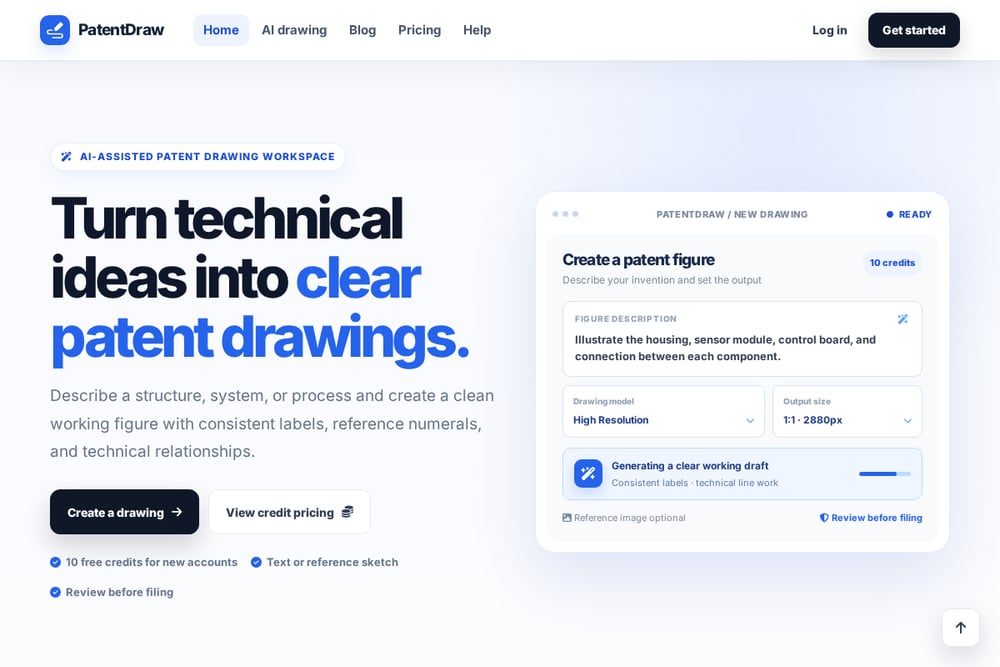 A screenshot of the PatentDraw website.
PatentDraw pairs an AI drawing engine with a steady stream of practical guidance for agencies and firms reselling patent figures. Its white-label guide walks through the real decision points, from USPTO, PCT and EPO compliance to stripping third-party branding off every deliverable. You get a platform built for volume, with reseller use cases spelled out rather than implied. For shops that want a self-serve tool and a playbook in one place, this is a strong starting point. The trade-off is that you own more of the finishing work yourself.
#2 White-Label Design Patent Drawings | Design Patent Lab
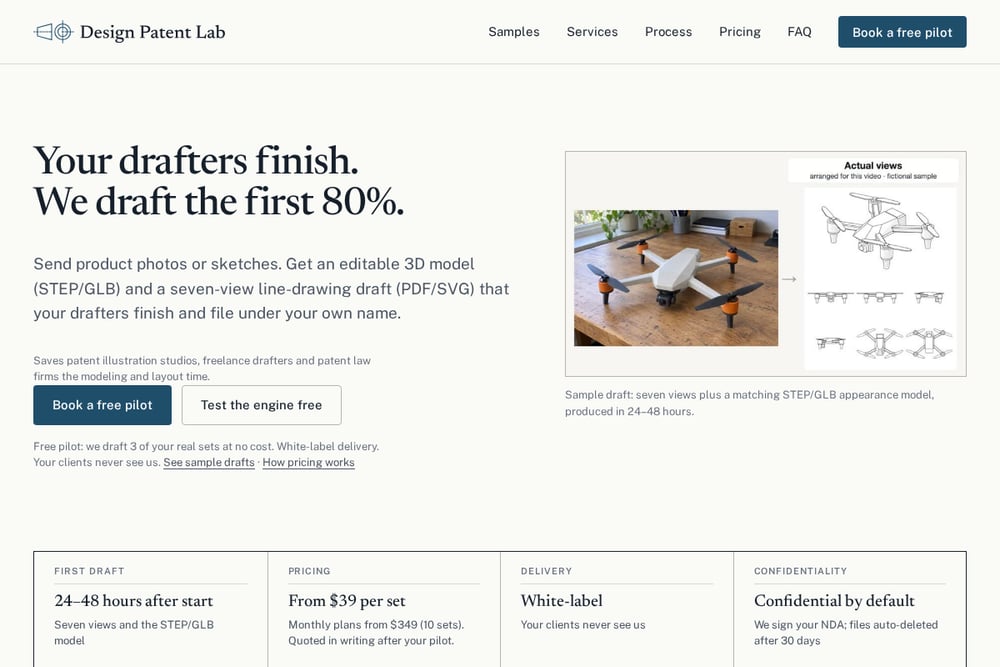 A screenshot of the White-Label Design Patent Drawings | Design Patent Lab website.
Design Patent Lab does one thing narrowly and well: it drafts the first 80% of a design patent set. Send product photos or sketches and you get an editable STEP/GLB appearance model plus a seven-view line-drawing draft in PDF and SVG, typically in 24 to 48 hours. The workflow is genuinely white-label, with NDAs signed by default and files auto-deleted after 30 days. Pricing is refreshingly plain, from $39 per set with monthly plans starting at $349 for 10 sets, and a free pilot covers three of your real sets. Your drafters confirm hidden sides, adjust line weights and file under your name, which keeps the final quality call in-house.
#3 Patent Drafting Catalyst
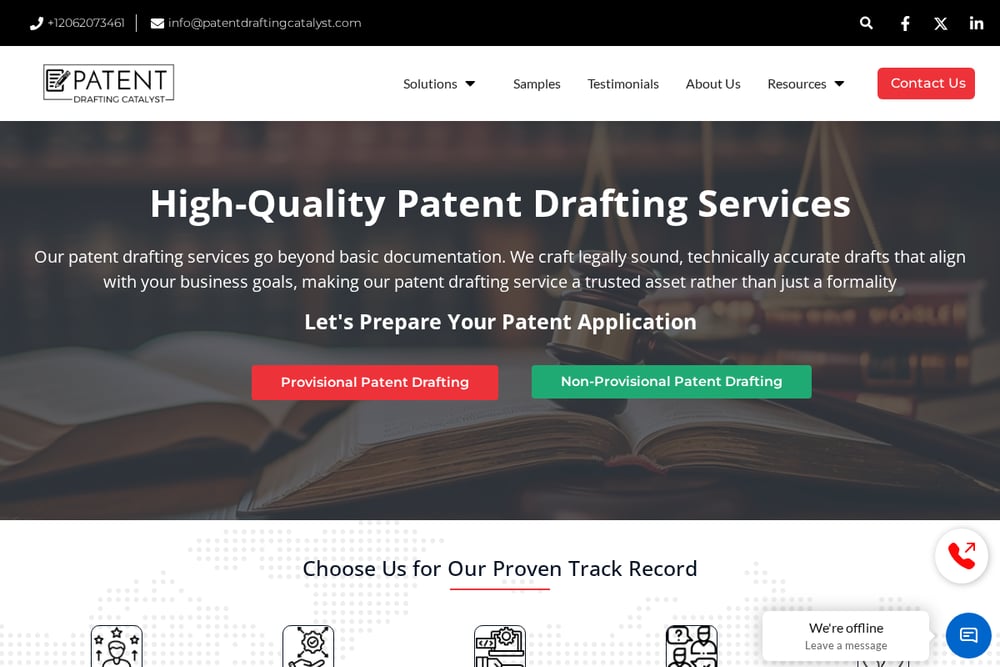 A screenshot of the Patent Drafting Catalyst website.
Patent Drafting Catalyst is a full-service patent support shop, and drawings sit inside a much wider menu. You can bundle illustration with searches, provisional and non-provisional drafting, filing, office action responses and docketing. That breadth matters if you would rather consolidate vendors than juggle five relationships. The drawing service is positioned as professional and production-grade, aimed at firms handling end-to-end prosecution. If your needs stretch beyond figures, this is the one-stop route. If you only want drafts, you may be paying for capability you will not use.
#4 NJQ & Associates
 A screenshot of the NJQ & Associates website.
NJQ & Associates brings an international footprint to patent drafting, with offices across multiple countries and a service list that spans trademarks, designs and legal work. Its drawing team works from informal sketches, photos and drawings to produce formal line art in AutoCAD, Photoshop and Illustrator, delivered as PDF. Plan, elevation, perspective, detail, exploded and cross-sectional views are all on the table. The pitch leans on affordability and on-time delivery against filing deadlines. It suits clients who need drawings as part of a cross-border IP relationship rather than a standalone drafting engine.
#5 Artworks IP
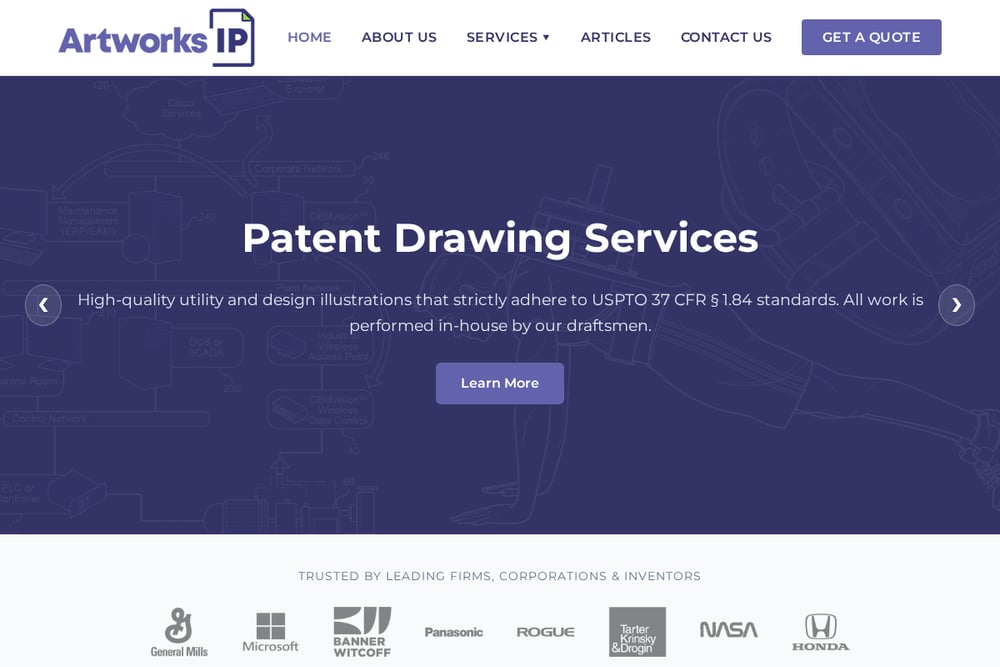 A screenshot of the Artworks IP website.
Artworks IP makes a pointed promise: 100% US-based work, no offshoring, no outsourcing. Its Washington, DC-area draftsmen handle utility, design, trademark and photo-case drawings, with formatting aligned to USPTO 37 CFR 1.84 and to WIPO and EPO standards for international filings. Design work gets specific attention to surface shading and contouring, the details examiners scrutinize. There is also 3D modeling and technical illustration under the same roof. Choose this when data residency and domestic handling are non-negotiable for your clients.
Matching the partner to your bottleneck
Start with what actually slows you down. If modeling eats your hours, pick a partner that hands back an editable 3D file, not just flat drawings. If layout is the drag, prioritize seven-view drafts already set to your target office's rules. Then check the commercial fit: published per-set pricing beats a quote cycle when you are scoping small jobs, while monthly plans reward steady volume. Ask about confidentiality in writing, including NDA terms and file retention. Finally, confirm who signs off. A white-label draft still needs your drafters' eyes before anything is filed, so make sure the handoff is clean and the revision loop is short.
Where automation fits in your workflow
Treat the first draft as raw material, not a finished product. Route incoming photos or sketches to your chosen provider, receive the STEP/GLB model and seven-view PDF/SVG, then push both into your existing review process. Your drafters confirm hidden sides, tune line weights and check broken-line treatment for unclaimed parts. Keep the model archived so you can render additional views later without restarting from scratch. Set a retention rule that matches your provider's deletion policy, and log each set against its filing deadline. Done this way, the automated portion compresses days of modeling into hours while your team keeps control of the final quality call.
The bottom line
There is no single winner here, only the right fit. Design Patent Lab is the sharpest tool if you want a cheap, fast first 80% with a white-label handoff and a free pilot to test it. PatentDraw suits teams that want a platform and a reseller playbook. Patent Drafting Catalyst and NJQ & Associates make sense when drawings should ride along with wider prosecution or international work. Artworks IP is the answer when US-based handling is a hard requirement. Pick based on your bottleneck, run a pilot, and let your drafters judge the drafts.