Drilling a well is one of those purchases where a single number can swing your budget by tens of thousands of dollars. These five calculators help you walk into a contractor conversation with real numbers instead of guesswork.
The State of Well Cost Estimation in 2026
Residential well drilling sits in an awkward spot. It is a major capital project, but pricing is opaque, geology-dependent, and wildly regional. A homeowner in Mississippi and a homeowner in California can face numbers that differ by three times for what sounds like the same job.
That gap is why cost calculators have multiplied. Most now anchor on the same core variables: depth, geology, casing, pump, pressure tank, and hookup. The better ones go further, pulling from state completion reports, per-foot drilling rates, and regional depth medians instead of a single national average.
For you, the practical takeaway is simple. A good calculator does not replace a written quote. It tells you whether the quote in front of you is reasonable, inflated, or missing line items entirely.
How We Evaluated These Calculators
We looked at the same factors across every tool. First, scope: does it estimate a finished system, or just drilling and casing? Second, data depth: are the numbers backed by state-level sources, completion reports, or published per-foot rates?
Third, pricing clarity: can you see the inputs and understand where the range comes from? Fourth, quote-checking utility: does the tool help you audit a contractor's bid line by line? Fifth, local fit: does it account for state and county variation rather than a flat national figure?
Cost to drill a well stands out for its state-by-state depth data and quote-checking mode. The Well Guide shines on input granularity, including trenching distance and casing size. SubcontractorHub itemizes extras and shows what each additional 100 feet costs. WellDrillingCosts.com leans on contractor directory data and state averages. Well Drilling Pros keeps things fast with a four-question flow and clear per-foot geology rates.
Here is the quick comparison. Each tool approaches the same question from a different angle, so the right pick depends on whether you are planning, auditing a bid, or just starting to explore.
| Provider | Best For |
|---|---|
| The Well Guide | Detailed, multi-variable planning estimates |
| Cost to drill a well (2026): $6,800–$42,500 for a finished well | State-level accuracy and auditing contractor quotes |
| SubcontractorHub | Line-item breakdowns and depth overrun scenarios |
| WellDrillingCosts.com | State averages plus contractor matching |
| Well Drilling Pros | Fast estimates with clear per-foot geology rates |
The Five Calculators in Detail
#1 The Well Guide
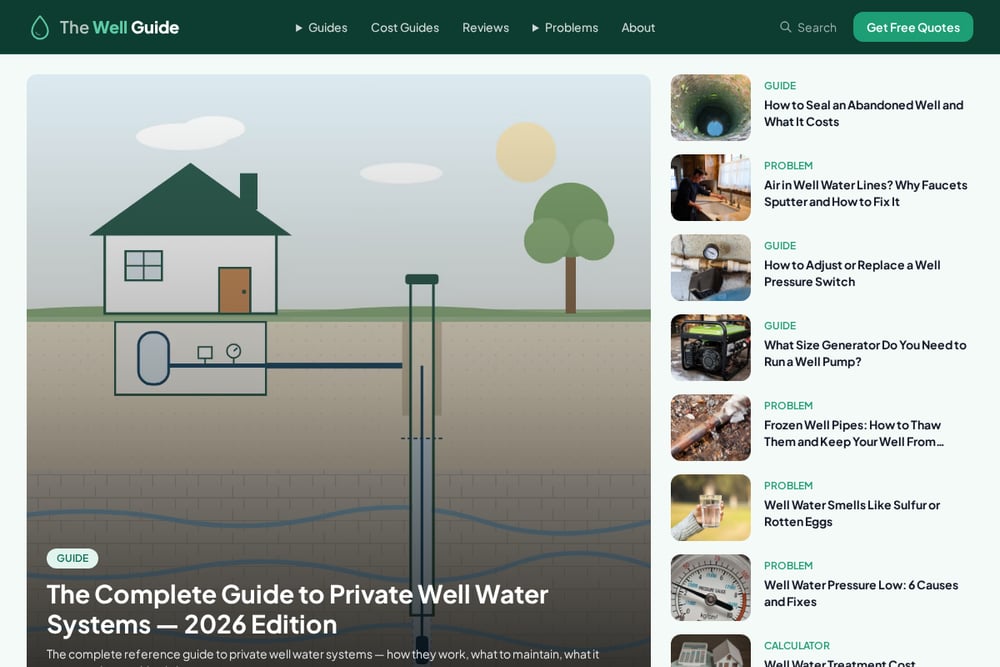 A screenshot of the The Well Guide website.
The Well Guide treats the estimate like an engineering problem, and that is a compliment. You plug in depth, geology, casing size, pump system, trenching distance, and region, and it returns a planning range you can hand to contractors. Its 2026 framing puts most projects between $7,000 and $22,000 fully equipped for wells up to 300 feet, with deep or hard-rock wells climbing past $25,000. The surrounding guide library on pumps, pressure tanks, and water testing adds context most calculators skip. If you want the most granular input set in this group, start here.
#2 Cost to drill a well (2026): $6,800–$42,500 for a finished well
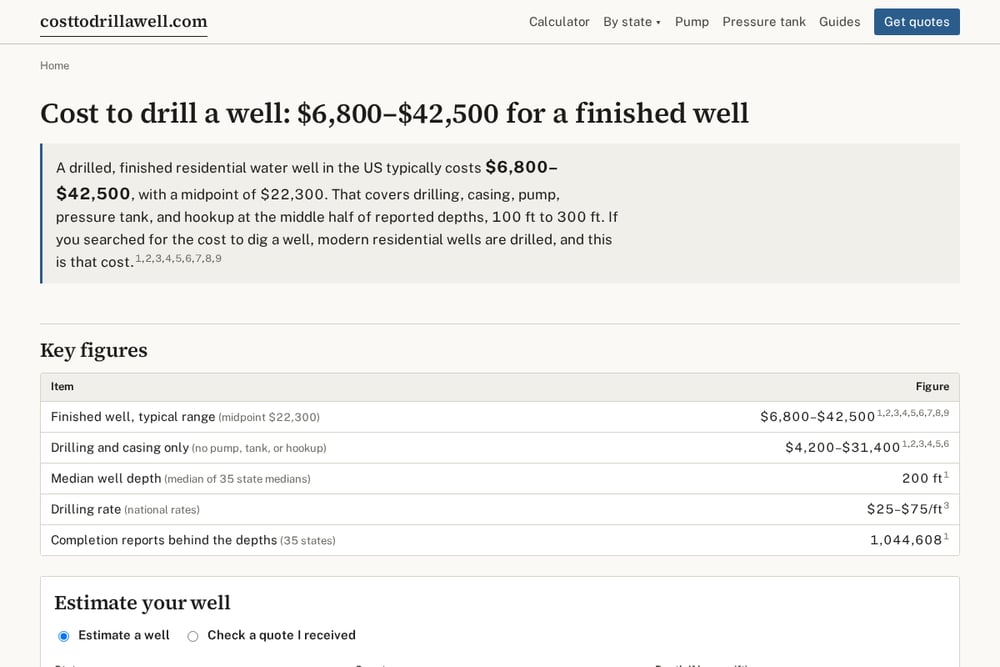 A screenshot of the Cost to drill a well (2026): $6,800–$42,500 for a finished well website.
This is the tool built around real state data. Cost to drill a well reports a finished residential well at $6,800 to $42,500 with a $22,300 midpoint, and it backs that with a median depth of 200 feet drawn from 35 state medians and over a million completion reports. You can estimate a well or flip into a mode that checks a quote you already received, itemizing drilling, casing, pump type, and tank. The state-by-state selector covers all 50 states, which matters because depth and per-foot rates swing hard across regions. Drilling and casing alone runs $4,200 to $31,400, so the tool makes clear what the pump and hookup actually add.
#3 SubcontractorHub
 A screenshot of the SubcontractorHub website.
SubcontractorHub comes at this from the contractor software side, and it shows. The calculator itemizes casing, pump, tank, wiring, and trenching separately, which is useful because casing depth is often much shallower than total depth in hard rock. It also tells you what each extra 100 feet costs if the aquifer sits deeper than expected, a scenario that surprises plenty of homeowners mid-project. Geology options run from sand and unconsolidated soil through shale and hard rock. It is a solid pick if you want to understand how a driller builds a bid from components.
#4 WellDrillingCosts.com
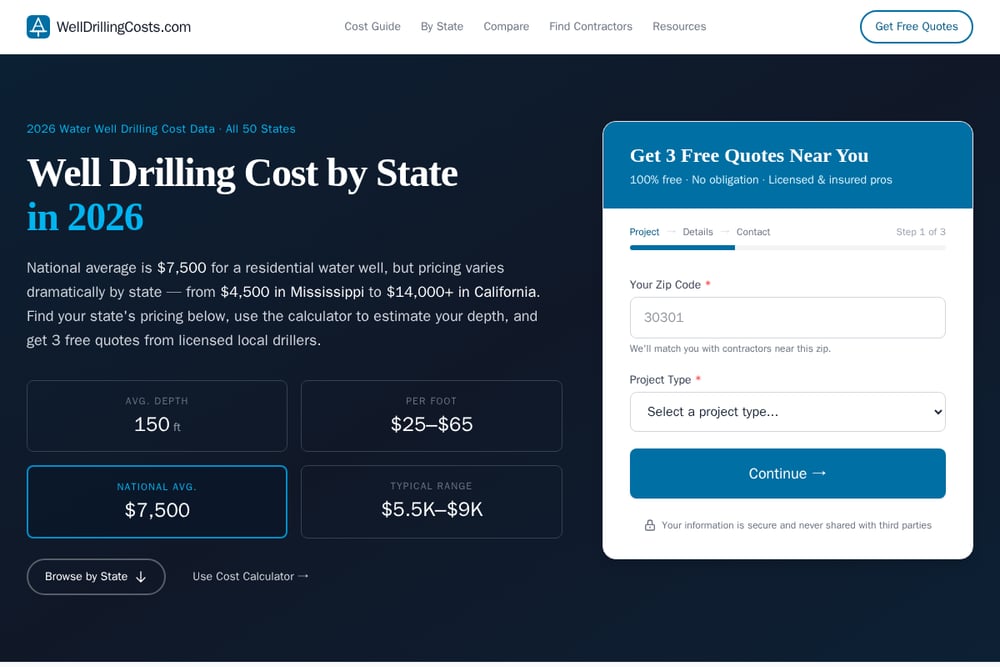 A screenshot of the WellDrillingCosts.com website.
WellDrillingCosts.com leads with state averages and a contractor directory, which makes it a natural first stop if you are still shopping. It cites a $7,500 national average, a $5,500 to $9,000 typical range, and state figures from roughly $4,500 in Mississippi to $14,000-plus in California. Per-foot drilling runs $25 to $65 depending on geology, with an average depth of 150 feet nationally. The quote request flow connects you with licensed local drillers, so the estimate and the next step live in one place. It also flags the break-even versus city water, usually five to ten years.
#5 Well Drilling Pros
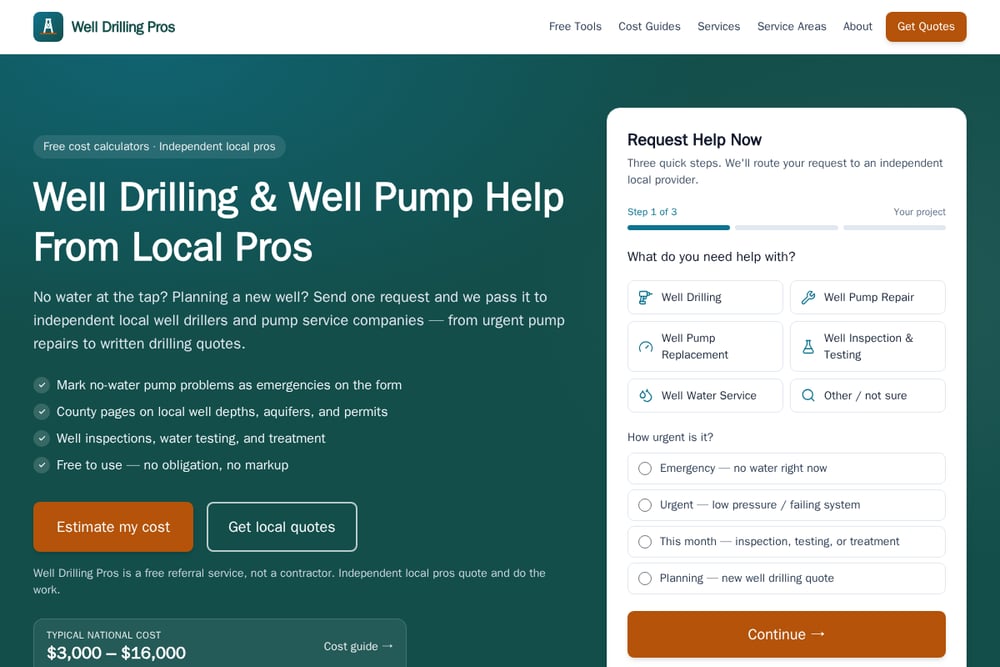 A screenshot of the Well Drilling Pros website.
Well Drilling Pros keeps it short. Four quick questions and you get a range, with defaults of 150 feet and unknown geology returning $5,250 to $14,250 including pump and pressure tank. The depth-and-geology table is the real value here, breaking out sand, sedimentary rock, and granite at 100, 150, 200, 300, and 500 feet. Per-foot rates are stated plainly: $25 to $40 in sand, $35 to $55 in sedimentary rock, $55 to $85 in granite. Add pump, tank, and permit costs and you can sanity-check a bid in about two minutes.
How to Pick the Right Calculator for You
Start with where you are in the process. If you have not talked to a driller yet, use WellDrillingCosts.com or Well Drilling Pros to get a fast ballpark and a sense of your state's pricing. Both take minutes and give you a number to react to.
If you already have a quote in hand, switch to Cost to drill a well and run its quote-check mode. Itemizing drilling, casing, pump, and tank against state depth data is the fastest way to spot a padded line item.
If you are planning a complex site, hard rock, long trench runs, or an unusual casing requirement, The Well Guide and SubcontractorHub give you the input depth to model it properly. Neither will replace a site visit, but both will tell you which questions to ask when the driller arrives.
Building a Repeatable Estimate Workflow
Treat these tools as a sequence rather than a menu. Step one: pull your state average and typical depth from WellDrillingCosts.com. Step two: model your specific depth and geology in Well Drilling Pros to get a per-foot sanity check.
Step three: refine with The Well Guide or SubcontractorHub if your site has complications like bedrock, trenching distance, or shallow casing. Step four: once quotes arrive, run each one through the quote-check mode at Cost to drill a well and compare line items against state data.
Save each output. A folder of dated estimates gives you leverage in negotiation and a paper trail if numbers shift mid-project.
The Bottom Line
No calculator drills a well, and none of these will match your final invoice to the dollar. What they do is close the information gap that lets homeowners overpay.
Use the fast tools to orient yourself, the detailed tools to model your site, and the quote-checking tools to pressure-test what contractors hand you. Do that, and you walk into the negotiation knowing what a finished well should cost in your state, at your depth, in your geology.
That is the whole game. Numbers first, signatures second.