
Operator certification math is where most candidates lose points, and it is exactly where most study tools go quiet. Here are five resources that actually show you the work.
The State of Operator Exam Prep
Water and wastewater operator certification is a state-by-state gate, but the math underneath it is remarkably consistent. Dosage, detention time, loading rates, chemical feed, and flow conversions show up on Class I and II exams across the country, and they show up as calculations, not multiple choice trivia. That is why the study market has split in two. On one side you have large question banks built for volume, thousands of items across every exam type and level. On the other side you have narrower tools that slow down and explain a single problem from start to finish. Most candidates need both, and most free resources lean hard toward volume. The gap worth knowing about is the worked solution, the place where a wrong answer becomes a lesson instead of a score.
How We Evaluated These Resources
We looked at the same factors for every resource. First, math depth: does the tool show the steps, or just the answer key? Second, exam coverage: which of the four exam families (water treatment, wastewater treatment, distribution, collection) and which class levels are addressed. Third, pricing clarity: can you tell what is free and what is paid before you sign up? Fourth, study structure: practice modes, topic breakdowns, progress tracking, and printable materials. Fifth, transparency: whether the site tells you plainly what is available now versus what is still coming. PassOperator stood out for computing answers in code and checking units, with a tutor layer for missed problems. WaterOperatorPracticeTest stood out for breadth, with a large free question bank and state-level navigation. Ziptility Practice Tests stood out for exam-mode simulation and topic scoring that surfaces your weakest areas first. Water Nuggets stood out for a simple, no-friction topic quiz format. Water Operator Certification Study Guide stood out for its membership model with randomized full-length tests and flashcards.
Here is the short version before the detail. Each entry below covers what the resource does, who it fits, and what you will actually see on the screen.
| Provider | Best For |
|---|---|
| WaterOperatorPracticeTest | High-volume free practice across all four exam types |
| PassOperator: Water and Wastewater Operator Exam Prep with Step-by-Step Math | Candidates who need the math worked out step by step |
| Ziptility Practice Tests | Simulating exam conditions and finding weak topics fast |
| Water Nuggets | Quick topic-by-topic knowledge checks |
| Water Operator Certification Study Guide | Structured membership study with randomized full-length tests |
The Five Resources in Detail
#1 WaterOperatorPracticeTest
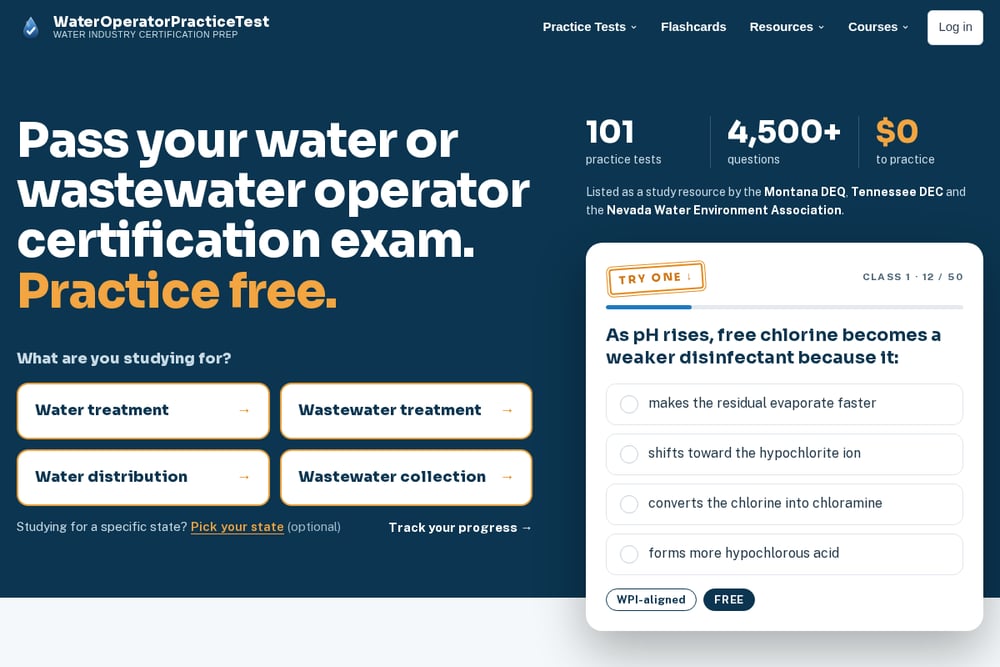 A screenshot of the WaterOperatorPracticeTest website.
If you want reps, this is where you get them. The site advertises 101 practice tests and more than 4,500 questions across drinking water, wastewater, distribution, and collections, all free to practice. You can drill by state, by topic, or by exam family, and there are printable PDFs plus a calculator section for operator math. It is also listed as a study resource by the Montana DEQ, the Tennessee DEC, and the Nevada Water Environment Association, which is a meaningful signal for a free tool. The tradeoff is depth on any single problem: you get volume and coverage, not a step-by-step walkthrough of every calculation. Start with a full test to find your weak topics, then use the category drills to close the gap.
#2 PassOperator: Water and Wastewater Operator Exam Prep with Step-by-Step Math
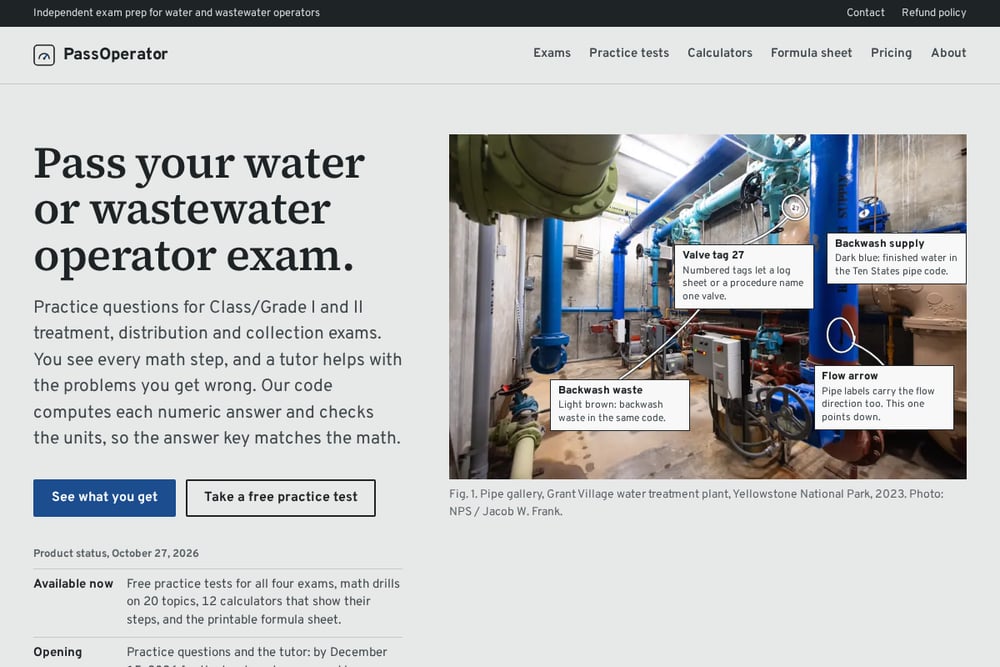 A screenshot of the PassOperator website.
PassOperator is built around the part of the exam that trips people up: the math. Every numeric answer is computed in code with unit checks, so the answer key matches the arithmetic instead of drifting from it. You see each step worked out, and a tutor feature steps in on the problems you miss. The free tier is genuinely useful right now: practice tests for all four exams, math drills on 20 topics, 12 calculators that show their steps, and a printable formula sheet. Coverage targets Class/Grade I and II across treatment, distribution, and collection. The site is also upfront about timing, noting that full practice questions and the tutor open by December 15, 2026 for treatment exams and by January 31, 2027 for distribution and collection. If you are weak on dosage or detention time calculations, this is the place to slow down and learn the mechanics.
#3 Ziptility Practice Tests
 A screenshot of the Ziptility Practice Tests website.
Ziptility comes at this from the utility software world, and its practice tests borrow the logic of a real exam session. You can pick practice mode to check answers as you go, or timed exam mode to feel the clock. Questions are written from the public frameworks that real exams draw on, and the worked answers explain why a choice was right rather than just naming the letter. The score breakdown sorts by topic with your weakest areas first, which turns a practice session into a study plan. There is also a calculator tool aimed at the everyday math operators actually use on the job. It sits inside a broader Field Guide for operators, managers, and boards, so the exam prep is one piece of a larger resource.
#4 Water Nuggets
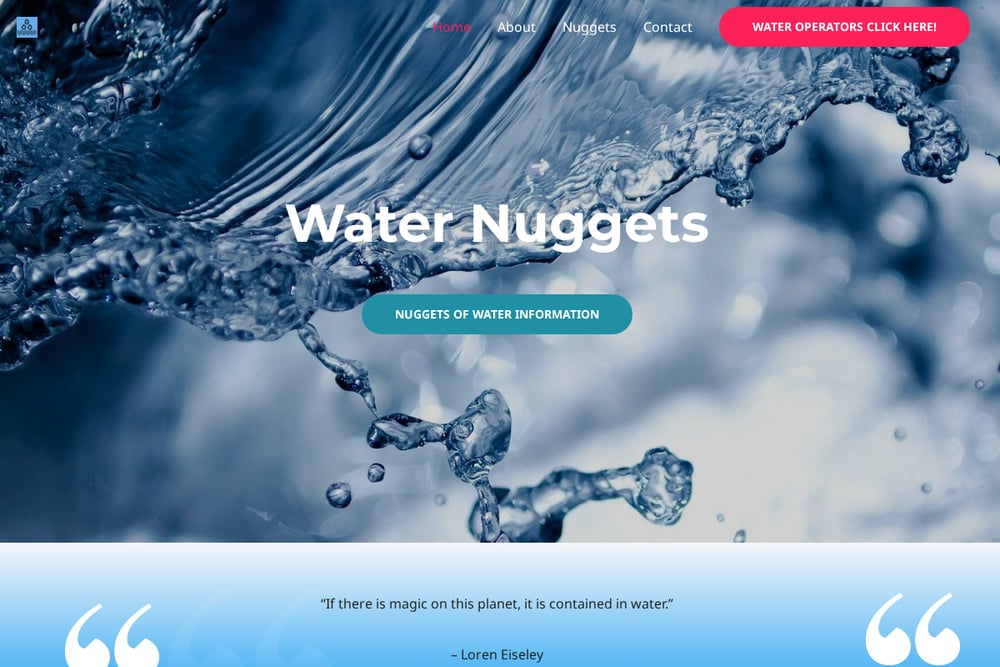 A screenshot of the Water Nuggets website.
Water Nuggets keeps it simple: pick a topic, answer questions, see the correct choice. The water treatment practice test covers chlorination and breakpoint chlorination, polymers, secondary contaminants like manganese, filter backwash limits, fluoride chemistry, and the federal laws that govern disposal and drinking water. It is a low-friction way to test yourself on discrete facts without creating an account or committing to a study plan. The format is closer to a quiz than a course, so treat it as a spot check rather than a full curriculum. Where it earns a place is speed: you can run a set of questions in a few minutes and find out whether a topic is solid or shaky.
#5 Water Operator Certification Study Guide
This one runs on a membership model, and the demo shows you the shape of it. The free demo is a five-question wastewater practice test, while members get a full 100-question test randomly generated from a database of hundreds of items, so no two attempts are identical. The same structure applies across water distribution, water treatment, and wastewater, with flashcards and keyword matching alongside the practice tests. There is also a water operator math section with guides, tutorials, tips, and quizzes available to treatment and distribution members. The site rounds things out with a glossary, state-by-state certification information, and member forums. If you like a structured, account-based study environment with repeatable full-length tests, this fits.
How to Pick the Right Study Resource
Start with your weak spot, not the tool. If you can read a problem and set up the equation but fumble the units, you need worked solutions, and PassOperator is built for exactly that. If you have never seen the breadth of the exam, run a free full-length test first so you know what you are up against, and WaterOperatorPracticeTest gives you the volume to do it at no cost. If test-day timing is your enemy, Ziptility's timed exam mode is the closer match. If you just want to check whether you remember what breakpoint chlorination means, Water Nuggets gets you there in minutes. And if you want a repeatable, account-based routine with fresh questions each time, the membership model at Water Operator Certification Study Guide fits. One practical note: check your state's certification page before you buy anything. Every state sets its own class structure and exam vendor, and the best study plan mirrors the exam you will actually sit for.
A Simple Weekly Study Workflow
You do not need a complicated plan. Set aside three sessions a week. Session one: take a timed practice test and log your score by topic. Session two: take your two weakest topics and work the math slowly, writing every step and checking units as you go, using a step-by-step calculator to verify. Session three: drill those same topics with fresh questions and re-test at the end of the week. Keep a running list of the problems you miss and revisit it before each new test. Rotate your question sources so you are not memorizing a single bank. Print the formula sheet and keep it where you study, not where you work. Repeat until your weak topics stop being weak, then shift the timed tests to full length.
The Bottom Line
Operator certification rewards people who can do the math under pressure, and the resources above cover that from different angles. Volume gets you exposure, simulation gets you stamina, and worked solutions get you understanding. The candidates who pass comfortably are usually the ones who combine all three instead of picking one. Start free, find your weak topics, and spend your study time where the points actually are.