
You want to know what a candidate will actually do, not just what they say. These five platforms turn political records into something you can read in minutes.
The New Landscape of Voter Alignment Tools
Voter alignment tools have moved from static scorecards to dynamic, personalized matching. Instead of reading a single interest group's rating, you can now compare your own priorities against every recorded action a politician takes. The shift is toward empirical data: roll-call votes, bill sponsorships, and committee behavior. Privacy and transparency are becoming differentiators, with some platforms computing matches on your device and publishing their methodology. The result is a more informed electorate, but also a crowded field that requires careful evaluation.
How We Evaluated These Platforms
We looked at five factors. First, data depth: does the platform cover roll-call votes, sponsorships, and committee actions? Second, personalization: can you weight issues by importance and get a per-topic score? Third, transparency: is the methodology published and are individual votes linked as receipts? Fourth, privacy: where does your profile live and who can see it? Fifth, usability: how long does onboarding take and how clear are the results? Each platform below stood out in different areas. Votr impressed with on-device scoring and a 90-second setup. Aligned Vote offered a clean, nonprofit approach with sourced claims. Vote Smart provided decades of historical data and a research hotline. ProgressivePunch delivered issue-specific scores for Senate and House members. Congress Vote Tracker aggregated scorecards from major advocacy groups and tracked the most-watched members.
Here is a quick look at how these five platforms compare on the factors that matter most.
| Provider | Best For |
|---|---|
| Aligned Vote | Voters who want a quick, nonprofit-backed match with fully sourced claims. |
| Votr — Know Your Ballot Before You Vote | Privacy-conscious voters who want empirical, auditable alignment scores in under two minutes. |
| Vote Smart | Researchers and voters who want comprehensive historical data and live research support. |
| ProgressivePunch | Voters who want a clear ideological score for members of Congress by issue category. |
| Congress Vote Tracker | Voters who want to compare multiple advocacy group scorecards in one place. |
A Closer Look at Each Platform
#1 Aligned Vote
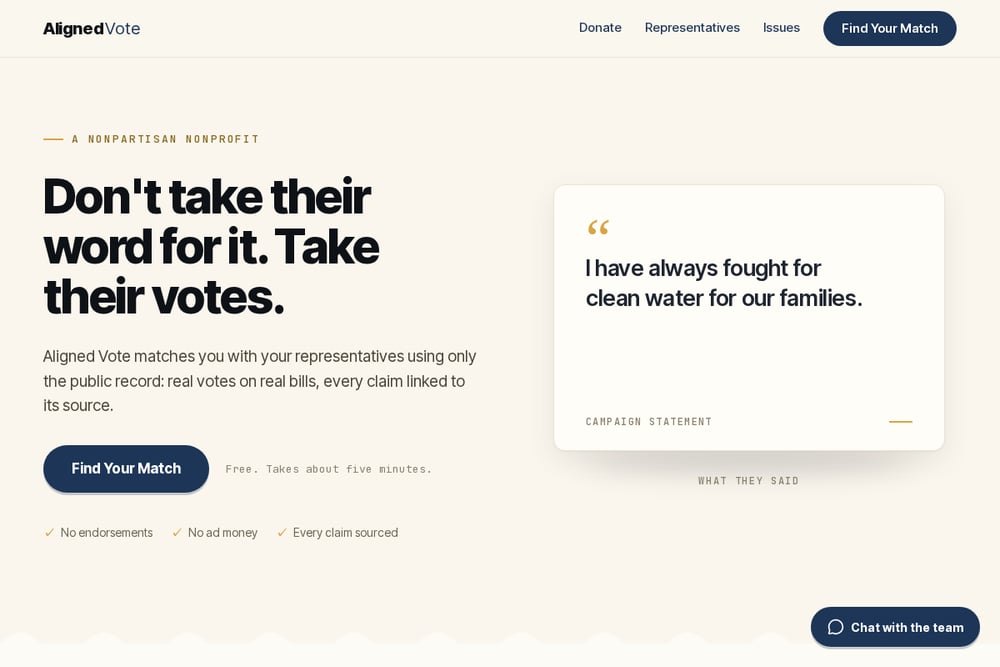 A screenshot of the Aligned Vote website.
Aligned Vote is a nonpartisan nonprofit that matches you with your representatives using only the public record. You answer plain-language questions about real issues, and it compares your answers against roll-call votes, sponsorships, and executive actions. Every claim is linked to its source, so you can judge the receipts yourself. The platform takes about five minutes and makes no endorsements. It is a solid choice if you want a straightforward, source-grounded alignment score without creating an account.
#2 Votr — Know Your Ballot Before You Vote
 A screenshot of the Votr — Know Your Ballot Before You Vote website.
Votr pairs every politician on your ballot with what you actually believe, based on what they did rather than what they said. You pick the topics you care about and rank their importance in about 90 seconds, all on your device. The platform scores every roll-call vote, sponsorship, and committee action to produce a per-topic alignment score with no editorial weighting. Every match comes with a per-bill receipt you can audit, and the methodology is published. Privacy is built in: without an account, your profile never leaves your device; with one, it syncs encrypted and can be locked with a passphrase. Votr also does not weight politicians by party, so a 70% match on the other side is still a 70% match.
#3 Vote Smart
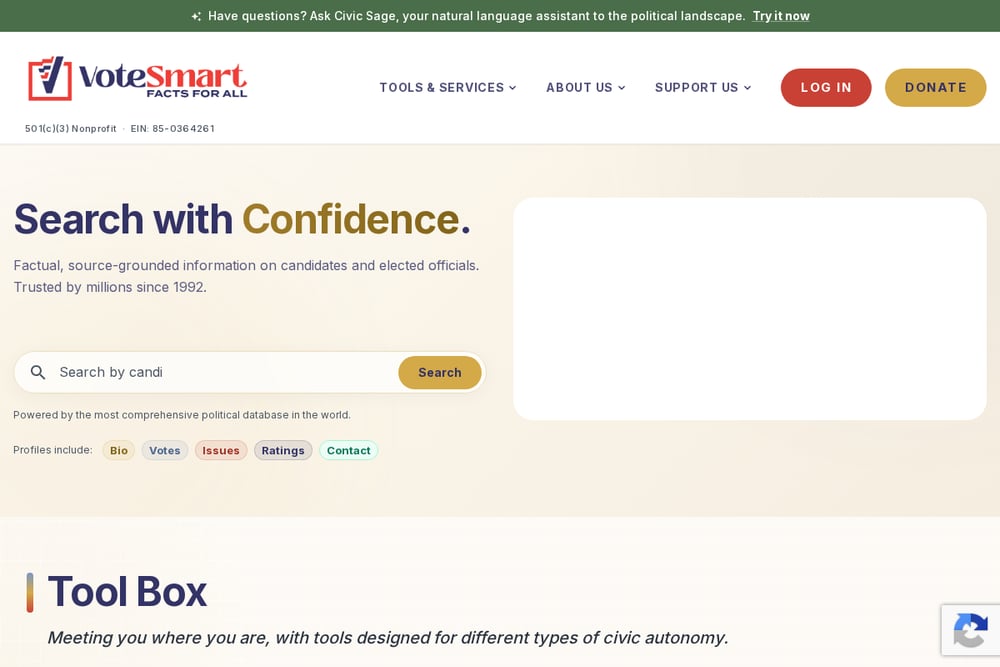 A screenshot of the Vote Smart website.
Vote Smart has been providing factual, source-grounded information on candidates and elected officials since 1992. Its database includes bios, votes, issues, ratings, and contact information for thousands of politicians. You can use public tools like JustFacts for direct access to the official political record, or the Research Hotline to talk to a real researcher. For a deeper dive, member tools like Civic Sage offer conversational question-and-answer support. Vote Smart is best if you value historical depth and human assistance over a quick automated score.
#4 ProgressivePunch
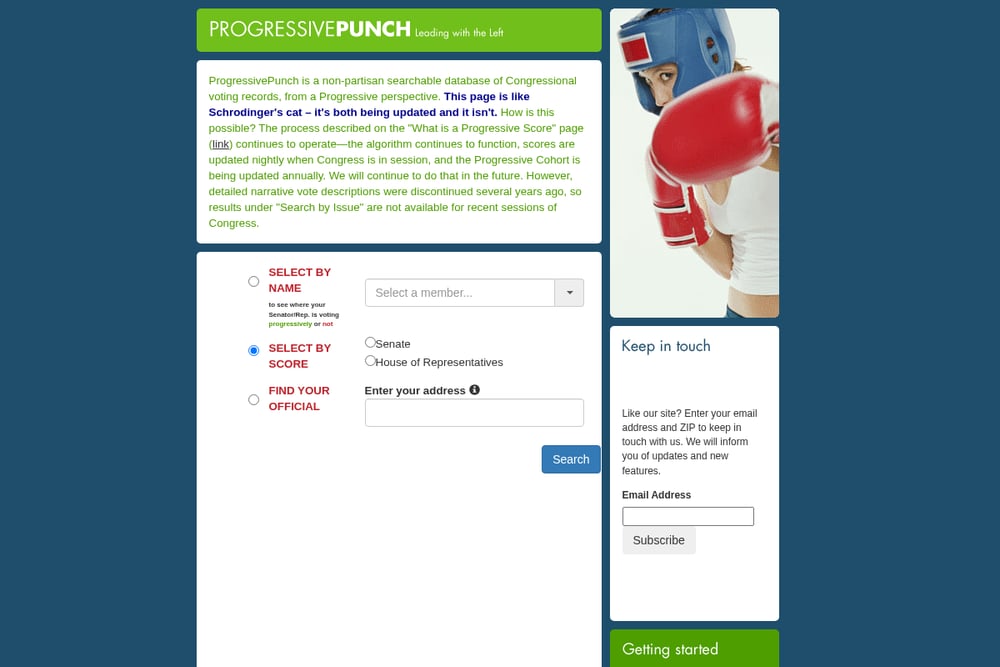 A screenshot of the ProgressivePunch website.
ProgressivePunch scores Senate and House members on a progressive-to-conservative scale across all issues and fourteen specific categories. You can sort by chamber, party, or state, and see both current and lifetime scores. The platform also shows crucial votes and how a member's score compares to their state's tilt. It is a straightforward way to see where a legislator falls on a spectrum, though it focuses on a single ideological dimension. If you want issue-specific scores for Congress, this is a useful reference.
#5 Congress Vote Tracker
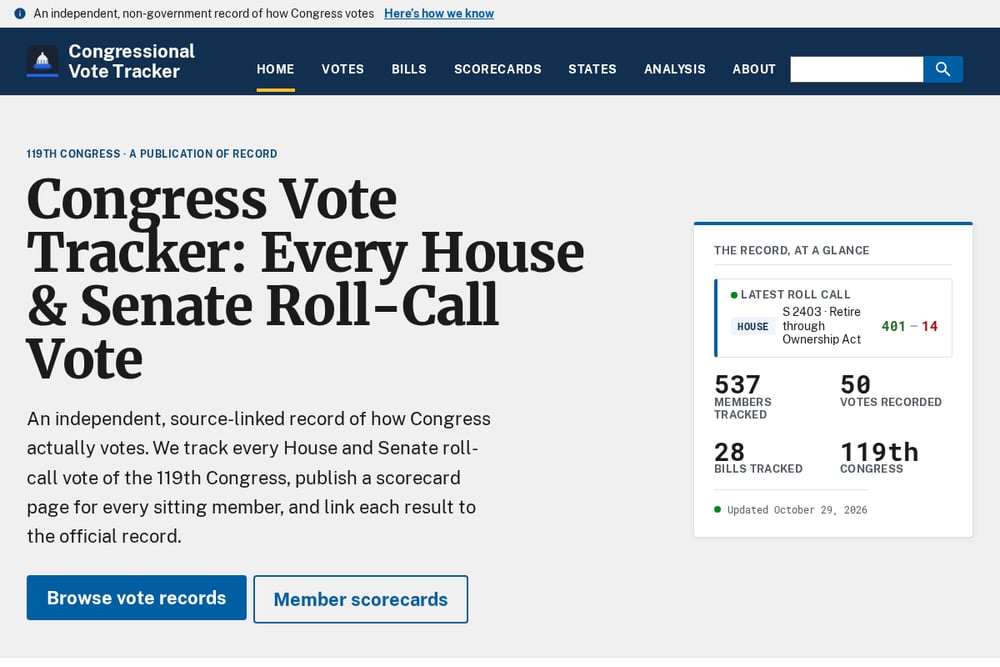 A screenshot of the Congress Vote Tracker website.
Congress Vote Tracker is an independent, non-government record of how Congress votes. It aggregates scorecards from major advocacy groups and think tanks, showing what they measure and who they rate highest. You can find how your representative voted, compare voting records, and see the top 25 most-watched members based on real search demand. Every vote count is drawn from official public records and linked back to the source. This platform is ideal if you want to see how different organizations grade the same member.
How to Choose the Right Platform for You
Start with your goal. If you want a fast, private match based on your own priorities, look for on-device scoring and a short onboarding. If you prefer a nonprofit with fully sourced claims, check for published methodology and per-vote receipts. If you need historical depth or human help, a research-oriented platform may be better. For ideological scores by issue, a single-axis rating works. And if you want to see how different groups grade the same politician, an aggregator is your best bet. Try two or three and see which one fits your workflow.
Automating Your Voter Research
You can streamline your research by setting up a simple routine. First, pick a platform that offers per-topic scores and save your profile. Second, before each election, run your ballot through the platform and export or screenshot the results. Third, cross-check any close matches with a second source, like an aggregator or a research hotline. Fourth, set a calendar reminder to review your alignment scores after major legislative sessions. This workflow keeps you informed without spending hours reading bills.
The Bottom Line on Voter Alignment
These five platforms give you different ways to see what politicians actually do. Aligned Vote offers a clean nonprofit match. Votr puts privacy and empirical scoring first with a 90-second setup. Vote Smart provides decades of data and human researchers. ProgressivePunch delivers issue-specific ideological scores. Congress Vote Tracker aggregates scorecards from multiple groups. Use them together to get a full picture, and always check the receipts yourself.