You want to sound sharper, write cleaner, and stop reaching for the same tired words. These five platforms each take a different route to a bigger, more usable vocabulary.
Where Vocabulary Learning Stands Now
Vocabulary tools have split into two camps: reference-first dictionaries that bolt on quizzes, and practice-first platforms that treat words as skills to drill. Most learners need both, which is why the strongest options blend definitions, context, and retrieval practice in one place. The gap between them is how much they help you actually use a word, not just recognize it.
How We Looked at Each Platform
We weighed four things: how well each tool teaches words in context rather than in isolation, the depth of practice options like quizzes and spaced review, how clearly the free versus paid line is drawn, and how quickly a new user can get from landing page to real learning. Breadth of word coverage and reading material also counted.
Here is the short version before the detail: each platform below earns its spot for a different reason, so match the tool to how you actually learn.
| Provider | Best For |
|---|---|
| Vocabulary.com | Learners who want an adaptive trainer plus a full dictionary |
| VocabVue — Discover Words. Express More. | Building usable vocabulary through context and reading |
| VocabTest.com | Students drilling a specific school word list |
| Merriam-Webster Vocabulary Quiz | A fast, timed vocabulary check-in |
| Britannica Dictionary Vocabulary Quiz | Casual learners who want a quick quiz with dictionary backup |
The Five Platforms in Detail
#1 Vocabulary.com
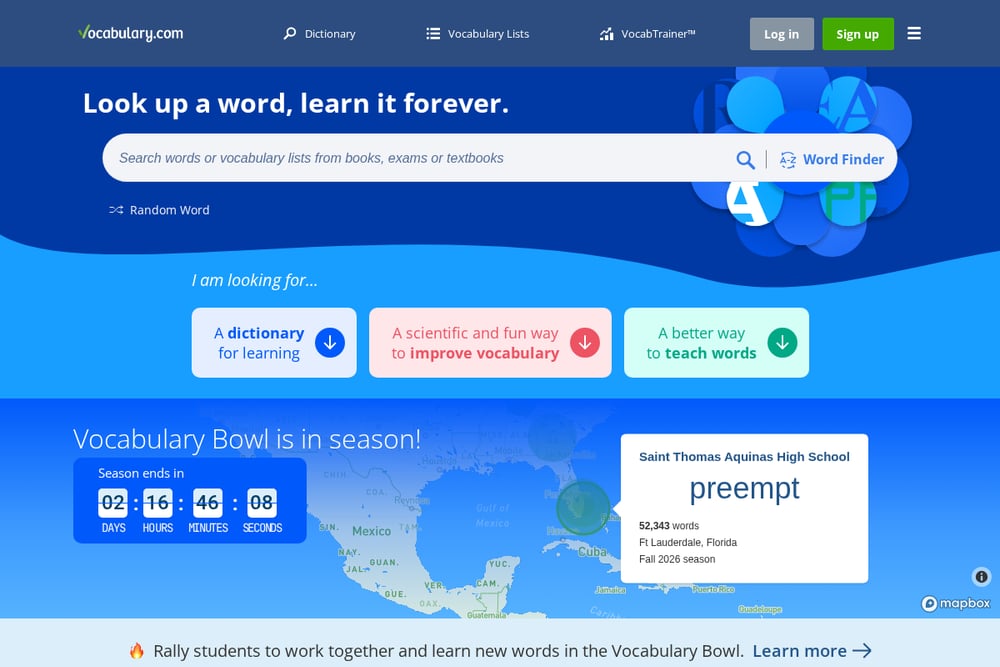 A screenshot of the Vocabulary.com website.
Vocabulary.com pairs a deep dictionary with a mastery-based trainer that adapts to the words you keep missing. Its VocabTrainer and proficiency score give you a concrete benchmark against millions of other learners, which makes progress feel measurable. The site also publishes a steady Word of the Day and a useful commonly confused words guide. It is the most complete single destination for someone who wants reference and practice under one roof. The tradeoff is a lot of surface area to navigate when you are new.
#2 VocabVue — Discover Words. Express More.
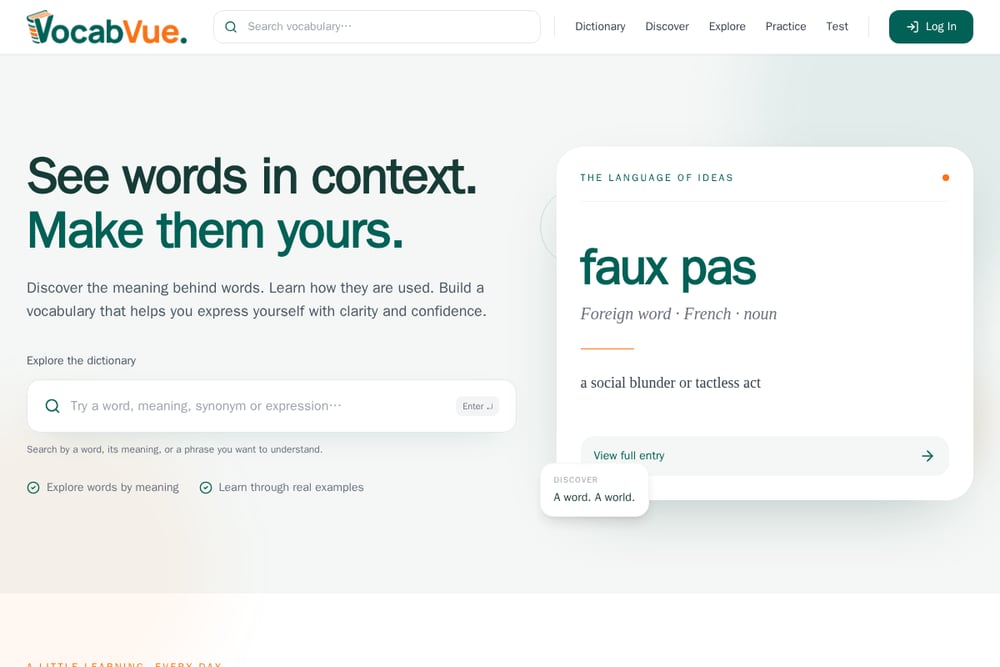 A screenshot of the VocabVue website.
VocabVue is built around a simple promise: see words in context, then make them yours. You can search by a word, a meaning, or a phrase you half-remember, and the platform routes you to definitions with real examples. Vocabulary is organized into Essential Words, Advanced Words, Foreign Words, and Idioms & Phrases, so you can start where you actually are. Quizzes, mock tests, and practice questions turn recognition into recall, while short reading passages with linked vocabulary let you meet new words in natural prose. It is the most context-forward option on this list, and the cleanest for a learner who wants to build confidence rather than grind flashcards.
#3 VocabTest.com
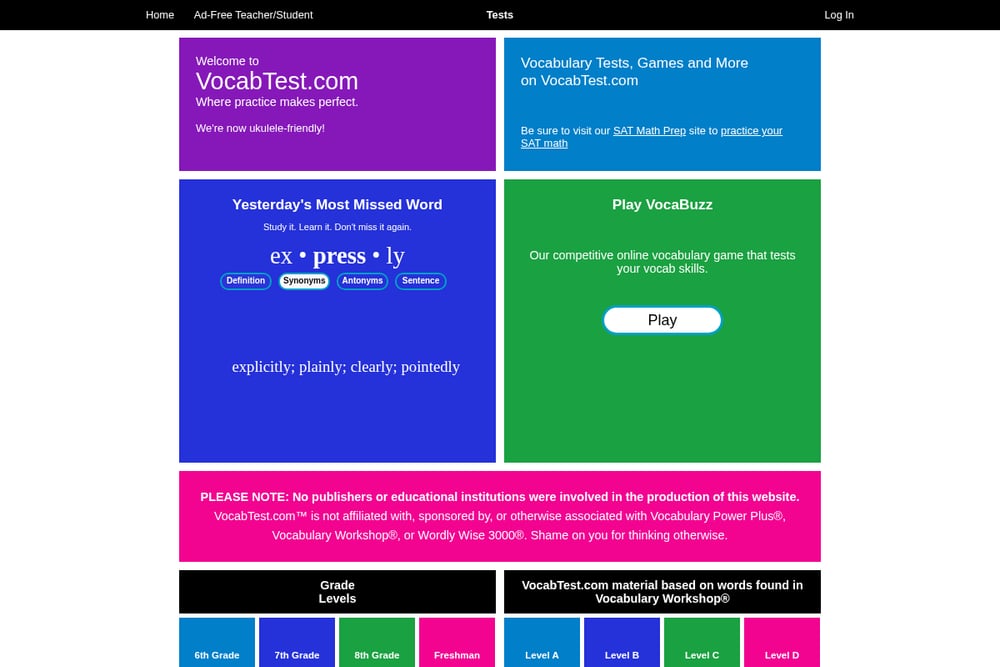 A screenshot of the VocabTest.com website.
VocabTest.com is unapologetically a testing site, and that focus is its strength. It maps practice tests to familiar school vocabulary programs like Vocabulary Workshop, Vocabulary Power Plus, and Wordly Wise 3000, plus grade levels from sixth through AP senior. Teachers and students can create their own tests, and the VocaBuzz game adds a competitive edge. If you already have a word list to master, this is the fastest route from list to quiz. It is less useful if you are starting from zero and need definitions and context first.
#4 Merriam-Webster Vocabulary Quiz
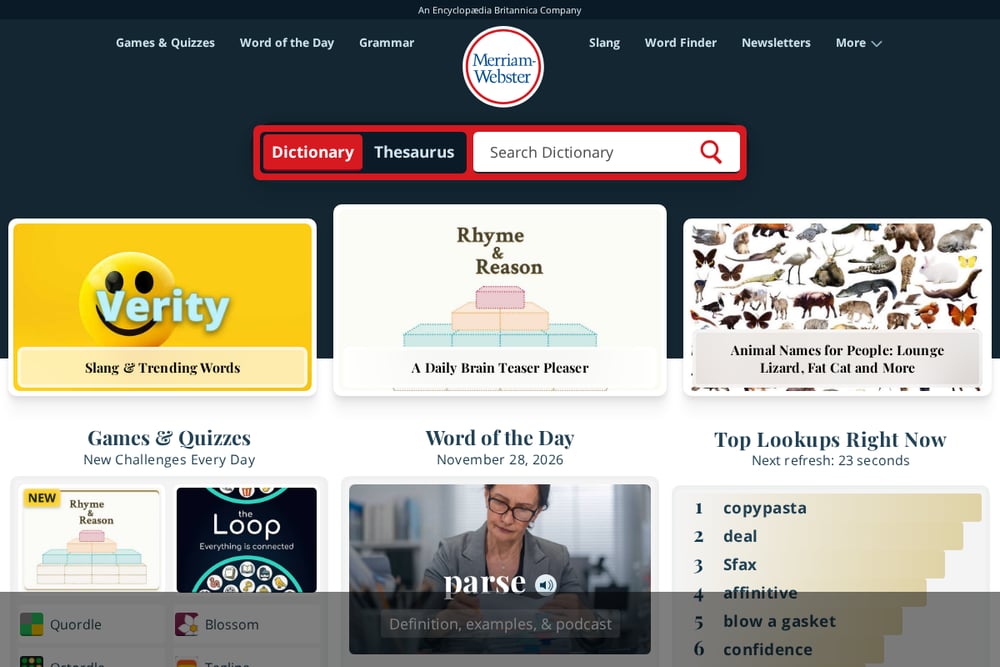 A screenshot of the Merriam-Webster Vocabulary Quiz website.
Merriam-Webster's ten-question quiz is a quick, timed gut check on how strong your vocabulary really is. You get ten seconds per question, and faster, harder answers score higher, which turns it into a game rather than a lesson. Dozens of quiz versions mean you can replay without memorizing the answers. It is backed by one of the most trusted names in American dictionaries, so the word choices are solid. Treat it as a warm-up or a benchmark, not a full curriculum.
#5 Britannica Dictionary Vocabulary Quiz
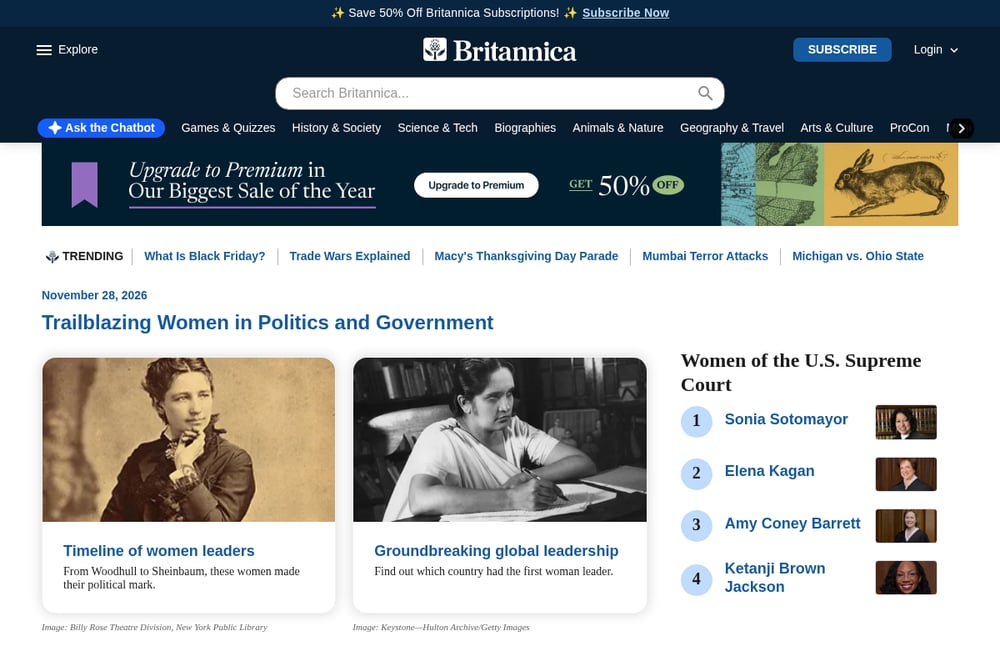 A screenshot of the Britannica Dictionary Vocabulary Quiz website.
Britannica's ten-question quiz follows a similar quick-hit format, with many versions so you can keep testing yourself. It sits inside the Britannica Dictionary, which means a missed word is one click from a clear definition and the site's Ask the Editor column. The Core Vocabulary section is a handy reference for learners who want to prioritize high-frequency words. It is a light, low-pressure way to sample new words. The quiz itself is a supplement rather than a standalone study plan.
Pick the Platform That Matches Your Goal
Start with your actual goal. If you want a benchmark and an adaptive trainer, go with Vocabulary.com. If you want to understand words in context and read your way to a bigger vocabulary, VocabVue is the better fit. If you are a student with a assigned word list, VocabTest.com saves you time. If you just want a two-minute daily check, the Merriam-Webster and Britannica quizzes are enough. Many learners get the most from pairing a context-first platform with a quick quiz for accountability.
A Simple Weekly Vocabulary Workflow
Set a recurring 15-minute block three times a week. Open VocabVue, read one short passage, and save two or three highlighted words. Run a quick quiz on those words the next day, then revisit them at the end of the week. Once a month, take a timed quiz on Merriam-Webster or Britannica to track whether the habit is moving your score. Keep a running list of words you have actually used in writing or conversation, because usage is the only real proof the vocabulary stuck.
The Bottom Line
No single platform does everything perfectly, and that is fine. Vocabulary.com gives you the deepest system, VocabVue gives you the strongest context-first path, VocabTest.com serves students with lists, and the two dictionary quizzes offer quick, low-commitment checks. Choose one primary tool, add a quiz for accountability, and give it a few weeks. Your vocabulary grows from consistent use, not from collecting bookmarks.