
You didn't go into medicine to spend your evenings typing notes. These five virtual scribe services are built to get your charts done before you leave the clinic.
The Virtual Scribe Boom: Why Clinicians Are Outsourcing Documentation
Documentation has quietly become the heaviest part of the job. A 2023 JAMA study found physicians spend over 8.1 hours on EHR work for every eight hours of patient care. That's a second shift, and it's driving burnout across the country. Virtual scribe services have stepped in to take that load off your plate. They combine AI speed with human review to produce notes that are ready to sign, not ready to edit. The market has exploded with options, from fully domestic teams to AI-first platforms with offshore support. The five services below are worth your attention because they tackle the problem from different angles. Some lean on human scribes, others on AI with a human-in-the-loop. All of them promise to give you your evenings back.
How We Evaluated These Virtual Scribe Services
We looked at five factors across every service. First, service scope: does it cover just scribing, or does it also handle prior authorizations, scheduling, and revenue cycle tasks? Second, accuracy and review process: is there a human checking the AI output before it reaches you? Third, compliance: are they HIPAA, SOC 2, and ISO 27001 certified? Fourth, turnaround time: how fast do charts get closed? Fifth, pricing clarity and fit: can you find clear pricing or a trial, and does the service match your practice size? Each service stood out in different areas. ScribeRunner impressed with its physician-reviewed AI and broad administrative support. Physicians Angels brought deep experience and real-time scribing. ScribeAmerica offered scale and tailored programs. Nivaran showed strong documentation reduction metrics. TransDyne delivered flexible turnaround and a free trial.
Here's a quick look at how these five services compare on the factors that matter most to busy clinicians.
| Provider | Best For |
|---|---|
| Physicians Angels | Real-time human scribing with deep experience |
| Virtual Medical Scribe Service | AI-Powered, Human-Driven | AI-powered, physician-reviewed charting and admin support |
| ScribeAmerica | Large organizations needing scalable, tailored scribe programs |
| Nivaran | Documentation plus revenue cycle and coding support |
| TransDyne | Flexible turnaround with a free trial |
The 5 Virtual Medical Scribe Services in Focus
#1 Physicians Angels
 A screenshot of the Physicians Angels website.
Physicians Angels has been in the virtual scribe game since 2007, making it one of the earliest players in the space. They use a team of English-speaking scribes based in HIPAA-compliant offices in India. The scribes work in real time, documenting each patient visit directly into your EHR using secure VOIP. They support any EHR and software platform, so you don't have to change your workflow. Their focus is on giving you completed charts in real time without adding another body to the room. If you want a proven, human-first scribe service with a long track record, this is a strong place to start.
#2 Virtual Medical Scribe Service | AI-Powered, Human-Driven
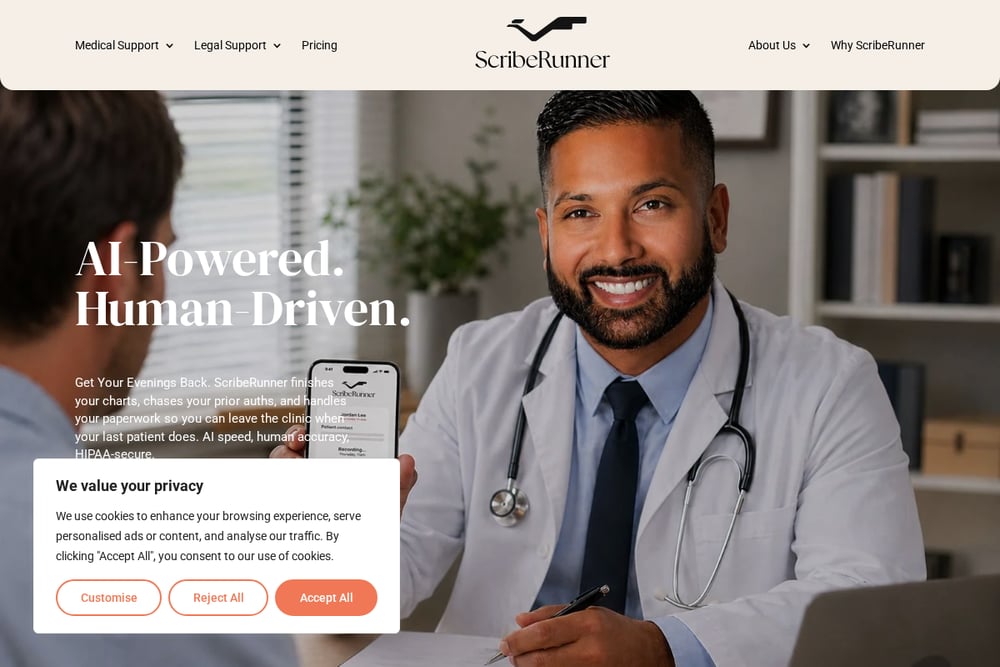 A screenshot of the Virtual Medical Scribe Service | AI-Powered, Human-Driven website.
ScribeRunner combines AI speed with human accuracy in a way that feels built for the modern clinic. Their AI handles the first pass on notes, claims, and records, then trained specialists—many of them licensed physicians—review every output before it reaches you. The result is documentation that's ready to sign, not ready to edit. They claim a 99.8% accuracy rate and charts closed within four hours of a visit. Beyond scribing, they offer virtual receptionists, scheduling, insurance verification, and revenue cycle management. They're HIPAA, SOC 2, and ISO 27001 certified, with 24/7 support across time zones. If you want to leave the clinic when your last patient does, this service is designed for exactly that.
#3 ScribeAmerica
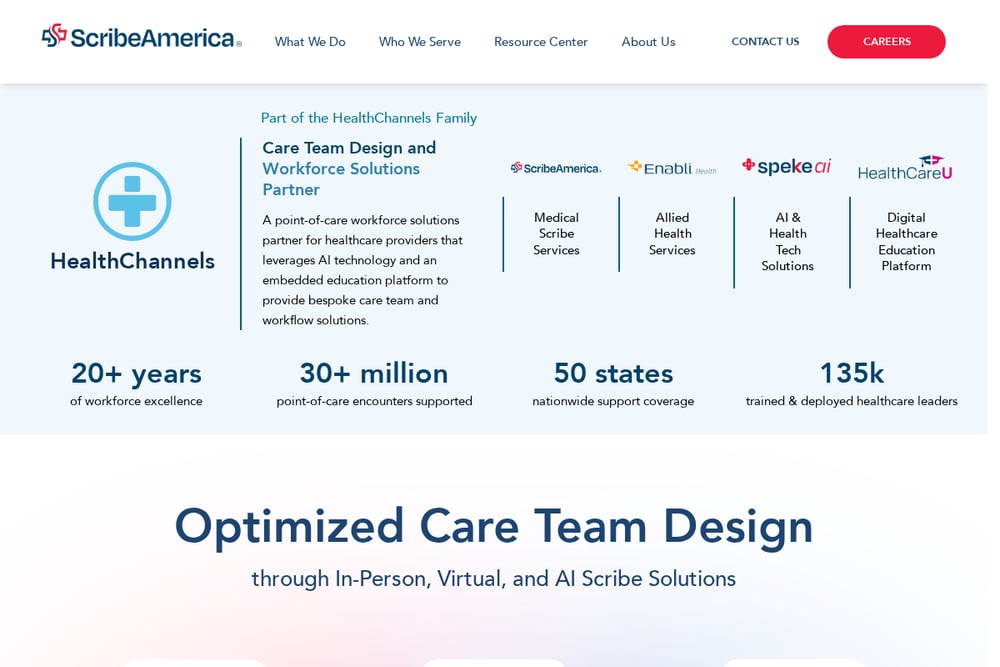 A screenshot of the ScribeAmerica website.
ScribeAmerica is the nation's largest medical scribe company, and their virtual scribe program brings that scale to remote documentation. They offer tailored options, including Virtual Scribes Video, where a live scribe connects through a secure mobile app as if they were in the room. They serve emergency departments, health systems, outpatient clinics, urgent care, and multi-specialty practices. Their programs are designed for flexibility, whether you have variable hours or low FTE demands. With a huge training and management infrastructure, they're a safe bet for organizations that need reliable coverage across many providers.
#4 Nivaran
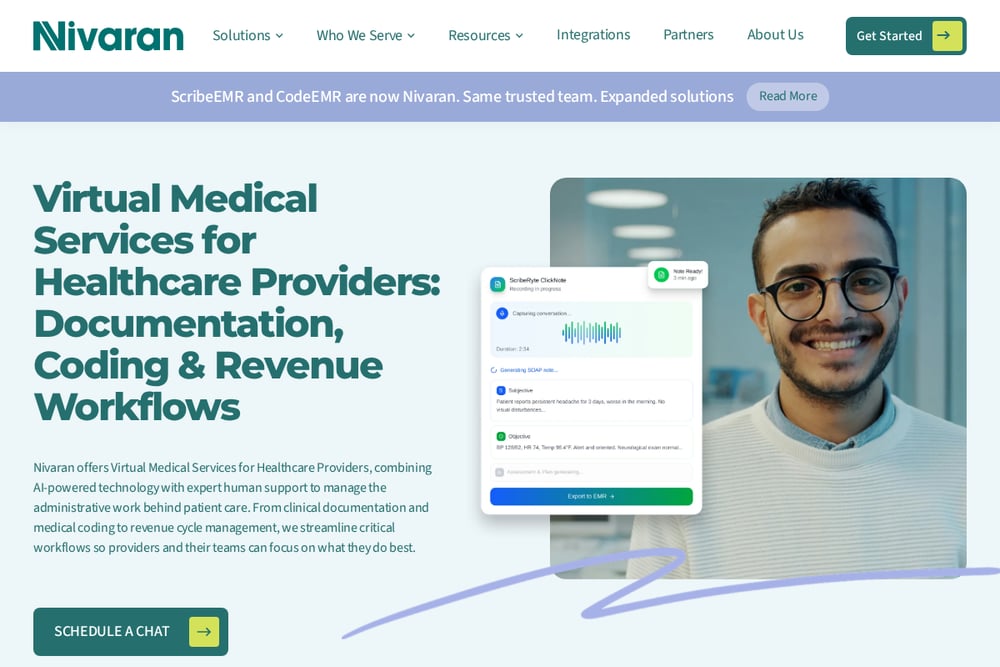 A screenshot of the Nivaran website.
Nivaran, formerly ScribeEMR and CodeEMR, blends dedicated human scribes with AI-powered documentation through their ScribeRyte AI platform. They report saving providers an average of two hours per day and reducing documentation time by 60%. They also claim a 30% reduction in documentation-related claim denials, which speaks to the quality of their notes. Their services extend beyond scribing to revenue cycle management, medical coding, virtual medical office support, and call center support. They're HIPAA verified and SOC 2 Type II certified, audited by PwC and ACCorp Partners. If you want a partner that can handle both documentation and the downstream revenue cycle, Nivaran is worth a look.
#5 TransDyne
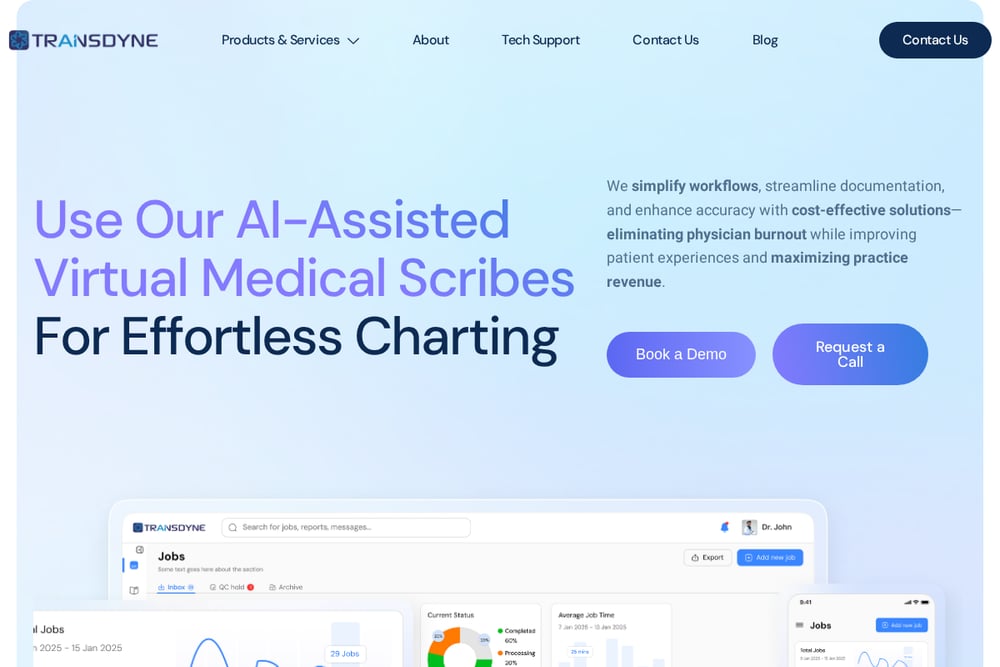 A screenshot of the TransDyne website.
TransDyne pairs AI with human experts to deliver what they call 'AI efficiency, human accuracy.' Their virtual scribe service handles pre-charting, patient encounter audio, prescription and order entry, and physician review. They offer same-day or next-day turnaround, with customizable options to fit your workflow. They claim providers can gain back up to three hours a day and handle up to 20% more patient visits. They also offer a 14-day free trial with no commitment, which lets you test the service risk-free. If you want flexible turnaround and a low-risk way to try virtual scribing, TransDyne is a solid option.
How to Choose the Right Virtual Scribe Service for Your Practice
Start by mapping your biggest pain point. Is it after-hours charting, prior authorizations, or scheduling? Some services, like ScribeRunner, cover all three. Others focus purely on scribing. Next, check the review process. AI alone can miss details, so you want a human in the loop. Ask whether the reviewers are clinically trained. Then look at compliance. HIPAA is non-negotiable, but SOC 2 and ISO 27001 show a deeper commitment to security. Turnaround time matters too. If you need charts closed same-day, confirm that's realistic. Finally, consider pricing and trial options. A free trial lets you test accuracy and fit before committing. Match the service to your specialty and EHR, and don't be afraid to start small with one provider.
Where Automation Fits in Your Documentation Workflow
Automation isn't about replacing humans—it's about removing the repetitive work. The best virtual scribe services use AI to draft notes, extract key details, and flag missing information. Then a human reviews and finalizes. This workflow cuts documentation time dramatically while keeping accuracy high. You can extend automation to prior authorizations, insurance verification, and scheduling. The goal is to let AI handle the first pass and humans handle the judgment calls. That way, you get speed without sacrificing quality. Look for services that clearly explain their AI-plus-human process, not just the AI part.
The Bottom Line on Virtual Scribe Services
You have five strong options, each with a different strength. Physicians Angels brings real-time human scribing and years of experience. ScribeRunner offers AI-powered, physician-reviewed charting plus broad administrative support. ScribeAmerica provides scale and tailored programs for large organizations. Nivaran combines documentation with revenue cycle expertise. TransDyne delivers flexible turnaround and a free trial. The right choice depends on your practice size, specialty, and biggest administrative headache. Whichever you pick, the goal is the same: less time in the EHR, more time with patients. And maybe, just maybe, dinner at a reasonable hour.