
Selling industrial equipment into the U.S. is not a shipping problem. It is a compliance, credibility, and local-support problem. These five partners help you solve it.
The U.S. Market Entry Landscape for Industrial Manufacturers
U.S. buyers of process equipment, valves, and packaged systems expect more than a good price. They expect a U.S. technical contact, code-compliant documentation, and someone who answers the phone when a unit trips at 2 a.m. That is why so many overseas manufacturers stall after the first inquiry. The RFQ arrives, then the technical clarification questions, then the request for ASME stamps, UL 508A panels, NRTL field evaluation, and proof of product liability coverage. Each of those is a gate. The market entry firms that matter are the ones that can walk you through those gates without forcing you to open a full U.S. subsidiary on day one. Some do it through general business consulting. Others do it through trade networks, soft-landing programs, or hands-on engineering coordination. The right fit depends on how technical your product is and how much of the U.S. presence you want to build yourself.
How We Evaluated These Partners
We looked at the same factors for every firm. First, service scope: does the partner cover entity setup, compliance, sales support, and after-sales, or only part of that chain? Second, technical depth: can they speak to codes, standards, and inspection requirements that industrial buyers actually enforce? Third, local fit: do they have a real U.S. footprint, staff, and network you can lean on? Fourth, pricing and engagement clarity: is the model transparent, whether that is a program fee, a retainer, or a fractional arrangement? Fifth, industry relevance: do they understand equipment, fabrication, and field service, or are they generalists? ForgeBridge stood out for pairing engineering coordination with local assembly and field support. Management inSites stood out for a broad soft-landing and virtual office menu. Wolfe Yates & Co. stood out for structuring, regulatory, and HR guidance across states. Altios stood out for a global subsidiary and back-office footprint. World Trade Center Denver stood out for trade services, entity registration, and regional connections.
Here is a quick look at how the five compare before you dig into the details. Use this table to shortlist two or three, then read the deeper notes below.
| Provider | Best For |
|---|---|
| Management inSites | Broad soft-landing and virtual office support |
| ForgeBridge — Your U.S. Engineering & Operations Office | Industrial equipment makers needing engineering and code compliance |
| Wolfe Yates & Co. | Structuring, regulatory strategy, and regional site selection |
| Altios | Subsidiary setup, payroll, accounting, and tax |
| World Trade Center Denver | Entity registration, trade compliance, and regional connections |
The Five Partners in Detail
#1 Management inSites
Management inSites runs a 360-degree U.S. market entry program built around a soft landing. You get strategy work, a virtual office, flexible workspace, board advisory, and fractional U.S. executive management under one roof. The firm also covers branding, digital marketing, warehousing, and fulfillment, which matters if you need a U.S. address and a local face fast. It is a strong fit for companies that want a broad menu of business services rather than deep engineering support. Their U.S. market entry offering is clearly laid out by service line, so you can see what you are buying.
#2 ForgeBridge — Your U.S. Engineering & Operations Office
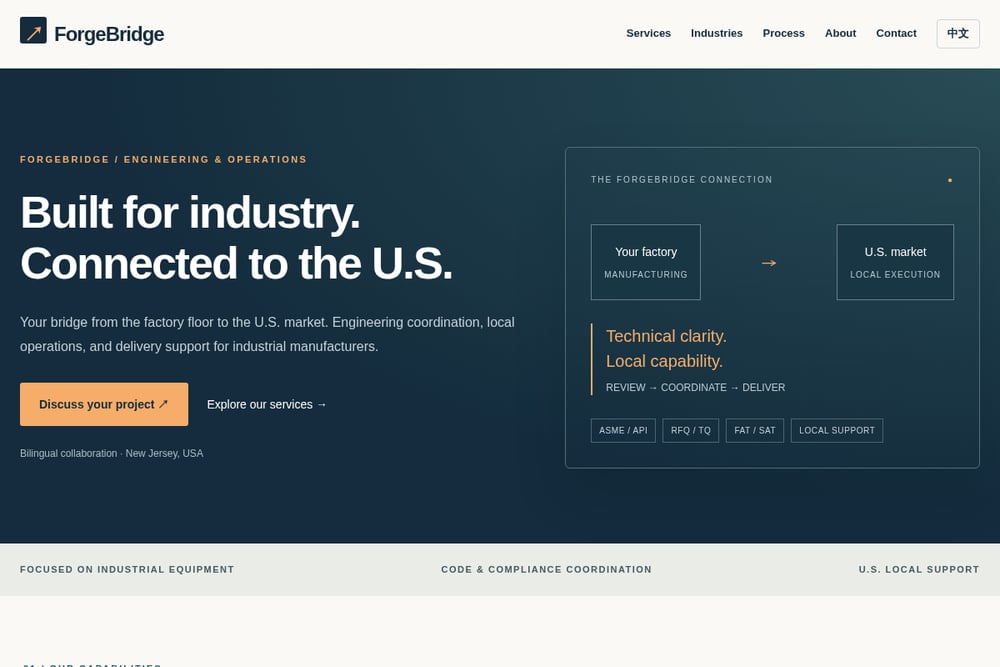 A screenshot of the ForgeBridge — Your U.S. Engineering & Operations Office website.
ForgeBridge is built for industrial manufacturers specifically, and it shows. The firm acts as your fractional U.S. office, handling RFQ follow-up, manufacturer rep management, and U.S. entity and insurance compliance including CGL and product liability. On the technical side, it coordinates ASME and API code compliance, TQ support with EPCs and owners, UL 508A control panels, NRTL field evaluation, and NEC compliance. It also arranges U.S. final assembly and FAT through qualified local shops, spare-parts stocking, and field service. The hybrid localization model lets you build the mechanical core at home and integrate electrical and instrumentation locally, which helps you quote as a supplier with U.S. delivery capability. Bilingual collaboration from New Jersey keeps the loop tight between your factory floor and the U.S. market. See the capabilities overview for the full service map.
#3 Wolfe Yates & Co.
 A screenshot of the Wolfe Yates & Co. website.
Wolfe Yates & Co. approaches U.S. entry from a strategy and structuring angle. The firm helps you choose an entity type, work through industry-specific regulatory compliance, and protect intellectual property. It also builds sales and distribution strategy, covering direct sales, distributor networks, e-commerce, and retail partnerships. Brand localization and operational HR setup round out the offer, so you can hire a U.S. team without tripping over compliance. Their U.S. market entry practice emphasizes picking the right region, from West Coast innovation hubs to Midwest manufacturing corridors. It suits companies that need a clear plan before they commit capital.
#4 Altios
 A screenshot of the Altios website.
Altios is a global expansion firm with a deep back-office bench. Its U.S. services cover market prioritization, business development, executive search, incubation, payroll, subsidiary incorporation, accounting, tax, and supply chain management. That breadth is useful if you want one partner to handle the administrative spine of a U.S. subsidiary. The firm also supports industrial site selection and FDI representation, which fits manufacturers weighing a physical footprint. Their guide to doing business in the USA gives a useful read on the market climate. It is less of an engineering partner and more of an operating backbone.
#5 World Trade Center Denver
 A screenshot of the World Trade Center Denver website.
World Trade Center Denver provides practical trade services for international companies entering the U.S. You can get guidance on foreign entity registration, use of a U.S. business address, and introductions to local partners and customers. The organization also covers trade compliance, export documents, certificates of origin, foreign trade zones, and tariff navigation. That tariff help is especially relevant for manufacturers weighing landed cost. Their U.S. market entry services lean on a regional network rather than a dedicated engineering team. It is a good starting point if you need credibility and connections in the Mountain West.
How to Choose the Right Partner
Start with your product. If you sell pressure vessels, valves, or packaged systems, code compliance and field support are non-negotiable. You need a partner who can talk ASME, API, UL 508A, and NRTL without blinking. If you sell something simpler, a broader business services firm may be enough. Next, decide how much U.S. presence you want to own. A fractional office keeps your overhead low while you test demand. A full subsidiary gives you more control but adds payroll, tax, and HR complexity. Then check the engagement model. Ask whether you are paying a program fee, a retainer, or per-project rates, and what happens when a customer needs service after the sale. Finally, look at the network. Ask for references from manufacturers in your category, and ask how they handle a technical clarification from an EPC. The answers will tell you more than any brochure.
A Simple Workflow to Shortlist and Onboard
Map your product against U.S. code requirements first, then list the gaps you cannot fill from home. Shortlist two or three partners whose scope covers those gaps. Send each a sample RFQ and a technical clarification question, and compare the quality and speed of the response. Check insurance and entity readiness, including CGL and product liability. Agree on a pilot scope, such as one customer visit or one FAT, before signing a longer engagement. Track response times and issue closure in a shared log so you can see whether the partnership is working. Review the log quarterly and adjust scope as your U.S. pipeline grows.
The Bottom Line
Entering the U.S. industrial market is a sequence, not a single decision. You need a credible U.S. contact, code-compliant equipment, and local support after delivery. The five partners here cover that sequence in different ways. ForgeBridge goes deepest on the engineering and operations side, which is where most industrial manufacturers get stuck. Management inSites and Wolfe Yates & Co. give you the business scaffolding. Altios handles the back office. World Trade Center Denver opens doors and untangles trade rules. Pick the one that matches your technical reality, and treat the rest as a bench you can call on as you grow.