
Waking up from the same nightmare night after night is exhausting. You deserve a path that targets the dream itself, not just the symptoms around it.
What are Health & Wellness Remote services?
Trauma nightmares are a common and distressing symptom of PTSD, especially among veterans and active duty servicemembers. The field has moved toward therapies that directly address the nightmare, such as Imagery Rehearsal Therapy (IRT), alongside trauma-focused approaches like Cognitive Processing Therapy and Prolonged Exposure. Access to specialized care remains uneven, so knowing which providers actually focus on nightmares can save you months of trial and error.
What we looked at when researching Health & Wellness Remote
We looked at each provider through the same lens: how directly they treat trauma nightmares, the depth of their clinical experience with PTSD, how clear their service model is, and how easy it is to start with a consultation. Each entry stood out in a different way, from a single-session protocol to residential care and telehealth options.
| Provider | Best For |
|---|---|
| Refresh Psychiatry | Medication plus therapy in one telehealth practice |
| doc-collins.com | Veterans seeking a focused single-session protocol |
| ScienceWorks Health | Adults who want IRT from doctoral-level clinicians |
| THE BALANCE | Immersive residential care for complex trauma |
| Tracy the Sleep Coach | Remote coaching with a focus on IRT |
A closer look at 5 standout Health & Wellness Remote
#1 Refresh Psychiatry
 A screenshot of the Refresh Psychiatry website.
Refresh Psychiatry brings a medical lens to trauma nightmares through telepsychiatry services based in Davie, Florida. Their team of psychiatrists and therapists addresses PTSD and sleep disruption with evidence-based therapies, including Imagery Rehearsal Therapy, Cognitive Processing Therapy, and Prolonged Exposure. You get medication management and therapy under one virtual roof, which matters when nightmares and daytime anxiety overlap. The practice also serves children and adolescents, making it a fit for families. If you want a clinical team that can coordinate both therapy and medication, this is a strong place to start.
#2 doc-collins.com
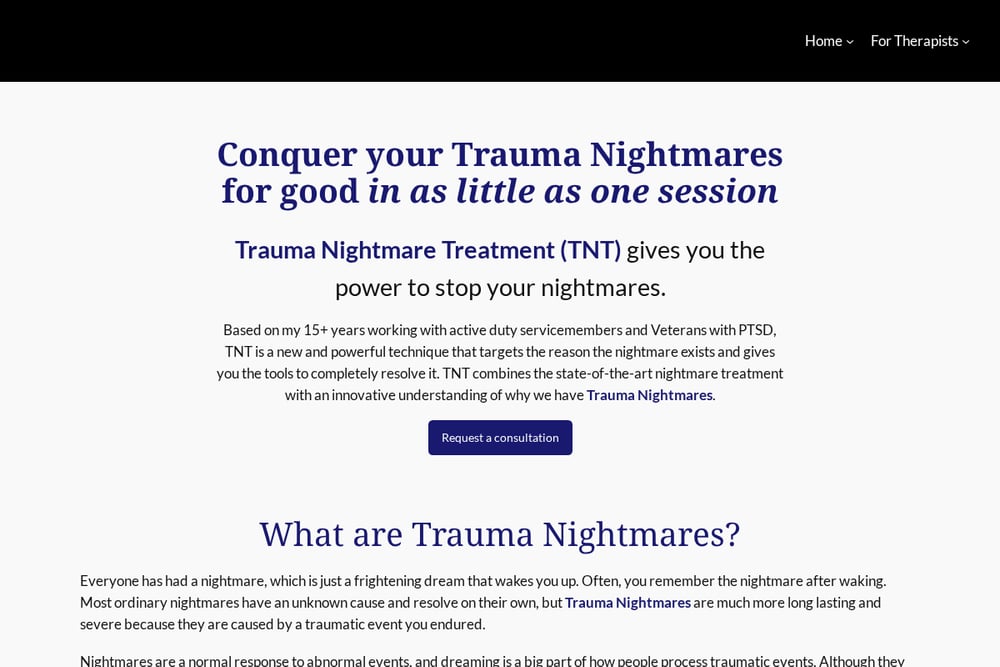 A screenshot of the doc-collins.com website.
Doc Collins offers Trauma Nightmare Treatment (TNT), a specialized technique built from more than 15 years of work with active duty servicemembers and Veterans with PTSD. The approach targets the reason the nightmare exists and aims to resolve it in as little as one session. TNT combines state-of-the-art nightmare treatment with an innovative understanding of why trauma nightmares persist, including the idea that getting stuck often means taking on more than your share of responsibility. You start with a personal consultation, and the site includes resources for therapists who want to learn the method. If you are looking for a focused, veteran-informed protocol rather than general talk therapy, this is worth a close look.
#3 ScienceWorks Health
 A screenshot of the ScienceWorks Health website.
ScienceWorks Health is a therapy practice with clinicians who specialize in trauma, OCD, and insomnia, and they write plainly about nightmare disorder and Imagery Rehearsal Therapy. Their team includes doctoral-level psychologists and licensed therapists, and they offer a free consultation to help you decide whether IRT is the right fit. The practice explains how IRT rewrites the dream script and what a course of treatment looks like, which makes the process less mysterious. They also provide assessments and groups, so you can step into care at the level you need. If you want a practice that treats the nightmare directly and explains the why, this is a solid option.
#4 THE BALANCE
 A screenshot of THE BALANCE website.
THE BALANCE is a private residential treatment program with locations in Mallorca, Zurich, and London, and it lists sleep disorders and PTSD among the conditions it treats. Their model is long-term and multidisciplinary, combining trauma-informed care, psychotherapeutic approaches, and medical and psychiatric support. If your nightmares are tangled with complex trauma, addiction, or severe dysregulation, a residential setting can provide the containment that weekly outpatient visits cannot. The program is international and private-pay, so it suits people who can step away for immersive care. For deep, around-the-clock support, this is a distinctive option.
#5 Tracy the Sleep Coach
Tracy the Sleep Coach is a UK-based sleep coaching service that focuses on Imagery Rehearsal Therapy as an evidence-based treatment for nightmares. The approach is educational and practical, walking you through how IRT works and how to practice it, which can be a good fit if you prefer a coaching-style relationship over a clinical one. The service is delivered remotely, so you can access it from anywhere with an internet connection. It may appeal to people who have tried sleep hygiene without success and want a structured, dream-focused method. If you are looking for a lower-intensity entry point into nightmare treatment, this is worth considering.
How to choose the right Health & Wellness Remote
Start by asking how directly a provider treats the nightmare itself. If you want a single-session protocol built for veterans, look at doc-collins.com. If you need medication and therapy coordinated, a telepsychiatry practice like Refresh Psychiatry may fit better. For a clear explanation of IRT from doctoral clinicians, ScienceWorks Health is a strong choice. Consider residential care with THE BALANCE only if your situation calls for immersive, around-the-clock support. And if you prefer a remote, coaching-style approach, Tracy the Sleep Coach offers a structured entry point. In every case, use the consultation to ask about their experience with trauma nightmares and what progress looks like.
Expert Conclusion
The right choice depends on your history, your support needs, and how much time you can commit. What matters most is that you stop waiting for the nightmares to fade on their own and start with a provider who treats them directly. Use the consultations to ask hard questions, and pick the setting that makes you feel understood.