
You know your strategy cold. So why do you keep breaking your own rules? These five trading psychology services help you fix the trader, not the chart.
The Trading Psychology Coaching Landscape
Trading psychology coaching has moved from the fringe to the mainstream of trader development. Most traders now accept that execution, not analysis, is where accounts bleed. The result is a crowded field of coaches, mentors, and structured programs all promising to fix your mindset. But the offerings vary wildly. Some are one-off consultations. Some are multi-week mentorship programs. Some come from sports psychology backgrounds adapted for markets. Others come from coaches who trade their own capital and know the pressure firsthand. Pricing is often opaque, and credentials range from certified mental performance coaches to former institutional leaders. What matters most is fit: does the coach work from your actual trades, or a generic curriculum? Do you get a framework you can use independently, or a dependency on weekly calls? The five services below represent the range of what's available in the US market right now.
How We Evaluated These Services
We looked at five factors across every service. First, service scope: is it a one-time audit, a multi-week program, or ongoing coaching? Second, methodology depth: does it address surface behaviors or the beliefs underneath them? Third, pricing clarity: are costs and commitments visible before you book a call? Fourth, practitioner background: does the coach trade, coach traders, or adapt from another field? Fifth, independent usability: do you leave with a framework you can apply alone, or do you need the coach forever? Hune Trades stood out for its structured six-week, four-session format and its explicit focus on underlying beliefs and a self-guided workbook. Trading Psychology Mentor stood out for its free psychology test and tiered consultation options. Peak Performance Sports stood out for its decades of mental performance coaching adapted from elite sport. For Traders stood out for its dashboard-based booking and bilingual sessions. Coach for Traders — Angelika Behling stood out for disclosed session volume and a behavior-change background from corporate leadership.
Here's a quick comparison of the five services, from structured programs to one-on-one coaching. Each entry includes what it does, who it fits, and what you'll see on the site.
| Provider | Best For |
|---|---|
| Trading Psychology Mentor | Traders who want a low-commitment entry point |
| Hune Trades | Trading Psychology & Behavioral Development | Experienced traders who break their own rules |
| Peak Performance Sports | Traders who want sports-derived mental coaching |
| For Traders | Traders who want structured, bookable sessions |
| Coach for Traders — Angelika Behling | Traders who want a coach with behavior-change depth |
The Five Services in Detail
#1 Trading Psychology Mentor
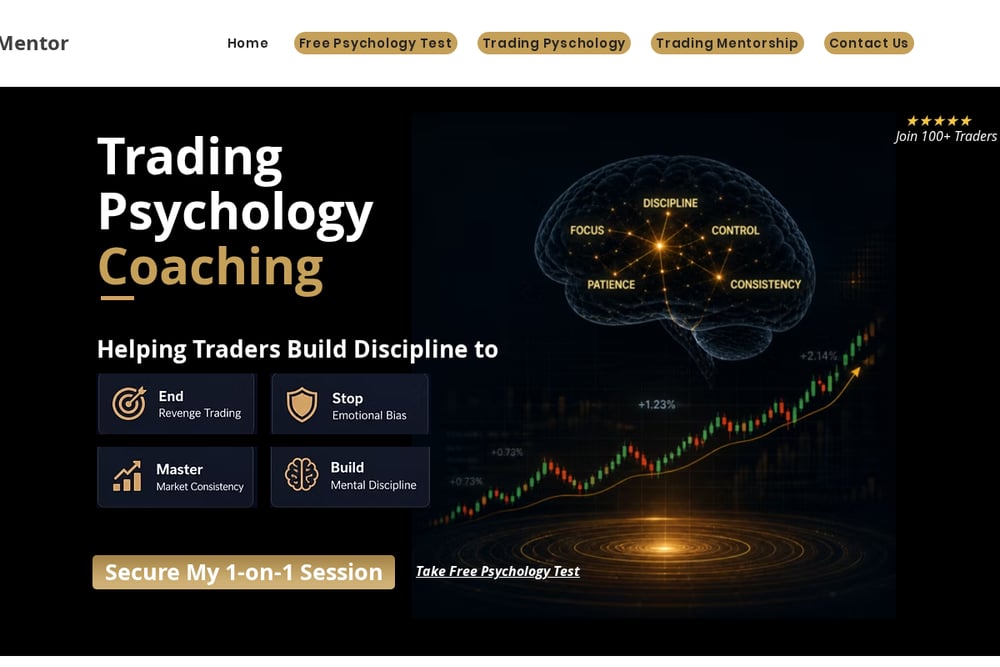 A screenshot of the Trading Psychology Mentor website.
Trading Psychology Mentor leads with a free psychology test, which is a smart low-friction entry point if you're not ready to commit to coaching. The site offers a one-time 1-on-1 consultation for immediate psychological challenges and a 5-week mentorship program for deeper work. The framing is accessible: it compares a trading coach to a driving instructor, helping you stay calm under pressure rather than teaching you mechanics. The service claims 100+ traders served and leans on emotional control, discipline, and risk management as its core pillars. If you want to sample the approach before paying, the free test and single consultation make that easy. See the full program at https://www.tradingpsychologymentor.com/.
#2 Hune Trades | Trading Psychology & Behavioral Development
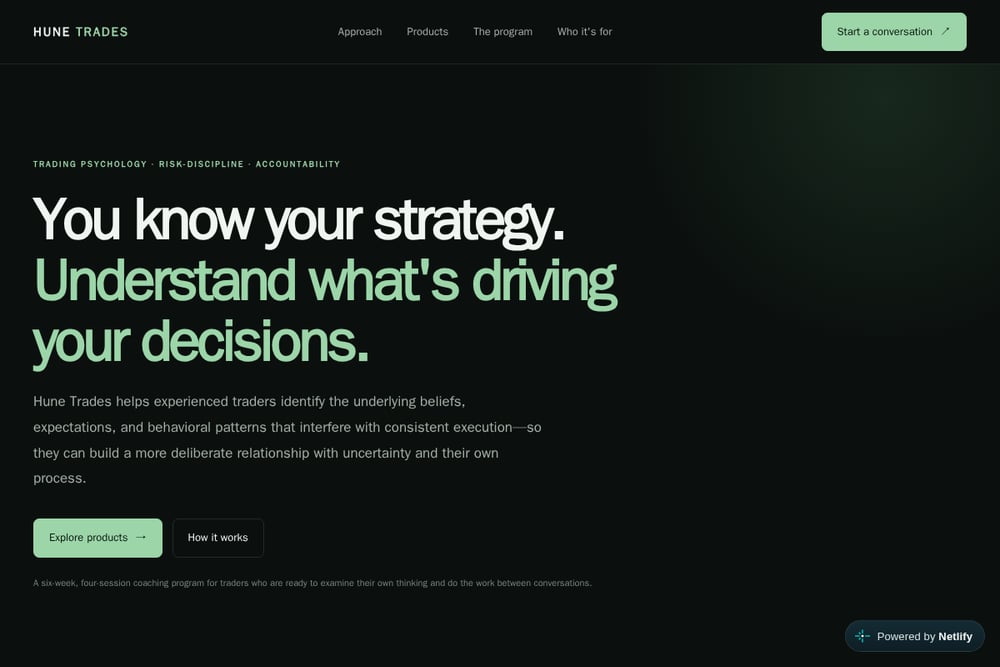 A screenshot of the Hune Trades website.
Hune Trades is built for experienced traders who already know their strategy but keep sabotaging execution. The core offer is a six-week, four-session coaching program that starts with your actual trading experiences, not a generic curriculum. It targets six specific patterns: needing certainty, breaking your own rules, attaching meaning to one trade, changing risk under pressure, second-guessing valid decisions, and understanding a problem without changing it. The site also promotes a self-guided Behavioral Correction System workbook, so you can do the work between sessions and keep a framework you can use independently. The goal is explicit: build a more deliberate relationship with uncertainty and your own process. Explore the approach at https://hunetrades.com/.
#3 Peak Performance Sports
 A screenshot of the Peak Performance Sports website.
Peak Performance Sports brings 40+ years of mental performance coaching from elite sport into trading. The pitch is direct: you have the strategy, your mindset is what's holding you back. Coaching is one-on-one via Zoom with certified mental performance coaches, available worldwide. The site speaks to specific pain points like freezing up in live trading, revenge trading after a loss, holding losers too long, and feeling pressure to make back losses. A free 15-minute consultation makes the first step low-risk. If you respond well to the language and structure of sports psychology, this is a credible bridge into trading. Learn more at https://www.peaksports.com/.
#4 For Traders
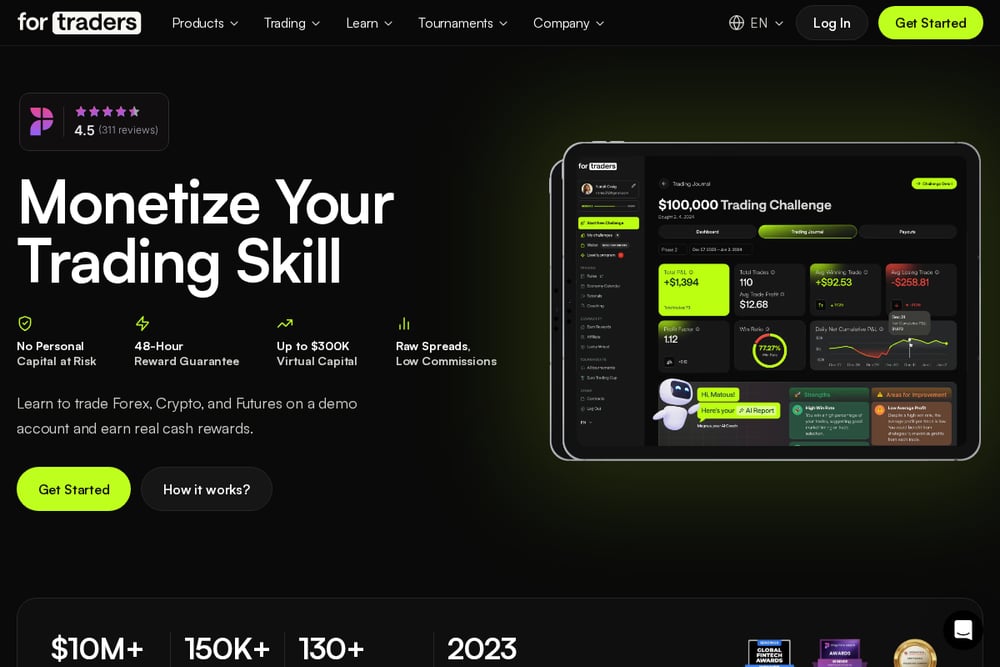 A screenshot of the For Traders website.
For Traders offers high-performance coaching through a dashboard-based booking flow: sign in, pick a slot, join a video call. Sessions are one-on-one and include a personalized trading psychology assessment, custom mental training exercises, performance tracking, and email support between sessions. The site cites the familiar stat that 90% of trading success comes from psychology, not strategy, and organizes session topics around emotional regulation, risk management psychology, analysis paralysis, confidence, patience, and routines. Sessions are available in English and Spanish. If you prefer a productized, calendar-driven coaching experience, this fits. See the coaching page at https://fortraders.com/high-performance-coaching.
#5 Coach for Traders — Angelika Behling
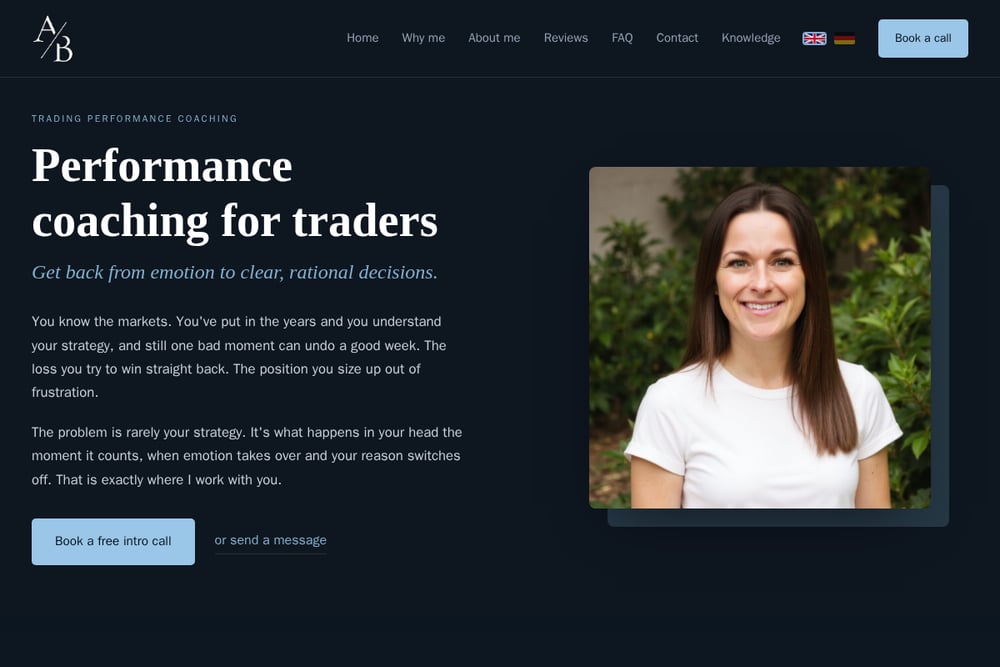 A screenshot of the Coach for Traders — Angelika Behling website.
Coach for Traders is the personal practice of Angelika Behling, who discloses 11+ years of coaching experience, 410+ traders and teams coached, and 1,550+ sessions. She trades her own capital, which matters if you want a coach who knows the pressure from the inside. Her background is leadership and transformation for a global company, helping people change ingrained behavior under pressure, and she applies that directly to trading. The work includes focused techniques, trade review, and deeper work on the beliefs that drive behavior, with a clear plan after every session. A free intro call is the entry point. Visit https://coachfortraders.com/ to book one.
How to Choose the Right Trading Psychology Coach
Start with your actual problem. If you break rules under pressure, you need a program that works from your real trades, not a generic curriculum. If you freeze up in live markets, look for a coach who addresses performance anxiety specifically. If you understand your mistakes intellectually but keep repeating them, prioritize a method that goes after underlying beliefs. Next, check the format. A six-week structured program suits traders who want a defined arc and homework between sessions. Ongoing one-on-one coaching suits traders who want to work through issues as they arise. A one-time consultation suits traders who want a diagnostic before committing. Then look at the practitioner. Does the coach trade? Have they coached traders specifically, or adapted from another field? Both can work, but know what you're buying. Finally, check pricing clarity and independent usability. You should know the cost and commitment before you book, and you should leave with a framework you can apply without the coach in the room.
A Simple Weekly Workflow to Reinforce the Work
Coaching only sticks if you reinforce it between sessions. Here's a lightweight weekly workflow. First, log every trade with the rule you followed or broke, and note the emotion in the moment. Second, at week's end, tag each deviation with one of the six patterns: certainty, execution, expectations, risk, hesitation, or repeating patterns. Third, review the tags and ask what belief sat behind the behavior. Fourth, write one sentence on what you'll do differently next week. Fifth, bring that summary to your next session so the conversation starts from evidence, not memory. If you're using a self-guided workbook like the one from Hune Trades, this workflow becomes the spine of your between-session work. Automate the logging with a simple spreadsheet or journaling app so the review takes ten minutes, not an hour.
The Bottom Line
The right trading psychology service depends on where you are. If you want a low-commitment entry point, start with a free test or a single consultation. If you're an experienced trader who keeps breaking your own rules, a structured program that works from your actual trades and targets underlying beliefs is the better fit. If you respond to sports psychology or want a coach with disclosed session volume and a behavior-change background, those options are on the table too. The common thread across all five is that they treat execution as a skill you can train, not a personality trait you're stuck with. Pick the format that matches your problem, show up with real trade data, and do the work between sessions. That's where the change happens.