
Complex science doesn't sell itself. You need someone who can turn dense evidence into language buyers actually trust. Here are five firms doing that work well.
Why Evidence Translation Is Becoming a Growth Function
Technical and science-led companies face a strange problem. The better your research, the harder it can be to explain. Buyers want proof, but they also want plain language. Regulators want precision, but sales teams want clarity. That gap has created a real market for firms that sit between the lab and the buyer. These consultancies review evidence, validate claims, and write material that survives scrutiny. They are not ad agencies and they are not academic departments. They are translators. And for founders selling complex products, they are increasingly the difference between a stalled pipeline and a clear message that converts.
How We Evaluated These Firms
We looked at five factors. First, service scope: does the firm handle research, claims, and communication, or just one piece? Second, evidence discipline: do they separate what the science supports from what it doesn't? Third, audience fit: can they write for buyers, regulators, and technical evaluators without losing meaning? Fourth, sector focus: do they understand science-led businesses specifically? Fifth, practical output: do they deliver usable assets like evidence briefs, product explainers, and decision memos? Each firm below stood out on different factors. Tembert impressed with its end-to-end evidence-to-market workflow. SLM Consulting showed strong public health dissemination experience. Tagus combined scientific research with technical documentation. Research Consulting brought deep scholarly communication knowledge. RTI Health Solutions offered broad life science evidence generation and medical writing depth.
Here is a quick look at how these five firms compare on focus, output, and the kind of buyer they serve best.
| Provider | Best For |
|---|---|
| SLM Consulting, LLC | Public health and community-focused evidence dissemination |
| Tembert Research & Consulting — Turn Complex Evidence Into Growth | Science-led businesses that need evidence-backed buyer communication |
| Tagus | Technical documentation and evidence synthesis for specialist audiences |
| Research Consulting | Universities, funders, and research organizations needing strategic evidence support |
| RTI Health Solutions | Pharmaceutical and bioscience companies needing integrated evidence and medical writing |
The Five Firms in Detail
#1 SLM Consulting, LLC
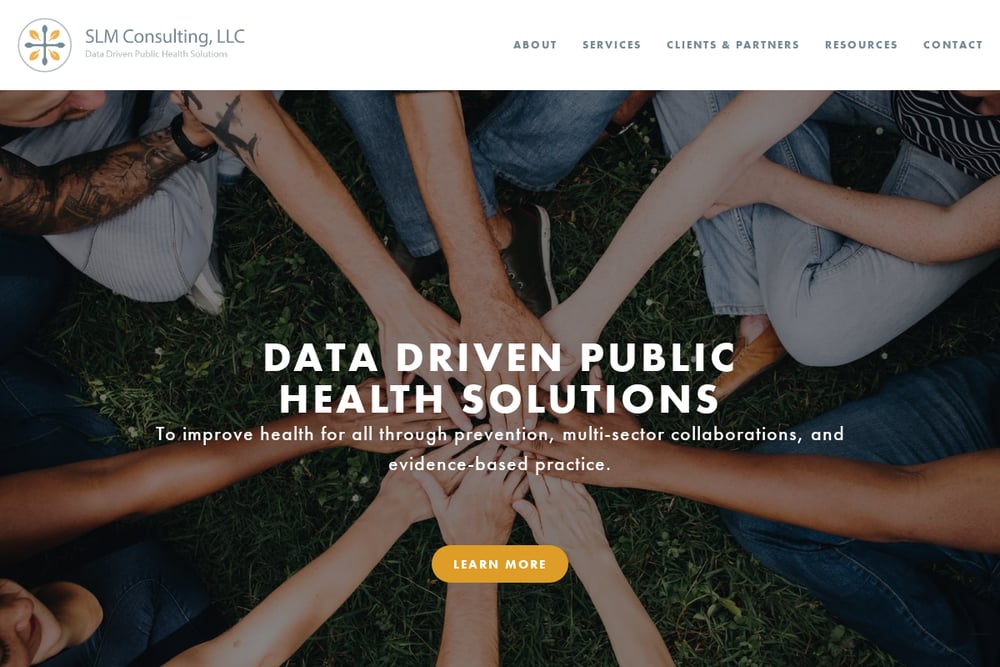 A screenshot of the SLM Consulting, LLC website.
SLM Consulting focuses on translating evidence into resources for public health and community audiences. They produce formal reports, white papers, infographics, blogs, and presentations. Their work helps stakeholders, decision makers, and community members understand data and outcomes. If your organization works in public health or social services, their dissemination experience is directly relevant. They also facilitate workgroups and support technical writing across diverse audiences. You can see their approach on their technical writing and communication page.
#2 Tembert Research & Consulting — Turn Complex Evidence Into Growth
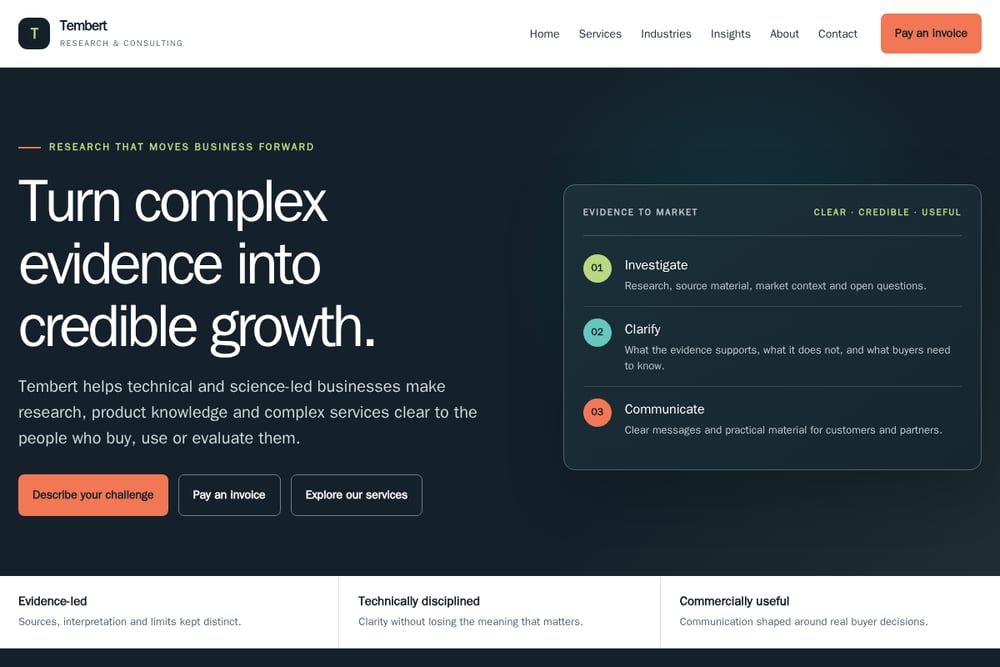 A screenshot of the Tembert Research & Consulting — Turn Complex Evidence Into Growth website.
Tembert helps technical and science-led businesses turn complex evidence into credible growth. Their workflow moves from investigate to clarify to communicate. They handle evidence reviews, claim validation, and buyer education. The output is practical: literature reviews, evidence briefs, competitor scans, decision memos, product explainers, and buyer guides. What sets them apart is the explicit separation of sources, interpretation, and limits. They keep what the evidence supports distinct from what it does not. That discipline makes their communication useful for cautious buyers and technical evaluators alike. You can explore their services at tembert.com.
#3 Tagus
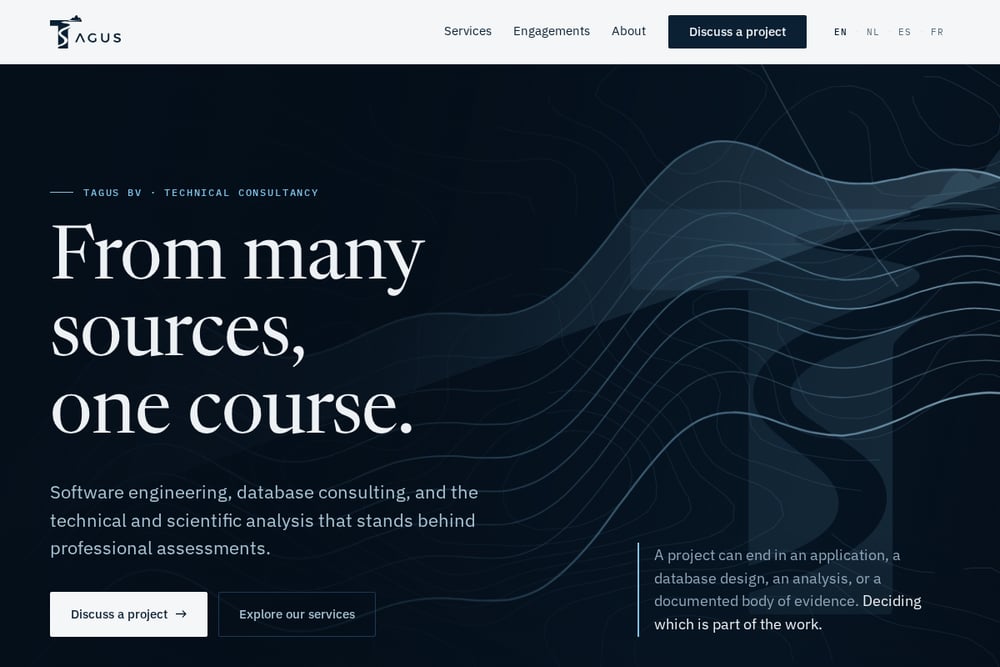 A screenshot of the Tagus website.
Tagus offers scientific and technical consulting with a strong documentation backbone. They conduct literature research, evidence synthesis, and interpretation of technical datasets. They also write scientific and technical documentation that survives review. Their model blends in-house research with a network of domain specialists. That means you get both structured analysis and specialist judgement. They are clear that they are not a lab or an academic institution. What they add is the combination of scientific understanding, data, technology, and professional communication. Their scientific and technical consulting page outlines this mix well.
#4 Research Consulting
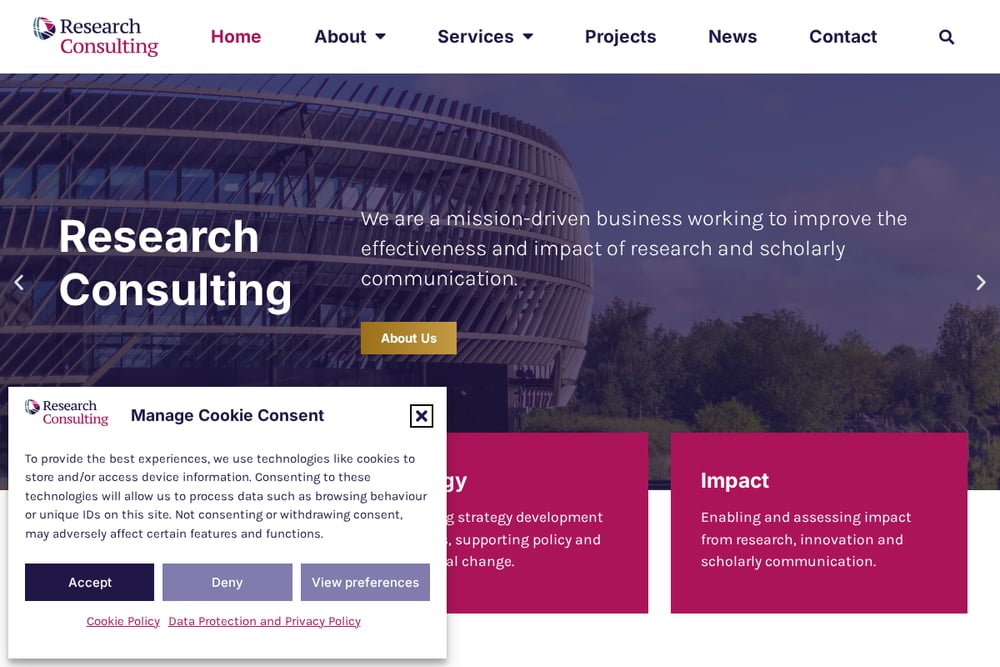 A screenshot of the Research Consulting website.
Research Consulting works with universities, funders, publishers, and learned societies. Their focus is research management, scholarly communication, and knowledge exchange. They provide insight, strategy, and impact assessment. If your organization operates in the research ecosystem, their sector knowledge runs deep. They understand how evidence moves through academic and policy channels. Their services help clients improve research effectiveness and commercialisation. You can see their full service map on their homepage.
#5 RTI Health Solutions
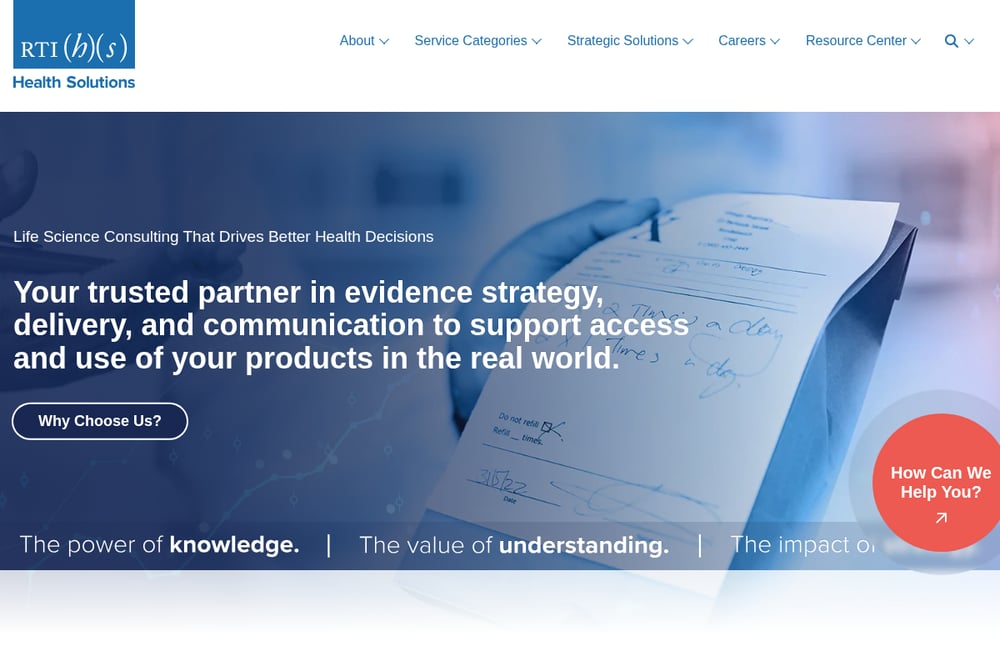 A screenshot of the RTI Health Solutions website.
RTI Health Solutions is a globally recognized research organization focused on healthcare decisions. They generate evidence across value, access, outcomes, and regulatory strategy. Their medical communications team handles integrated evidence strategy, expert insights, and medical writing. They also offer creative and digital solutions for pharmaceutical and bioscience companies. If you need large-scale evidence generation paired with publication strategy, they have the infrastructure. Their therapeutic experience and research team depth are significant. You can review their service categories on their website.
How to Choose the Right Evidence Translation Partner
Start with your buyer. If you sell to public health departments or community organizations, look for dissemination experience like SLM Consulting. If you sell a technical product to cautious buyers, you need claim validation and plain-language explainers like Tembert provides. If your challenge is documentation that survives regulatory or technical review, Tagus is built for that. If you work inside the research ecosystem, Research Consulting understands your stakeholders. If you are in pharma or bioscience and need evidence generation at scale, RTI Health Solutions has the breadth. Then ask a second question: what output do you actually need? A decision memo is different from a white paper. A product explainer is different from a publication strategy. Match the firm to the deliverable, not just the category. Finally, check how they handle limits. Good firms tell you what the evidence does not support. That honesty protects your brand and your claims.
Where Automation Fits in Evidence Communication
You can automate parts of this work, but not the judgement. Use literature screening tools to triage sources. Use reference managers to keep citations clean. Use templates for evidence briefs and product explainers. But keep humans in the loop for interpretation and claim validation. The risk of automated claim generation is real. A tool can string together words that sound supported when they are not. The firms above succeed because they separate sources, interpretation, and limits. Build your workflow the same way. Automate the collection and formatting. Keep the clarification and communication steps human-led.
The Bottom Line on Evidence-Led Growth
Complex evidence is not a marketing problem. It is a translation problem. The firms worth knowing in this space do three things well. They investigate the evidence. They clarify what it supports. They communicate it in language buyers can act on. Tembert builds its entire workflow around that sequence. SLM Consulting applies it to public health. Tagus applies it to technical documentation. Research Consulting applies it to the research ecosystem. RTI Health Solutions applies it to life sciences at scale. Pick the one that matches your buyer, your output, and your tolerance for nuance. Then let them turn your evidence into growth.