Your work is strong. Your numbers are holding you back. If your WIP schedule doesn't tie to the books, your surety and your bank see risk before they see revenue.
The Surety-Readiness Gap in Construction Finance
Contractors don't lose bonding capacity because they swing a hammer poorly. They lose it because their financials tell a messy story. Sureties typically want internal year-end statements around 60 days after fiscal year end and CPA-reviewed or audited statements within 150 days, according to carrier guidance cited by FinTruction. NASBP notes sureties often ask for three years of fiscal year-end statements, interim statements every three or six months, and a quarterly WIP schedule. That cadence is the problem. Most contractors close the books late, carry bid-time estimates to complete forward without project manager updates, and let job costing drift from the general ledger. When the job-cost reports and the GL disagree, the underwriter trusts neither. The result is a smaller bonding line, tighter loan covenants, and bids you can't chase. A new category of specialized advisors has emerged to close that gap: monthly WIP reconciliation, rolling cash forecasts, and quarterly surety packages built for the underwriter's eye, not just the tax preparer's.
How We Evaluated These Providers
We looked at the same factors for every firm. Service scope: does the provider handle WIP schedules, job-cost reconciliation, cash forecasting, and surety packages, or only general bookkeeping? Pricing clarity: is the fee fixed and quoted upfront, or open-ended? Surety and bank fit: does the work map to what underwriters and lenders actually test, including over/under billings, profit fade, and covenant compliance? Delivery cadence: monthly, quarterly, or year-end only? And construction specialization: does the team speak percentage-of-completion, change orders, and estimates to complete? Bondline Advisory stood out for a fixed-fee Bond-Readiness Review followed by monthly WIP and job-cost reconciliation. FinTruction stood out for a clear surety review timeline and Procore integration. Steph's Books stood out for transparent pricing and a plain-language guide to surety financial benchmarks. Precision Accounting Consulting stood out for deep WIP and percentage-of-completion education. Nexus Works CPA stood out for CPA-prepared statements and lender letters.
Here's the short version. Five firms, five different angles on the same problem: making your numbers trustworthy to the people who extend bonding and credit.
| Provider | Best For |
|---|---|
| FinTruction | Contractors who want a surety review timeline that starts before year end |
| Bondline Advisory | Surety-ready financials for contractors | Contractors who depend on bonding and bank credit and need monthly surety-ready numbers |
| Steph's Books | Small contractors who want transparent pricing and a plain-language surety benchmark guide |
| Precision Accounting Consulting | Contractors who need to understand WIP and percentage-of-completion before fixing it |
| Nexus Works CPA | Contractors who need CPA-prepared statements and lender letters alongside bookkeeping |
The 5 Firms in Detail
#1 FinTruction
 A screenshot of the FinTruction website.
FinTruction treats the surety review as a timeline problem, not a year-end fire drill. Their guide lays out what the surety asks for and when, citing carrier guidance that internal year-end statements are wanted around 60 days after fiscal year end and CPA-reviewed or audited statements within 150 days. They also flag the NASBP expectation of three years of fiscal statements, interim statements every three or six months, and a quarterly WIP schedule. Their service menu runs from bookkeeping cleanup and controller services to CFO services and systems integration, with Procore and Buildertrend hubs for construction clients. If your close is slow and your WIP doesn't tie, their timeline-first approach is worth a look. See their surety review preparation guide at fintruction.com/surety-bond-renewal-preparation.
#2 Bondline Advisory | Surety-ready financials for contractors
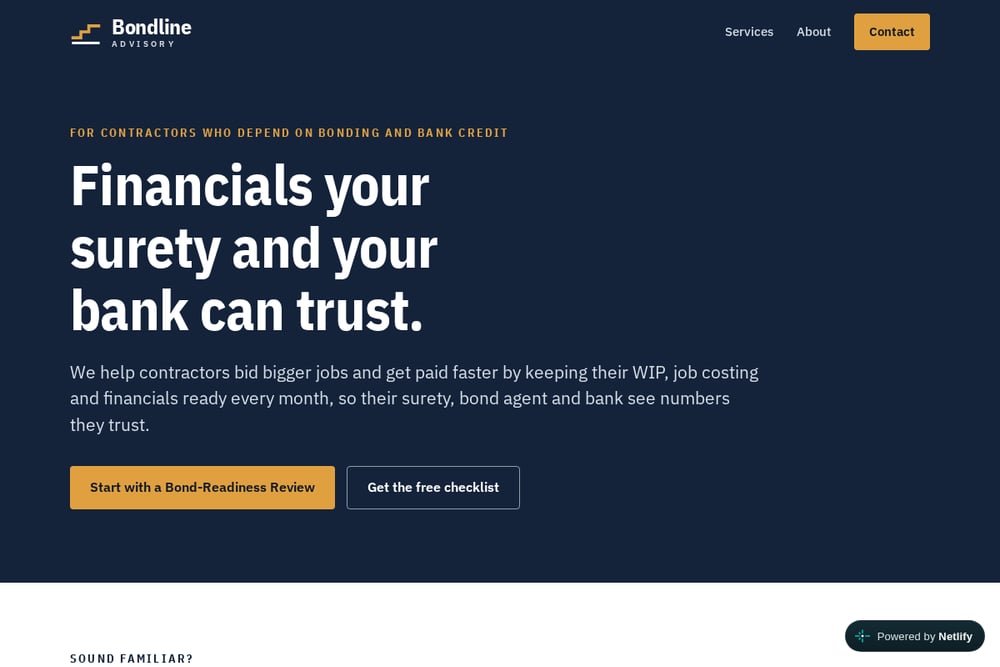 A screenshot of the Bondline Advisory | Surety-ready financials for contractors website.
Bondline Advisory is built around one promise: financials your surety and your bank can trust. They start with a two-week Bond-Readiness Review that looks at your numbers the way an underwriter would, covering WIP schedule review, estimates to complete, over/under billings, profit fade, and job-cost reconciliation to the general ledger. You get written findings and an owner meeting, with your bond agent invited if you like, at a fixed fee quoted before work starts. Then their Bond-Ready Monthly service keeps WIP, job costing, and cash current every month, with a rolling cash forecast, underbilling follow-up, and quarterly and year-end surety packages. That monthly cadence is the differentiator: it prevents the year-end surprises that shrink bonding lines and put loan covenants at risk. Learn more at bondlineadvisory.com.
#3 Steph's Books
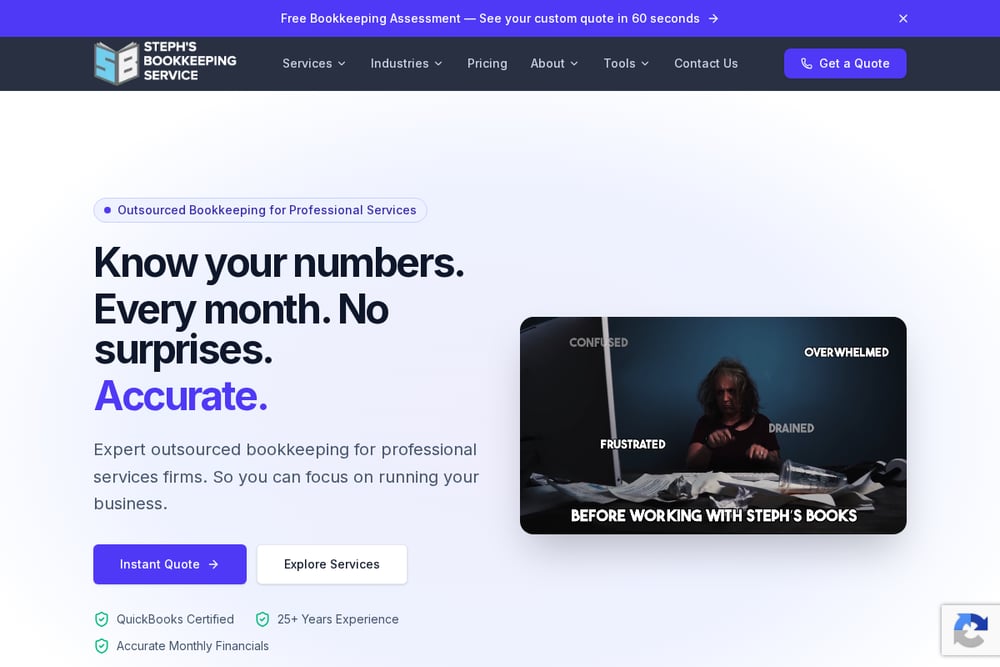 A screenshot of the Steph's Books website.
Steph's Books makes the financial side of surety qualification concrete. Their guide walks through the benchmarks underwriters test, including working capital ratio, debt-to-equity, and the value of reviewed financials, using a scenario where a $3.6 million contractor gets capped at $500,000 per job because the statements scream risk. The firm serves professional services firms in the $1MM to $10MM revenue range with bookkeeping, payroll, AR/AP, bank reconciliation, and catch-up bookkeeping. They publish instant pricing quotes, which is rare in this niche. If you want to understand the numbers a surety is actually reading before you hire anyone, their resource library is a useful starting point. Visit stephsbooks.com.
#4 Precision Accounting Consulting
 A screenshot of the Precision Accounting Consulting website.
Precision Accounting Consulting goes deep on the tool at the center of every surety package: the WIP schedule. Their article explains percentage-of-completion using the cost-to-cost method, showing how costs incurred divided by total estimated job costs drives revenue recognition under ASC 606. They explain how overbillings and underbillings reveal whether you've billed enough to cover costs, and why the WIP gives your surety and banker a real-time read on job profitability instead of a closeout surprise. The firm organizes its accounting by industry and offers recovery audits alongside its knowledge hub and podcast. If your team still doesn't fully trust the WIP, their educational content is a strong place to build understanding. See precisionaccountingconsulting.com.
#5 Nexus Works CPA
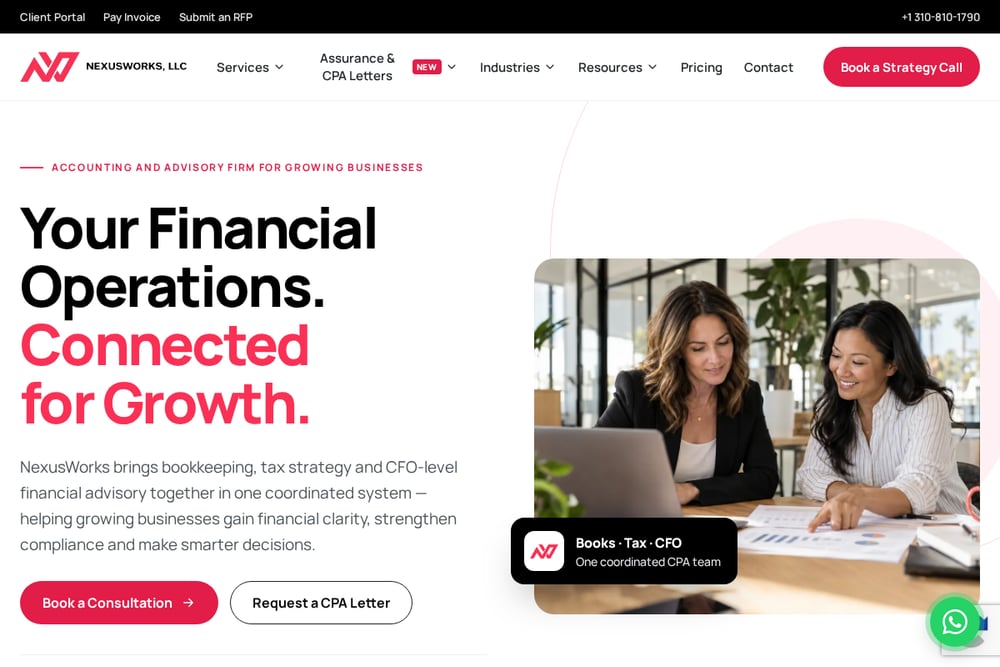 A screenshot of the Nexus Works CPA website.
Nexus Works CPA covers the assurance side of surety readiness. Their service menu includes reviewed financial statements, compiled and CPA-prepared statements, personal financial and net worth statements, and CPA letters for lenders and third parties, including bid, licensing, and regulator letters. That matters because sureties often want CPA-reviewed or audited statements within 150 days of fiscal year end, and banks want comfort letters tied to covenants. They pair that with bookkeeping, catch-up and clean-up work, fractional CFO services, and forecasting and budgeting support. For contractors who need a CPA signature on the package, not just monthly bookkeeping, this is a relevant option. Visit nexusworks.cpa.
How to Choose the Right Fit
Start with your bottleneck. If your WIP doesn't tie to the books, you need reconciliation depth, which points toward Bondline Advisory's monthly WIP and job-cost work or Precision Accounting Consulting's WIP education. If your close is late and the surety package is always a scramble, a timeline-driven approach like FinTruction's makes sense. If you need a CPA signature on reviewed statements or a lender letter, Nexus Works CPA covers that ground. If you're a smaller firm that wants transparent pricing and a clear explanation of the benchmarks, Steph's Books is a practical entry point. Ask every provider three questions: Is the fee fixed and quoted upfront? Will you reconcile job costing to the general ledger every month? And will you produce quarterly and year-end surety packages your underwriter can rely on? The answers separate a bookkeeper from a surety-readiness partner.
The Monthly Workflow That Keeps You Bond-Ready
Surety readiness is a rhythm, not an event. Month one: close the books and reconcile job costing to the general ledger so the two never disagree. Month two: update estimates to complete with your project managers, not the bid, and refresh the WIP schedule to surface overbillings and underbillings. Month three: roll the cash forecast, follow up on underbillings, and check covenant compliance before your lender asks. Every quarter: assemble the surety package with current WIP, financial statements, and cash review. Every year: deliver internal statements around 60 days after fiscal year end and CPA-reviewed or audited statements within 150 days. Automate the handoffs, set calendar reminders for each step, and the year-end fire drill disappears.
The Bottom Line
Your bonding line and your bank credit are only as strong as the numbers behind them. The five firms here attack the same problem from different angles: timeline discipline, monthly WIP reconciliation, benchmark education, percentage-of-completion depth, and CPA assurance. Bondline Advisory's fixed-fee review and monthly Bond-Ready service make it a natural fit for contractors whose surety and bank see the numbers every month. Pair that with the right CPA support and a disciplined monthly close, and you stop bidding smaller jobs because of your financials. That's the whole point.