Growth is a discipline, not a gamble. If you are leading an organization and need a partner who can turn ambition into a repeatable system, these five advisory firms deserve a closer look.
The Strategic Growth Advisory Landscape
Growth advisory has matured into its own discipline. Leadership teams no longer want a slide deck and a handshake. They want clarity on where to grow, who to reach, and how to build momentum that survives contact with the market. That shift has pulled advisory firms in two directions. Some operate at scale, bringing deep analytical firepower and industry specialization to major capital and commercial decisions. Others stay boutique, embedding with leadership teams and staying involved through execution. You will also find firms that blend advisory with talent and organizational work, and specialists who focus on a single vertical. The common thread is a move away from templated strategy toward market-grounded recommendations tied to real capacity. For buyers, the practical question is fit. A firm built for enterprise transformation may overwhelm a mid-market team. A boutique may lack the bench for a multi-market rollout. The five firms below sit at different points on that spectrum, and each brings a distinct model to the same core problem: how to grow with intention.
How We Evaluated These Firms
We looked at each firm through the same lens. First, service scope: does the firm cover the full arc from market intelligence and growth planning through acquisition, outreach, partnerships, and organizational alignment, or does it specialize? Second, execution model: does the firm hand off a strategy, or does it stay involved as plans turn into results? Third, market fit: which organizations, sectors, and sizes does the firm's approach genuinely suit? Fourth, clarity of positioning: can you tell from the outside what the firm does and who it serves? Fifth, transparency around engagement: how clearly does the firm describe its process, from discovery through sustainment? LCOS Management stood out for its six connected capability areas and its explicit commitment to staying involved through execution. L.E.K. Consulting stood out for analytical depth and breadth across commercial and capital decisions. Calibrate stood out for pairing growth strategy with organizational readiness and talent. Craig Group stood out for aligning investors, management, and employees around measurable initiatives. Stambaugh Ness stood out for vertical focus and practical implementation support. Each factor was weighed the same way for every firm.
Here is a quick comparison of the five firms, ordered for readability. Use it to shortlist based on your organization's size, sector, and how much hands-on execution support you need.
| Provider | Best For |
|---|---|
| L.E.K. Consulting | Large organizations facing complex, high-stakes growth and investment decisions |
| LCOS Management — Strategic Advisory for Growth | Leadership teams that want tailored strategy plus hands-on support through execution |
| Calibrate | Professional services firms where growth depends on talent and organizational readiness |
| Craig Group | Private equity sponsors and executive teams needing fast, measurable alignment |
| Stambaugh Ness | AEC firms seeking vertical-specific growth and business development support |
The Five Firms in Detail
#1 L.E.K. Consulting
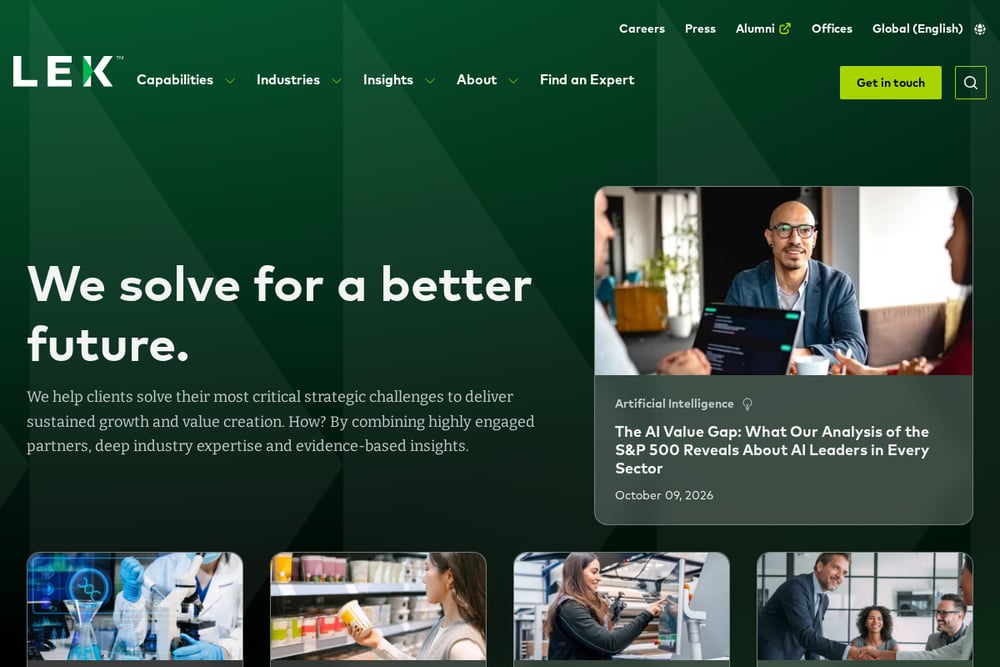 A screenshot of the L.E.K. Consulting website.
L.E.K. is a global strategy consultancy with a dedicated growth strategy practice. The firm brings serious analytical firepower to questions of where to invest, which markets to enter, and how to build commercial organizations that can execute. Its capability map spans marketing and sales, M&A, pricing and revenue optimization, and organization design, which means a growth question rarely sits in isolation. If you are weighing a major capital commitment or a new product strategy, the depth here is substantial. The tradeoff is scale: this is an enterprise-grade engagement model, and smaller organizations may find the fit less natural. You can explore the firm's growth strategy practice and its broader capabilities on its site.
#2 LCOS Management — Strategic Advisory for Growth
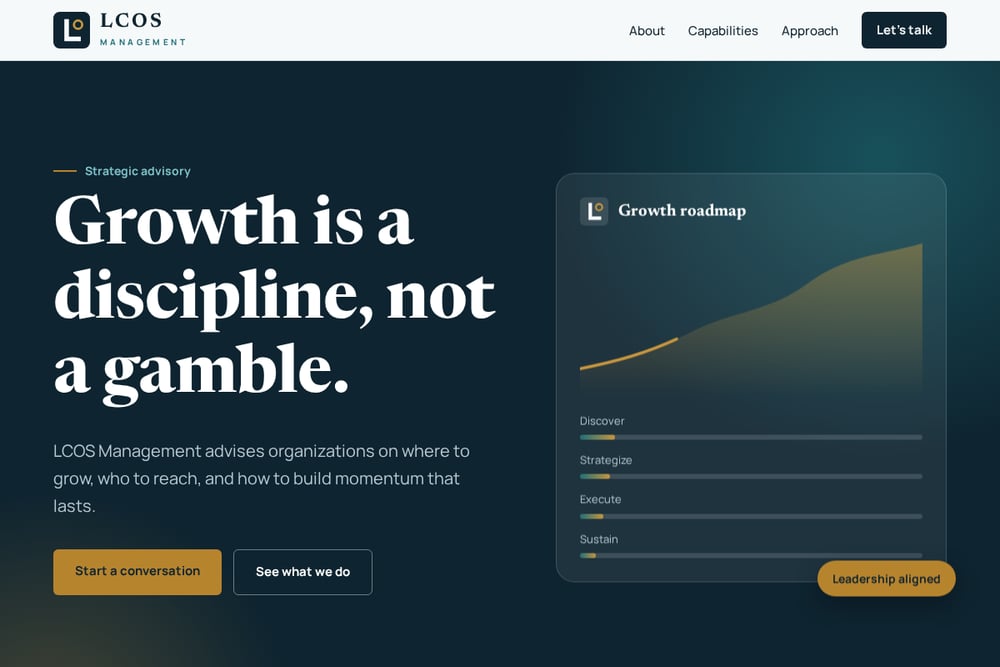 A screenshot of the LCOS Management website.
LCOS Management is a boutique strategic advisory firm built around a simple premise: growth is a discipline, not a gamble. The firm works alongside leadership teams to clarify direction, sharpen market positioning, and build the systems behind lasting growth. Its six focus areas, strategic growth planning, market intelligence, customer acquisition, outreach strategy, partnership development, and organizational alignment, work on their own or together, shaped around your market and your team. What sets the model apart is the refusal to offer templated solutions. Every recommendation is grounded in your market reality, your capacity, and your long-term vision, and the firm stays involved through execution so strategy turns into results. The growth roadmap runs from discover through strategize, execute, and sustain, which gives you a clear sense of what an engagement looks like from start to finish.
#3 Calibrate
 A screenshot of the Calibrate website.
Calibrate approaches growth strategy through the lens of firm leadership and long-term value. The firm helps leaders evaluate expansion opportunities, assess readiness, and prioritize where to invest based on strategy, market conditions, competitive positioning, and organizational capacity. Its advisory work sits alongside executive search, interim and fractional talent, and organizational performance services, which makes it a useful fit when growth depends on getting the right people in place. The framing is disciplined and intentional: which opportunities align with your strengths and your capacity to succeed? If you run a professional services firm or a similar people-driven business, that combination of strategy and talent is worth a conversation. The firm's growth strategy page lays out its evaluation approach in detail.
#4 Craig Group
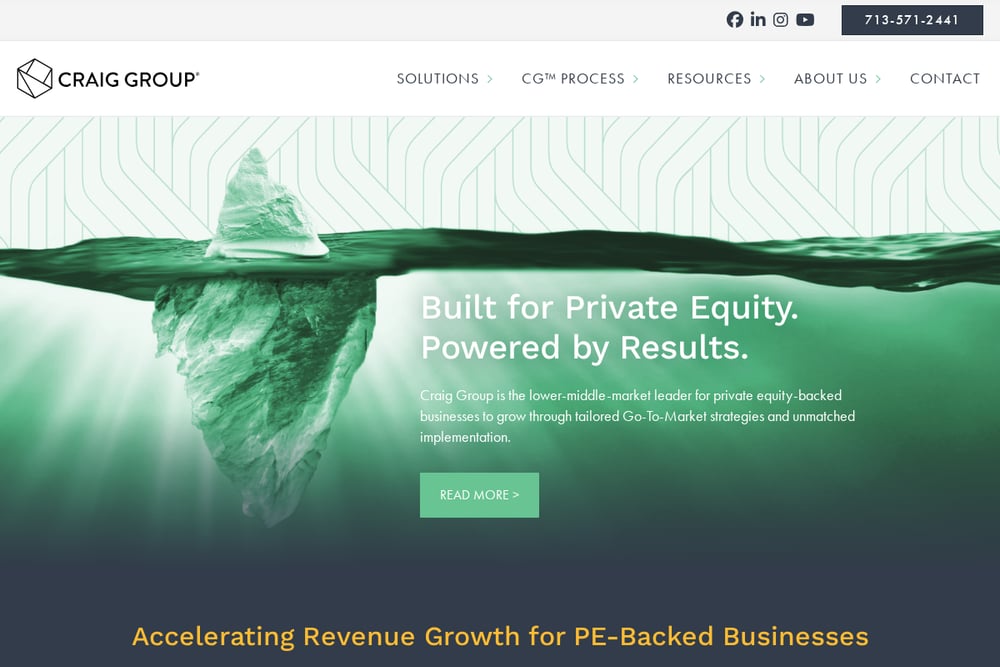 A screenshot of the Craig Group website.
Craig Group focuses on strategic growth alignment, bringing investors, management, and employees onto the same page around a clear roadmap of high-impact initiatives. The firm's operator background shows in its emphasis on measurable results within one to two quarters rather than long theoretical roadmaps. Its work spans go-to-market due diligence, exit-readiness assessment, sales improvement, and training, with a discover, launch, evaluate process behind it. That makes it a natural fit for private equity sponsors and executive teams who need to close the gap between growth expectations and actual execution capacity. If alignment is your bottleneck, this is a firm that treats it as the core problem rather than a side note. Its strategic growth alignment page explains the methodology.
#5 Stambaugh Ness
 A screenshot of the Stambaugh Ness website.
Stambaugh Ness brings strategic growth advisory to a defined vertical: architecture, engineering, and construction firms. The firm recognizes that many AEC firms lack dedicated marketing and business development resources on staff, and it builds anticipatory solutions delivered by industry experts who help implement and execute. Its growth paths include strategic planning, business development and marketing strategy, training and development, and performance improvement. That vertical focus means less time explaining your business and more time on the work itself. If you lead an AEC firm and want advisory that speaks your language, this is a strong place to start. The firm's strategic growth page outlines its service paths and benchmarking events.
How to Choose the Right Advisory Partner
Start with the shape of your problem. If you need analytical depth on a major market entry or capital decision, a large consultancy gives you the bench and the frameworks. If you need someone embedded with your leadership team, translating strategy into execution week by week, a boutique is often the better fit. Next, look at scope. Some firms stop at the strategy. Others stay through execution. LCOS Management, for example, explicitly frames its work as discover, strategize, execute, and sustain, which matters if your team has limited bandwidth to carry a plan forward alone. Then consider sector fit. Stambaugh Ness speaks the language of AEC firms. Craig Group is built around investor-backed companies. Calibrate pairs strategy with talent for people-driven firms. Ask about capacity, too. A growth plan that ignores your team's ability to execute is a plan that stalls. Finally, ask how the firm measures progress. The strongest partners define what success looks like early and check in against it. Match the firm to your reality, not to a brand name.
Where Automation Fits Into a Growth Engagement
Strategy still runs on judgment, but the execution layer benefits from automation. Here is a practical workflow you can run alongside an advisory engagement. First, consolidate market intelligence into a single source of truth so your team stops debating whose spreadsheet is current. Second, automate outreach sequencing so your message reaches the right level at the right time without manual chasing. Third, connect your CRM to reporting so acquisition performance is visible weekly rather than quarterly. Fourth, set up partnership pipeline tracking so introductions do not fall through the cracks. Fifth, build a simple alignment dashboard that shows whether strategy, structure, and culture are moving in the same direction. None of this replaces the advisory work. It makes the advisory work stick. When you evaluate a firm, ask how its recommendations will be operationalized and what systems will carry them after the engagement ends.
The Bottom Line
Growth advisory is not one product. L.E.K. Consulting gives you analytical depth for complex decisions. Calibrate connects growth strategy to talent and organizational readiness. Craig Group aligns investors and management around measurable initiatives. Stambaugh Ness brings vertical expertise to AEC firms. LCOS Management sits in the boutique lane, with six connected capabilities and a model built on staying involved through execution. The right choice depends on your size, your sector, and how much hands-on support you need. Pick the firm that matches your reality, define what success looks like up front, and make sure the plan can survive after the engagement ends.