Everyone wants an edge in the market, but few want to read ten filings to find it. These five platforms turn prediction into something you can actually see, score, and compare.
The State of Stock Prediction Tools
Stock prediction tools have split into a few clear camps. Some rank stocks with AI scores built on hundreds of factors. Some run trading robots and pattern engines on short time frames. Some let a crowd compete against an AI on public leaderboards. And some are prediction markets where you trade on the outcome of real-world events. What they share is a promise: turn noisy market data into a clearer signal. What separates them is transparency, time horizon, and whether the forecast comes from a model, a crowd, or a market price.
What I Looked At
I looked at the same factors across every platform. Service scope mattered, from single-score stock rankings to full robot libraries and event markets. Pricing clarity mattered, since some are free to join while others gate data behind subscriptions. Transparency mattered, meaning whether predictions and their accuracy are shown in public. Time horizon mattered, because a weekly forecast and a three-month ranking serve very different investors. Finally, output format mattered, whether you get a score, a probability, a pattern signal, or a market price. Each platform stood out on a different combination of these factors.
Here is the quick view. Each platform below approaches stock prediction from a different angle, from crowd-sourced forecasts to AI scoring models and event-driven markets. Scan the list, then dig into the details that match how you actually invest.
| Provider | Best For |
|---|---|
| Danelfin | AI-ranked stock picking over a three-month horizon |
| QPOS: Stock Market Prediction Platform, AI Bots and Crowd | Comparing crowd wisdom against AI forecasts |
| Tickeron | Pattern-based signals and AI trading robots |
| WallStreetZen | Simple buy, hold, or sell ratings on any stock |
| Polymarket | Trading on the outcome of real-world events |
A Closer Look at Each Prediction Platform
#1 Danelfin
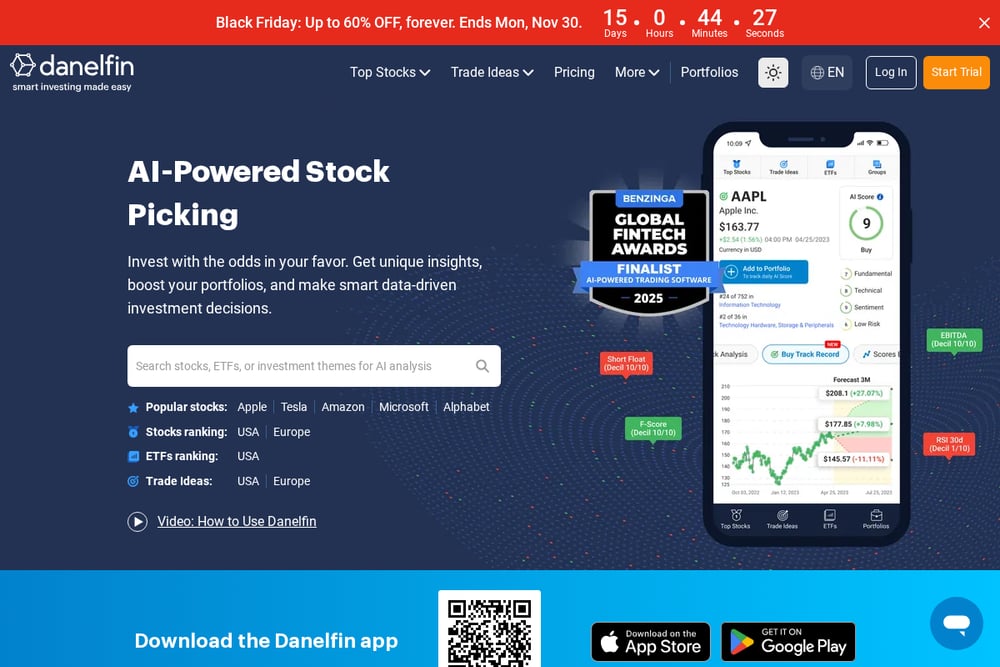 A screenshot of the Danelfin website.
Danelfin ranks thousands of US and European stocks and ETFs with an AI Score that estimates the probability of beating the market over the next three months. The score breaks down into fundamental, technical, sentiment, and low-risk components, so you can see why a stock lands where it does. You get screeners, trade ideas, sector and industry rankings, and portfolio tools in one place. The platform also publishes an AI Score audit and offers API and MCP access for builders. It is a strong fit if you want a single number to filter a large universe of stocks.
#2 QPOS: Stock Market Prediction Platform, AI Bots and Crowd
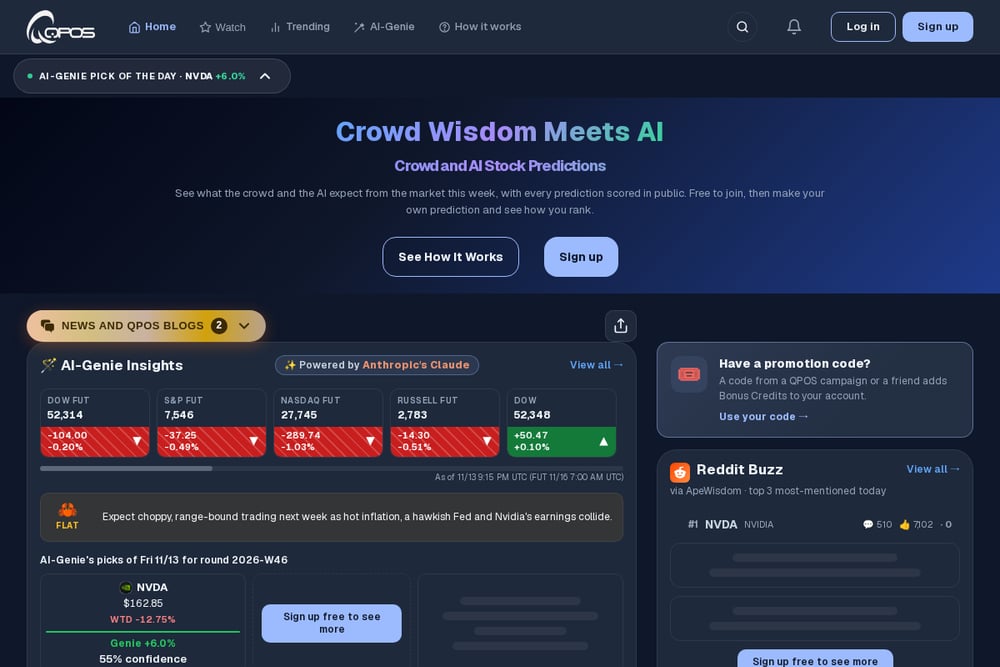 A screenshot of the QPOS: Stock Market Prediction Platform, AI Bots and Crowd website.
QPOS is a free platform where you make public stock predictions and get scored against both the crowd and an AI. The AI-Genie, powered by Anthropic's Claude, publishes daily picks and weekly market outlooks across indices, mega-caps, and macro assets like gold, oil, and bitcoin. You can see crowd accuracy and bot accuracy side by side, then make your own call and watch how you rank. With coverage of more than 750 stocks and a live leaderboard, it turns prediction into a public, accountable exercise. It is the most direct way to test whether you beat the machine.
#3 Tickeron
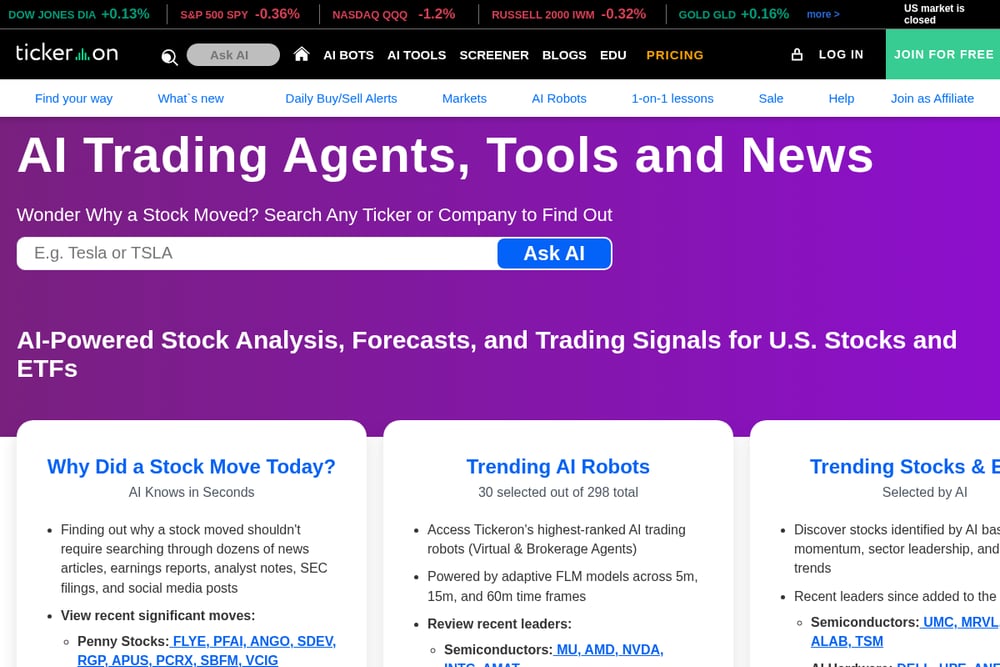 A screenshot of the Tickeron website.
Tickeron bundles a wide set of AI tools for stock forecasts, including a pattern search engine, a trend prediction engine, and a stock screener that returns entry and exit prices with confidence levels. It also runs a large library of AI trading robots across multiple time frames, which you can review and follow. A standout feature answers the simple but useful question of why a stock moved today, pulling the explanation in seconds. The breadth is impressive, though the volume of tools means a learning curve. It suits traders who want short-term, pattern-driven signals rather than long-horizon rankings.
#4 WallStreetZen
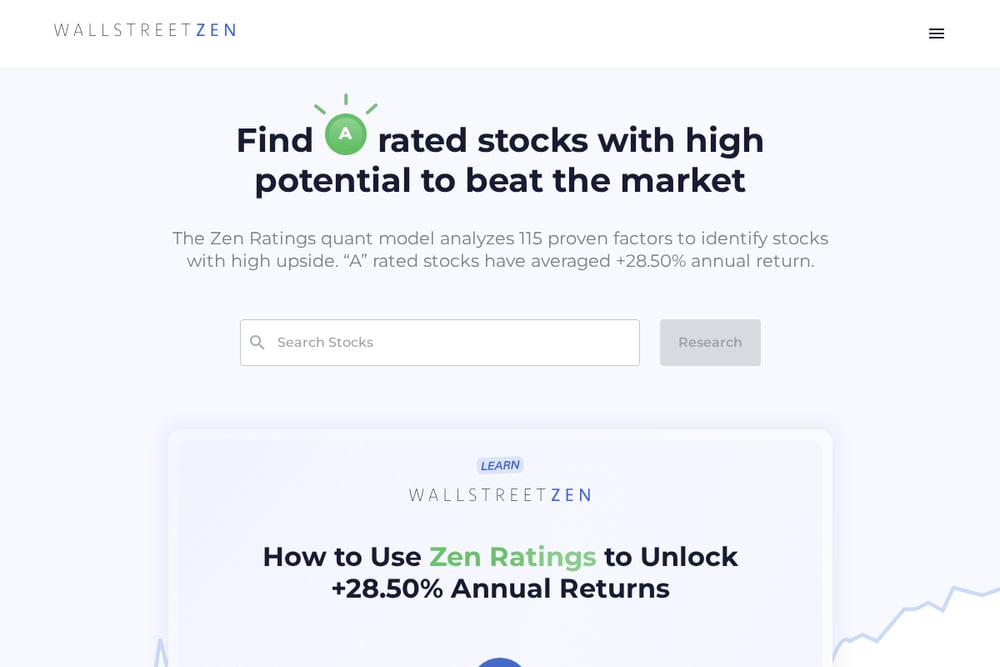 A screenshot of the WallStreetZen website.
WallStreetZen takes a quant approach, scoring every stock with a Zen Rating built from 115 proven factors. The rating maps to a plain recommendation, from Strong Buy to Strong Sell, and the site publishes historical performance for each grade. You also get screeners, industry rankings, analyst views, and weekly stocks-to-watch writeups. The framing is aimed at the serious part-time investor who wants a clear answer without building a model. It is a clean entry point if you prefer a letter grade over a probability.
#5 Polymarket
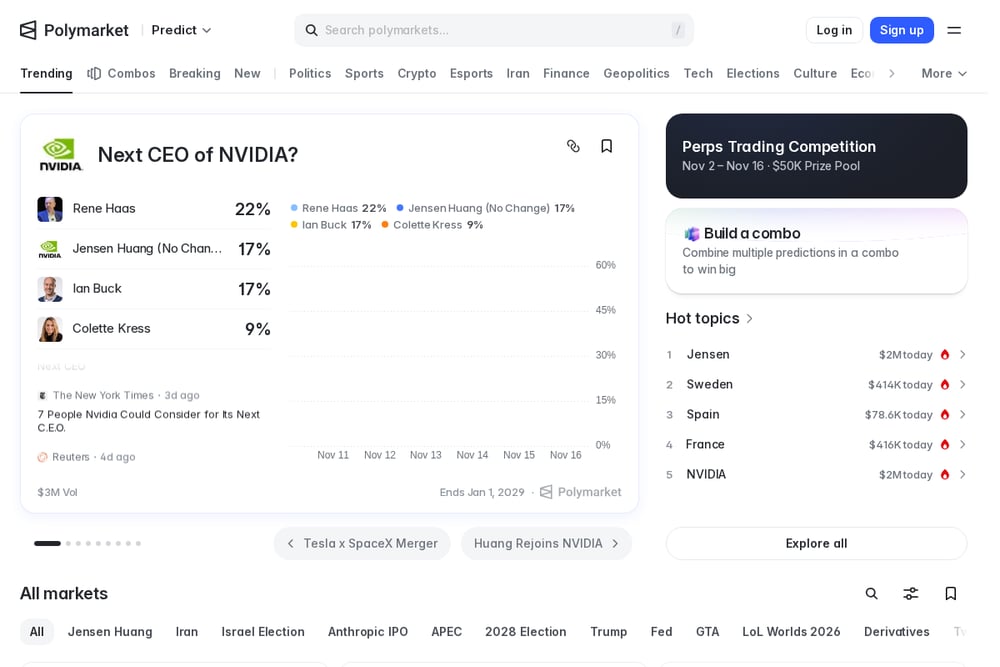 A screenshot of the Polymarket website.
Polymarket is a prediction market where prices reflect what traders collectively believe about future events, from Fed decisions to earnings and beyond. Instead of a forecast handed to you, you see live probabilities backed by real money and volume. The finance and economy sections cover the macro questions that move markets, which makes it a useful sentiment gauge alongside traditional tools. It is a different animal from a stock picker, but the crowd-sourced pricing is a powerful signal in its own right. Use it to sense where the market's expectations actually sit.
How to Pick the Right Platform for You
Start with your time horizon. If you trade weekly and want a scoreboard, look at crowd-versus-AI platforms. If you hold for months, favor tools with a longer evaluation window. Next, check transparency. Can you see how predictions are scored, and are results public? Then look at cost. Several of these are free to join, while others gate the deeper data behind a subscription. Finally, match the output to your style. Some tools give you a single score, others give you probabilities, and others give you pattern-based entry and exit levels. Choose the format you will actually use.
How Prediction Platforms Automate Your Research
Most of these tools follow a similar loop. First, data flows in from prices, fundamentals, news, and sentiment. Second, a model or a crowd turns that data into a score, forecast, or probability. Third, the output gets ranked or scored in public so you can see how it performs over time. Fourth, you get alerts, dashboards, or weekly outlooks that translate the signal into something actionable. The difference between platforms is mostly in step two, where some lean on AI models and others lean on collective human judgment.
Putting It All Together
There is no single winner here because each platform answers a different question. QPOS asks what the crowd and an AI think will happen next week. Danelfin asks which stocks are most likely to beat the market over three months. Tickeron asks what the patterns and robots say about a specific ticker. WallStreetZen asks whether a stock is a buy based on a broad factor model. Polymarket asks what the world believes about a future event. Pick the question you care about most, and the right platform becomes obvious.