Most people learn the stock market by watching videos and nodding along, then freezing when a real number appears on screen. These five platforms flip that by making you do the math yourself.
Where stock education is heading
Stock market education has split into two camps: simulators that hand you a virtual $100,000 and let you trade, and lesson-based tools that drill the underlying math. Simulators build comfort with order tickets and portfolio swings. Drill-based tools build the numeracy that tells you whether a price is sane. The strongest programs now blend both, and the weakest still confuse watching with learning.
How these platforms were compared
Each platform was weighed on four things: whether you actually practice rather than passively consume, how real the underlying data is, how much you can do before paying or registering, and how clearly the pricing and sign-up path is explained. Depth of coverage across valuation, margins, and dividends also counted, along with how quickly a beginner can get to a first completed exercise.
Here is the short version before the detail. The list runs from the most hands-on, number-driven option to the broadest classroom-style programs, so you can match the format to how you actually learn.
| Provider | Best For |
|---|---|
| StockTrak | Classrooms and serious simulator practice |
| Stock Exercises · Learn the stock market with hands-on exercises | Beginners who want to practice real numbers |
| Wall Street Survivor | Learning through contests and courses |
| The Stock Market Game | Structured classroom and group learning |
| Investing 101 | Self-paced beginners who want a full course |
The five platforms in detail
#1 StockTrak
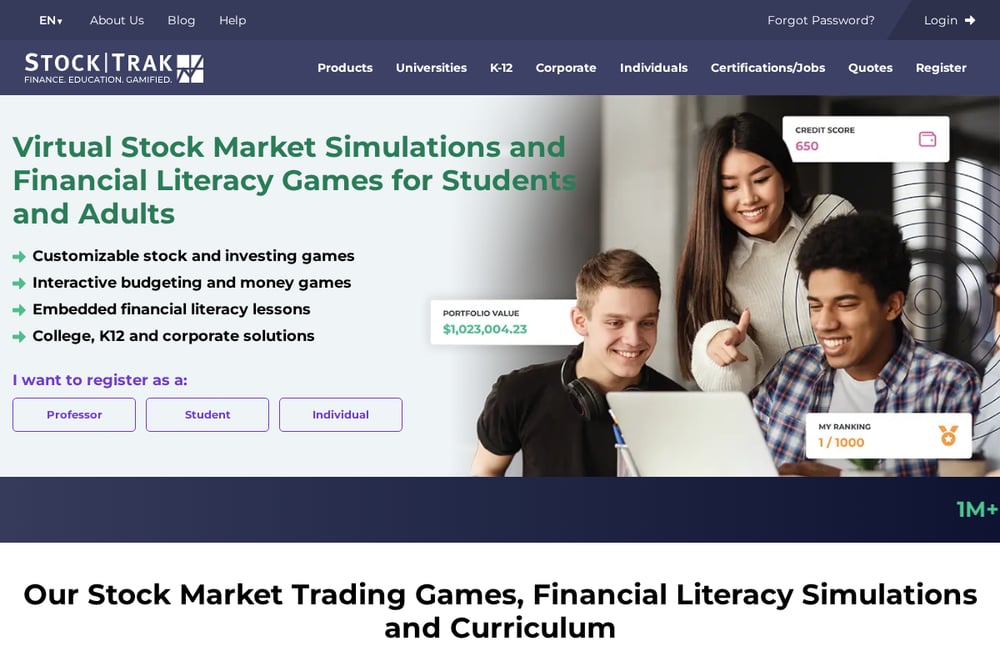 A screenshot of the StockTrak website.
StockTrak is the heavyweight option for anyone who wants a full trading simulation with real market mechanics behind it. You get quotes, interactive charts, option chains, key ratios, earnings, financial statements, and SEC filings in one place, so the research you do inside the platform mirrors what a real investor does. It also runs budgeting games and financial literacy curricula, which makes it a common pick for university finance faculty and K-12 programs. The trade-off is scope: there is a lot here, and a total beginner may need guidance to know where to start. Pricing runs through site licenses and institutional plans rather than a simple consumer checkout.
#2 Stock Exercises · Learn the stock market with hands-on exercises
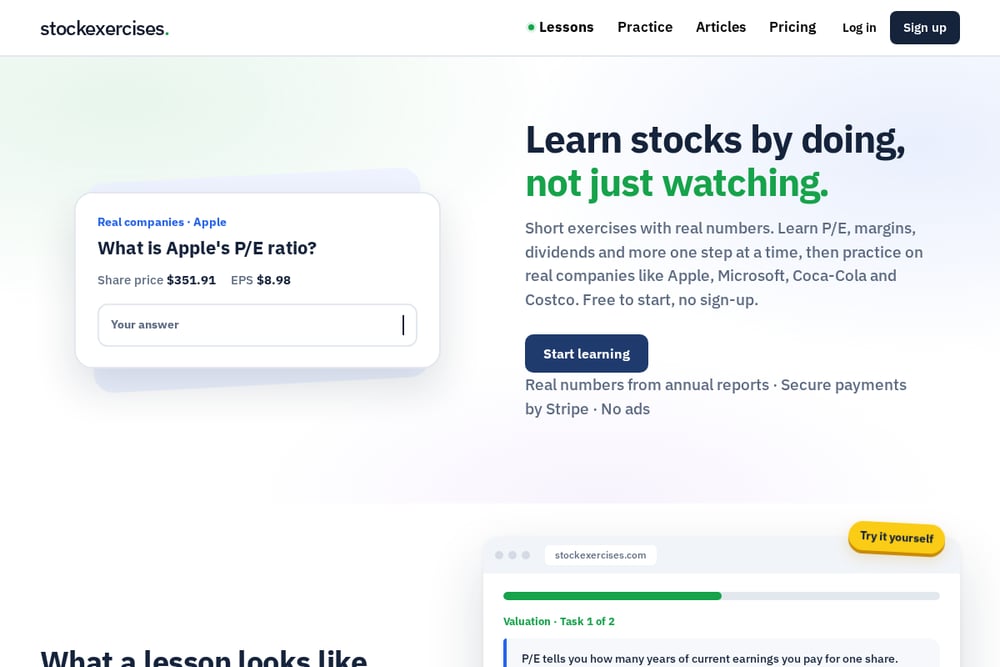 A screenshot of the Stock Exercises · Learn the stock market with hands-on exercises website.
Stock Exercises takes the opposite approach to a simulator: instead of trading, you calculate. Each lesson is two or three short tasks where you read a two-line explanation, work the answer with a built-in calculator, and find out immediately whether you got it. The numbers come from real annual reports, so you practice P/E on Apple at 39.2, margins on Microsoft at 40.3%, dividend yield and payout on Coca-Cola, and a 53.5 P/E on Costco. You can start free with no sign-up, and the quarterly reports refresh each earnings season so the figures stay current. It is the fastest path from watching to doing, and the Costco example alone shows why the math matters.
#3 Wall Street Survivor
 A screenshot of the Wall Street Survivor website.
Wall Street Survivor pairs a free stock market game with a structured course library, so you can learn a concept and then test it in a contest. The site covers beginner investing, dividend and value strategies, and how to read stock charts, with a steady stream of starter guides alongside the trading game. Contests and cash prizes add a competitive pull that keeps people coming back after the novelty wears off. It leans more toward trading activity than deep valuation math, so treat it as a bridge between curiosity and practice. Much of the core content is free, with reviews and tool recommendations layered on top.
#4 The Stock Market Game
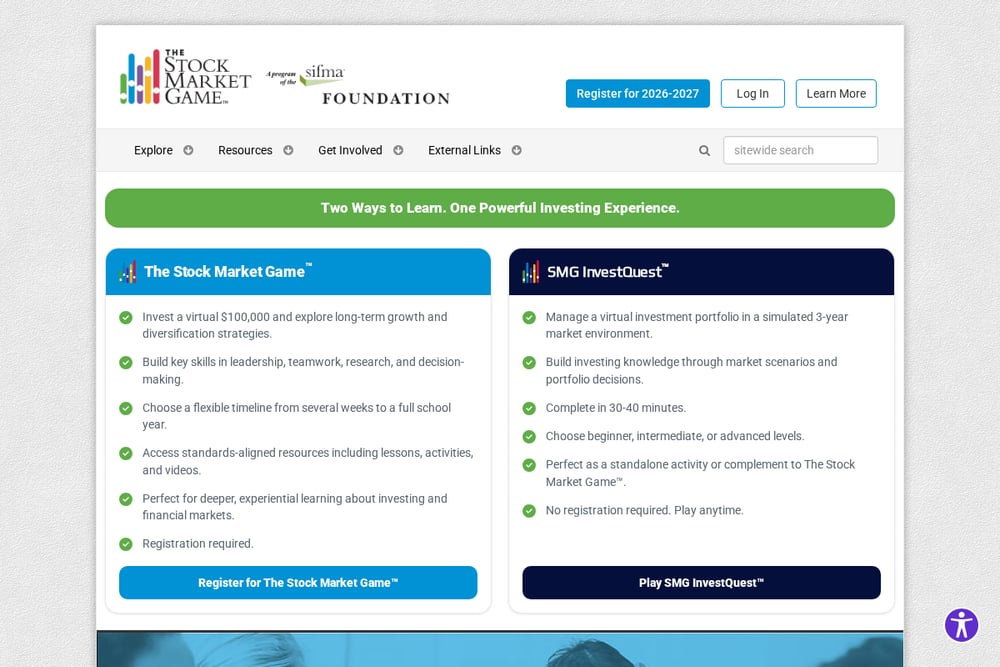 A screenshot of The Stock Market Game website.
The Stock Market Game, run by the SIFMA Foundation, gives participants a virtual $100,000 to invest across stocks, bonds, and mutual funds on the NYSE and Nasdaq. It is built for classrooms, with teacher support, standards-aligned lessons, and flexible timelines running from a few weeks to a full school year. The companion InvestQuest offers a 30-to-40-minute simulated three-year market at beginner, intermediate, or advanced levels with no registration required. Registration is needed for the main game, which makes it less of a drop-in tool for solo learners. If you are learning with a group or a teacher, though, the structure is hard to beat.
#5 Investing 101
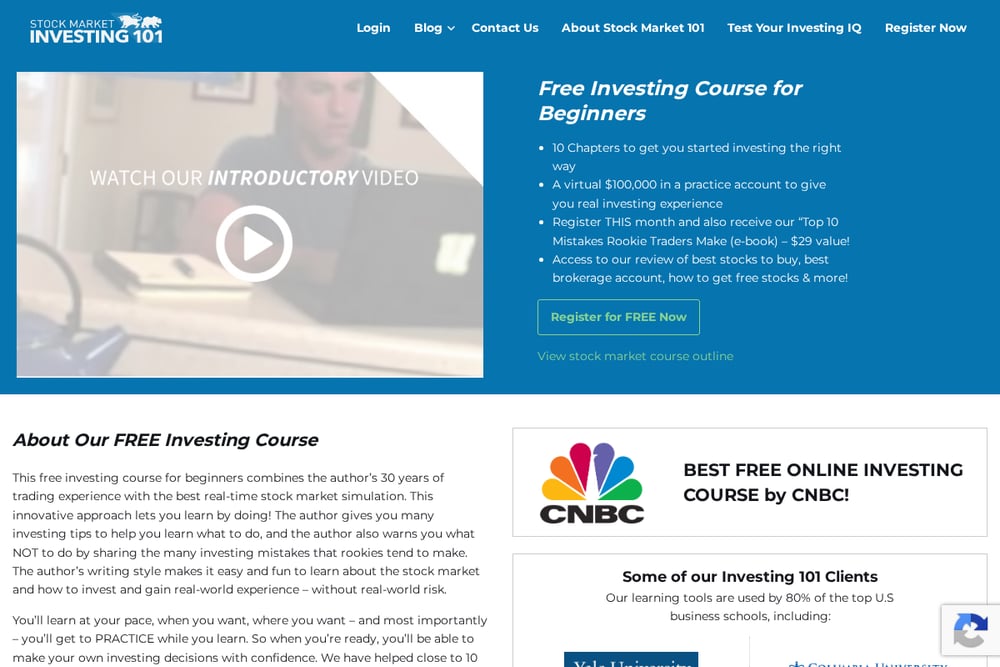 A screenshot of the Investing 101 website.
Investing 101 is a free ten-chapter beginner course wrapped around a practice account stocked with a virtual $100,000. The author draws on decades of trading experience and spends real time on the mistakes rookies make, which is often more useful than another explanation of what a stock is. You work at your own pace, and the course is aimed at everyone from college students to people near retirement. It is broader and more narrative than a drill tool, so you get context and caution rather than repetitive calculation. Registration is required to access the course and practice account.
Picking the right fit
Ask yourself one question first: do you want to trade or do you want to calculate? If you freeze when someone says P/E, start with a drill-based tool and build the numeracy before you touch a simulator. If you already understand the ratios and want to feel how a portfolio moves, a simulator gives you that reps. If you are learning with a class or a group, pick the platform built for teachers. And check the sign-up path early, because friction is what kills most learning streaks in week one.
Building a practice habit that sticks
Set a repeating 15-minute block two or three times a week and treat it like brushing your teeth. Open one lesson, do the tasks by hand with the calculator, and write the answer down before you check it, because guessing teaches you nothing. Keep a simple spreadsheet of the companies you have worked through, with their P/E, margin, and yield, and update it each earnings season when new reports land. Once a month, pick one stock you actually care about and run the same math on it cold. That loop, short reps plus quarterly refreshes, is what turns a few exercises into real fluency.
The bottom line
You do not need a virtual fortune to learn investing. You need to work real numbers until they stop being intimidating. Stock Exercises is the sharpest tool for that specific job, StockTrak and The Stock Market Game carry the classroom load, Wall Street Survivor adds competition, and Investing 101 gives you the long-form foundation. Pick the format that matches where you are today, then show up for the reps.