Your kid can name every dinosaur but still thinks money grows on trees. These five investing games fix that, one virtual trade at a time.
Where financial literacy meets play
Kids learn money the way they learn everything else: by touching it. That is why stock market simulators have quietly become a staple of classrooms, homeschool co-ops and kitchen-table conversations across the US. The pitch is simple. Give a child virtual cash, show them real prices, and let them feel the small sting of a bad pick without losing a dollar.
The category splits into two camps. On one side sit school-first platforms built for teachers, with lesson plans, contest dashboards and semester-long timelines. On the other sit consumer products aimed at parents and kids, often with characters, stories and gamified rewards. Both work. The right choice depends on who is actually holding the mouse.
What unites the field is a shared belief: compound interest is easier to understand at ten than at forty. The tools below take different routes to that same lesson.
How we looked at these platforms
We judged every platform on the same four factors. First, age fit: does the language, design and pacing suit the kids it claims to serve? Second, learning depth: does it teach why a company grows, or just how to click buy? Third, access: can you start without a credit card, a school account or a teacher's approval? Fourth, adult support: are there materials for parents and educators, or does the child play alone?
KapiMoni stood out for pairing company stories with a practice portfolio and a no-sign-up entry point. The Stock Market Game stood out for its classroom infrastructure and standards-aligned curriculum. KidVestors stood out for tying lessons to virtual currency and real-stock milestones. HowTheMarketWorks stood out for teacher-created contests with live market data. Build Your Stax stood out for compressing two decades of investing into a fast, replayable session.
No single factor decides it. A parent homeschooling one child has different needs than a teacher running five classes.
Here is the short version before the detail. Each platform below earns its place for a different reason, so scan the one-line summaries and jump to the entry that matches your situation.
| Provider | Best For |
|---|---|
| The Stock Market Game | Classroom teachers who need curriculum and reporting |
| KapiMoni · From learning to count to their first real investment | Parents and kids ages 10 to 15 learning side by side |
| KidVestors Stock Market Simulator Game | Families who want lessons plus real-stock rewards |
| HowTheMarketWorks | Budget-conscious teachers who want live market data |
| Build Your Stax | A quick, replayable intro to growing wealth over time |
The five platforms in detail
#1 The Stock Market Game
 A screenshot of the The Stock Market Game website.
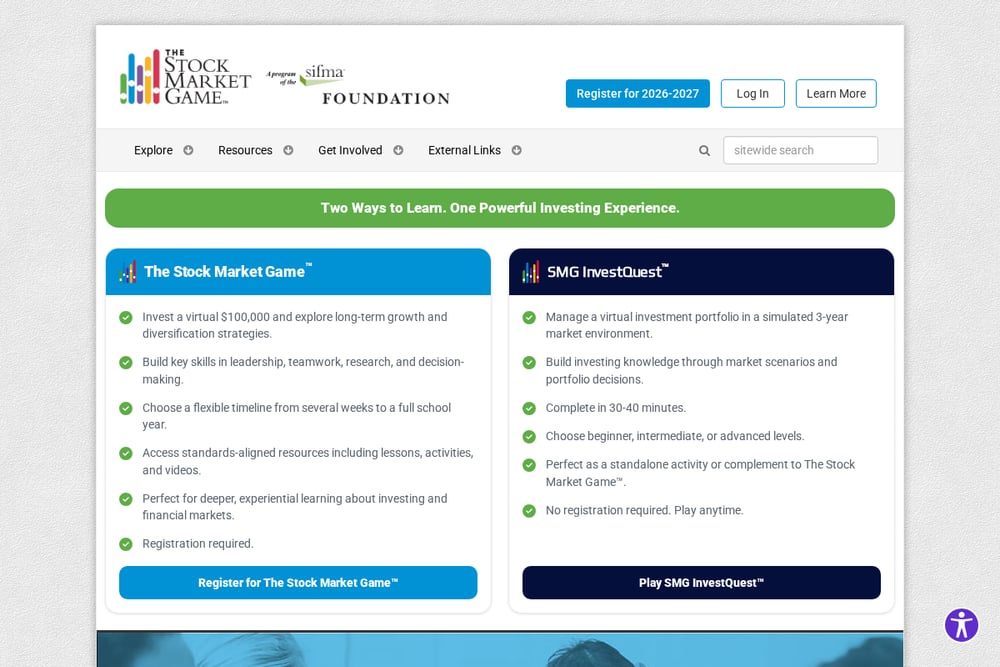
Run by the SIFMA Foundation, this is the granddaddy of classroom investing simulations. Students invest a virtual $100,000 and track how market events move their portfolio over weeks or a full school year. Teachers get standards-aligned lessons, activities and videos, plus a support center built for educators rather than parents. The companion InvestQuest offers a 30-to-40-minute scenario-based session with beginner, intermediate and advanced levels and no registration. If you are a teacher who needs structure, reporting and a proven curriculum, this is the most complete package in the category. Registration is required for the main game, so plan ahead for the 2026-2027 cycle.
#2 KapiMoni · From learning to count to their first real investment
 A screenshot of the KapiMoni · From learning to count to their first real investment website.
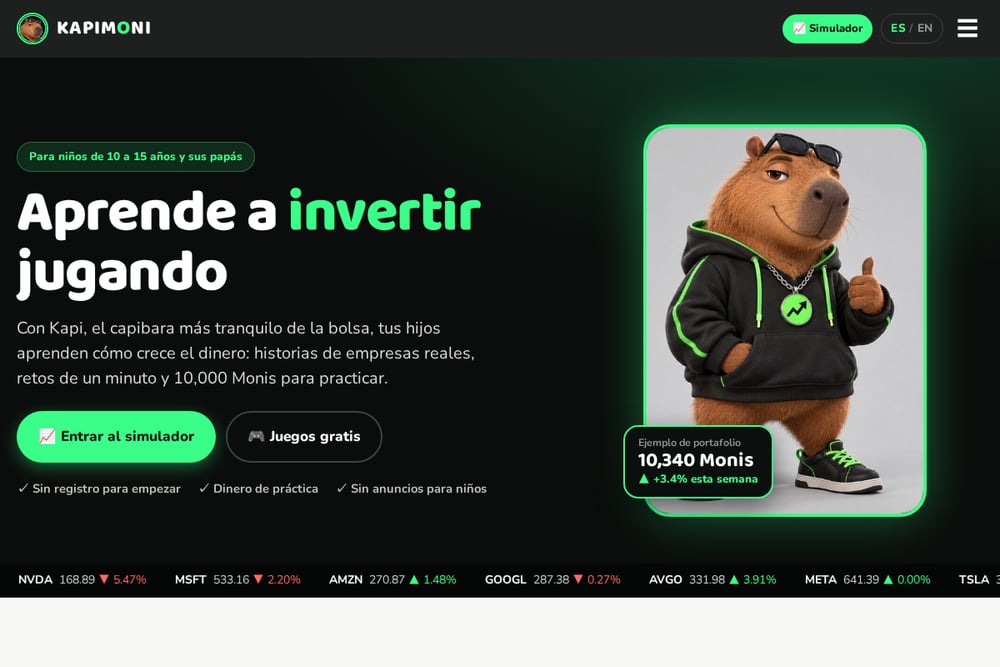
KapiMoni takes a story-first approach for kids ages 10 to 15 and their parents. Kapi, a calm capybara, narrates episodes about companies kids already know, from Disney to Coca-Cola to SpaceX, so the investing idea lands before the ticker symbol does. Players then get 10,000 Monis, where one Moni equals one practice dollar, and buy tiny pieces of real companies at real prices. A question appears before each purchase, which turns every trade into a one-minute lesson. You can start free with no sign-up, there are no ads for kids, and the site includes books, a compare tool and leagues. It is the gentlest on-ramp here for a parent and child exploring together.
#3 KidVestors Stock Market Simulator Game
 A screenshot of the KidVestors Stock Market Simulator Game website.
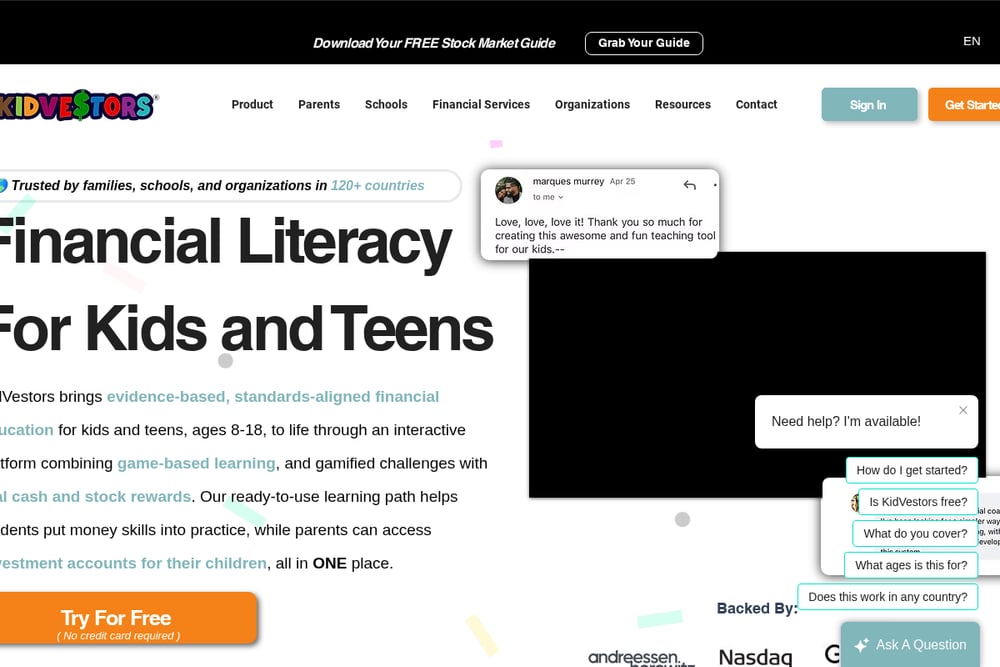
KidVestors wraps paper trading in a reward loop. Students complete financial education lessons, earn up to 10,000 KV Bucks per lesson, transfer those bucks into a virtual brokerage account and start trading. The twist is the milestone system: meet your goals and you can earn real stock. Live market data and access to global exchanges give the simulation a realistic feel, and the platform serves parents, schools and homeschool families with a curriculum track. There is a free trial with no credit card required. It suits families who want a structured lesson path with a tangible incentive at the end.
#4 HowTheMarketWorks
 A screenshot of the HowTheMarketWorks website.
HowTheMarketWorks is the free option that punches above its price. Teachers create a private contest in under ten minutes, setting dates, starting cash, commissions and custom trading rules. Students begin with $100,000 in virtual cash and trade stocks, ETFs, bonds and mutual funds using real-time prices. Built-in lessons, teacher dashboards and assignment tools make it easy to run across multiple classes or grade levels. The site reports use by more than 10,000 teachers and 475,000 students each year. If budget is the deciding factor and you want live data, this is the practical pick.
#5 Build Your Stax
 A screenshot of the Build Your Stax website.
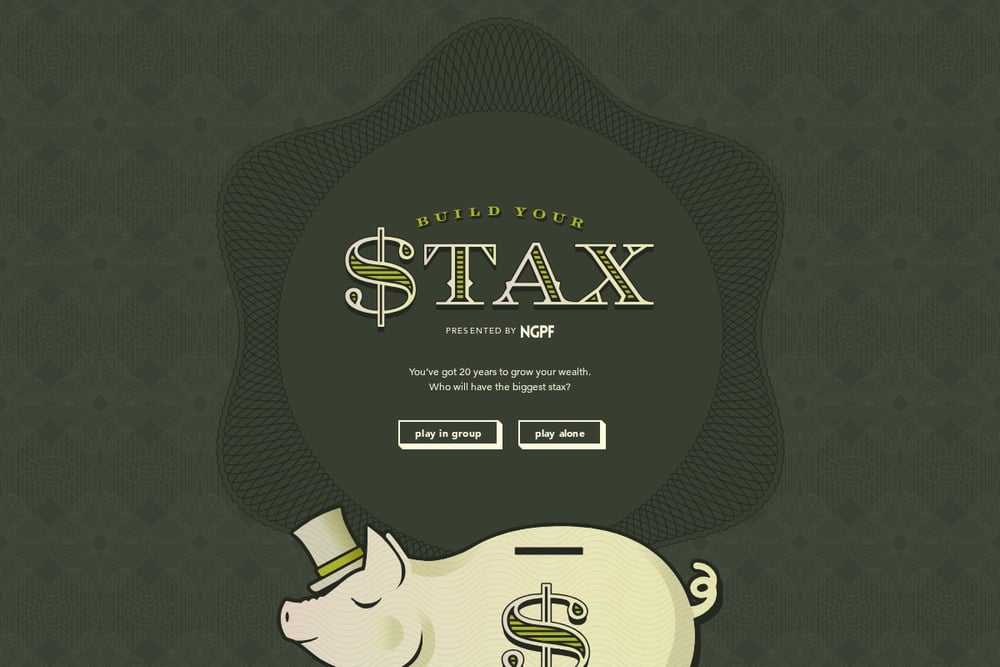
Build Your Stax strips investing down to a single question: who ends up with the biggest stack? You get 20 years of simulated time to grow your wealth, making choices about saving, spending and investing along the way. Sessions are short and replayable, which makes it a strong warm-up activity rather than a full curriculum. You can play alone or in a group, so it works for a family game night or a classroom opener. It will not teach a child to read a balance sheet, but it will teach them that time and consistency matter. Think of it as the hook that gets them curious about the deeper tools above.
How to pick the right one for your kid
Start with who is running the show. If you are a teacher, prioritize platforms with lesson plans, contest controls and reporting. The Stock Market Game and HowTheMarketWorks were built for exactly that. If you are a parent, look for something a child can open without a class code. KapiMoni's no-sign-up start and story-driven episodes fit that gap well.
Next, decide how much realism you want. Live prices and global exchanges feel exciting but can overwhelm a ten-year-old. A practice currency with a fixed universe of companies keeps the focus on the lesson. Ask yourself whether your child needs guardrails or a full sandbox.
Then check the incentive structure. Some kids respond to leagues and milestones, others just want the story. KidVestors leans on rewards, Build Your Stax leans on competition, and KapiMoni leans on narrative. Match the motivator to the kid, not the other way around.
Finally, test before you commit. Most of these platforms offer a free entry point. Spend one evening with two of them and watch which one your child asks to reopen.
A simple weekly routine that makes it stick
Pick one platform and block 20 minutes a week. Week one, read or listen to a single company story together and ask your child why that company makes money. Week two, make one practice trade and review the question that came before it. Week three, compare two companies in the same industry and talk about why one might grow faster. Week four, review the portfolio and name one thing that went right and one that went wrong. Repeat. The routine matters more than the platform.
The bottom line
Every platform here teaches the same core idea: money grows when you understand what you own. The Stock Market Game gives teachers the most complete classroom toolkit. KapiMoni gives parents the friendliest starting line, with stories, a capybara and 10,000 practice Monis. KidVestors adds real-stock rewards, HowTheMarketWorks keeps it free with live data, and Build Your Stax makes the first lesson fast and fun.
You do not need all five. You need one your child will actually open again next week. Start free, keep it short, and let curiosity do the rest.