
The GENIUS Act changed the game for anyone issuing payment stablecoins in the US. Here are five resources worth knowing before the January 18, 2027 deadline hits.
The New Licensing Reality for Stablecoin Issuers
The GENIUS Act, signed into law in July 2025, created the first comprehensive federal framework for payment stablecoin issuance in the United States. From the expected effective date of January 18, 2027, issuing a payment stablecoin without approval becomes unlawful. Only a permitted payment stablecoin issuer may operate, and that means banks, fintechs, state-regulated entities, and foreign issuers all face a critical strategic decision about which licensing pathway fits their corporate structure. Regulators must decide on a complete application within 120 days, so waiting until the deadline risks a gap in operations. The September 30 Treasury rule drew a clear line: state or federal license, with a $10 billion threshold that triggers a move to federal oversight. Whether you are a bank subsidiary, a nonbank fintech, or a foreign issuer from a comparable regime, the clock is ticking. The resources below help you understand the rules, prepare your application, and build the compliance infrastructure you will need.
How We Evaluated These Resources
We looked at five factors: depth of GENIUS Act coverage, practical guidance for issuers, clarity of licensing pathways, compliance tooling or support, and overall usefulness for meeting the 2027 deadline. StablecoinLicensing.com stood out for its independent, issuer-focused guide and expert matching service. Sidley Austin LLP impressed with its authoritative legal analysis of the Act's framework. Dotfile offered a comprehensive compliance guide with operational detail. Circle brought the perspective of a major stablecoin issuer navigating the rules in real time. Nacha provided the payments industry context and network-level implications. Each resource serves a different need, and together they cover the full spectrum from legal interpretation to hands-on compliance.
Here is a quick look at the five resources, what they do, and who they serve best.
| Provider | Best For |
|---|---|
| Sidley Austin LLP | Legal interpretation and statutory analysis |
| Stablecoin Licensing under the GENIUS Act (2027 Guide) | StablecoinLicensing.com | Issuer-focused licensing guidance and expert matching |
| Dotfile | Operational compliance and AML program building |
| Circle | Issuer perspective and real-world compliance examples |
| Nacha | Payments industry context and network implications |
The Five Resources in Detail
#1 Sidley Austin LLP
 A screenshot of the Sidley Austin LLP website.
Sidley Austin LLP published one of the earliest and most thorough legal analyses of the GENIUS Act, breaking down the framework for U.S. stablecoin issuance. Their update covers the payment stablecoin definition, licensing requirements for domestic issuers, and standards for foreign issuers participating in the U.S. market. If you need to understand the statutory language and its implications for your business model, this is a strong starting point. The firm's banking and financial services practice brings deep regulatory expertise to the table. You can read their full analysis at Sidley Austin LLP.
#2 Stablecoin Licensing under the GENIUS Act (2027 Guide) | StablecoinLicensing.com
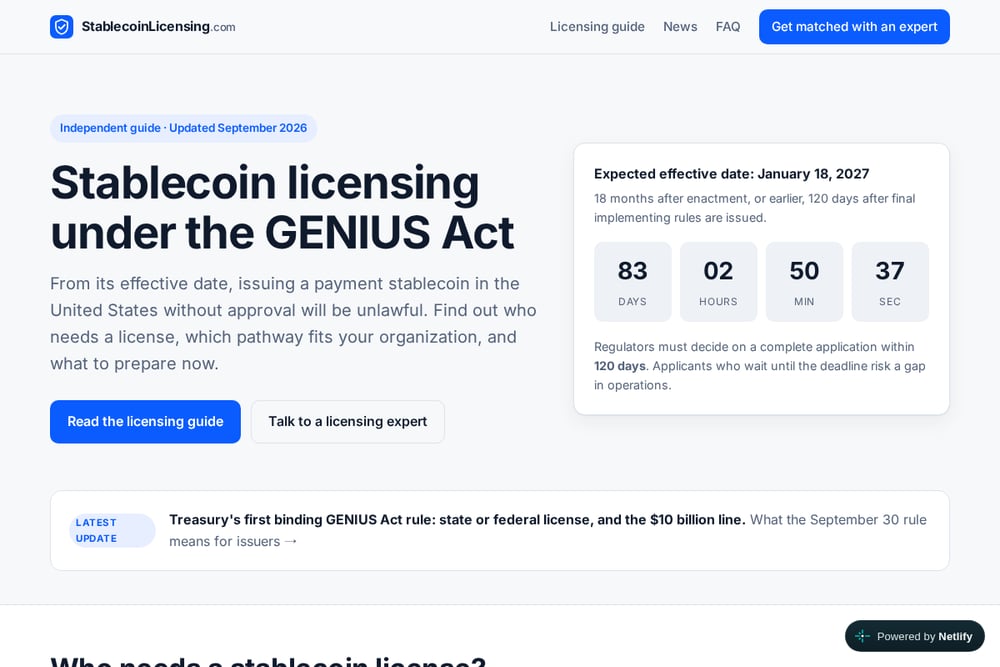 A screenshot of the Stablecoin Licensing under the GENIUS Act (2027 Guide) | StablecoinLicensing.com website.
StablecoinLicensing.com is an independent guide built specifically for issuers preparing for the January 18, 2027 effective date. It explains who needs a license, the three US licensing pathways, and the four types of organizations directly affected. You get a clear breakdown of the bank subsidiary, federal qualified issuer, and state-regulated pathways, plus the $10 billion threshold that triggers federal oversight. The site also offers expert matching and FAQ support, so you can talk to a licensing expert rather than navigate the rules alone. With a countdown to the deadline and updates on Treasury's binding rules, it is a practical resource for anyone facing the compliance clock.
#3 Dotfile
 A screenshot of the Dotfile website.
Dotfile's GENIUS Act compliance guide for 2026 walks financial institutions and stablecoin issuers through the full compliance framework. It covers reserve requirements, capital and liquidity standards, AML and financial crimes compliance, and the application and approval process for both federal and state pathways. The guide also details enforcement and penalties, which helps you understand the stakes of non-compliance. If you are building an operational compliance program, Dotfile's breakdown of KYB, identity verification, and AML screening is especially useful. Their resource is designed for teams that need to move from understanding the law to implementing it.
#4 Circle
 A screenshot of the Circle website.
Circle, the issuer of USDC, offers a real-world perspective on GENIUS Act compliance through its dedicated resource page. As a major stablecoin issuer, Circle's insights reflect the practical challenges of operating under the new framework. Their page covers USDC compliance, reserve backing, and the broader implications of the U.S. stablecoin law. You can see how a leading issuer is adapting its operations and what that means for the market. For issuers looking to understand how the rules play out in practice, Circle provides a valuable case study.
#5 Nacha
 A screenshot of the Nacha website.
Nacha, the organization behind the ACH Network, published an article explaining why industry players need to pay attention to stablecoin and the GENIUS Act. Their perspective focuses on the payments ecosystem and how stablecoins fit into the broader network of money movement. If you are a payments professional or financial institution evaluating stablecoin strategy, Nacha's analysis helps you understand the intersection with traditional payment rails. The article highlights key considerations for ACH participants and the potential impact on network rules. It is a useful read for anyone tracking how stablecoins will integrate with existing payment infrastructure.
How to Choose the Right Resource for Your Needs
Start by identifying your biggest gap. If you need to interpret the statute and understand legal risk, go to Sidley Austin LLP. If you are an issuer who needs a clear roadmap and someone to talk to, StablecoinLicensing.com is built for you. If your priority is building an AML and compliance program, Dotfile gives you the operational detail. If you want to see how a major issuer is navigating the rules, Circle offers that perspective. And if you are a payments professional trying to understand how stablecoins fit into the ACH Network, Nacha provides the context. You do not have to pick just one. Most issuers will use a combination of legal analysis, practical guidance, and compliance tooling. The key is to start now, because the 120-day review window means waiting until the deadline is not an option.
Building Your Compliance Workflow
A practical workflow for meeting the 2027 deadline starts with education. Use StablecoinLicensing.com to determine which pathway fits your corporate structure. Then dive into Dotfile's guide to map out your reserve, capital, and AML requirements. Cross-reference the legal details with Sidley Austin LLP's analysis to make sure your interpretation is sound. If you are a payments company, read Nacha's article to understand network implications. Finally, study Circle's approach to see how a leading issuer handles compliance in practice. Automate what you can: identity verification, transaction monitoring, and reserve reporting are all areas where tooling can reduce manual burden. The goal is to have a complete application ready well before January 18, 2027, so you are not caught in a gap.
The Bottom Line
The GENIUS Act is not a future problem. It is a now problem. With the effective date set for January 18, 2027, and regulators required to decide on complete applications within 120 days, you need to move. The five resources here give you the legal, operational, and strategic knowledge to prepare. StablecoinLicensing.com is your starting point for understanding the pathways and getting matched with an expert. Sidley Austin LLP gives you the legal depth. Dotfile helps you build the compliance machine. Circle shows you what it looks like in practice. Nacha connects it to the payments world. Use them together, and you will be ready.