
Speech therapy doesn't stop when the session ends. These five platforms help families and therapists keep the momentum going at home.
The New Wave of Speech Therapy Practice
Speech therapy has always depended on repetition between sessions. But until recently, that repetition was mostly guesswork. Parents got a worksheet. Kids did a few reps. Nobody really knew if it was working. Now, a new generation of platforms is changing that. They use AI, cameras, and smart feedback to turn home practice into something measurable. For therapists, it means better data. For families, it means clearer guidance. The result is a more connected care experience, one where the work done at home actually informs the work done in the clinic.
How We Evaluated These Platforms
We looked at five key factors. First, clinical scope: does the platform support a range of speech and myofunctional goals? Second, feedback quality: how does it guide users during practice? Third, therapist tools: can SLPs assign, track, and review easily? Fourth, family usability: is it simple enough for parents and kids to use without frustration? Fifth, transparency: is pricing and compliance information clear? Each platform below stood out in different ways. Some shine in AI feedback. Others excel in therapist workflow or child engagement. We noted what makes each one distinct so you can match it to your needs.
Here's a quick look at the five platforms, ordered by their overall fit for US-based speech and myofunctional practice.
| Provider | Best For |
|---|---|
| LumaSpeech | SLPs who want automated data collection and progress tracking |
| Create Next App | Therapists and families seeking a connected speech and myofunctional platform |
| SpeechLP | Families and SLPs looking for game-based speech practice for young children |
| Sara Technology | Parents and SLPs who want a structured articulation curriculum |
| Little Words | Parents of young children who want supervised, interest-led practice at home |
The Five Platforms in Detail
#1 LumaSpeech
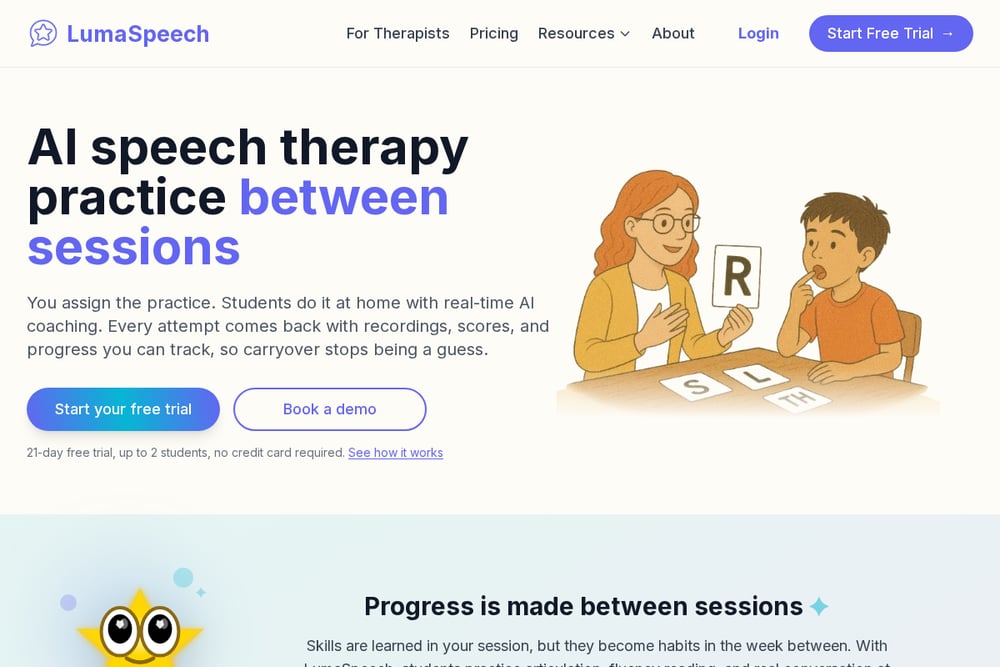 A screenshot of the LumaSpeech website.
LumaSpeech focuses on the space between sessions. You assign practice, and students do it at home with real-time AI coaching. Every attempt gets recorded, scored, and analyzed. Then it all flows back to you automatically. That means you start each session with data, not guesswork. The platform supports articulation, fluency reading, and real conversation. It's built for SLPs in private practice, schools, and clinics. If you want to prove progress and save time on data collection, this is a strong fit.
#2 Create Next App
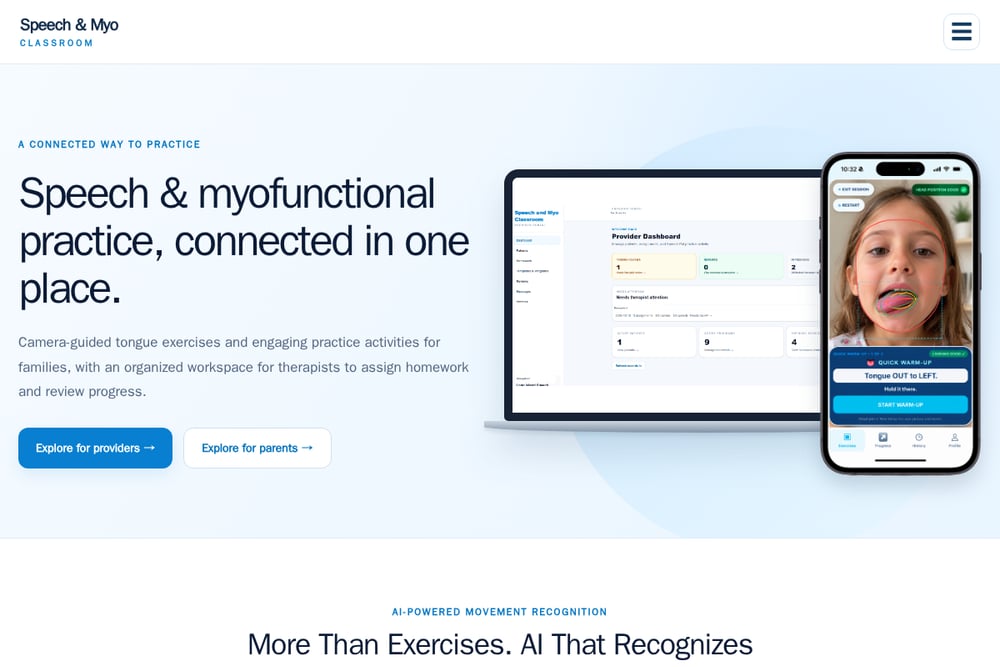 A screenshot of the Create Next App website.
Create Next App, also known as Speech & MyoCLASSROOM, connects therapists and families in one workspace. It uses camera-guided tongue exercises and AI-powered movement recognition to make home practice interactive. Therapists can assign homework, track progress, and give feedback. Parents get guided activities that are easy to follow. The platform supports speech and myofunctional practice, with individual calibration for each user. It's a unified system that keeps everyone on the same page. For practices that want a connected experience, this stands out.
#3 SpeechLP
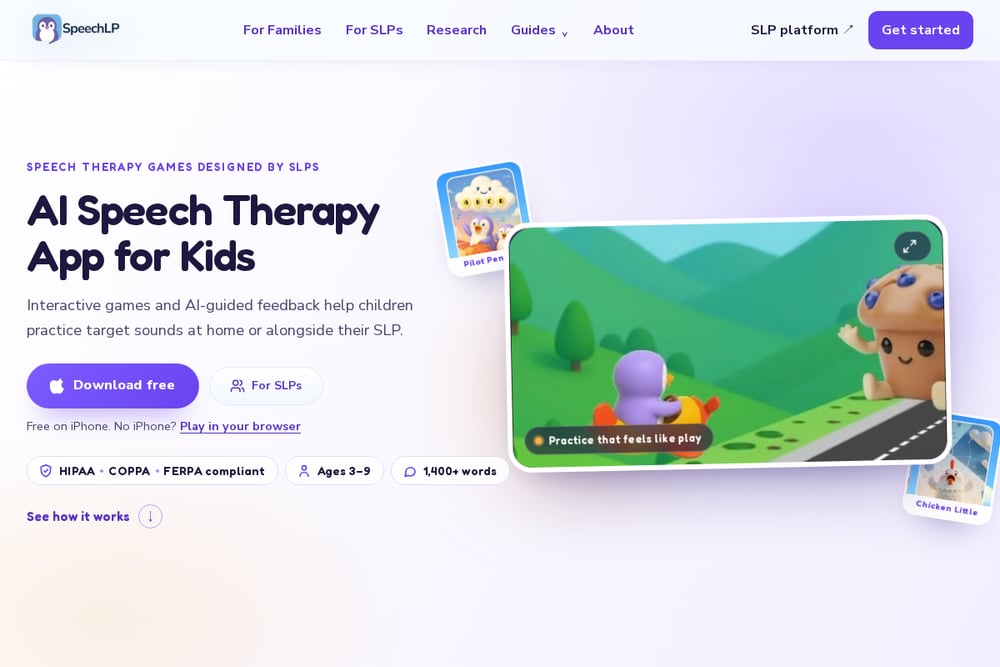 A screenshot of the SpeechLP website.
SpeechLP turns speech practice into a game. It's designed for kids ages 3 to 9, with over 1,400 illustrated word cards. The AI chooses target sounds and age-based levels, or an SLP can assign them. Results flow back to the SLP for better carryover. The app is free on iPhone and also works in a browser. It's HIPAA, COPPA, and FERPA compliant. If you want engaging practice that feels like play, this is a solid choice.
#4 Sara Technology
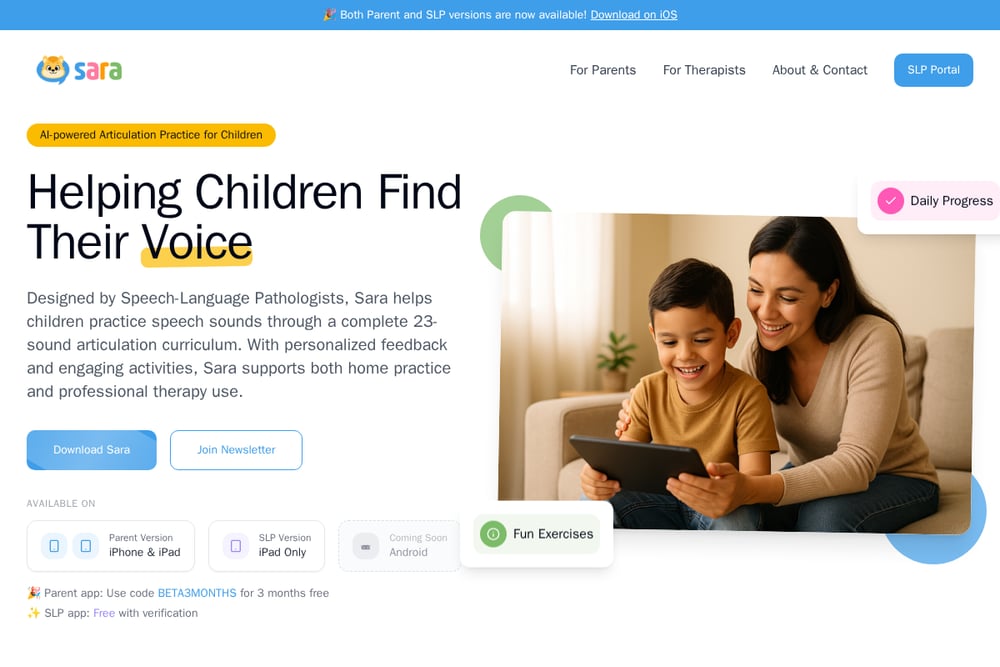 A screenshot of the Sara Technology website.
Sara Technology offers a complete 23-sound articulation curriculum. It was designed by certified speech-language pathologists. The app provides personalized feedback and adaptive exercises. Kids practice through fun, guided games. Parents can monitor progress with detailed reports and growth charts. There's a parent version for iPhone and iPad, and an SLP version for iPad. It's a structured, evidence-based approach to articulation practice. If you want a curriculum-driven app, Sara is worth a look.
#5 Little Words
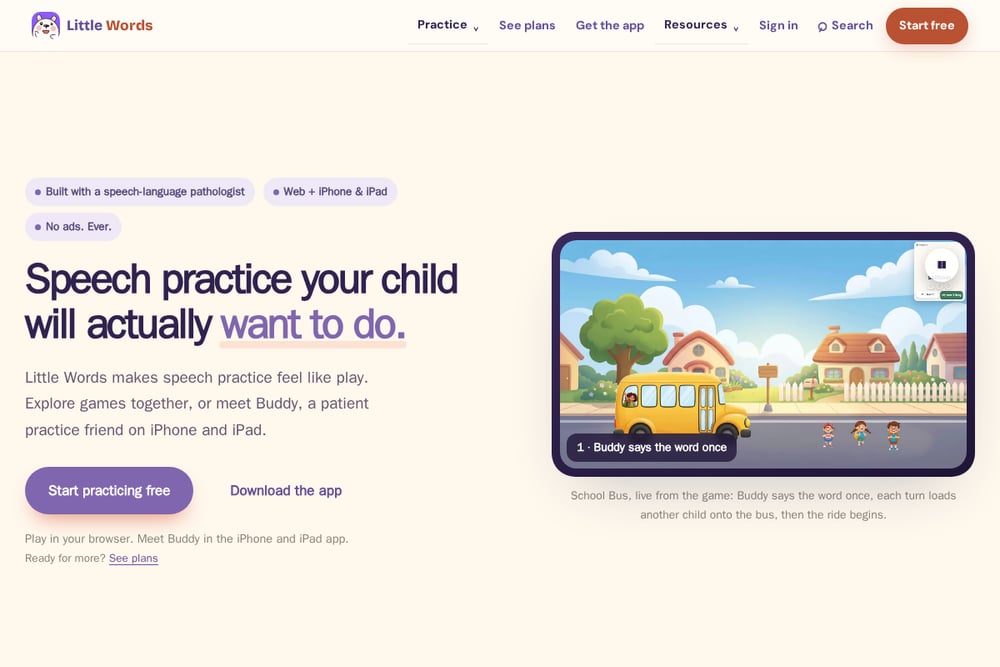 A screenshot of the Little Words website.
Little Words uses AI to create responsive, interest-led practice for children ages 2 to 8. It's designed for supervised home practice, not diagnosis or treatment. The app can follow a child's interests and adjust prompts. Parents stay in control, and there are no third-party ads. It supports multiple ways to respond, including speech, pictures, and gestures. It's a gentle, parent-controlled option for early language practice. If you want a low-pressure supplement to therapy, this fits.
How to Choose the Right Platform
Start with your goal. Are you a therapist who needs better data between sessions? Look for strong tracking and assignment tools. Are you a parent who wants engaging practice for a young child? Prioritize kid-friendly design and clear guidance. Consider the age range. Some apps are built for ages 3 to 9, others for 2 to 8. Check the clinical scope. Does it cover articulation, fluency, or myofunctional goals? Think about device compatibility. Some work on iPhone and iPad, others in a browser. Finally, look at compliance and pricing. You want transparency. Match the platform to your specific needs, not just the biggest feature list.
What Automation Looks Like in Practice
Imagine this: A therapist assigns a set of tongue exercises. The parent opens the app at home. The camera guides the child through each movement. AI recognizes the movement and gives instant feedback. The session is recorded and scored. The therapist gets a summary before the next appointment. No paperwork. No guessing. That's the workflow these platforms enable. It's not about replacing the therapist. It's about extending their reach into the home. The best systems make that handoff seamless, so practice actually happens and progress is visible.
The Bottom Line
Speech therapy is evolving. The tools you use between sessions can make or break progress. Whether you're a therapist or a parent, the right platform can turn home practice from a chore into a connected, measurable part of care. LumaSpeech excels at data. Create Next App shines in connected speech and myofunctional practice. SpeechLP makes it playful. Sara Technology brings structure. Little Words keeps it gentle and parent-led. Choose based on your needs, and you'll find a tool that fits.