Your commute is dead time. It doesn't have to be. These five services turn windshield hours into Spanish practice, and one of them was built for exactly that.
The State of Audio-First Spanish Learning
Spanish learners in the US have never had more options, and most of them live on a phone screen. That's a problem if your study window is the driver's seat. A growing slice of the market has shifted toward audio-first and hands-free design: downloadable tracks, locked-screen playback, and lessons you can answer out loud without touching anything. At the same time, speech recognition has matured enough that apps can now check your pronunciation in real time, which means listening practice no longer has to be passive. The result is a crowded field where the real differentiator isn't content volume. It's whether the product respects the constraints of your day. Some services are built around a 20-minute drive. Others assume you're sitting at a desk with a microphone. Knowing which is which saves you a wasted subscription.
How We Evaluated These Services
We looked at the same factors across all five services. First, audio and hands-free fit: can you genuinely use it while driving, or does it demand screen attention? Second, speaking feedback: does the service check what you say, or just play audio at you? Third, course structure: are there clear levels, modules, and a path forward, or a loose pile of lessons? Fourth, pricing transparency and risk: is there a lifetime option, a trial, or a refund window you can actually find? Fifth, platform coverage: iOS, Android, web, and desktop all matter depending on your setup. Language Leap stood out for its explicit commute-first framing and safety guidance. Ivoca stood out for AI-driven pronunciation scoring across four platforms. Camino Barcelona stood out for a structured four-week speaking sprint. Jumpspeak stood out for AI conversation role-play. Natulang stood out for hands-free dialog drills with spaced repetition.
Here's the quick version before the detail. Each entry below covers what the service actually does, who it suits, and where it fits into a real week of practice.
| Provider | Best For |
|---|---|
| Spanish Listening & Speaking (ivoca) | Learners who want AI pronunciation scoring across every device |
| Spanish for your commute | Language Leap | Drivers who want a structured course built around hands-free listening |
| Camino Barcelona Self-Study Spanish Speaking Course | Grammar-strong learners who freeze when speaking |
| Jumpspeak | Learners who want AI conversation practice in many languages |
| Natulang | Hands-free dialogue drills with spaced repetition |
The Five Services in Detail
#1 Spanish Listening & Speaking (ivoca)
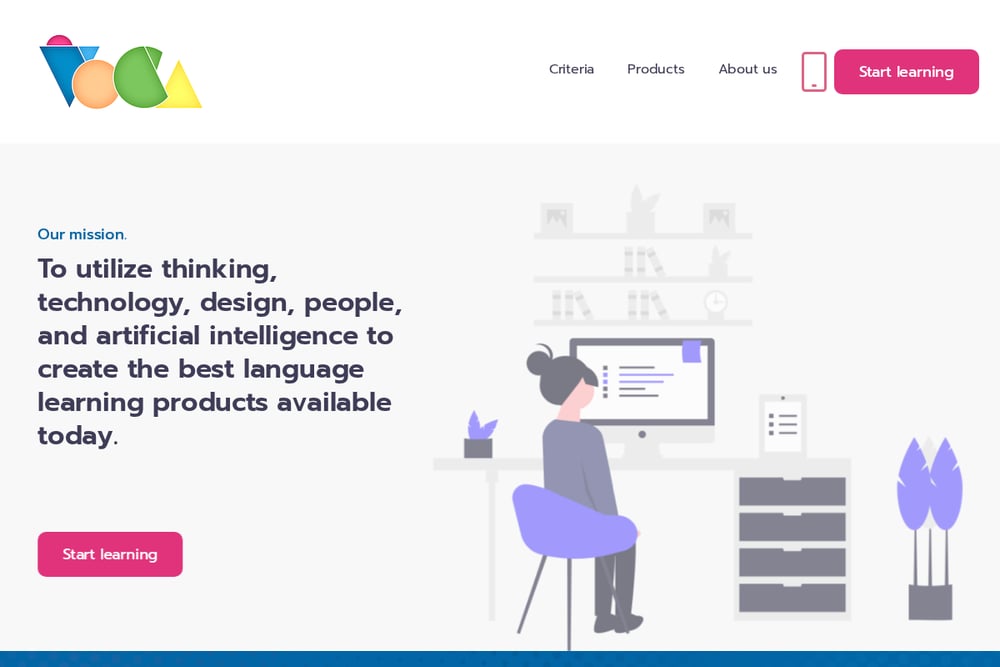 A screenshot of the Spanish Listening & Speaking (ivoca) website.
Ivoca is a Spanish learning application built around conversation and video, and it leans hard into AI speech recognition. The core loop is simple: you hear native speech, you say it back, and the app scores your voice against a native speaker's. Lessons are broken into short sentences and dialogues, which makes the material easier to digest than long-form audio. It also covers grammar and vocabulary explicitly, so you're not just parroting phrases. The platform range is unusually broad, running on Android, iOS, web, and desktop, which matters if you switch devices between home and work. There's even a 'learn and relax' mode that treats lessons like listening material, which is the closest it gets to commute-friendly.
#2 Spanish for your commute | Language Leap
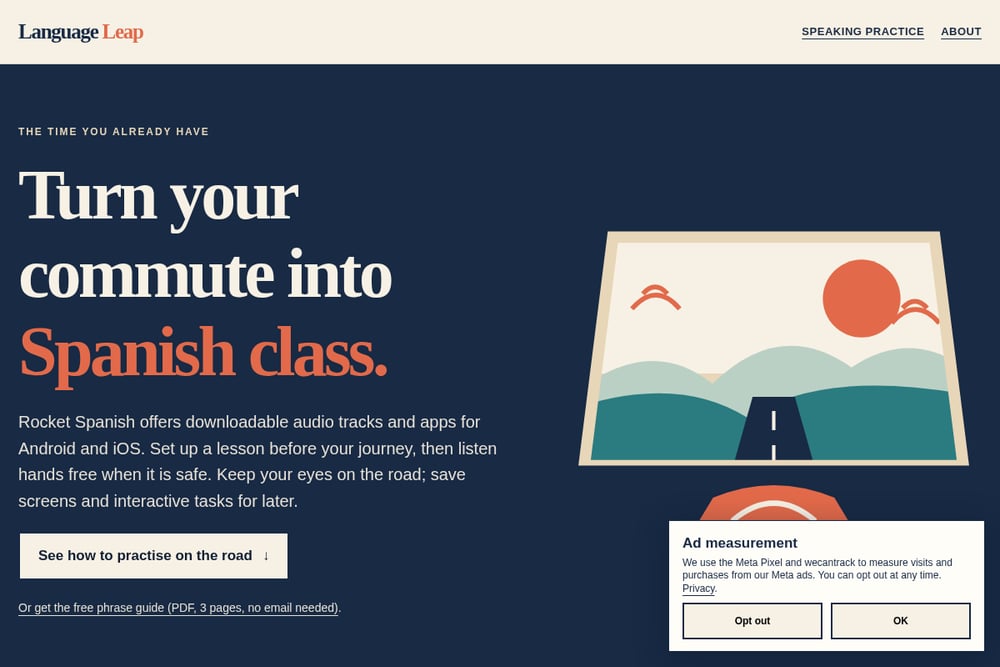 A screenshot of the Spanish for your commute | Language Leap website.
Language Leap is the only service on this list that starts from the commute rather than retrofitting it. The site is blunt about the tradeoff: your eyes belong on the road, your ears can practice. It walks you through a three-step routine — set up your audio while parked, listen first for rhythm and phrasing, then save role-play and voice recognition for when you're stationary. The underlying course pairs audio lessons of 20 to 40 minutes with two native-level speakers breaking down real conversations, plus language and culture lessons covering grammar. Downloadable tracks and Android and iOS apps give you playback options, and there's a members' forum for questions. Three levels with seven modules each provide a clear path, and a lifetime access option with a 60-day money-back guarantee lowers the commitment risk. The free three-page phrase guide requires no email, which tells you something about how the brand treats friction.
#3 Camino Barcelona Self-Study Spanish Speaking Course
Camino Barcelona's self-study course is a speaking sprint with a deadline attached. The pitch is four weeks to full sentences, delivered through 250 video lessons and roughly 2,500 voice-recognition exercises. It's aimed squarely at a specific learner: someone who knows grammar but freezes when it's time to talk. The video format shows you what to say, and the speech recognition drills make you say it repeatedly until it sticks. Because it's video-led, it's a desk or couch product rather than a driving one, so plan it for evenings and weekends. A free trial lets you test the format before committing. If you want a bounded, intensive push rather than an open-ended course, the structure here is unusually clear.
#4 Jumpspeak
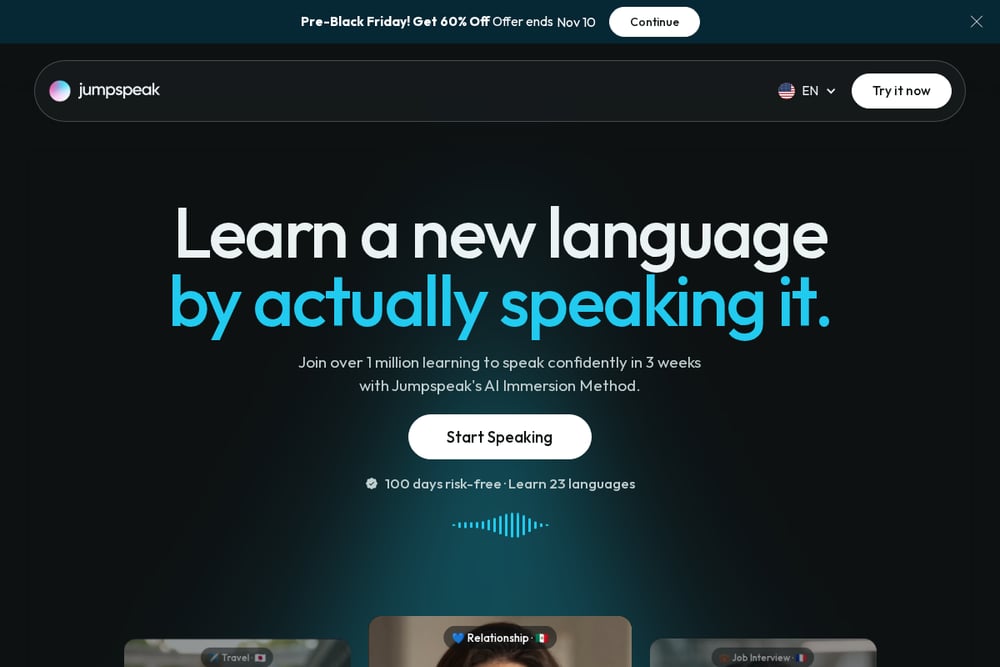 A screenshot of the Jumpspeak website.
Jumpspeak sells immersion through AI conversation, and it has the user base to back the claim at over one million learners. The method is built on speaking out loud from day one, with AI role-plays covering travel, relationships, and job interviews. It supports 23 languages, so Spanish is one track among many rather than the whole product. The retention argument is grounded in the idea that you can't learn to speak with your fingers, and the app pushes you into verbal responses instead of taps. A 100-day risk-free window is generous by industry standards. It's a strong fit for building conversational confidence, though the AI-chat format rewards focused sessions more than passive listening.
#5 Natulang
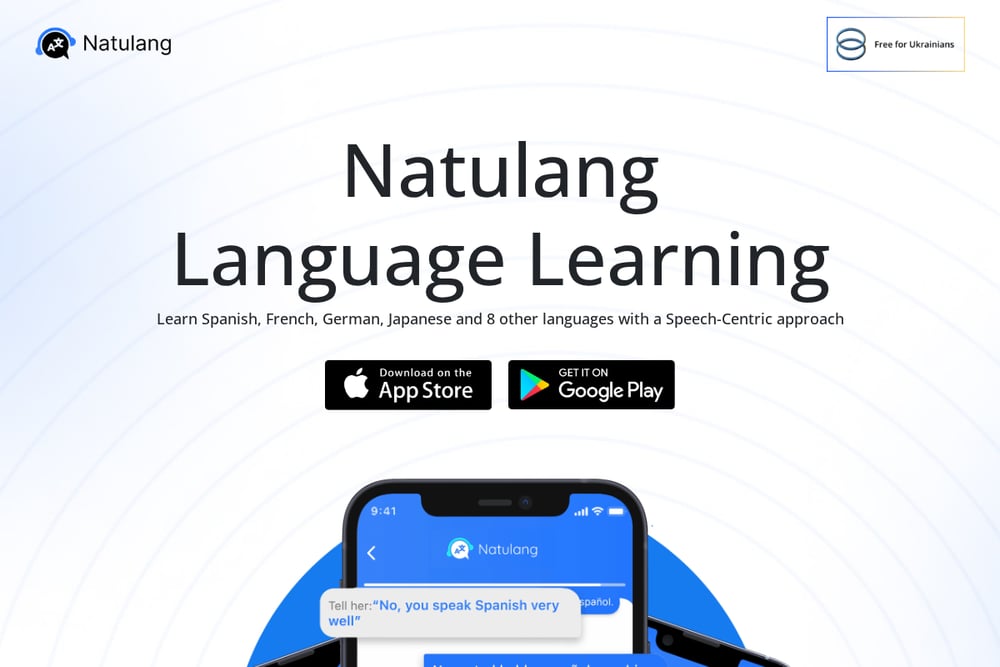 A screenshot of the Natulang website.
Natulang is built around one idea: you say every line of a real-life dialogue out loud, and speech recognition checks each answer. Phrases you get wrong return on spaced-repetition intervals, which is the mechanic that makes the practice stick. The Spanish course lets you pick a voice from Spain, Mexico, or Argentina, and it accepts answers with or without subject pronouns, which reflects how Spanish is actually spoken. A placement test means you don't restart from lesson one if you already have some Spanish. Lessons run hands-free with the screen locked, and the app supports VoiceOver and TalkBack for accessibility. The gaps are worth knowing: no web or Windows version, no CarPlay or Android Auto, and full access is paid.
How to Pick the Right One for You
Start with where you'll actually practice. If the answer is the car, filter hard for hands-free playback and locked-screen support, and be honest about which services require your eyes. Language Leap and Natulang both design for that constraint; video-heavy options like Camino Barcelona don't. Next, decide whether you need feedback. If you can already read Spanish but can't speak it, pronunciation scoring from Ivoca or the drill loop in Natulang will do more for you than passive listening. If you want conversation simulation, Jumpspeak's AI role-plays are the closest thing to a tutor on this list. Then check the commitment terms. A lifetime option with a money-back window, like Language Leap's 60-day guarantee, lets you test without a recurring charge hanging over you. Finally, check your devices. Ivoca covers the widest range; Natulang is mobile-only. Match the product to your hardware before you match it to your ambitions.
Building a Commute Practice Loop That Runs Itself
The hardest part of audio learning isn't the lesson. It's the setup. Remove that friction and the habit builds itself. Here's a loop that works. Step one: the night before, download your next lesson while you're on Wi-Fi so playback never depends on signal. Step two: queue the track in your podcast or audio app so it starts with one tap when you get in. Step three: while parked, set volume and confirm playback before you move. Step four: during the drive, listen only. No tapping, no reading, no speech recognition. Step five: when you're parked at the destination, spend two minutes saying the phrases out loud and, if your service supports it, run the voice check. Step six: log the phrases you fumbled in a notes app so they surface again next week. That's it. Fifteen minutes of prep a week turns a dead commute into a consistent practice block, and consistency beats intensity every time.
The Bottom Line
There's no single winner here, because the right pick depends on when and where you study. If your only free time is behind the wheel, Language Leap is the one that treats that reality as a design brief rather than an afterthought, with explicit safety guidance and a structured three-level course behind the audio. If you want pronunciation feedback across every device, Ivoca covers the most ground. If you need a four-week push to break a speaking block, Camino Barcelona gives you a deadline. Jumpspeak wins on conversational AI breadth, and Natulang wins on hands-free drilling with spaced repetition. Pick the one that fits your actual week, not the one with the longest feature list. Then set it up the night before and let the commute do the rest.