You've talked about your patterns long enough. At some point, your body wants a say. These five practices put sensation, breath, and boundaries back at the center of the work.
Where Somatic Intimacy Coaching Stands Right Now
Somatic intimacy coaching sits in a strange, fertile middle ground. It isn't therapy, and most practitioners are careful to say so. It isn't sex education either, though desire and pleasure are squarely on the table. What it is, increasingly, is body-based practice: guided experiential work where you notice what happens in your nervous system when you set a boundary, ask for something, or let yourself be seen. The field has grown fast because talk alone leaves a gap. You can understand a pattern intellectually and still freeze when it counts. Coaches fill that gap with breathwork, role-play, touch training, and present-moment experiments. The result is a category that borrows from Somatics, the Somatica Method, tantra, and trauma-informed care, and is still figuring out its own guardrails. That makes choosing carefully more important than choosing quickly.
How We Looked at These Practices
We weighed the same factors across every practice. First, service scope: does the practitioner work with individuals, partners, or both, and is there a clear arc from first session to deeper work? Second, method transparency: can you tell what actually happens in a session before you book one? Third, accessibility: online availability, discovery calls, and how easy it is to start. Fourth, fit for the specific work of intimacy, meaning boundaries, desire, and relational presence rather than general life coaching. Fifth, clarity of positioning, including whether the practitioner names what they are not. Christina Sophie Coaching stands out for its explicit Somatica Method grounding and its blend of individual and partner sessions. Embodied Acceptance distinguishes itself with a relationship-lab framing and a steady stream of workshops. Somatic Intimacy Coaching earns attention for plainly explaining how body-based coaching differs from traditional sex therapy. Relating with Grace is notable for its trauma-informed lens and its focus on couples. Somatic Intimacy — Into Me I See | Mooky Best draws notice for its reflective, self-trust-centered language and its birth doula offering, which widens the scope beyond intimacy alone.
Here's the short version. Five practices, five different entry points. Scan the list, notice which description sounds like the conversation you've been avoiding, and start there.
| Provider | Best For |
|---|---|
| Christina Sophie Coaching | People who want a named, structured methodology |
| Somatic Intimacy — Into Me I See | Mooky Best | Anyone ready to stop organizing life around what hurt |
| Embodied Acceptance | Skill-builders who want to practice, not just process |
| Somatic Intimacy Coaching | People deciding between coaching and therapy |
| Relating with Grace | Couples who want a trauma-informed container |
The Five Practices, One by One
#1 Christina Sophie Coaching
 A screenshot of the Christina Sophie Coaching website.
Christina Sophie Coaching builds its somatic work on the Somatica Method, developed by Celeste Hirshman and Danielle Harel, and the site is unusually direct about why that matters. The argument is simple: most therapists, even couples specialists, receive little or no training in sexuality, so talking alone has a ceiling. Sessions combine talk-based coaching, sex education, experiential learning, and embodied process work, with tools like role-play, rehearsal, and touch training. The practice serves individuals, partners, and online clients, and it frames the work as building a relationship laboratory where you practice real-time intimacy rather than analyze it after the fact. If you want a named, structured methodology behind the coaching, this is the clearest example on the list. Learn more at christinasophiecoaching.com.
#2 Somatic Intimacy — Into Me I See | Mooky Best
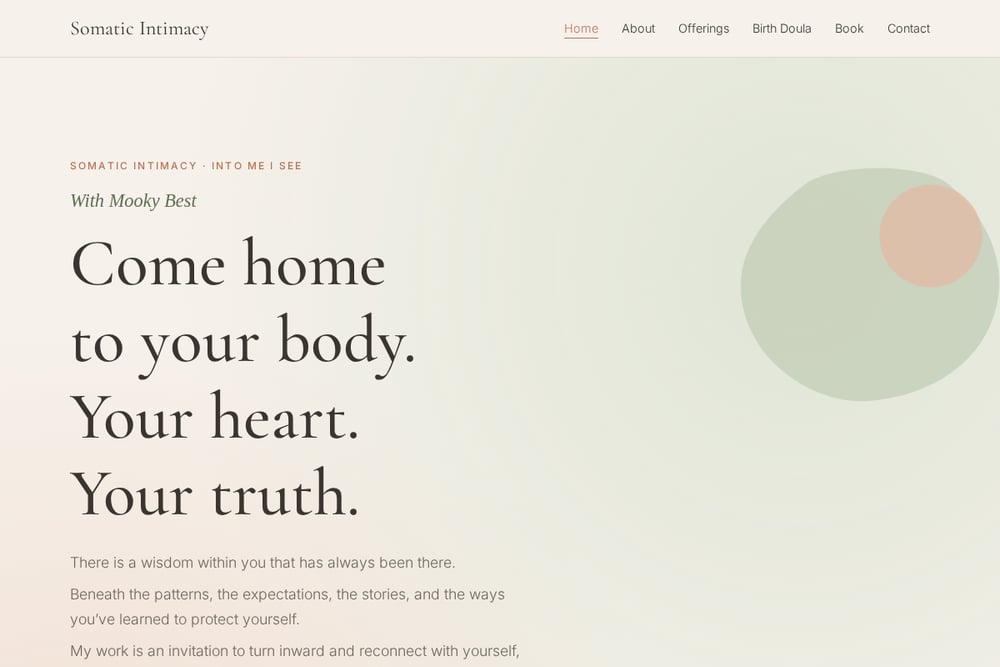 A screenshot of the Somatic Intimacy — Into Me I See | Mooky Best website.
Mooky Best's practice opens with an invitation rather than a pitch: come home to your body, your heart, your truth. The language throughout is about self-trust, and the site is candid about who it serves. You might recognize yourself if you've spent years caring for everyone else, if you know what you need intellectually but can't seem to honor it, or if you struggle to know where you end and someone else begins. The work is somatic in the literal sense, moving past talking about patterns and into exploring them through the body, including tension, numbness, and disconnection as information. Best also offers birth doula services, which extends the practice into one of the most physically intense transitions a body goes through. Bookings and a full list of offerings are available at mookybest.com.
#3 Embodied Acceptance
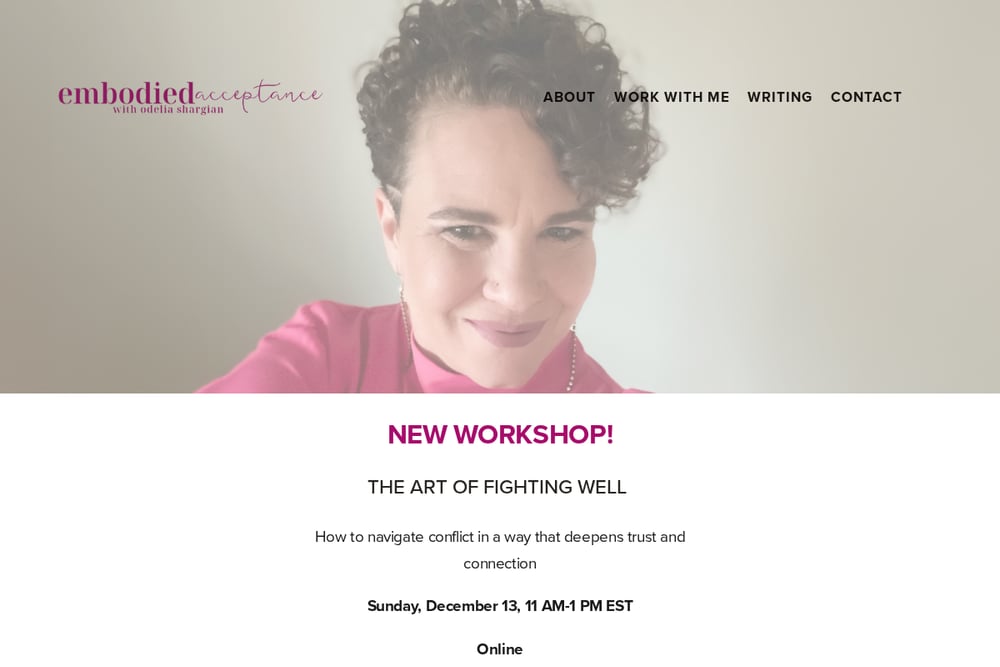 A screenshot of the Embodied Acceptance website.
Embodied Acceptance makes a refreshingly blunt case: being good at intimacy is a learnable skill, not something you're supposed to instinctively know. The practice runs somatic sex and relationship coaching with sessions treated as a relationship lab, where you sense and feel things in your body in real time instead of theorizing about them. The service list is specific and practical, covering reconnecting with your sexual self, finding safety in your body, mapping pleasure points, reclaiming erotic self-expression, and learning to give guidance about what you want. There's also a workshop layer, including a session on navigating conflict in a way that deepens trust. If you like the idea of practicing skills rather than unpacking history, this framing will land. Details are at embodiedacceptance.com.
#4 Somatic Intimacy Coaching
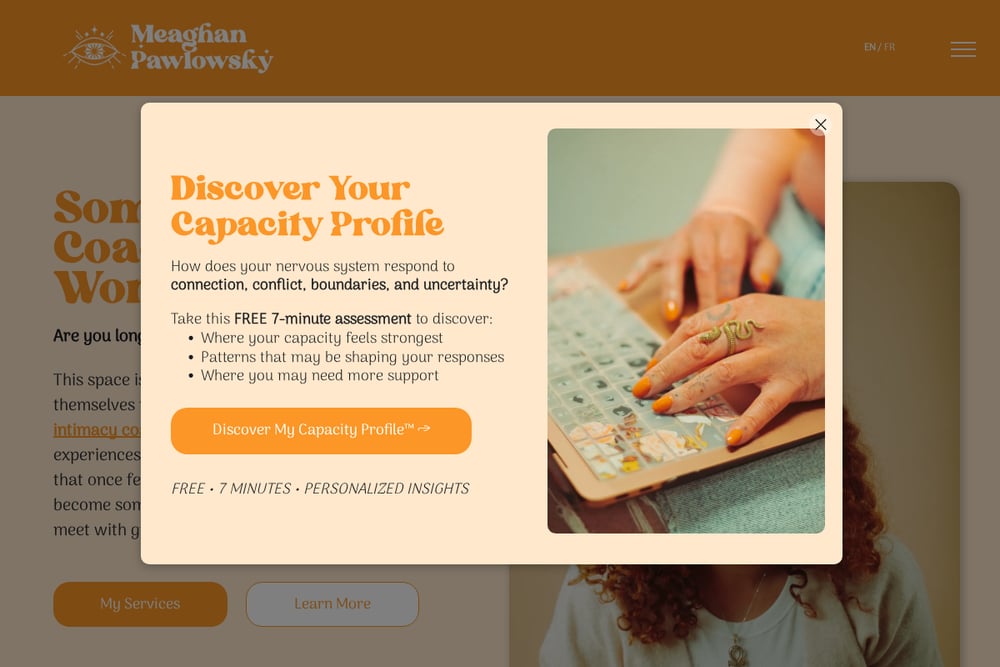 A screenshot of the Somatic Intimacy Coaching website.
Meaghan Pawlowsky's practice does something most competitors skip: it explains the difference between somatic intimacy coaching and traditional sex therapy in plain language. Sex therapy, as she describes it, is reflective and analytical, usually delivered by licensed mental health professionals and focused on the why behind your experiences. Somatic intimacy coaching is body-centered and present-focused, working with sensation and awareness to shift how you actually experience intimacy. The site outlines 1:1 coaching, embodiment circles, and a conversation series, and it offers a free strategy call as an entry point. Bilingual service in English and French broadens the reach. If you're weighing coaching against therapy and want help telling them apart, start with the article at somaticintimacycoaching.ca.
#5 Relating with Grace
 A screenshot of the Relating with Grace website.
Relating with Grace positions itself as trauma-informed intimacy and relationship coaching for both individuals and couples, and that dual focus shapes everything else. The practice's writing on somatic sex coaching versus traditional sex therapy is clear about the mechanics: coaches help you become aware of bodily sensations and use that awareness to deepen sexual experience. Sessions may include breathwork, mindfulness, exploring fantasies, and mapping boundaries and triggers. The stated benefits are concrete, from increased pleasure and improved sexual function to reduced anxiety around sex and greater body awareness. The trauma-informed framing matters if you want a practitioner who assumes sensitivity rather than treating it as an exception. Explore the approach at relatingwithgrace.com.
How to Pick the Right Practitioner for You
Start with the format. If you're going alone, look for practices with clear individual tracks. If a partner is involved, prioritize someone who works with couples and says so openly. Next, check the method. Somatica-trained practitioners will name the method and describe the tools. Others lean on breathwork, embodiment circles, or trauma-informed frameworks. None of these is inherently better, but you should know what you're walking into before the first session. Then look at the entry point. A free strategy call tells you a lot about how a practitioner listens. A detailed FAQ does too. Finally, be honest about scope. Coaching is not therapy, and good practitioners will say so. If you're carrying significant trauma, ask directly how they handle it and whether they collaborate with licensed clinicians. The right answer will be specific, not evasive.
A Simple Workflow for Choosing Without Overthinking
Set a timer for twenty minutes. Open all five sites in separate tabs. On each one, find three things: the session formats offered, the method named, and the easiest way to start. Write one line per practice. Then close every tab except the two that made you feel something rather than impressed. Book a discovery call with both. Ask each practitioner the same three questions: what happens in a first session, how you'll know it's working, and what they do when a client gets overwhelmed. Compare the answers, not the websites. Pick the one who answered plainly. Give it three sessions before you judge the results.
The Bottom Line
The best practice for you is the one whose language you can actually hear. Christina Sophie Coaching offers structure and a named method. Mooky Best offers a gentle, self-trust-centered invitation that widens into birth support. Embodied Acceptance treats intimacy as a skill you practice. Somatic Intimacy Coaching helps you understand what you're signing up for. Relating with Grace brings a trauma-informed lens to couples work. Read each description again and notice which one made you exhale. That's your starting point.