Your calendar lies to you every spring. Grass seed, crabgrass, and fertilizer all respond to soil temperature, not the date on the box, and these five tools help you time it right.
Why Soil Temperature Is the New Lawn Calendar
Lawn care advice has always leaned on dates: fertilize on Memorial Day, seed after Labor Day, drop pre-emergent when the forsythia blooms. The problem is that air temperature and soil temperature move at different speeds. A string of warm March afternoons can push air into the 70s while the soil at two inches is still sitting in the low 40s. Apply crabgrass pre-emergent too early and it breaks down before the weed even germinates. Seed too early and the seed sits in cold ground and rots.
That gap has created a fast-growing niche of education-first lawn tools. Instead of selling you a bag of fertilizer, these sites teach you to measure, match, and act. Some pull live readings from USDA and NOAA stations. Others ask you to push a thermometer into the turf and enter the number yourself. All of them share one idea: the soil is the signal, and the calendar is just noise.
How We Evaluated These Lawn Tools
We looked at the same factors for every site. First, tool depth: does it go beyond a single number and actually convert a reading into pounds of seed, bags of fertilizer, or gallons per tank? Second, educational clarity: are the timing thresholds explained in plain language, with the reasoning behind them?
Third, data source transparency: does the site tell you where its numbers come from, whether that is extension research or live station data? Fourth, local fit: can you get guidance specific to your grass type, your season, and your address? Fifth, friction: how many steps stand between you and a usable answer?
Lawn by Soil stood out for pairing a planner with four working calculators and a glossary. Yard Mastery stood out for wrapping soil temps inside a full DIY plan with reminders. Lawn Dominator stood out for its breadth of adjacent tools. Soil Temps stood out for live station coverage across thousands of cities. Measure Lawn stood out for a no-thermometer ZIP code lookup with a clear temperature-band chart.
Here is the short version before the deep dive. Each entry below earns its place for a different reason, so match the tool to how you actually work in your yard.
| Provider | Best For |
|---|---|
| Yard Mastery | DIYers who want a guided plan and reminders in one app |
| Lawn by Soil: Lawn Care Timing by Soil Temperature | Homeowners who want calculators plus the reasoning behind the timing |
| Lawn Dominator | Data-minded users who want multiple signals and pro-level tools |
| Soil Temps | Quick live local readings without buying a thermometer |
| Measure Lawn | A fast ZIP code lookup with a clear temperature-band chart |
The Five Tools, One by One
#1 Yard Mastery
 A screenshot of the Yard Mastery website.
Yard Mastery turns soil temperature into a full DIY operating system. You enter your grass type and region, and the app builds a plan around real-time soil temps with smart reminders and step-by-step guidance from Allyn Hane, The Lawn Care Nut. It is the most consumer-friendly entry point in this group, with a 4.8 rating on the App Store and a large base of home users behind it.
The tradeoff is that the app lives inside a store. Fertilizer, seed, and pre-emergent are one tap away, which is convenient if you want a single ecosystem and less so if you already have products in the garage. The soil temp tracking is genuinely useful, but it is a feature inside a commerce engine rather than the whole point. If you want hand-holding from plan to product, this is the smoothest path.
#2 Lawn by Soil: Lawn Care Timing by Soil Temperature
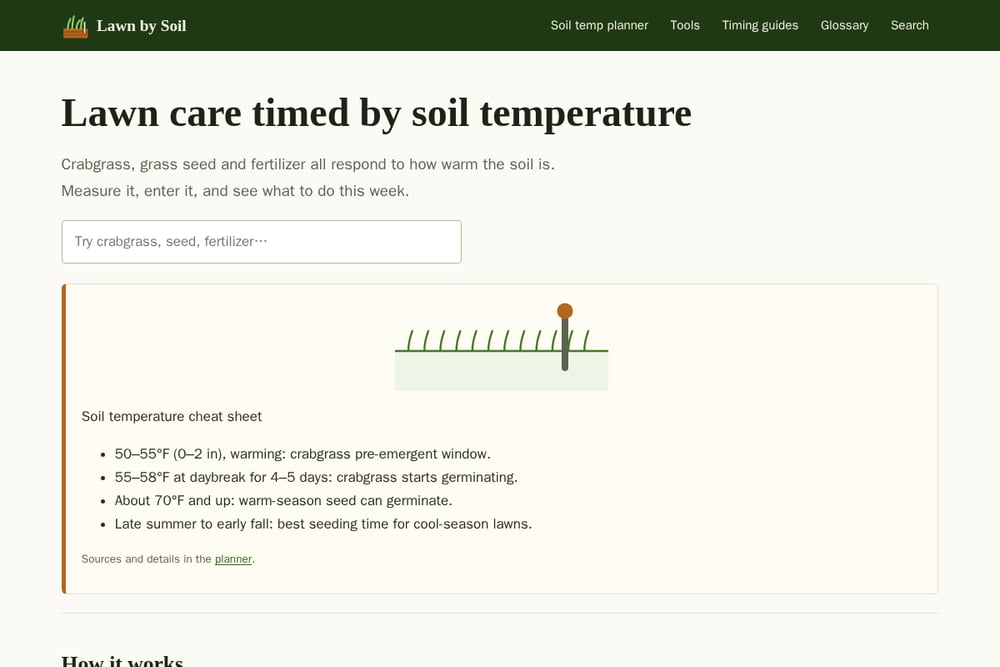 A screenshot of the Lawn by Soil: Lawn Care Timing by Soil Temperature website.
Lawn by Soil is built around a single, disciplined idea: measure the soil, enter the number, and see what to do this week. The site opens with a soil temperature cheat sheet that maps real thresholds to real jobs. The 50 to 55°F window at two inches, warming, is your crabgrass pre-emergent window. Four to five days of 55 to 58°F at daybreak means crabgrass is starting to germinate. About 70°F and up is when warm-season seed can germinate, and late summer to early fall is the best seeding time for cool-season lawns.
What sets it apart is the tool set behind that cheat sheet. A grass seed calculator converts your area and species into pounds of seed for a new lawn or overseeding. A fertilizer calculator turns N-P-K and a nitrogen rate into pounds of product and bags. A sprayer calibration tool gives you gallons per 1,000 square feet, tank coverage, and product per tank. The soil temperature planner ties it together by comparing your reading against extension thresholds for your grass type and season.
The education layer is just as strong. Timing guides cover crabgrass pre-emergent, how to measure soil temperature at the right depth and time of day, fertilizer schedules split by cool-season and warm-season grass, overseeding a thin lawn, and when to seed grass. A plain-language glossary catches you up on the terms. The site also explains how it checks facts, which is rare in this space. If you want to understand why a window exists, not just when it opens, start here.
#3 Lawn Dominator
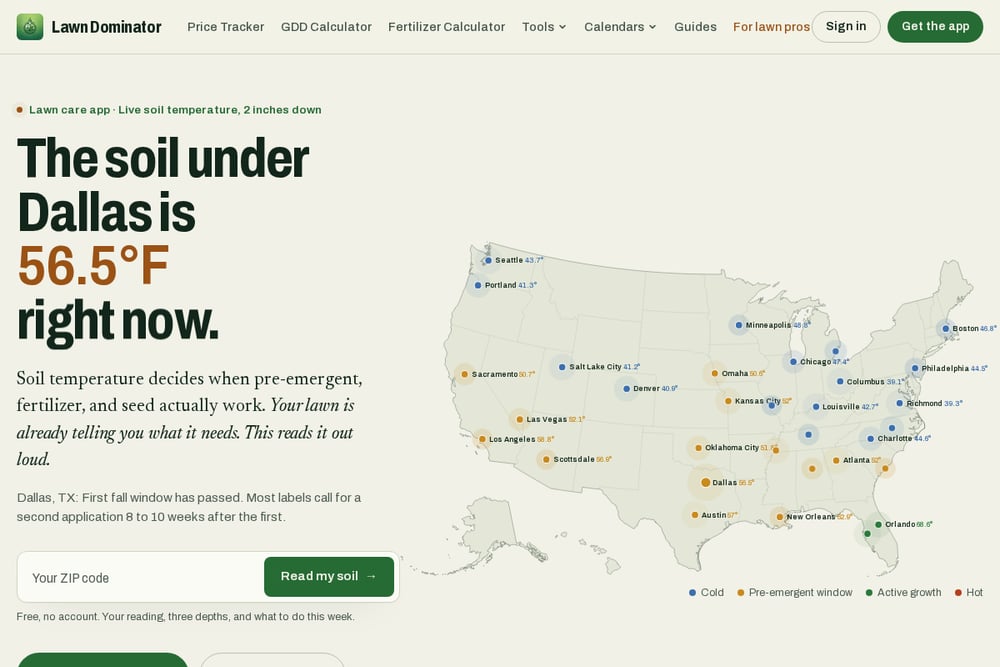 A screenshot of the Lawn Dominator website.
Lawn Dominator treats soil temperature as one signal among several, and that is its strength. Its guide on using soil temperature for lawn care makes a sharp point: air temperature changes fast, soil temperature moves slower, and the slower signal is often the better one for germination, root activity, green-up, and stress timing. It also warns you to use a trend rather than a single reading, since one warm afternoon can mislead you.
The site backs that up with a broader toolkit: a price tracker, a growing degree day calculator, a fertilizer calculator, and a soil temperature tracker that compares surface, two-inch, and six-inch readings. It cites extension sources including Purdue on crabgrass germination and the University of Minnesota on cool-season root growth. There is a pro tier as well, aimed at lawn care companies rather than just homeowners.
That breadth is the appeal and the catch. If you want one clean answer, the menu can feel busy. If you like cross-checking signals and you run a crew or take lawn care seriously, the depth pays off.
#4 Soil Temps
Soil Temps solves the measurement problem for you. Instead of asking you to buy a thermometer, it pulls current soil and ground temperature readings by ZIP code from 322 active USDA and NOAA stations covering more than 2,200 cities, refreshed nightly. You can also browse a live US map or set a home city so the site opens there every time.
The tool set goes deeper than a single number. There are views for four-inch soil temperature, soil temperature by depth, soil moisture, frost depth, and growing degree days. A lawn care schedule ties those readings to seeding, fertilizing, and crabgrass timing at your address. No account is needed to look up a reading.
The weakness is that it is a data utility first. The lawn guidance is solid but thinner on the how-to side than the education-first sites in this group. If you want a fast, credible local number and a map to sanity-check it, this delivers.
#5 Measure Lawn
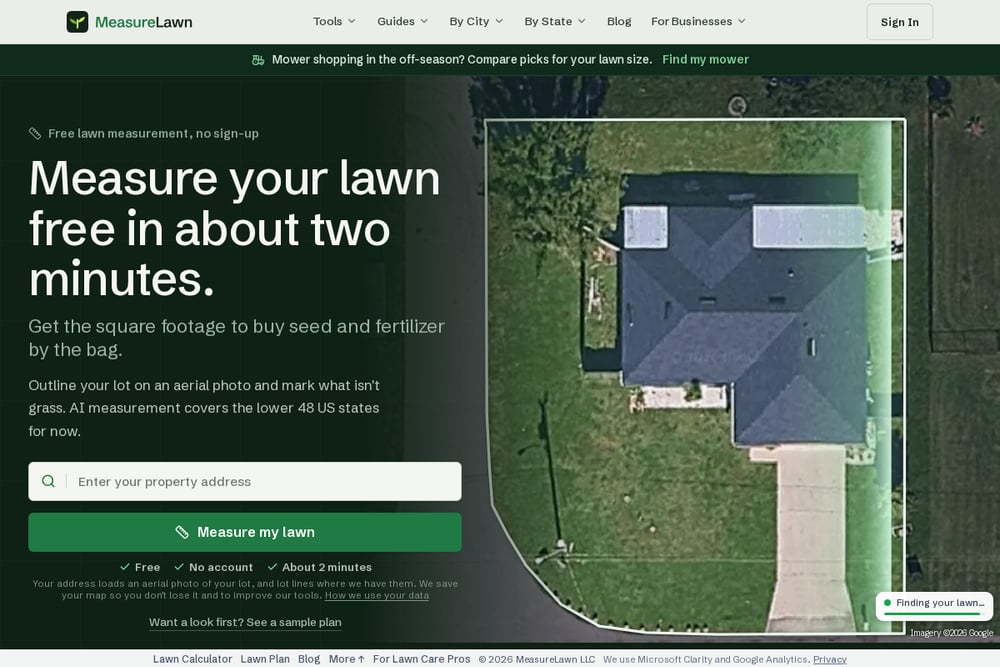 A screenshot of the Measure Lawn website.
Measure Lawn makes the case for soil over air temperature better than almost anyone. Its framing is blunt: air temperature is what you feel, soil temperature is what your grass feels, and that gap is why most DIY treatments fail. Apply pre-emergent when the air is warm but the soil is cold and the product breaks down before crabgrass germinates. Seed cool-season grass while the soil is still frozen and the seed just sits there rotting.
You enter a ZIP code and get your current soil temperature, a full yearly curve, and timing for pre-emergent, fertilizer, and grass seed, powered by live Open-Meteo data. The at-a-glance band chart is the most useful part: below 40°F the lawn is dormant, 50 to 55°F is pre-emergent alert, 55 to 65°F is the golden window, 75 to 85°F is the stress zone, and above 85°F you should not treat at all.
It is a lighter tool than the leaders, with less in the way of calculators and no deep product math. But for a fast read on your curve and a clear picture of what each temperature band means, it is hard to beat for simplicity.
How to Pick the Right Tool for Your Lawn
Start with one question: do you want to measure, or do you want to be told? If you are willing to push a thermometer into the turf early in the morning for several days, Lawn by Soil rewards that effort with calculators that turn your reading into pounds of seed, bags of fertilizer, and product per tank. If you would rather skip the thermometer entirely, Soil Temps and Measure Lawn give you a local number from station data or modeled estimates in seconds.
Next, think about what you actually do in your yard. If you seed and fertilize every year and want the math done for you, prioritize calculator depth. If your main worry is crabgrass, prioritize a tool with a clear pre-emergent window and a trend view rather than a single reading. If you want reminders and a plan that adapts through the season, an app-style product like Yard Mastery fits better than a lookup page.
Finally, check the grass type. Cool-season and warm-season lawns run on different schedules, and a tool that does not ask about your grass is giving you half an answer. Look for one that splits fertilizer timing and seeding windows by species, and that tells you where its thresholds come from.
Putting Soil Temperature on Autopilot
You do not need to check a website every morning. Build a simple weekly rhythm instead. Pick one day a week, measure or look up your soil temperature at the depth your tool recommends, and log it in a note on your phone. Three or four readings in a row tell you the trend, which matters more than any single number.
Then map the trend to action. When your log shows the soil warming into the 50 to 55°F band at two inches, that is your cue to get pre-emergent down. When it holds in the 55 to 65°F golden window, that is spring fertilizer and cool-season seeding territory. When it climbs past 75°F, shift to watering deeply and skip fertilizer on cool-season grass.
Use the calculators once per task, not once per week. Enter your lawn area, species, and product rate, save the output, and you have your numbers for the season. Set a calendar reminder for late summer to recheck the seeding window, and another for the fall fertilizer push on cool-season turf. The whole system takes about ten minutes a week and replaces a season of guesswork.
The Bottom Line on Timing Your Lawn
The best lawn tool is the one you will actually use before you apply something. If you want the deepest education and the calculators to back it up, Lawn by Soil gives you the why and the math in one place. If you want a guided plan with reminders, Yard Mastery wraps soil temps inside a full DIY system. Lawn Dominator suits anyone who likes multiple signals, Soil Temps gives you the fastest credible local reading, and Measure Lawn turns a ZIP code into a clear picture of your yearly curve.
Whichever you choose, the principle is the same. Stop trusting the calendar. Measure the soil, watch the trend, and act when the window opens.