Your releases are speeding up, but your QA isn't. These five QA services help you keep critical bugs out of production without slowing your team down.
The State of Software Testing and QA
Software teams are shipping faster than ever, thanks to AI-assisted coding and tighter CI/CD loops. But faster code means more surface area to test, and traditional QA methods can't keep up. That's why a new wave of QA services is blending senior human judgment with AI-powered automation. You now have options that range from fully managed QA teams to self-serve AI testing platforms. The right fit depends on your stack, your team structure, and how much control you want over the testing process.
How We Evaluated These QA Services
We looked at five factors that matter most to engineering leaders. First, service scope: does the provider cover manual, automation, and AI-specific testing? Second, depth of AI capabilities: how well do they test LLM and GenAI applications? Third, engagement model: do they offer risk-free POCs, dedicated engineers, or self-serve tools? Fourth, transparency and reporting: can you see what's tested and why it failed? Fifth, fit for growing teams: how quickly can you get value without a long buildout? Each provider stood out in different areas, and we noted what made each one distinct.
Here's a quick comparison of the five QA services in this roundup. Each one brings a different strength to the table, so you can match them to your team's needs.
| Provider | Best For |
|---|---|
| Momentic | Teams wanting an AI agent that files bugs automatically |
| Software Testing & QA Services Company | ThinkSys | Teams needing senior QA engineers and LLM testing expertise |
| Rainforest QA | SaaS teams wanting no-code AI test automation |
| QA.tech | Fast-shipping teams needing PR-level verification |
| ContextQA | Enterprises testing complex app landscapes and AI agents |
The 5 QA Services in Detail
#1 Momentic
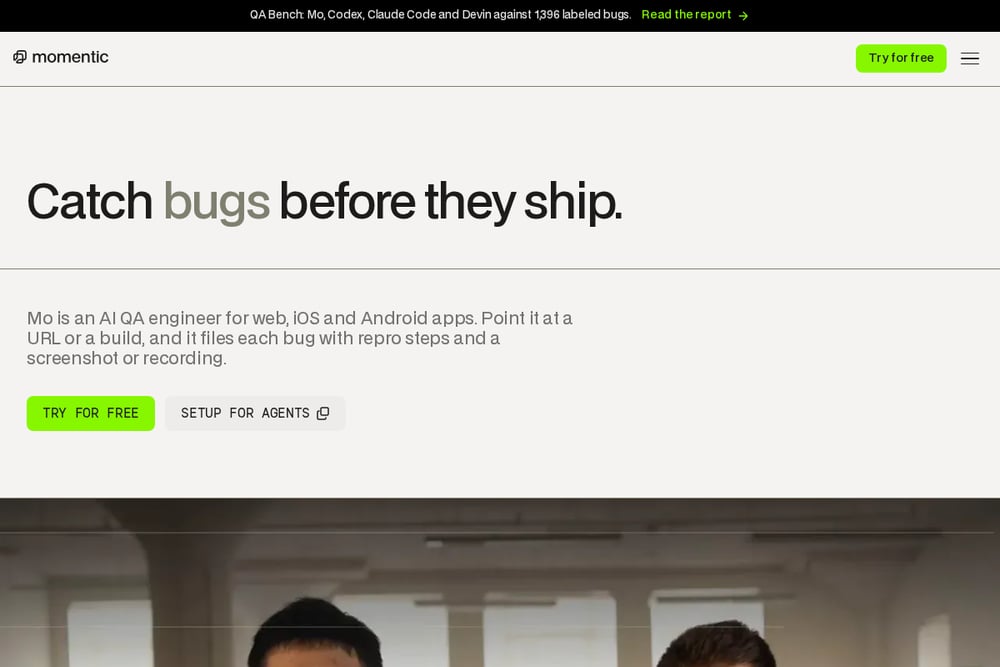 A screenshot of the Momentic website.
Momentic positions itself as an AI QA engineer named Mo that catches bugs before they ship. You point it at a URL or a build, and it files each bug with repro steps and a screenshot or recording. It supports web, iOS, and Android testing, and you can run tests on your own machines, in CI, or on Momentic-hosted infrastructure. The platform also offers an MCP server so you can write, run, and debug tests from your coding agent. Engineering teams at Notion, Quora, and Webflow use Momentic to scale their QA efforts. Learn more at momentic.ai.
#2 Software Testing & QA Services Company | ThinkSys
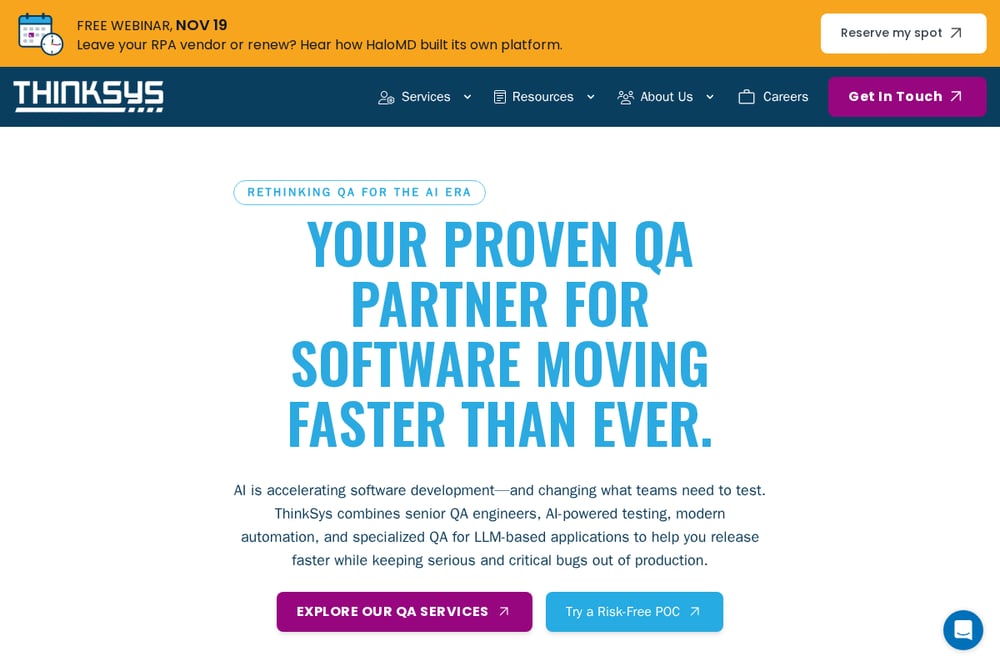 A screenshot of the ThinkSys website.
ThinkSys is a US-based software testing company with 400+ QA engineers and an automation-first approach. They combine senior QA engineers, AI-powered testing, and specialized QA for LLM-based applications to help you release faster while keeping critical bugs out of production. Their services include AI-augmented exploratory testing, agentic test automation, and LLM & GenAI application testing for accuracy, hallucinations, and reliability. They emphasize senior engineers, not rotating juniors, and offer a risk-free POC so you can try before you commit. ThinkSys also backs its work with a Zero Critical Bugs Guarantee. Visit thinksys.com to explore their QA services.
#3 Rainforest QA
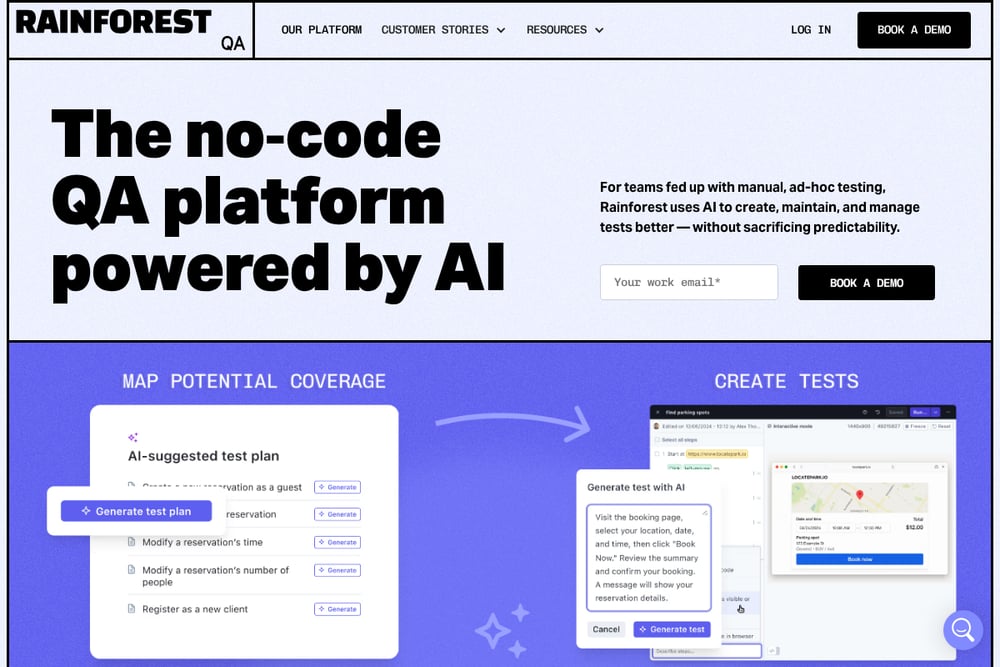 A screenshot of the Rainforest QA website.
Rainforest QA offers a no-code QA platform powered by AI for growing SaaS companies. It uses AI to create, maintain, and manage tests without sacrificing predictability. You get no-code tests that don't rely on CSS selectors, so they're less brittle when your UI changes. The platform provides org-wide transparency so anyone can see what's tested, what failed, and why. It fits your workflow with CLI, GitHub Actions, and CircleCI integrations, and parallel runs finish fast. Rainforest QA is designed for teams that want AI QA without the risk of shipping bugs. Check it out at rainforestqa.com.
#4 QA.tech
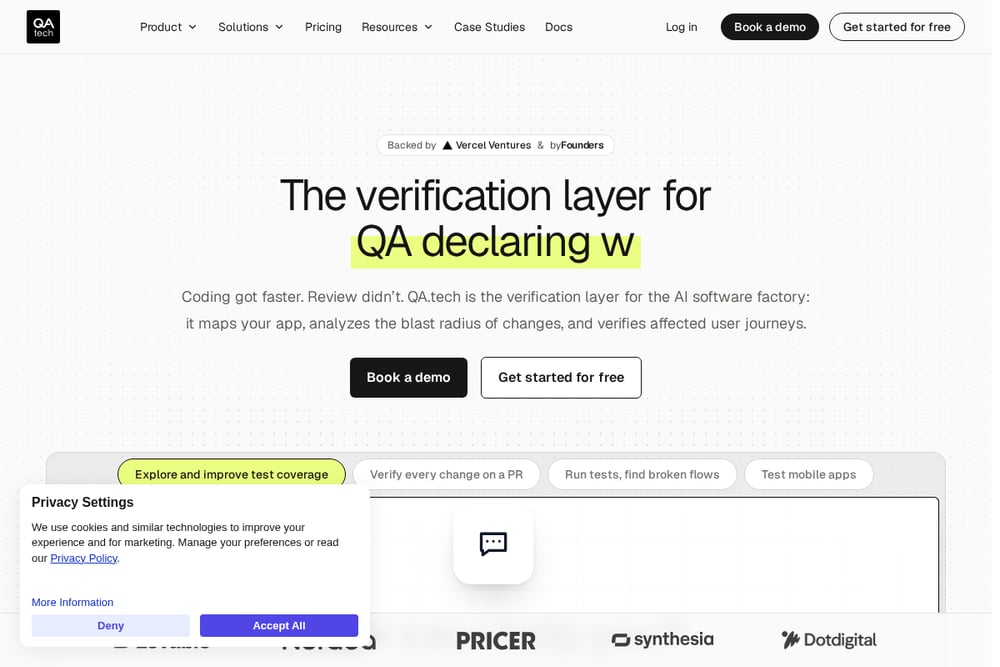 A screenshot of the QA.tech website.
QA.tech calls itself the verification layer for the AI software factory. Its agents run dynamic tests against your live web or native mobile app on every pull request, exercising it visually like a real user. You teach the agent user journeys and rules, and it reports what works before merge. The platform maps your app, analyzes the blast radius of changes, and verifies affected user journeys. It's built for teams that ship fast and want quality guardrails in their pipeline. QA.tech is backed by Vercel Ventures and byFounders. Learn more at qa.tech.
#5 ContextQA
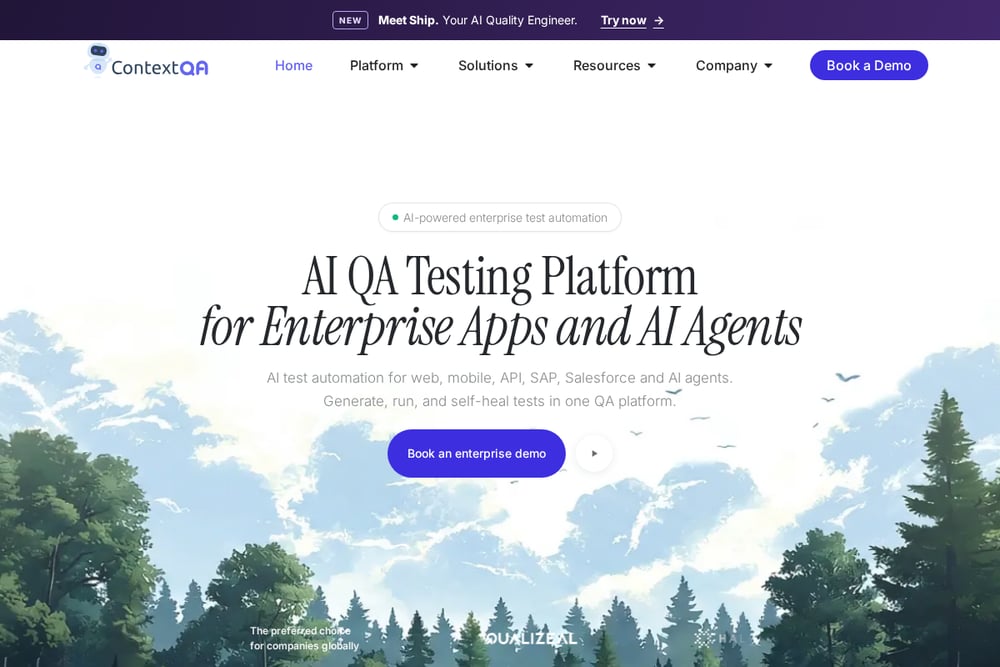 A screenshot of the ContextQA website.
ContextQA is an AI QA testing platform for enterprise apps and AI agents. It covers web, mobile, API, SAP, Salesforce, and AI agents, letting you generate, run, and self-heal tests in one platform. You can validate agent responses, guardrails, and tool calls alongside the applications they interact with. ContextQA is built for scale, with enterprise testing that reduces maintenance while keeping tests reliable. Customers report cutting regression testing time by 80% and validating every AI agent before it goes live. It's recognized by real users on G2. Visit contextqa.com for an enterprise demo.
How to Choose the Right QA Service
Start by mapping your biggest QA pain points. Are you struggling with brittle automation? Do you need help testing LLM-based features? Or do you want a fully managed QA team that feels in-house? If you need senior engineers and specialized AI testing, look for a service like ThinkSys that offers a risk-free POC. If you want self-serve automation, consider platforms like Momentic or Rainforest QA. For enterprise-scale testing across multiple systems, ContextQA might be the fit. And if you need verification on every pull request, QA.tech is built for that. Always ask about reporting transparency and how quickly you can see value.
Building an Automation Workflow That Works
A solid automation workflow starts with clear goals. Identify the critical user journeys you must test on every release. Then choose a tool that fits your team's skills, whether that's no-code or code-based. Integrate testing into your CI/CD pipeline so every pull request gets verified. Use AI to self-heal tests when the UI changes, but keep senior QA judgment in the loop for exploratory testing. Finally, review reports regularly to spot gaps and improve coverage. The right QA partner will help you set this up without a months-long buildout.
The Bottom Line
You don't have to choose between speed and quality. The five QA services in this roundup give you different paths to faster, more reliable releases. ThinkSys stands out for its senior engineers and specialized LLM testing, while Momentic, Rainforest QA, QA.tech, and ContextQA each bring unique strengths in AI-powered automation. Evaluate your team's needs, try a risk-free POC where possible, and pick the partner that feels like an extension of your team.