
The SOC analyst role is changing fast, and the training that gets you hired has to change with it. These five resources give you real logs, real attacks, and a clear path from zero to your first security operations job.
What are Education & Training services?
Security operations centers are hiring, but they are not hiring blindly. Employers want analysts who can read a log line, spot the anomaly, and explain why it matters. That demand has fueled a wave of hands-on training platforms, free labs, and structured learning paths. The best resources now blend case-file investigation, MITRE ATT&CK mapping, and honest career guidance. AI is part of the story too, both as a tool you will use and as a force reshaping entry-level tasks. If you are breaking in, you need practice that feels like the job, not just slides about it.
What we looked at when researching Education & Training
We looked at five factors across every resource. First, service scope: does it cover the full SOC skill set, from log analysis to incident response? Second, pricing clarity: is the free tier genuinely useful, and are paid options transparent? Third, local fit: does the content speak to the US hiring market and the realities of entry-level SOC work? Fourth, hands-on depth: are you investigating real or realistic attacks, or just watching videos? Fifth, career guidance: does it explain each level of the SOC career honestly, including pay and AI's impact? Each resource below stood out on different factors, and we describe what stood out for each without pitting them against one another.
| Provider | Best For |
|---|---|
| MyDFIR SOC Analyst Course | Structured, instructor-led SOC training with deep labs |
| HuntHex · Become a SOC analyst in the age of AI | Free case-file practice and an honest career roadmap |
| CyberDefenders SOC Analyst Tier 1 Track | Free, bite-sized blue team labs mapped to ATT&CK |
| InfoSecLabs | Graded, console-style alert triage practice |
| LetsDefend SOC Analyst Learning Path | A guided, module-by-module SOC learning path |
A closer look at 5 standout Education & Training
#1 MyDFIR SOC Analyst Course
 A screenshot of the MyDFIR SOC Analyst Course website.
MyDFIR built this course around the investigation process, not just the tools. You get 8 chapters and more than 30 hands-on labs tailored to security operations, with a focus on uncovering hidden details in evidence. The instructor encourages you to check the free YouTube playlist first so you can judge the teaching style before you buy. At $499.97, it is a paid investment, and sales are final, so the preview matters. Students describe it as a practical bridge from certification study to real SOC work.
#2 HuntHex · Become a SOC analyst in the age of AI
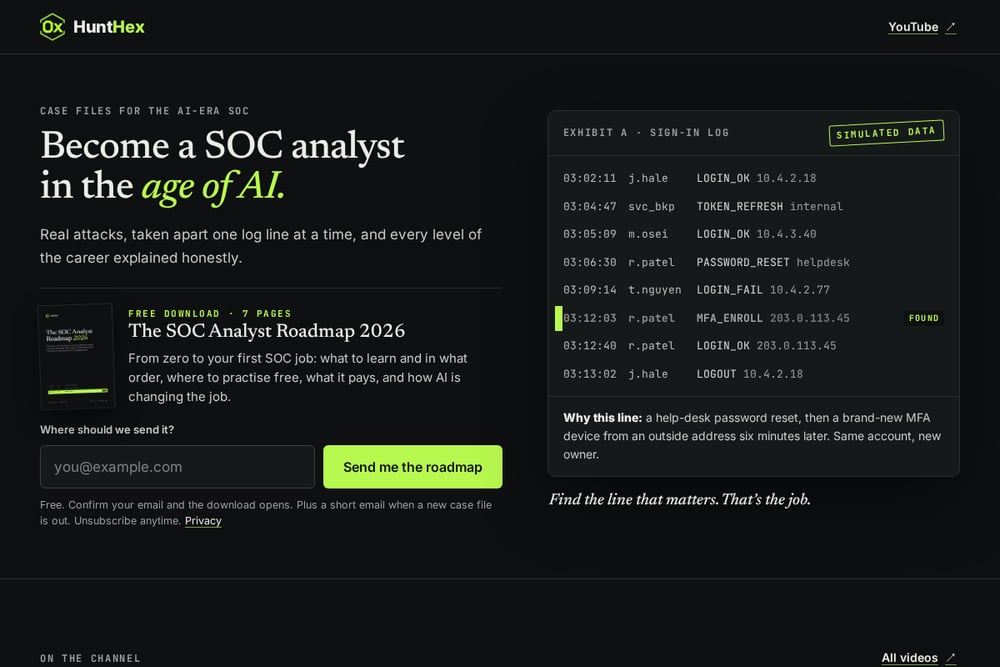 A screenshot of the HuntHex · Become a SOC analyst in the age of AI website.
HuntHex takes real cyber attacks apart one log line at a time, and it does not charge you for the core case files. The site pairs simulated sign-in logs with a simple challenge: find the line that matters. You also get a free 7-page SOC Analyst Roadmap 2026 that covers what to learn, in what order, where to practise free, what it pays, and how AI is changing the job. The YouTube channel adds free labs, including a Splunk beginner lab and a case file on how a 10-minute phone call cost MGM $100 million. Every figure is sourced and simulated data is labelled, which builds trust fast.
#3 CyberDefenders SOC Analyst Tier 1 Track
 A screenshot of the CyberDefenders SOC Analyst Tier 1 Track website.
CyberDefenders organizes hands-on labs into tracks, and the SOC Analyst Tier 1 track is built for foundational monitoring and escalation skills. You work through network forensics with Wireshark, cloud forensics with Splunk and AWS CloudTrail, and introductory incident response scenarios. Each lab is short, often 30 to 60 minutes, and asks you to answer specific questions about attacker techniques and indicators. The platform is free to join and maps activity to MITRE ATT&CK, which helps you speak the language hiring managers expect.
#4 InfoSecLabs
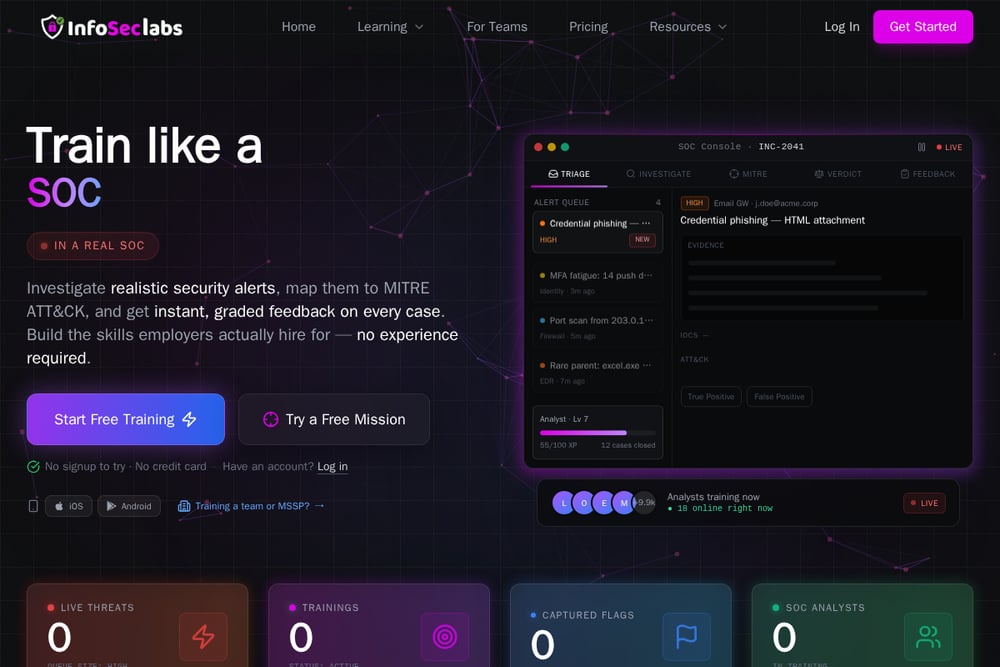 A screenshot of the InfoSecLabs website.
InfoSecLabs simulates a live SOC console where you triage alerts, inspect evidence, and submit a verdict. You get instant, graded feedback on every case, plus XP and written notes on your investigation. The platform covers Splunk, CrowdStrike Falcon, Wireshark, Sysmon, YARA, Sigma, and MITRE ATT&CK mapping in one workflow. You can try a free mission without signing up or entering a credit card, which lowers the barrier to test it. It is built for individuals and teams, including MSSPs training analysts at scale.
#5 LetsDefend SOC Analyst Learning Path
 A screenshot of the LetsDefend SOC Analyst Learning Path website.
LetsDefend lays out a structured SOC Analyst Learning Path with lessons, quizzes, challenges, and alerts across 25 modules. You start with SOC fundamentals, the cyber kill chain, and MITRE ATT&CK, then move into phishing analysis, web attack detection, SIEM alerts, and malware analysis fundamentals. The path includes practical steps like building a SOC lab at home, which helps you demonstrate initiative to employers. It is a medium-difficulty path aimed at security analysts, and it blends reading with hands-on alert investigation.
How to choose the right Education & Training
Start with your budget and your timeline. If you need free practice right now, prioritize resources with open labs and case files you can access today. If you want structure and are ready to invest, look at paid courses with clear outlines and preview content. Check whether the training uses realistic logs and alerts, because reading about attacks is not the same as investigating them. Look for career guidance that explains each SOC level honestly, including pay and how AI is shifting the work. Finally, test the teaching style before you commit, whether through a free lab, a YouTube playlist, or a no-signup trial.
Expert Conclusion
You do not need every resource on this list. You need one that matches where you are now and one that stretches you next. HuntHex gives you free case files and a roadmap to orient yourself. MyDFIR adds structured, instructor-led depth. CyberDefenders, InfoSecLabs, and LetsDefend give you labs and paths to build repetition. Pick your starting point, investigate one alert this week, and let the logs teach you what the job actually feels like.