Buying a small business with an SBA 7(a) loan is a math problem wrapped in a psychology test. These five calculators do the math so you can focus on the decision.
The SBA Buyer's Math Problem
First-time buyers using SBA 7(a) financing face a narrow window: lenders want at least a 1.25x debt service coverage ratio, and sellers want a multiple that matches the market. Most listings don't tell you whether the numbers actually work until you've already spent weeks on diligence. Deal-screening calculators close that gap by turning an asking price and an earnings figure into a clear pursue, negotiate, or walk verdict.
How We Looked at These Tools
We evaluated each calculator on four factors: how clearly it explains the math behind its verdict, whether it handles SBA-specific rules like DSCR floors and seller notes, how fast you can go from a listing to a usable answer, and whether the free tier gives you enough to make a real decision. We also weighed how well each tool handles the SDE-versus-EBITDA ambiguity that trips up most first-time buyers.
Here's a quick look at the five calculators, ordered by how directly each one answers the question every buyer asks: should I pursue this deal?
| Provider | Best For |
|---|---|
| DealScore Pro Business Acquisition Calculator | Fast listing-to-verdict screening |
| SDE or EBITDA? | First-time SBA buyers who want the math shown |
| PeerSense Business Acquisition Calculator | Modeling complex capital stacks |
| BizHub Deal Calculator | Industry benchmarking alongside deal math |
| Aryo Acquisition Deal Analyzer | Post-close cash flow analysis |
The Five Calculators in Detail
#1 DealScore Pro Business Acquisition Calculator
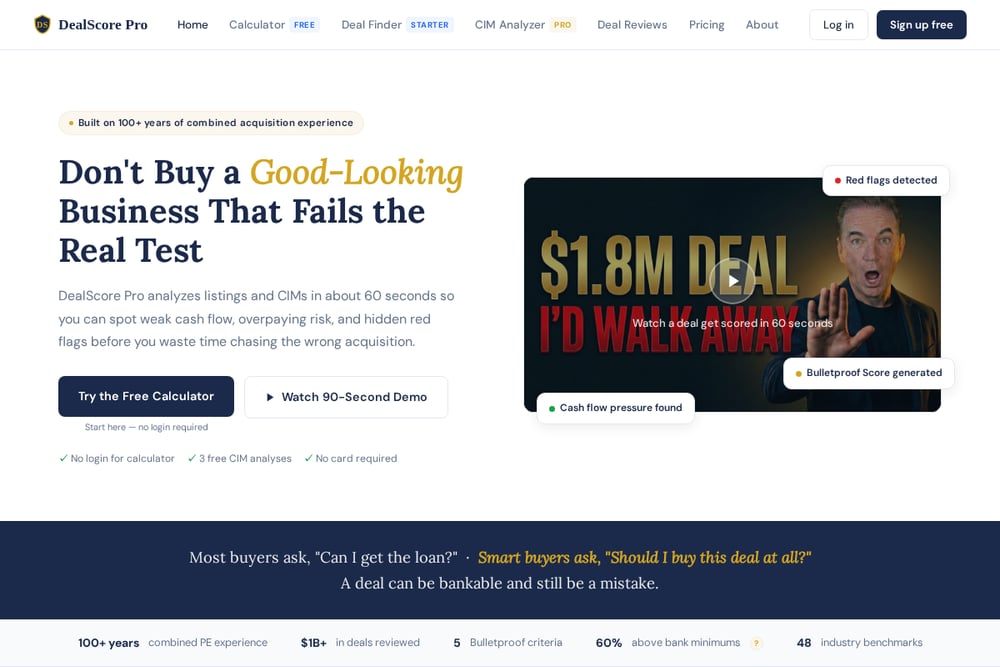 A screenshot of the DealScore Pro Business Acquisition Calculator website.
DealScore Pro opens with a single question: should you buy this business? You paste a listing from BizBuySell, Empire Flippers, or a broker page, and the tool extracts the numbers automatically. It then scores the deal against five criteria that the site says are twice as strict as typical bank requirements. The calculator handles SBA financing, seller notes, down payments, and manager salary adjustments in one pass. It's the fastest path from a listing URL to a scored verdict, which makes it ideal for the early stages of a search when you're screening dozens of deals.
#2 SDE or EBITDA?
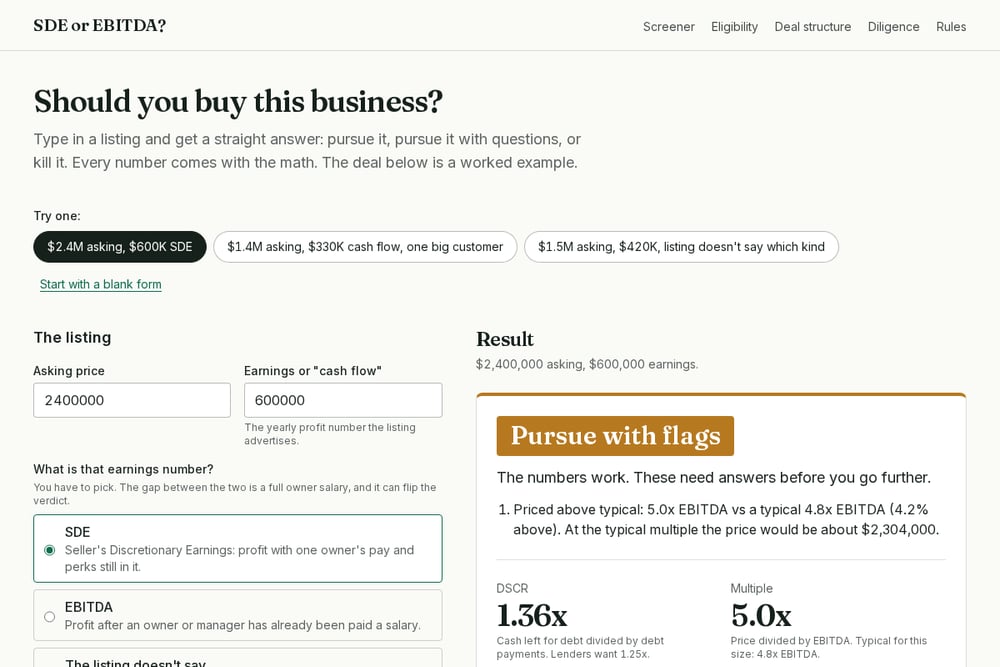 A screenshot of the SDE or EBITDA? website.
SDE or EBITDA? does one thing and does it well: it tells you whether a listing is worth pursuing, pursuing with flags, or killing outright. You enter an asking price and an earnings figure, and the tool runs three tests: whether the deal is big enough for you, whether it covers the loan at a 1.25x DSCR floor, and whether the price is within tolerance of typical market multiples. Every verdict comes with the math shown, including the most you could pay before the debt floor breaks. The site also handles the SDE-versus-EBITDA ambiguity directly, which is the single biggest source of confusion for first-time buyers. It's free, focused, and built specifically for SBA 7(a) buyers.
#3 PeerSense Business Acquisition Calculator
 A screenshot of the PeerSense Business Acquisition Calculator website.
PeerSense models the full capital stack: SBA 7(a) loans, seller notes, mezzanine financing, and equity injection. You enter a purchase price and EBITDA, and the tool auto-calculates loan amounts, monthly debt service, and DSCR. It's built for deals from $100K to $25M, so it scales beyond the typical first-time buyer range. The interface shows you exactly how each layer of financing affects your cash requirements at close. If you're structuring a deal with multiple funding sources, this is the tool that shows you how the pieces fit together.
#4 BizHub Deal Calculator
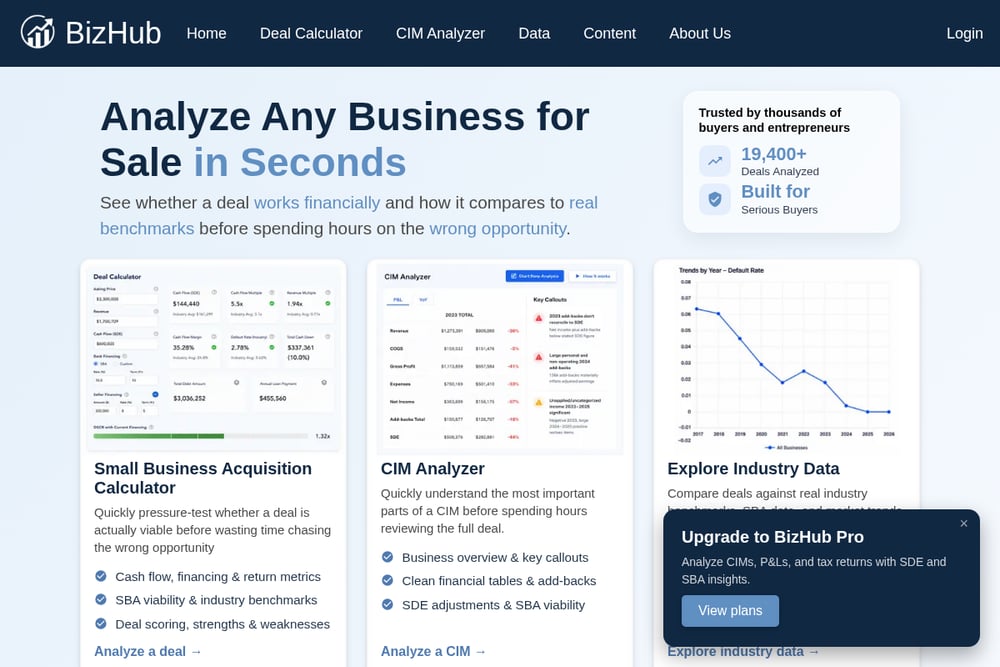 A screenshot of the BizHub Deal Calculator website.
BizHub combines a deal calculator with industry benchmarking data. You enter an asking price, revenue, and SDE, and the tool compares your deal against industry averages for cash flow multiples, revenue multiples, and default rates. It also calculates SBA guaranty fees, total acquisition cost, and payback period. The CIM Analyzer feature adds an AI-driven score that highlights the deal's overall strength. It's a good fit if you want context beyond the deal itself, like how your target compares to others in the same industry.
#5 Aryo Acquisition Deal Analyzer
 A screenshot of the Aryo Acquisition Deal Analyzer website.
Aryo's analyzer goes deep on the numbers that matter after close: cash-on-cash return, equity payback period, and free cash after debt and salary. You enter the purchase price, SDE, revenue, your salary, maintenance capex, and financing terms, and the tool shows you the maximum supportable price at a 1.25x DSCR. It also flags next actions, like anchoring your LOI below the max price and stress-testing at 15% lower SDE. The interface is built for buyers who want to understand the deal's cash flow profile, not just whether it passes a lender's test.
How to Pick the Right Calculator
Start with what you need. If you're screening dozens of listings and want a fast verdict, DealScore Pro or SDE or EBITDA? will save you the most time. If you're structuring a deal with seller financing and multiple lenders, PeerSense gives you the clearest picture of the capital stack. If you want to know how your target compares to industry norms, BizHub's benchmarks are the differentiator. And if you're past the screening stage and want to understand the cash flow you'll actually live on after close, Aryo's analysis is the deepest. Most buyers end up using two: one for screening and one for structuring.
Where Automation Fits
You can automate the screening layer without automating the decision. Set up a workflow where new listings from BizBuySell or a broker's email alerts get pasted into a calculator like SDE or EBITDA? or DealScore Pro, and the verdict gets logged in a spreadsheet with the asking price, multiple, and DSCR. That gives you a running shortlist of deals that pass the math test. From there, you spend your time on the deals that clear the bar, not on the ones that never had a chance.
The Bottom Line
The right calculator doesn't make the decision for you. It makes the decision clearer. SDE or EBITDA? earns the second spot because it answers the first-time buyer's core question with the math laid bare, and it does it for free. Pair it with a structuring tool like PeerSense or Aryo once you're serious about a deal, and you'll walk into every negotiation knowing exactly where your ceiling is.