You want to know which vice runs your life, but you do not want to hand over your email to find out. These five sin tests each take a different route to the same uncomfortable mirror.
Where sin testing stands in 2026
Online vice quizzes have quietly matured from throwaway Facebook fodder into structured self-reflection tools. Most now borrow language from psychometrics, map all seven sins instead of hiding six, and lean on visual outputs like radar charts you can screenshot and share. The best ones stay free, skip the sign-up wall, and treat the tradition seriously without pretending to be a diagnosis.
How these five were weighed
Each test was judged on depth of the result report, transparency of scoring, whether an account is required, mobile usability, and how honestly it frames itself as entertainment rather than clinical assessment. Breadth of the sin model, including counter-virtues, also counted heavily.
Here is the short version before the detail: one test goes deep on psychology, one goes deep on aesthetics, and three keep it fast and shareable.
| Provider | Best For |
|---|---|
| IDRlabs 7 Deadly Sins Test | Readers who want a long-established, essay-style result |
| Seven Deadly Sins Test — Weigh Your 7 Sins | MindWeigh | Deep, scenario-driven psychological profiling |
| Freudly Seven Deadly Sin Quiz | Granular per-sin scoring with banded ranges |
| My Deadly Sin | A fast, private, no-frills answer |
| 7 Deadly Sins Radar Test | Shareable radar charts and friend comparisons |
The five sin tests, one by one
#1 IDRlabs 7 Deadly Sins Test
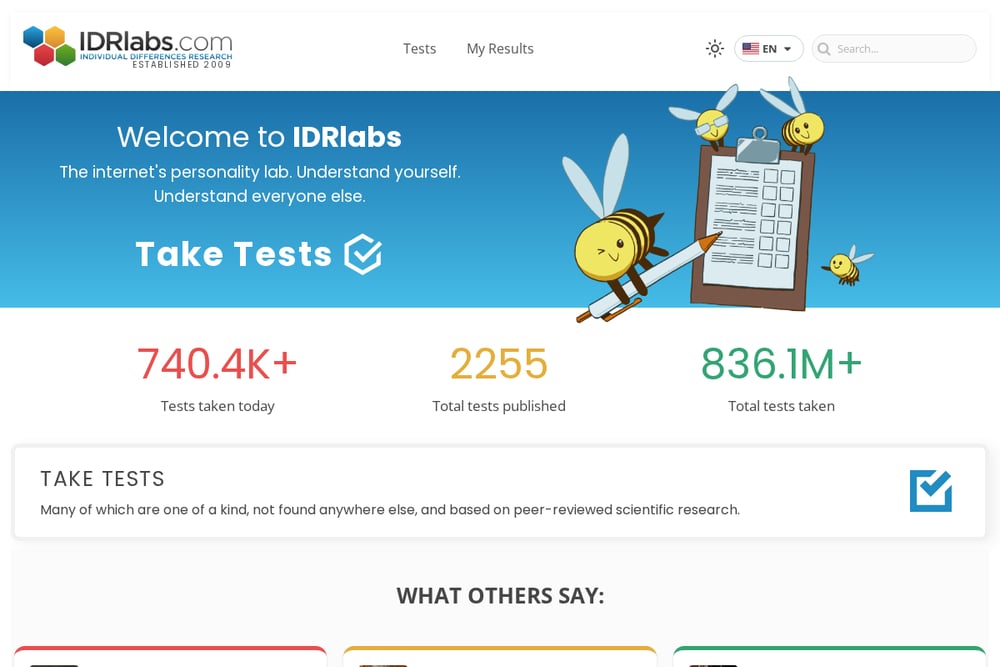 A screenshot of the IDRlabs 7 Deadly Sins Test website.
IDRlabs has been publishing tests since 2009, and it shows in the polish. The 35-question format asks you to agree or disagree with statements like feeling overlooked when attention goes elsewhere, then ranks all seven sins against the classical catalogue fixed by Pope Gregory the Great. Results read like short essays, treating lust, for example, as desire that stops serving love and starts commanding it. It is the most established name on this list and the safest starting point if you want a credible-feeling result. A companion 7 Heavenly Virtues Test covers the other side of the ledger.
#2 Seven Deadly Sins Test — Weigh Your 7 Sins | MindWeigh
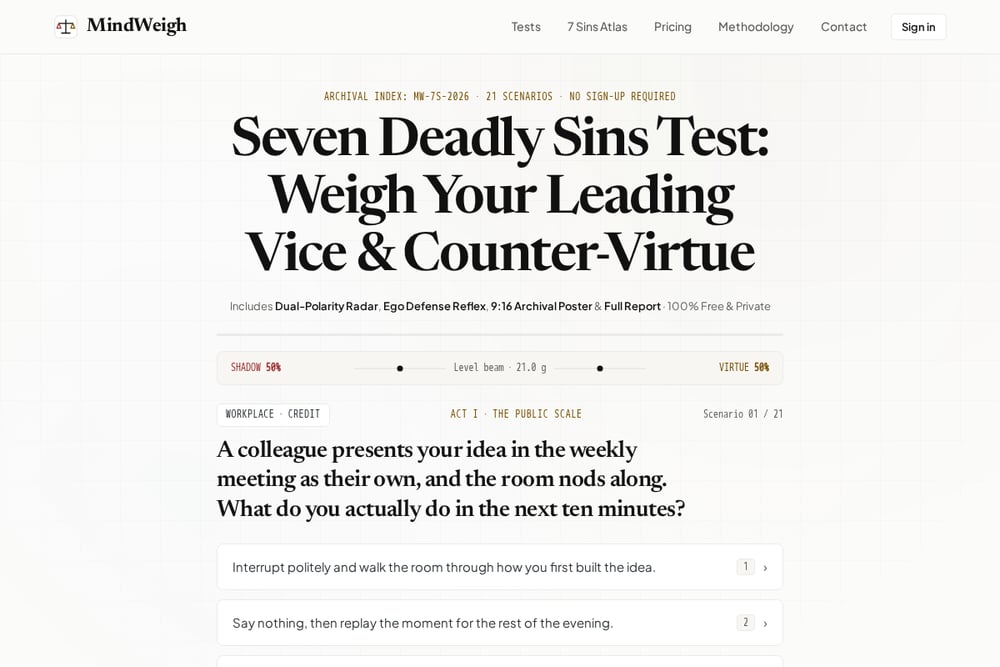 A screenshot of the Seven Deadly Sins Test — Weigh Your 7 Sins | MindWeigh website.
MindWeigh takes the most ambitious swing here. Its free 21-scenario test drops you into real moments, like a colleague presenting your idea as their own, and asks what you actually do in the next ten minutes. The payoff is a dual-polarity radar chart plotting both sins and counter-virtues, plus an archival-style dossier covering ego defense reflexes, a 7-day counter-virtue protocol, and literary matches drawn from 42 public-domain classics. It cites VAVS, HEXACO, and Vaillant's defense framework, and no sign-up is required. If you want a report you will still be reading an hour later, start here.
#3 Freudly Seven Deadly Sin Quiz
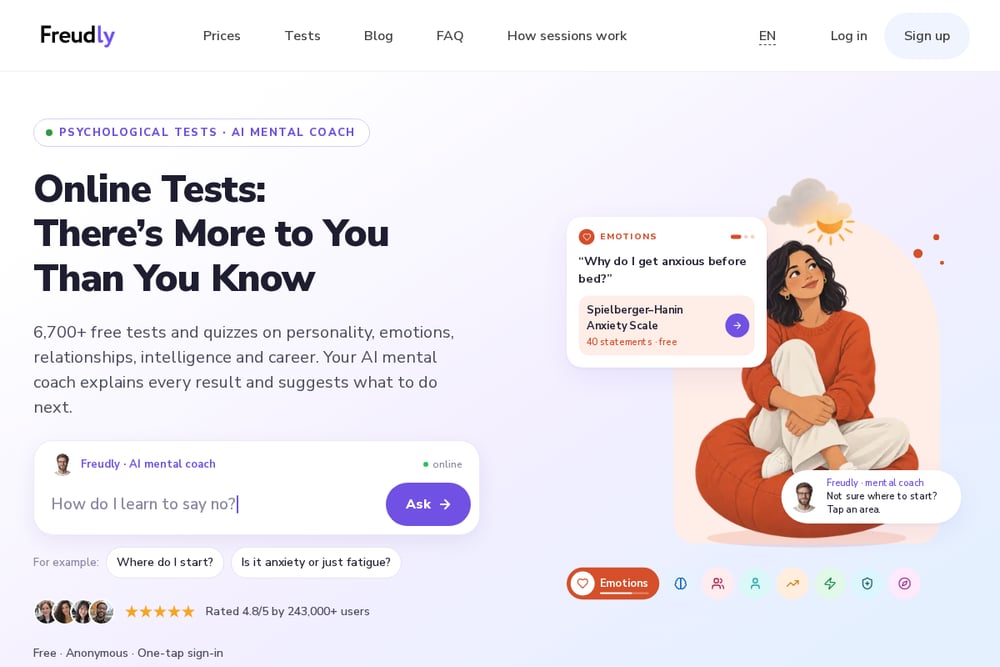 A screenshot of the Freudly Seven Deadly Sin Quiz website.
Freudly runs the longest assessment in this group at 80 questions and roughly ten minutes. Each sin gets its own scale with a maximum score, so pride tops out at 48 while lust and envy cap at 44, and your result is placed in bands from barely there to runs strong. That structure makes it easy to see not just your leading vice but how close the runners-up sit. The site reports tens of thousands of completions and a named psychologist as reviewer, which adds a layer of reassurance. It is the pick when you want granularity over speed.
#4 My Deadly Sin
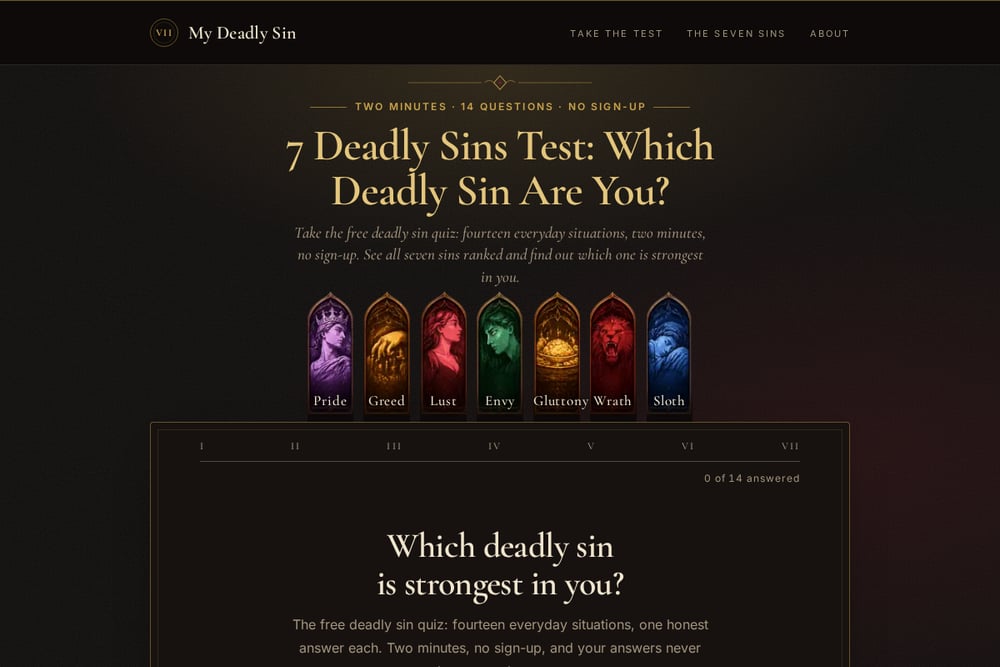 A screenshot of the My Deadly Sin website.
My Deadly Sin is refreshingly blunt about what it is: a two-minute quiz, fourteen everyday situations, and a result page that shows all seven sins ranked instead of hiding six. Scoring runs entirely in your browser, and a solo test saves only an anonymous summary for sharing. Friends who take it through an invite can compare results and choose whether to share their top types. The site explicitly says it is not a psychological assessment or a religious authority, just a mirror with a score attached. Sometimes that honesty is exactly what you need.
#5 7 Deadly Sins Radar Test
 A screenshot of the 7 Deadly Sins Radar Test website.
This newer entry keeps things simple and visual. You rate 28 statements on a five-point scale, four items per sin, and each raw score is normalized to a 0 to 100 percent scale so a neutral answer lands at 50 percent. The output is a heptagon radar chart you can download as a PNG or share via a compare link that overlays your profile on a friend's. Mobile handling is thoughtful, with a full-width answer stack and a fullscreen mode. It is the most game-like option on the list, and it knows it.
Pick the test that fits your patience
Start with how much time you have. Two minutes gets you My Deadly Sin; ten minutes gets you Freudly's 80 questions. Then ask what you want back. If it is a shareable image, the radar test wins. If it is a document you will reread, MindWeigh's dossier is the one. And if you simply want the most established name, IDRlabs has been at this since 2009.
Put your result to work
A test result is only useful if it changes something. Take your leading vice and set a weekly calendar reminder to review one trigger situation, using MindWeigh's four life arenas or Freudly's banded scores as your baseline. Save your radar chart and retake the same test in 30 days, then compare the two images side by side. If a sin score moves, you will see it before anyone else does.
The verdict you came for
None of these tests will diagnose you, and the honest ones say so. What they will do is name the appetite you keep feeding. MindWeigh gives you the deepest read, IDRlabs gives you the most trusted one, and the other three give you speed, granularity, and shareability respectively. Pick one, answer honestly, and let the result sting a little.