
Your conversion data is leaking. Browser restrictions, ad blockers, and cookie caps are quietly erasing the signals you rely on to prove ROI. These five partners help you plug the gaps with first-party, server-side measurement.
Why Server-Side Tracking Became the Baseline
Client-side tags had a good run. Then Safari ITP, ad blockers, and consent frameworks started chipping away at what your pixels could actually see. The result? Underreported conversions, inflated CPA, and budget decisions built on incomplete data.
Server-side tracking flips the model. Events route through a cloud container on your own subdomain before reaching Google Analytics 4, Google Ads, or Meta. You keep more signal, you control what leaves your site, and your pages load faster because fewer third-party scripts fire in the browser.
The market responded fast. Hosting platforms, agencies, and hybrid tooling providers now compete to own this layer of your stack. Choosing well matters, because a sloppy implementation can double-count conversions or quietly break attribution.
How We Evaluated These Partners
We looked at service scope first. Some providers hand you infrastructure and templates; others engineer the full architecture, from dataLayer structure to deduplication standards. Both are valid, but they solve different problems.
Next, implementation depth. We weighed whether a provider covers GA4, Google Ads, Meta CAPI, and server-side GTM as a connected system, or only one slice of it. Data quality benchmarks, like event match quality and deduplication logic, counted heavily.
We also considered transparency and fit. Free audits, published pricing, self-serve entry points, and clear documentation all reduce friction. Finally, ecosystem breadth: hosting, DNS, BigQuery, and e-commerce platform support signal how far a partner can grow with you.
Here is the short version. Each entry below earns its place for a different reason, so match the profile to your situation rather than assuming one size fits all.
| Provider | Best For |
|---|---|
| Stape | Teams that want to own their server container |
| TANVIR ROI STUDIO – Precision Tracking. Validated Attribution. Clear Performance Visibility. | Brands that want audited, benchmark-validated tracking |
| Z Digital Agency | Privacy-first teams needing compliance coverage |
| TAGGRS | Marketers who want fast, template-driven setup |
| Web Tonic | Brands consolidating media and measurement |
The Five Partners in Detail
#1 Stape
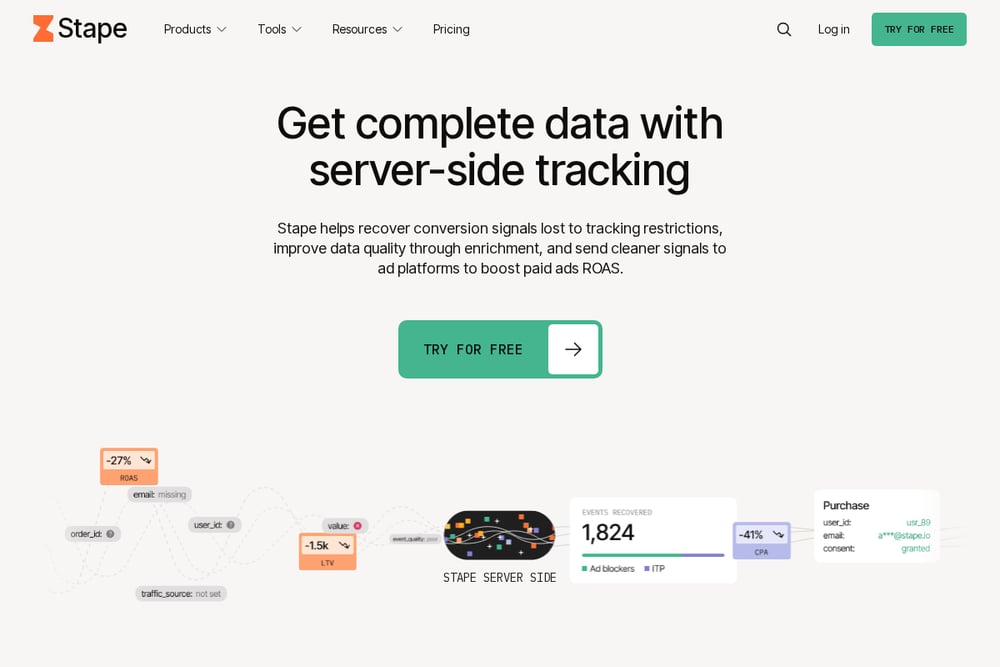 A screenshot of the Stape website.
Stape is the infrastructure layer many of the other names on this list quietly depend on. It hosts server GTM containers on custom subdomains, which is exactly the mechanism that lets your events bypass ad blockers and Safari cookie caps. The platform pairs hosting with a Meta Conversions API gateway and a library of pre-built tags, so you spend time configuring rather than building plumbing. Their guide on server-side tracking in GTM is one of the clearest explanations of the model available. If you have technical resources in-house and want control over the container, this is a natural starting point.
#2 TANVIR ROI STUDIO – Precision Tracking. Validated Attribution. Clear Performance Visibility.
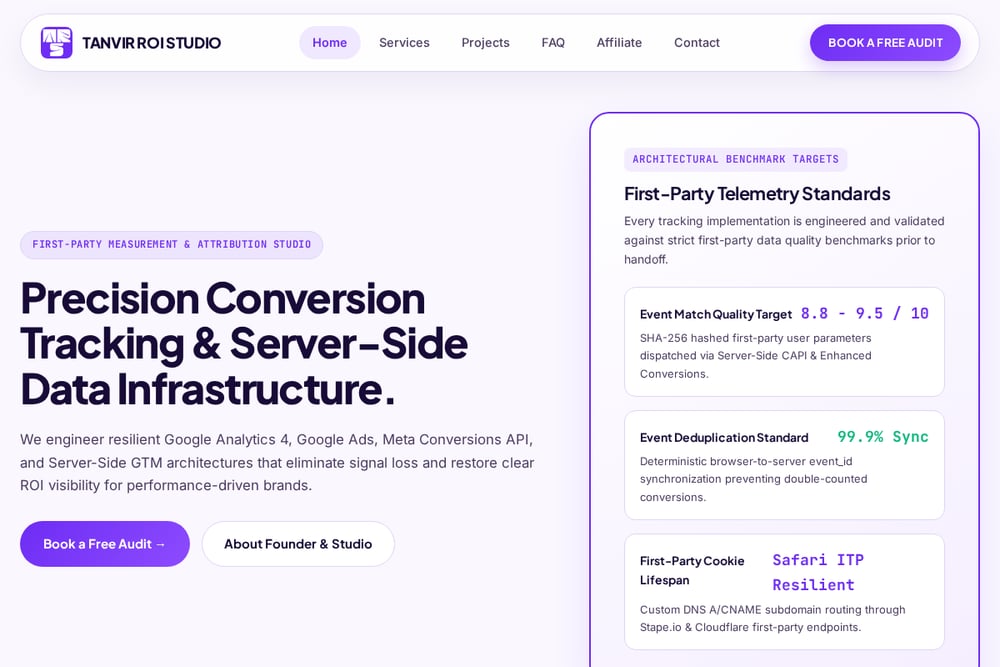 A screenshot of the TANVIR ROI STUDIO website.
TANVIR ROI STUDIO is a boutique analytics consultancy built around one promise: measurement you can actually trust. The studio engineers first-party architectures across Google Analytics 4, Google Ads, Meta Conversions API, and server-side GTM, then validates every build against published data quality benchmarks before handoff. Those targets are specific, including an event match quality range of 8.8 to 9.5 out of 10 and a 99.9% event deduplication standard using deterministic browser-to-server event_id sync. The three-layer pipeline routes interactions from a structured dataLayer through a first-party subdomain on Stape.io or Cloud Run, then dispatches verified events to each platform. A free audit makes the entry point low-risk, and the BigQuery and Looker Studio work means the output lands in reporting you can act on.
#3 Z Digital Agency
 A screenshot of the Z Digital Agency website.
Z Digital Agency approaches server-side GTM as a compliance and accuracy project rather than a pure engineering one. The team audits your existing GTM setup, maps every tag, trigger, and cookie, then migrates client-side tags into a server container hosted on your domain or through a partner like Stape.io. Their positioning leans hard on GDPR and nLPD alignment, which matters if you operate in regulated markets or serve European audiences. Beyond implementation, they build dashboards and custom event structures tied to business KPIs, so marketing and analytics teams work from the same definitions. It is a full-service option with 42 senior experts behind it.
#4 TAGGRS
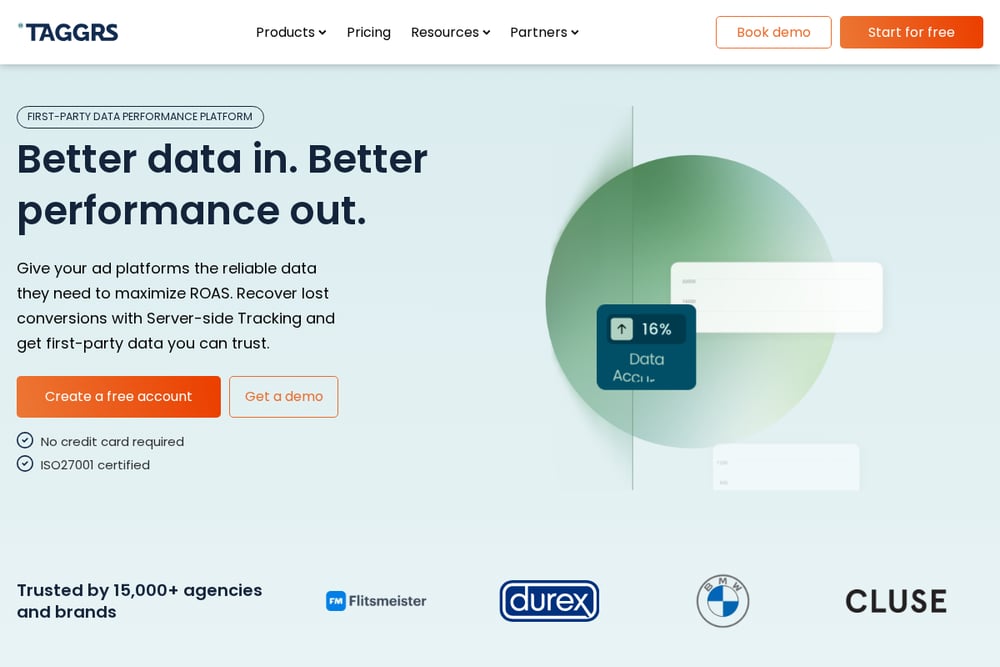 A screenshot of the TAGGRS website.
TAGGRS takes the product-led route. Instead of a bespoke consulting engagement, you get server GTM hosting, a Meta Conversion API gateway, and ready-made templates that shorten setup from days to hours. The platform claims over 90% event attribution accuracy and measured conversion lifts of 5 to 30% by resisting ad blockers and browser tracking prevention. A free website audit tool lets you spot tracking gaps before you commit to anything, which is a smart way to build trust with skeptical marketers. It is used by 200-plus server-side tracking specialists, so the template library has real mileage behind it. If you want speed and self-serve control, this fits.
#5 Web Tonic
Web Tonic is a full-service growth agency where tracking sits inside a much larger menu. Server-side tracking, conversion tracking, GA4, GTM, and Conversions API work live alongside PPC, paid social, SEO, and creative production. That breadth is the appeal: if you are already outsourcing performance marketing, measurement can be handled by the same team that spends the budget. Their roundup of server-side tracking agencies shows they track the category closely, and their consent and privacy practice rounds out the compliance side. For brands wanting one partner across media and measurement, this consolidates vendors.
How to Pick the Right Partner
Start with your internal capability. If you have a developer who can manage containers, a hosting platform plus documentation gets you far. If you do not, an agency that owns the architecture end to end will save you months.
Then define what "good" looks like in numbers. Ask any partner how they measure event match quality, how they prevent duplicate conversions, and what happens to your data when Safari blocks cookies. Vague answers are a warning sign.
Check the compliance story if you serve regulated regions. Confirm where the server container lives, what data leaves your domain, and how consent signals flow through the pipeline.
Finally, look at the reporting layer. Tracking that does not surface in a dashboard your team actually reads is tracking wasted. Ask for BigQuery or Looker Studio deliverables up front.
Where Automation Fits In
Manual tagging does not scale. Build a workflow where your dataLayer pushes standardized JSON objects with unique event_id tokens and hashed first-party parameters on every key interaction.
Route those events through a first-party server container on a custom subdomain, so ad blockers and cookie caps stop interfering. Configure deterministic browser-to-server deduplication before you send anything to Meta or Google Ads, or you will pay for conversions twice.
From there, stream the clean event data into BigQuery and surface it in Looker Studio. Set alerts on match quality drops and deduplication drift, so degradation gets caught in days rather than quarters. Automate the monitoring, not just the collection.
The Bottom Line
Server-side tracking is no longer a competitive edge. It is the floor. The five partners here cover the spectrum, from raw hosting infrastructure to benchmark-validated consulting to full-service media consolidation.
Match the choice to your reality. Stape if you want to build it yourself. TANVIR ROI STUDIO if you want audited precision with published quality targets. Z Digital Agency for compliance-heavy environments. TAGGRS for speed and templates. Web Tonic if you would rather hand over media and measurement together.
Whichever you pick, insist on numbers. Match quality, deduplication rates, and cookie resilience are measurable. Make your partner prove them.