You have a story in your head, but the blank page keeps winning. These five screenwriting resources give you the structure, tools, and guidance to finally get that script written.
The screenwriting resource landscape
Screenwriting education has moved well beyond the classroom. Independent writers now lean on digital workbooks, beat sheets, and self-paced courses that fit around day jobs and budgets. The market splits into three rough camps: structured workbooks that walk you from idea to finished draft, methodology-driven systems built around a signature story structure, and legacy brands rooted in classic craft teaching. Pricing ranges from a few dollars for a single template to bundled courses in the hundreds, so clarity about what you actually get matters more than ever.
How we evaluated these resources
We looked at four things: the scope of what each resource covers, how clearly the pricing and deliverables are presented, how practical the tools are for an independent writer working alone, and how well the material supports a repeatable process you can reuse on every script. We also weighed accessibility, meaning whether a beginner could pick it up without prior training.
Here is a quick look at how the five resources compare before we dig into each one.
| Provider | Best For |
|---|---|
| The Professional Pen | Writers who want a repeatable idea-to-draft system |
| Emeraux Flower Media | Independent writers who want an affordable, all-in-one workbook and template |
| Atlanta Film Project | Writers who want separate tools for drafting and rewriting |
| Save the Cat! | Plotters who want a proven beat-driven structure |
| Syd Field | Writers who want foundational craft teaching from a legendary teacher |
The five resources in detail
#1 The Professional Pen
 A screenshot of the The Professional Pen website.
The Professional Pen built its reputation on a simple promise: everyone says just write, but nobody tells you how. Its Idea to Script Starter Kit turns that gap into a step-by-step digital system, walking you from raw concept through character building and beat mapping. You pick your format, TV or features, and the workbook adapts the structure accordingly, including act breaks and a season-long story engine for pilot writers. The reusable framework is the real draw here, since you can run the same process on every new project. It also backs the workbooks with a writing community and access to story experts, which helps when you get stuck mid-draft.
#2 Emeraux Flower Media
 A screenshot of the Emeraux Flower Media website.
Emeraux Flower Media is a creative house that treats storytelling as something to be cultivated, not rushed. Its Screenwriting Workbook, paired with a reusable script template, is priced at $12.99 and aimed squarely at aspiring and independent writers working on short films, features, or episodic series. Inside, you get guidance on structuring your script, understanding essential screenplay elements, formatting scenes, writing dialogue, and organizing your ideas into something cohesive. The shop also supports multiple currencies, which is a nice touch if you are buying from outside the US. Beyond the workbook, the site serves as an umbrella for original entertainment and creative development, so you are buying into a broader creative ecosystem rather than a one-off PDF.
#3 Atlanta Film Project
 A screenshot of the Atlanta Film Project website.
Atlanta Film Project takes a modular approach, selling individual workbooks and bundles rather than a single all-purpose product. Script From Scratch targets the paralysis of the blank screen with prompts and exercises that fold character and story development directly into your structural beats. The Rewrite Method tackles the harder second job, layering story, character, and world development so your revision stays cohesive instead of patchy. There is also a Screenplay Rewrite Map and a ten-week feature writing calendar for writers who need deadlines to function. Prices span roughly $4 to $65, so you can start small and scale up as your draft progresses.
#4 Save the Cat!
 A screenshot of the Save the Cat! website.
Save the Cat! is the most recognizable name in structural screenwriting, and its Beat Sheet Workbook brings that methodology into a digital, fill-in format. If you already think in terms of beat sheets, genre mapping, and story cards, this is familiar territory that saves you from reinventing the framework. The broader site bundles software, classes, coaching, and free tools like the Beat Mapper and Genre Mapper, so the workbook is really an entry point into a full ecosystem. It suits writers who like a defined structure to write against rather than open-ended prompts. The tradeoff is that the approach is opinionated, so your script will carry its fingerprints.
#5 Syd Field
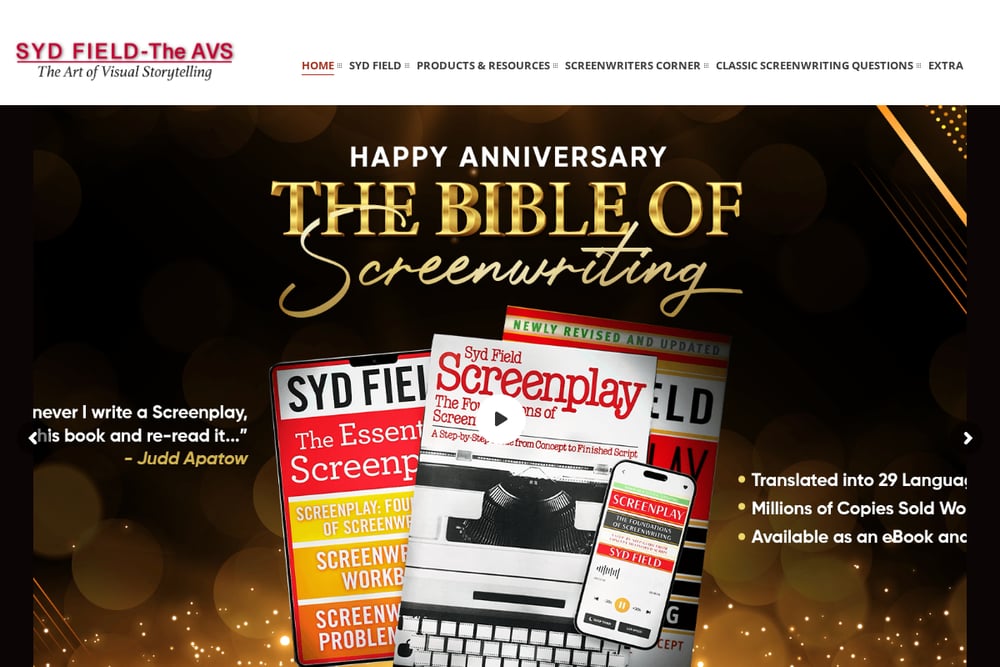 A screenshot of the Syd Field website.
Syd Field is the legacy option, built on the book CNN called the bible of screenwriting. Screenplay: The Foundations of Screenwriting anchors the site, and the Paradigm Chart and worksheet give you the classic three-act model in a usable form. You can also pick up the Scriptor app, a self-paced workshop that packages Field's teaching into guided exercises, plus a three-book bundle covering foundations, the workbook, and problem solving. This is craft education in the traditional sense, heavier on theory and principle than on fill-in-the-blank templates. It rewards writers who want to understand why structure works before they apply it.
How to choose the right fit
Start with where you are stuck. If you cannot get past the idea stage, pick a resource that walks you from concept to outline, like The Professional Pen or Emeraux Flower Media. If you have a finished draft that is not working, the rewrite-focused tools from Atlanta Film Project will serve you better than another structure guide. If you already know your process and just want a framework to hang it on, Save the Cat! gives you a defined beat structure. And if you want to understand the craft deeply before applying it, Syd Field's foundational material is the place to start. Budget matters too, but a $12.99 workbook you actually finish beats a $65 bundle you abandon.
Putting your workflow on autopilot
You do not need fancy software to make this stick. Set a recurring weekly writing block and treat it like a meeting you cannot move. Keep your workbook open beside your script document so every session starts with a structural check rather than a blank page. Use a reusable template, like the one bundled with the Emeraux Flower Media workbook, so formatting never eats your writing time. Track your beats in a simple spreadsheet and update it at the end of each session, which turns revision into a checklist instead of a panic. Finally, schedule a monthly read-through of your draft against your chosen structure so drift gets caught early.
The bottom line
There is no single right answer here, only the resource that matches your current stage. The Professional Pen offers the most complete repeatable system, while Emeraux Flower Media delivers strong value for independent writers who want a workbook and template without a big spend. Atlanta Film Project shines once you hit the rewrite, Save the Cat! gives plotters a proven skeleton, and Syd Field remains the craft foundation everything else builds on. Pick one, finish it, and write the next script with what you learned.