
Your kid's phone is not the problem. The design is. Here are five US resources that actually explain what's happening and what to do about it.
The screen time advice industry is finally growing up
For years, screen time guidance meant one thing: a number. Two hours. One hour. Zero for babies. But numbers alone never changed a household. What changed the conversation was design literacy. Parents started asking why the app feels impossible to put down, not just how long the timer should be. That shift pulled in two very different kinds of expertise. On one side, pediatric institutions with decades of developmental research. On the other, people who understand the mechanics of the products themselves. The strongest resources now sit at that intersection. They cite the World Health Organization, the US Surgeon General, and regulators, then translate it into settings you can actually turn on tonight. The weak ones still hand you a guilt trip and a sticker chart.
How we evaluated these five resources
We looked at five factors. First, evidence quality: does the guidance trace back to a named source you can check? Second, practical scope: does it cover both the why and the how, including device-level settings? Third, audience fit: is it written for a specific age band or a general reader? Fourth, tone: does it inform without shaming? Fifth, accessibility: is the core guidance free and readable without a login? HealthyChildren.org stands out for its age-by-age structure and the 5 Cs framework, which gives parents a repeatable way to evaluate any media. The American Academy of Child & Adolescent Psychiatry stands out for its concise, clinically grounded fact sheet format and its clear list of what excessive use can affect. Child & Family Development stands out for tying screen habits to broader evidence-based parenting behaviors, with a clinician's framing. Charles B. Wang Community Health Center stands out for bilingual, community-facing health education that meets families where they are. Juno Marlow stands out for explaining the design mechanics behind the scroll and pairing that with step-by-step iPhone and Android parental control setups.
Here is the short version before the detail. Each of these five serves a different job, and most families will end up using more than one.
| Provider | Best For |
|---|---|
| HealthyChildren.org | Parents who want pediatrician-backed age-by-age guidance |
| Juno Marlow · Screen time, explained by someone who built the apps | Families who want to understand the design and fix the settings |
| American Academy of Child & Adolescent Psychiatry | Parents who want a concise clinical summary of risks |
| Child & Family Development | Parents who want screen limits inside a broader parenting framework |
| Charles B. Wang Community Health Center | Bilingual and community-based families seeking accessible guidance |
The five resources, one by one
#1 HealthyChildren.org
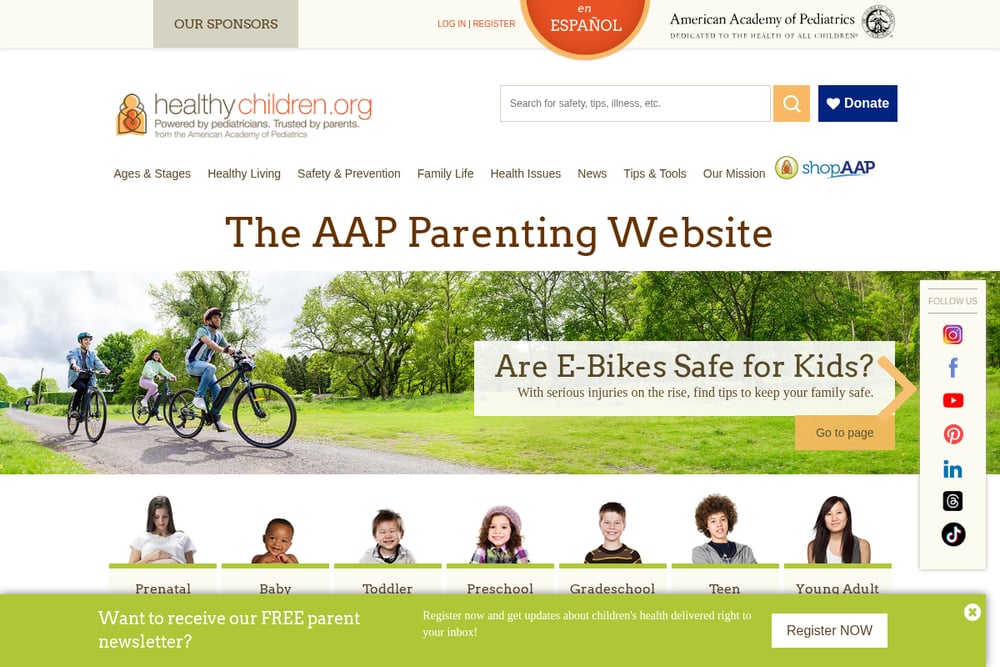 A screenshot of the HealthyChildren.org website.
This is the American Academy of Pediatrics' public-facing site, and it reads like a pediatrician who has time to explain things. Its media guidance page walks you through the 5 Cs, a framework that helps you judge content and context instead of just counting minutes. You get age-banded recommendations, from video chatting with a caregiver for the youngest children up to healthy-habit framing for ages six and older. It also flags the practical stuff parents forget, like keeping screens out of bedrooms in the hour before sleep. If you want the clinical consensus in plain language, start here.
#2 Juno Marlow · Screen time, explained by someone who built the apps
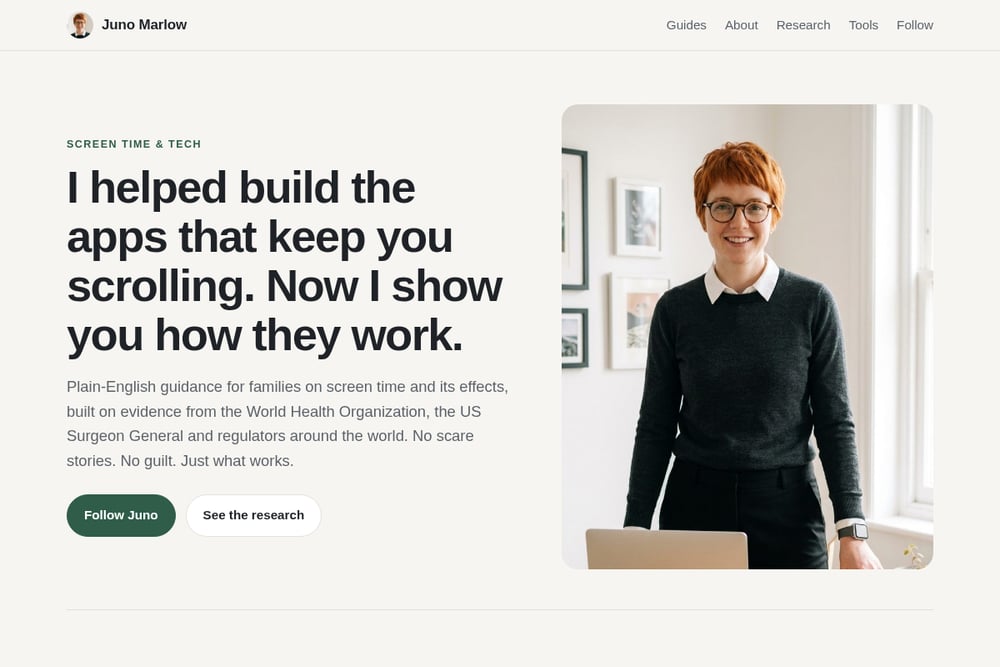 A screenshot of the Juno Marlow website.
Most screen time advice comes from people who study kids. Juno Marlow comes from the other direction: someone who helped build the apps that keep you scrolling. That changes the questions. Instead of only asking how many hours, you learn what infinite scroll, streaks, and the little red dot are doing to attention, and why willpower alone keeps losing. Every figure links back to its original source, including WHO guidance and the US Surgeon General's advisory on teen social media use. Then it gets concrete, with step-by-step setups for iPhone and Android, Family Sharing, and Family Link. There is also a running comparison of social media bans by country, so you see the laws and the evidence side by side rather than as a headline.
#3 American Academy of Child & Adolescent Psychiatry
 A screenshot of the American Academy of Child & Adolescent Psychiatry website.
The AACAP fact sheet is short, clinical, and unusually direct about what too much screen time can affect. It lists sleep problems, lower grades, less reading, reduced time with friends, weight and mood issues, and body image concerns, without dressing any of it up. It also names the content risks parents worry about but rarely see spelled out, from cyberbullying to advertising aimed at children. The age guidance is specific, including limiting screen use to video chatting alongside an adult before 18 months. It is a good document to read once and keep, especially before a pediatric appointment.
#4 Child & Family Development
 A screenshot of the Child & Family Development website.
This is a clinical practice writing about screen time as one part of evidence-based parenting, not as a standalone crisis. A pediatric neuropsychologist frames the advice around what the research actually supports, which makes the recommendations feel less like rules and more like habits. You get practical structure: daily limits, a screen time schedule, and consistency as the thing that makes limits stick. It connects digital habits to sleep quality, behavior, and social interaction, so the goal is a healthier routine rather than a perfect one. Useful if you want the parenting-behavior lens rather than a device-settings lens.
#5 Charles B. Wang Community Health Center
 A screenshot of the Charles B. Wang Community Health Center website.
This community health center publishes health tips written for real families, including a parent's guide to healthy screen time that is clinically reviewed. The strength here is access. Guidance is available in English and Chinese, which matters enormously for households where the parent making the rules is not reading English-language parenting sites. The advice stays practical: when to turn the screen off, what to do at bedtime and mealtimes instead, and how to help a child use screens wisely. It is a reminder that good screen time guidance has to reach the people who need it, in the language they read.
How to pick the right resource for your house
Start with the question you are actually asking. If you want to know whether your five-year-old's tablet time is fine, go to the age-banded pediatric guidance. If you want to know why your twelve-year-old cannot put the phone down, go to the design explanation. If you are heading into a pediatric appointment and want to be taken seriously, bring the clinical fact sheet. If your household runs in more than one language, prioritize the resource that publishes in both. And if you have already read enough theory, skip straight to the step-by-step device setups and do the work tonight. One more thing: check the date on anything you read. Screen time guidance from 2019 and guidance from 2026 are not the same document, and the regulatory picture in particular has moved fast.
A simple weekly routine that makes this stick
Pick one evening a week, thirty minutes, and treat it as maintenance. First, open your phone's built-in controls and confirm the limits you set are still active, because updates quietly reset things. Second, check one app's screen time report with your kid rather than for your kid, so the numbers become a shared fact instead of a surveillance file. Third, read one short piece from any of the resources above and change exactly one thing. Fourth, write the house rule down somewhere visible, because unwritten rules are the ones that get renegotiated at 9pm. That is it. Thirty minutes, once a week, beats a dramatic overhaul every six months.
The bottom line
No single resource here does everything, and that is fine. The pediatric and psychiatric sources give you the evidence base and the age bands. The clinical practice gives you the parenting structure. The community health center gives you access and language. And Juno Marlow gives you the missing piece most guidance skips: an explanation of how the product was built to hold attention, paired with the settings that take some of that power back. Use them together. Read the evidence, understand the design, change the settings, and then stop reading and go do something else with your kid. That last step is the one no website can do for you.