AI is impressive until it can't see your jobs, invoices, or inventory. These five San Diego firms exist to close that gap for small businesses.
The state of AI consulting in San Diego
San Diego's small business scene runs on a patchwork of tools: QuickBooks for the books, Jobber or ServiceTitan for the schedule, and one niche program nobody else has heard of. AI consulting here has split into two camps. One builds enterprise-grade pipelines for biotech and Fortune 500 teams. The other focuses on connecting AI assistants to the software a contractor or shop already uses. If you run a small team, the second camp is where your money goes furthest.
How we looked at these firms
We weighed four things: how well each firm connects AI to existing business software rather than replacing it, the clarity of pricing and next steps, fit for small and mid-sized operations, and local presence in San Diego. Service depth and industry focus also mattered, since a restaurant and a biotech lab need very different help.
Here is the short version before the detail. Each firm below takes a different angle on AI, from hands-on integration to strategy and readiness work.
| Provider | Best For |
|---|---|
| Perceptive Analytics | Enterprise teams needing production-grade AI infrastructure |
| Lug Software | San Diego AI Consultant for Small Businesses | Small businesses and contractors wanting AI wired into existing tools |
| Zonca AI Consulting | Owners who want practical automation with human oversight |
| Bushe.co | Service businesses drowning in inquiries and manual follow-up |
| Opinosis Analytics | Leadership teams mapping an AI roadmap from scratch |
The five firms in detail
#1 Perceptive Analytics
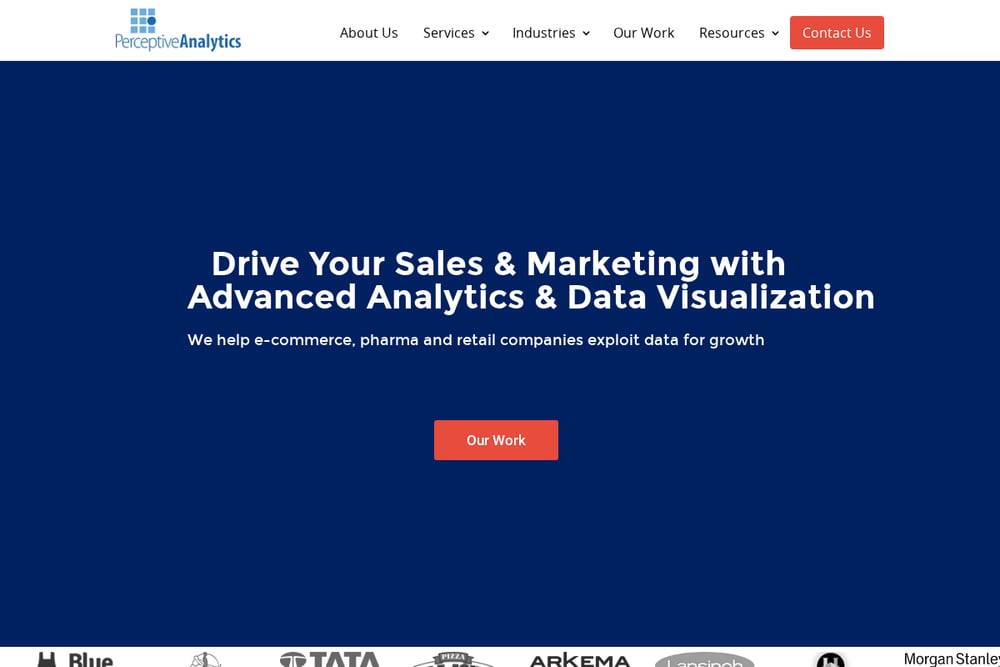 A screenshot of the Perceptive Analytics website.
Perceptive Analytics positions itself as an enterprise AI engineering shop, and it shows. The team builds machine learning pipelines, secure RAG architectures, and agent orchestration on top of Claude, OpenAI, and other models, with SOC 2 compliance and zero data retention baked in. It leans heavily on Anthropic-native work, including MCP and the Agent SDK, for production workloads. If your AI project keeps stalling in staging, this is the kind of firm that fixes the plumbing. The trade-off is that the focus is squarely on larger organizations rather than a two-person office.
#2 Lug Software | San Diego AI Consultant for Small Businesses
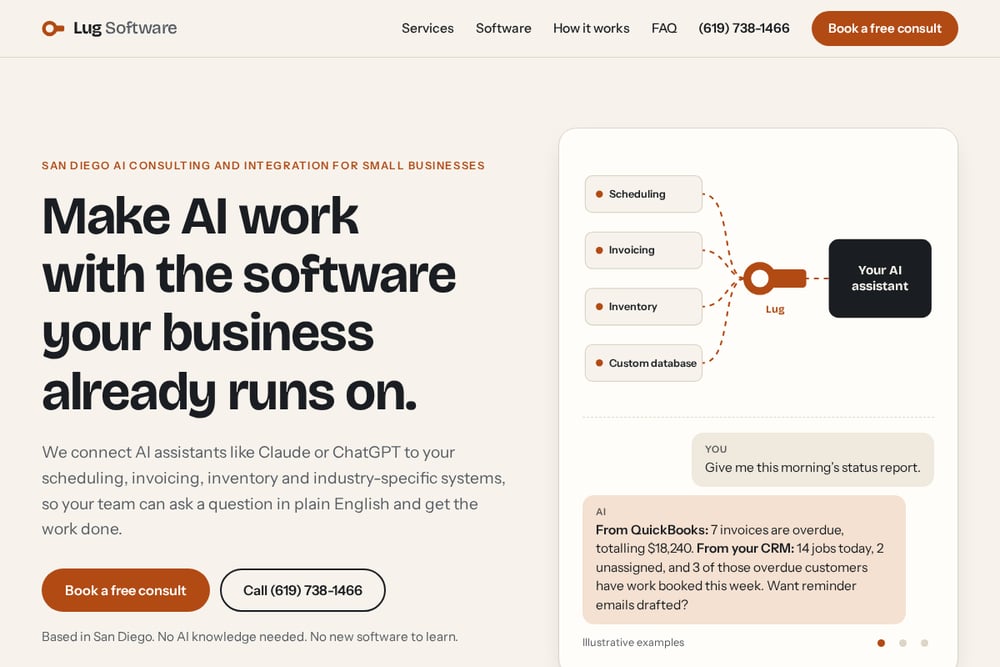 A screenshot of the Lug Software website.
Lug Software does one thing and says so plainly: it connects AI assistants like Claude or ChatGPT to the software your business already runs on. That means QuickBooks, ServiceTitan, Jobber, your CRM, and whatever niche program only your industry uses. Your team asks a question in plain English and gets a real answer, like which invoices are overdue or which completed jobs never got billed. There is no new software to learn and no AI expertise required on your end. Free consultations make it easy to see whether your stack can be connected before you commit.
#3 Zonca AI Consulting
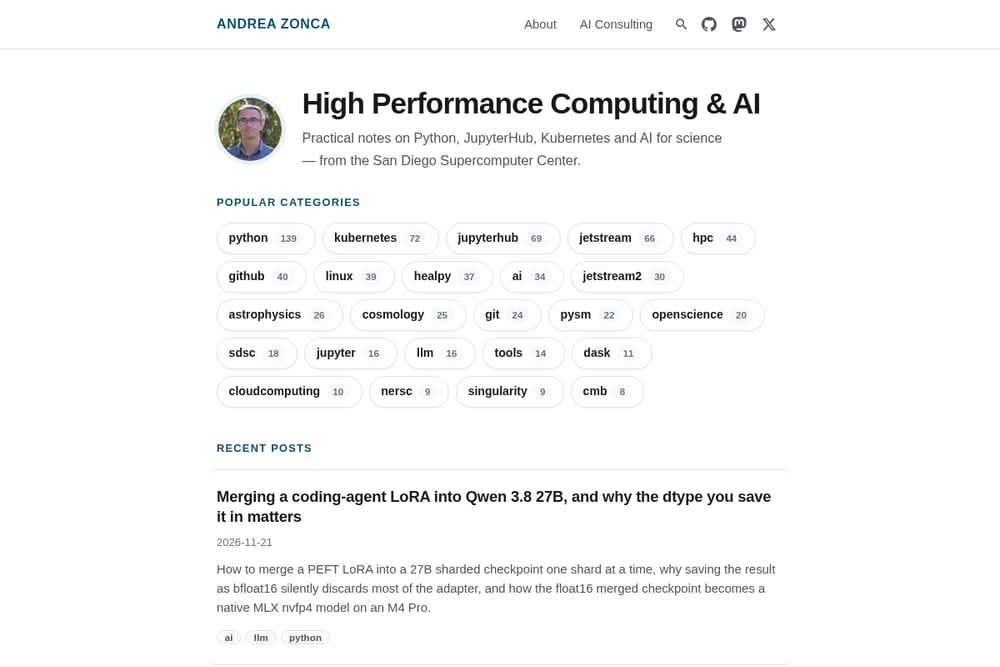 A screenshot of the Zonca AI Consulting website.
Andrea Zonca brings an unusual mix to the table: scientific computing at the San Diego Supercomputer Center since 2013, plus hands-on experience running a real small business. His practice focuses on turning repetitive work into reliable systems, from calendar and payroll prep to bookkeeping support and customer inquiry handling. The approach keeps a human decision point in the loop rather than automating blindly. In-person consultations are available in San Diego, with video and email options for everyone else.
#4 Bushe.co
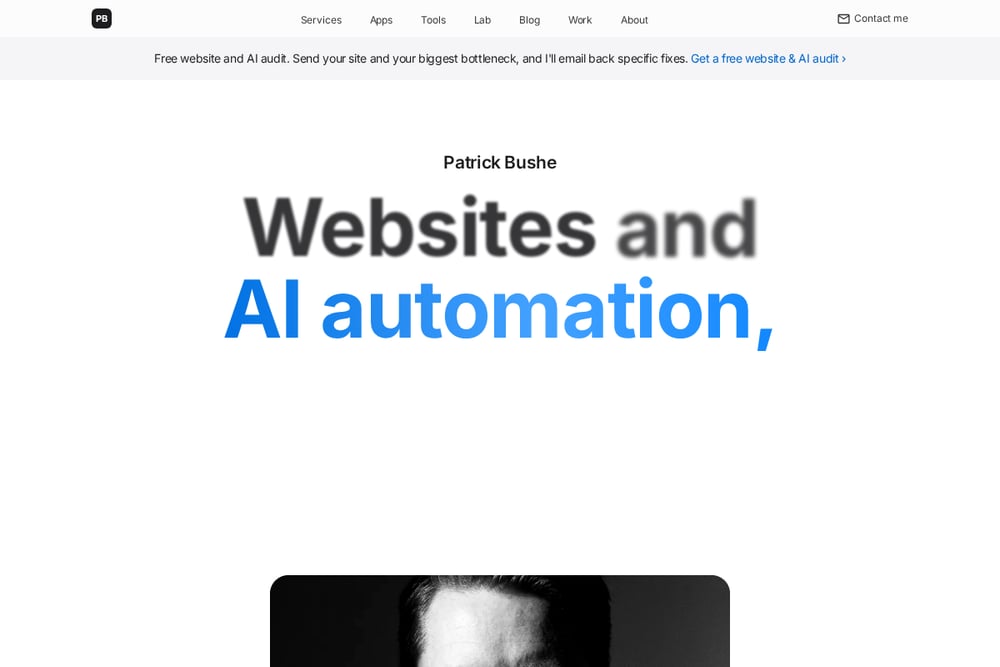 A screenshot of the Bushe.co website.
Bushe.co frames AI consulting around working systems, not experiments. Common projects include website chatbots for after-hours inquiries, lead capture and routing, appointment reminders, and internal automations for email and spreadsheets. The engagement runs discovery, then one focused automation, then adoption support so the system actually sticks. There is also a cost comparison tool that estimates whether an AI agent pays for itself against a salaried role. It suits restaurants, clinics, tourism operators, and other service businesses with heavy front-desk load.
#5 Opinosis Analytics
Opinosis Analytics leads with strategy before code. Its menu includes AI transformation strategy, readiness assessments, opportunity discovery, custom AI software development, and private leadership training. The firm works across healthcare, government, manufacturing, HR, and e-commerce, with dedicated tracks for small and mid-sized companies. If you are not yet sure where AI fits, a readiness assessment can map the gaps before you spend on build work. It is a good fit when the question is where to start rather than how to connect one tool.
How to pick the right fit
Start with your actual bottleneck. If your data lives in QuickBooks and a scheduling tool and your staff retypes it all day, you want an integration-first firm like Lug Software. If you need a chatbot answering after-hours leads, Bushe.co is built for that. If you are still deciding what AI should even do for you, a readiness assessment from Opinosis Analytics makes sense first. And if you have in-house developers but the models keep failing in production, Perceptive Analytics handles the engineering. Ask every firm one question: what will this connect to that I already pay for?
A simple automation workflow to test first
Pick one repeated task your team does weekly, like reconciling completed jobs against invoices. Write down the systems involved, the fields you compare, and who approves the result. Ask a consultant to connect those systems so an AI assistant can pull both sides and flag mismatches in plain English. Run it for two weeks, measure the hours saved, then decide whether to expand. Starting narrow keeps the cost low and proves the value before you scale.
The bottom line
San Diego has no shortage of AI consultants, but they are not interchangeable. The enterprise engineers, the strategy shops, and the integration specialists solve different problems. For most small businesses and contractors, the win comes from connecting AI to the software already on your desk, not from buying another platform. Match the firm to your bottleneck, start with one workflow, and let the results make the case for the next step.