
Rubber prices don't wait for you to finish your coffee. If you buy, sell, or hedge rubber, you need a read on the market before your competitors get one.
The Rubber Intelligence Landscape Right Now
Rubber isn't a quiet commodity anymore. Natural rubber benchmarks hit multi-year highs in 2026, with Indonesian SIR20 up 39% year-on-year and European TSR20 up 68%, according to Rubber World's coverage of the IRSG price outlook. At the same time, the global industrial rubber market is projected to grow from $11.48 billion in 2025 to $14.90 billion by 2030, a 5.4% CAGR, per MarketsandMarkets. That combination of tight supply and steady demand means the gap between well-informed and poorly-informed buyers is widening. You don't need to be a statistician. You need a source that turns noise into a number you can act on.
How We Evaluated These Sources
We looked at five factors. First, service scope: does the source cover natural rubber, synthetic rubber, or both, and does it go beyond headlines into usable data? Second, pricing clarity: can you tell what you're paying for before you commit, or is it quote-only? Third, local fit: how useful is the coverage if you're operating in or sourcing from the US market? Fourth, update frequency: monthly, quarterly, or daily matters depending on whether you're hedging or planning a year out. Fifth, actionability: does the source tell you what happened, or does it help you decide what to do next? Each source below stands out on a different combination of these factors.
Here's the short version before the deep dive. Each source below serves a different kind of rubber market participant, from the trader who needs a fast read to the procurement team building a five-year plan.
| Provider | Best For |
|---|---|
| Rubber World Market Reports | Daily and weekly market pulse checks |
| Tapline | Comparing your market read against peers |
| International Rubber Study Group Reports | Authoritative statistical baselines |
| MarketsandMarkets Industrial Rubber Market | Segment-level market sizing and forecasts |
| Mordor Intelligence Synthetic Rubber Market | Synthetic rubber-specific analysis |
The 5 Sources, One by One
#1 Rubber World Market Reports
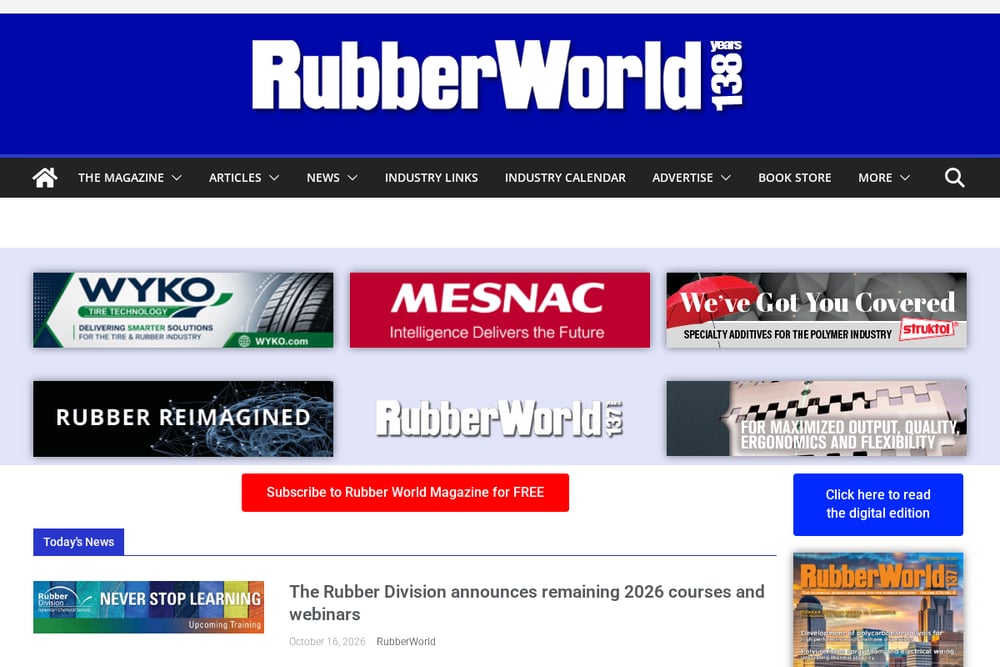 A screenshot of the Rubber World Market Reports website.
Rubber World is the technical service magazine for the rubber industry, and its market reports section is a running feed of price and forecast news. In October 2026 alone, it covered the high-styrene rubber market forecast reaching $544 million by 2032 and natural rubber prices hitting multi-year highs. The strength here is breadth and cadence: you get a steady stream of short, sourced updates rather than one dense annual report. If you want to know what moved this week and why, this is where you start. It's also free to read, which matters when you're scanning for signals rather than building a model.
#2 Tapline
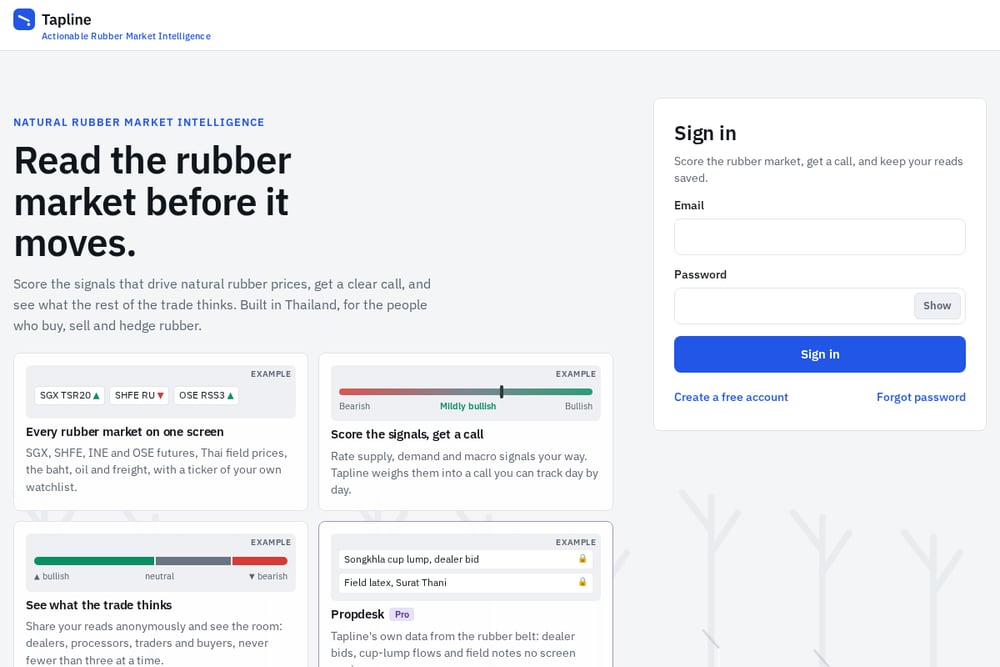 A screenshot of the Tapline website.
Tapline takes a different angle: it's built around scoring the rubber market and getting you a call, then comparing your read with the room. The site describes itself as market information, not investment advice, which tells you it's aimed at people making real decisions, not spectators. Where Rubber World gives you the news feed, Tapline gives you a comparison layer, so you can see how your view stacks up against other participants. It's a small, focused professional service, and that focus is the point. If you've ever wanted a second opinion on your rubber market read before you commit, this is the tool to try.
#3 International Rubber Study Group Reports
 A screenshot of the International Rubber Study Group Reports website.
The IRSG has been the recognized world authority on rubber statistics for over seventy years, and its reports show it. The Rubber Statistical Bulletin gives you quarterly country-level data on production, consumption, trade, and prices for both natural and synthetic rubber. The Rubber Industry Report covers short-term forecasts, while the World Rubber Industry Outlook handles the long view. Most major rubber producing and end-user companies use the RSB as a reference guide for their own analysis. If you need the underlying numbers rather than a summary of them, this is the source the summaries are built on.
#4 MarketsandMarkets Industrial Rubber Market
 A screenshot of the MarketsandMarkets Industrial Rubber Market website.
MarketsandMarkets publishes a 311-page industrial rubber market report with 320 tables, covering applications from automotive to wire and cable. The headline numbers are clear: $11.48 billion in 2025 growing to $14.90 billion by 2030 at a 5.4% CAGR. It breaks the market down by type, product, end-use processing, and region, which makes it useful for segment-level planning rather than just headline reading. Pricing is published up front, with single-user and corporate license options. If you're building a business case or a procurement strategy, this is the kind of structured report you cite.
#5 Mordor Intelligence Synthetic Rubber Market
 A screenshot of the Mordor Intelligence Synthetic Rubber Market website.
Mordor Intelligence focuses specifically on the synthetic rubber market, with forecasts running from 2026 to 2031. The report segments by type, including styrene-butadiene rubber and polybutadiene rubber, by manufacturing process, by raw material, and by application, with tire and tire components as a major category. That granularity is useful if your exposure is concentrated on the synthetic side rather than natural rubber. It also covers the regulatory landscape and value chain, which helps you understand not just the price but the pressures behind it. If synthetic is your world, this is a targeted read.
How to Pick the Right Source for You
Start with your time horizon. If you're making decisions this week, you want a source that updates constantly, like Rubber World's market reports feed. If you're planning a budget or a hedge for next year, you want the statistical depth of the IRSG or the structured forecasts from MarketsandMarkets. Next, look at your exposure. If you're mostly in synthetic rubber, Mordor Intelligence gives you the focused view; if you're in natural rubber, the IRSG bulletins and Rubber World's price coverage are more directly relevant. Then think about whether you want data or a decision aid. Tapline sits in the second category, giving you a way to score the market and compare your read with others. Finally, check pricing clarity. Some sources publish their rates; others are membership or quote-based. Know which you're walking into before you invest time.
Where Automation Fits In
You don't need to read everything. Set up a simple workflow: pull headline price moves from Rubber World's feed into a weekly note, check the IRSG bulletin quarterly for the statistical baseline, and use Tapline when you want a structured comparison before a big call. If you're building models, the MarketsandMarkets and Mordor reports give you the segment assumptions to plug in. The goal isn't to consume more information. It's to consume the right information at the right cadence so you're never reacting to a price move you could have seen coming.
The Bottom Line
Rubber market intelligence isn't one product. It's a stack. You need a fast feed for the daily pulse, a statistical authority for the baseline, structured reports for planning, and a comparison tool for the moments when your read needs a sanity check. The five sources here cover that stack, and each one earns its place by doing one job well. Pick the two or three that match your exposure and your horizon, and you'll be better informed than most of the room.