You know the rules. You still lose to players who seem to read your hand like a menu. These five resources are built to close that gap.
Where Riichi Study Is Heading
Riichi mahjong has quietly grown from a niche import into a serious study culture. English-speaking players now grind Tenhou and Mahjong Soul ladders, and the demand for structured learning has followed. The old path was scattered forum posts and translated PDFs. The new path looks more like a curriculum: paid seminars, coaching, trainers, and reference academies. What separates the useful resources from the noise is specificity. Beginners can find rules anywhere. Intermediate and advanced players need targeted work on discard reading, threat assessment, and push-fold decisions. That is exactly where the market is moving, and where the strongest offerings now compete.
How We Evaluated These Resources
We looked at the same factors for every entry. First, scope: does the resource cover a defined skill area deeply, or skim everything? Second, pricing clarity: can you see what you get and what it costs before committing? Third, format fit: recorded seminars, interactive drills, and written references serve different study habits. Fourth, credibility signals: competitive rank, published track record, and how the material is sourced. Fifth, accessibility for an English-speaking audience, including terminology handling. Mr Feng's Riichi Courses stands out for a paid focus on discard reading and situational decision-making, with a visible price. NPMahjong impresses with a broad tool and guide ecosystem. RIICHI~SENSEI offers an unusually complete free curriculum. Daina Chiba's books deliver depth in written form. The Mahjong Efficiency Trainer adds hands-on repetition for tile efficiency.
Here is the quick comparison before the deep dive. Each entry serves a different study style, so match the format to how you actually learn.
| Provider | Best For |
|---|---|
| NPMahjong | Players who want tools, guides, and coaching in one place |
| Mr Feng's Riichi Courses | Intermediate players who want a structured, affordable course on situational decision-making |
| RIICHI~SENSEI | Self-directed learners who want a free, complete curriculum |
| Riichi Mahjong Strategy Books by Daina Chiba | Readers who prefer a written, revisitable strategy reference |
| Mahjong Efficiency Trainer | Daily drill practice to sharpen tile efficiency instincts |
The Five Resources in Detail
#1 NPMahjong
 A screenshot of the NPMahjong website.
NPMahjong is the closest thing to a full study hub in English. You get strategy articles, a glossary of 216 riichi terms, scoring and dora guides, and a stack of calculators covering Tenhou rank, wait win rates, and push-or-fold decisions. The site also runs 1-on-1 coaching and game reviews, so you can move from reading to direct feedback. Its free lessons run in order from rules to defense, which makes it easy to plug gaps you did not know you had. If you want one bookmark that covers both theory and tools, this is it. See the online play guide and the coaching options for the full picture.
#2 Mr Feng's Riichi Courses
 A screenshot of the Mr Feng's Riichi Courses website.
Mr Feng's Riichi Courses is a focused, paid training program for players who already know tile efficiency and the 5-block method. The flagship Discard Reading seminar is split into three parts and costs US$18 with instant access, which makes the commitment easy to judge up front. Inside, you work through reading early discards, judging tenpai proximity, using suji reads properly, and deciding which block to sacrifice. The instructor's Tenhou 8-dan rank and 2,000+ YouTube subscribers give you a clear credibility signal before you buy. Free slides are available if you want a sample first. The material goes past tile efficiency math into situational adaptation, adjusting your play as the table situation changes. The course page lays out exactly who it is for and who it is not, which is refreshingly honest.
#3 RIICHI~SENSEI
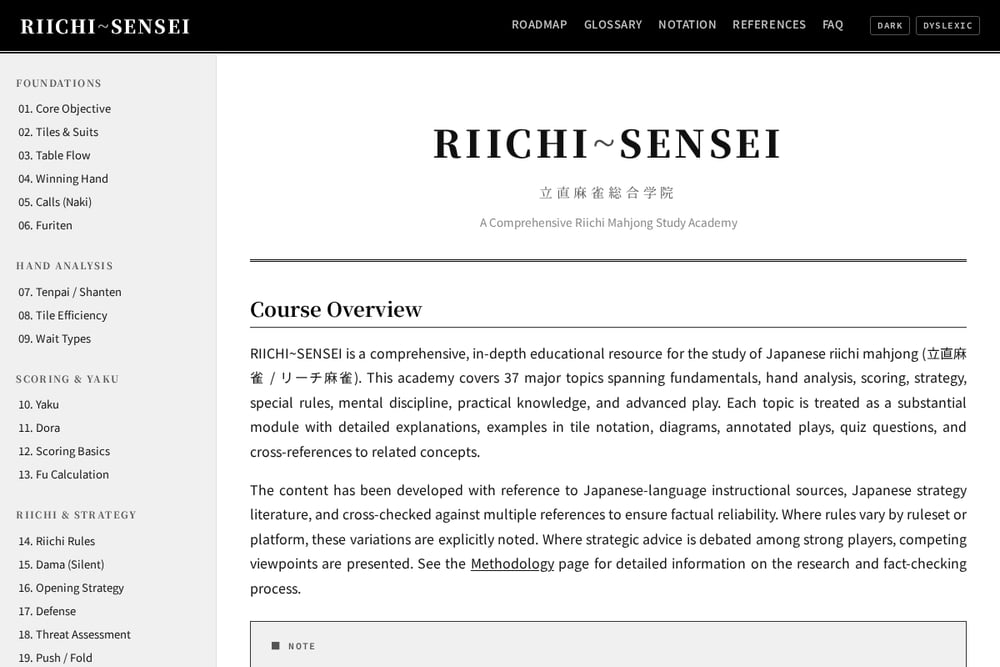 A screenshot of the RIICHI~SENSEI website.
RIICHI~SENSEI bills itself as a comprehensive study academy, and the structure backs that up. It spans 37 major topics across fundamentals, hand analysis, scoring, strategy, special rules, mental discipline, and advanced practice. Each module includes tile notation examples, diagrams, quizzes, and cross-references, so you can follow a thread from concept to application. The material is cross-checked against Japanese-language sources, and where strong players disagree, competing viewpoints are presented rather than flattened. It is free to read, which makes it a low-risk starting point for building a study habit. The threat assessment and push-fold modules are especially useful for players moving past beginner territory.
#4 Riichi Mahjong Strategy Books by Daina Chiba
 A screenshot of the Riichi Mahjong Strategy Books by Daina Chiba website.
Daina Chiba's Riichi Book I is a fixed-layout PDF written specifically for European and English-speaking players. It covers beginner and intermediate strategy in depth, with a second volume planned for advanced play. The book is freely downloadable, with donations welcomed, and translations exist in Spanish among other languages. Because it is written rather than recorded, it rewards slow reading and note-taking, which suits players who like to revisit material. Reviews and mentions from Reddit, Mahjong News, and several national associations give you outside validation. If you prefer a reference you can annotate and return to, this is a strong pick.
#5 Mahjong Efficiency Trainer
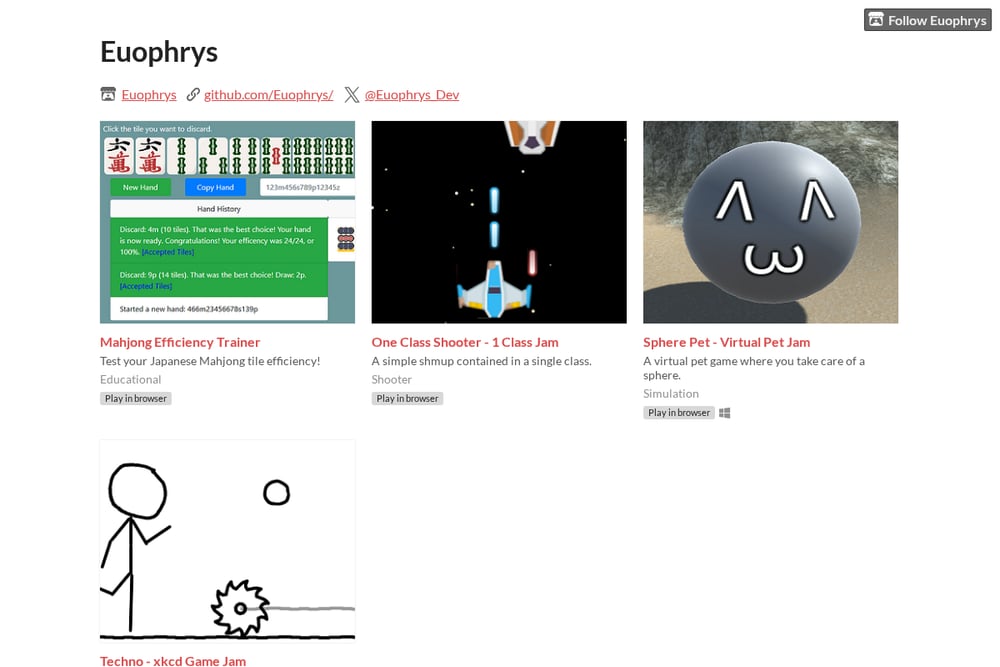 A screenshot of the Mahjong Efficiency Trainer website.
The Mahjong Efficiency Trainer is a browser-based drill for tile efficiency, and it does one job well. For every possible discard, it checks how many tiles would improve your shanten, then tells you the efficiency cost of a suboptimal choice. Settings let you remove suits, enable three-player rules, and add red fives, so you can tune the difficulty. The tool is honest about its limits: pure efficiency is not optimal play, and defense matters more. That framing makes it a good complement to a reading-focused course rather than a replacement. Use it for short daily reps and your discard instincts will sharpen.
How to Pick the Right Study Path
Start with your weakest skill, not the most popular resource. If your decisions stall once the table situation gets messy, a course like Mr Feng's on adapting your play beyond tile efficiency gives you the most direct return. If you are still leaking efficiency in the first six turns, drills will fix that faster than any lecture. If you want a single place to look things up mid-game, a hub with calculators and a glossary saves you time. Written references suit players who study in bursts and like to revisit notes. Free options are genuinely strong here, so budget is not the barrier. The real question is whether you will actually sit down and use the format you choose.
Building a Repeatable Study Loop
Treat study like a training plan. Set a weekly block for one course module or one book chapter, then follow it with twenty minutes of efficiency drills. Log your deal-in rate and your average placement over ten games, and review one replay each week against what you just learned. Keep a running note of recurring mistakes, because patterns show up fast. When a concept stops clicking, switch formats: read it, then drill it, then watch it applied in a recorded scenario. This loop turns passive consumption into measurable improvement without adding much time.
The Bottom Line
You do not need every resource on this list. You need one that matches your current leak and one that keeps you honest. Pair a focused course with a drill tool, and add a reference for lookup. That combination covers learning, repetition, and recall. The players who climb fastest are not the ones who consume the most content. They are the ones who review their own decisions with a system. Pick your entry point, set a weekly block, and track the numbers. The rest follows.