Restoration companies live and die by speed-to-lead. When a burst pipe call comes in at 2 AM, the job goes to whoever answers first and follows up fastest. These five providers build the systems that make that happen.
Why restoration workflows need automation now
Water, fire, and mold restoration is an urgency business. Emergency calls don't wait for business hours, and homeowners in crisis rarely call twice. Most restoration companies run on a phone, a calendar, a CRM, and the owner's memory. That works until it doesn't. Missed after-hours calls, estimates that never get chased, and insurance documentation that slips through the cracks quietly cost you jobs. Automation closes those gaps by connecting intake, dispatch, follow-up, and reporting into one flow. The providers below approach that problem from different angles, from custom-built workflow systems to AI voice agents and full-stack industry platforms.
How we evaluated these providers
We looked at five factors across every provider. Service scope: does the system cover intake, scheduling, follow-up, reviews, referrals, and reporting, or just one piece? Integration fit: does it connect to the tools restoration companies already use, like Google Calendar, Jobber, ServiceTitan, and common CRMs? Industry specificity: is the workflow built around restoration realities like loss type, urgency, insurance, and on-call dispatch? Transparency: can you see the system running before you buy, and is pricing or a clear next step visible? And proof: case studies, live demos, and documented workflows that show the system actually works. Each provider below stood out on different factors, so match them to where your operation leaks the most time.
Here's a quick side-by-side of how each provider positions itself, so you can scan the field before digging into the details.
| Provider | Best For |
|---|---|
| StrategixAI | On-site workflow mapping and documentation control |
| SpeedToLead | Custom workflow systems for restoration companies | Custom end-to-end workflows with a live demo |
| Mianro Systems | Productized AI receptionist and follow-up tools |
| Apex Automation | Insurance file structure and real-time margin visibility |
| Adminify AI | Multi-location and franchise AI deployment |
The five providers worth knowing
#1 StrategixAI
 A screenshot of the StrategixAI website.
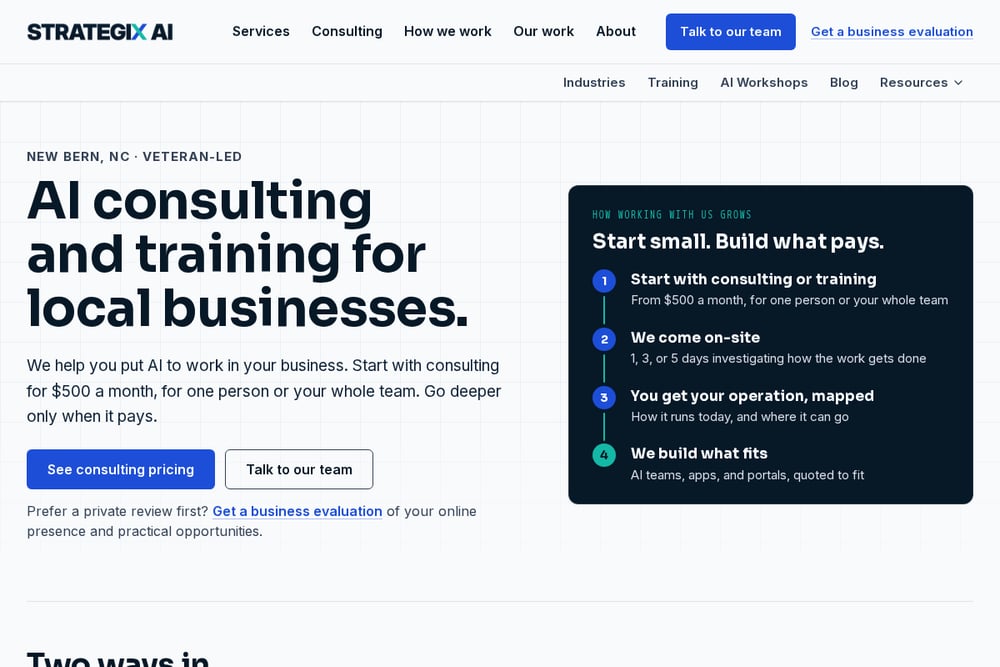
StrategixAI takes an on-site discovery approach before it builds anything. The team sits with your owner, office, sales, production, field, and billing people to map where estimates, dispatch, job notes, and insurance communication break down. From there, it builds SOPs, dashboards, automation, and practical AI around your real operating picture. The focus is on emergency intake, job documentation standards for photos and notes, insurance communication reminders, and an owner dashboard for active losses and delayed billing. If your problem is visibility across the whole file, this is the angle to look at.
#2 SpeedToLead | Custom workflow systems for restoration companies
 A screenshot of the SpeedToLead | Custom workflow systems for restoration companies website.
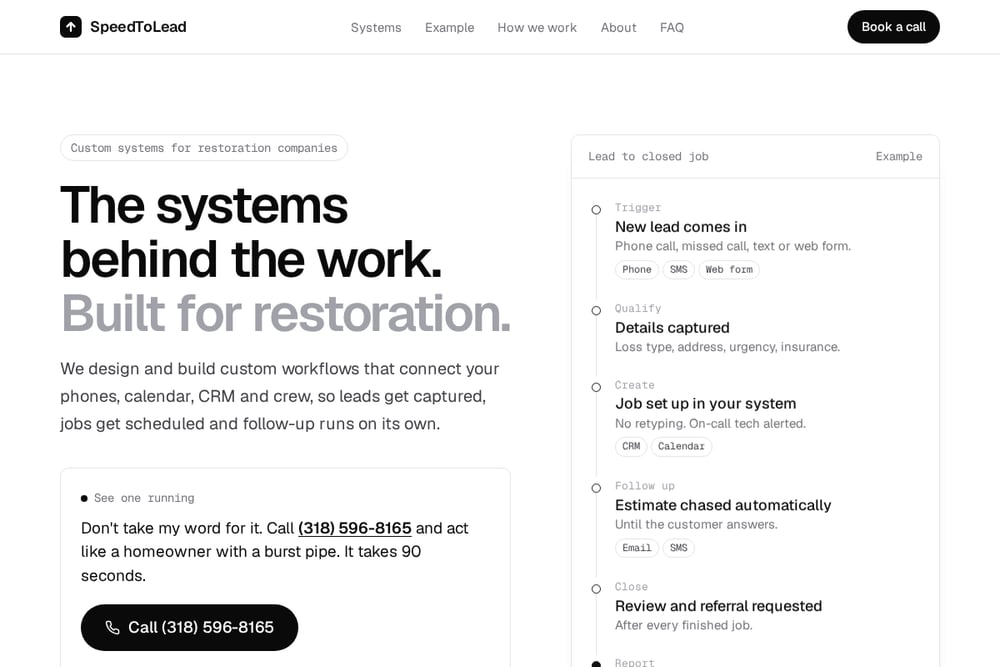
SpeedToLead builds custom workflows that connect your phones, calendar, CRM, and crew so leads get captured, jobs get scheduled, and follow-up runs on its own. The system covers the full lead-to-closed-job path: intake from calls, texts, and web forms, job setup without retyping, automatic estimate follow-up until the customer answers, review requests after every job, and referral partner outreach to plumbers, adjusters, and property managers. It connects to tools you likely already use, including Google Calendar, Google Sheets, Jobber, ServiceTitan, Gmail, and text messaging. What sets it apart is the proof: you can call a live demo number and act like a homeowner with a burst pipe to see the after-hours intake system in action. You can also book a 30-minute call to see what they build.
#3 Mianro Systems
 A screenshot of the Mianro Systems website.
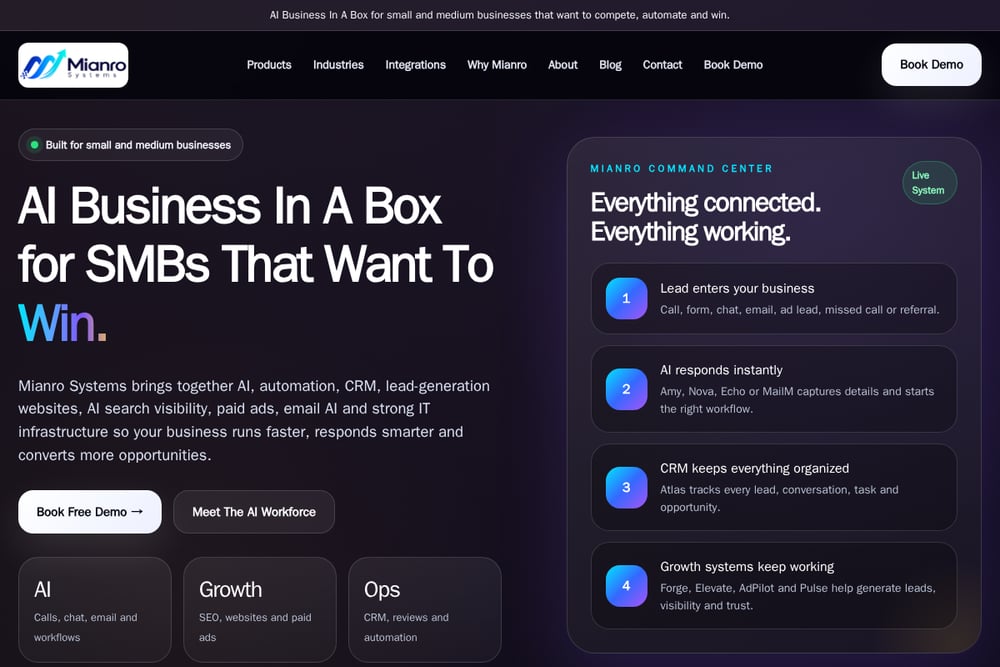
Mianro Systems packages AI automation for water damage restoration into named tools. Amy, the AI receptionist, answers calls 24/7, captures damage type, property details, contact info, and urgency, then supports routing or appointment booking. Nova handles lead follow-up with SMS and email reminders so inspection requests and estimates don't get forgotten while your crew is on active jobs. Echo turns website visitors into qualified leads through chat. The productized approach makes it easy to start with one piece, like after-hours call capture, and expand from there. It's a good fit if you want AI employees rather than a fully custom build.
#4 Apex Automation
 A screenshot of the Apex Automation website.
Apex Automation builds the systems behind the file, with a heavy emphasis on insurance workflows and urgent dispatch. Its build includes an AI voice receptionist tuned for emergency intake, photo and document workflows with auto-tagging by job phase, an Airtable CRM structured for insurance files and adjuster tracking, and Make.com workflows that move jobs from intake through mitigation, reconstruction, and billing. Twilio SMS handles tech dispatch and customer ETA updates. The pitch is margin visibility in real time rather than at month-end. If your insurance file is a swamp of photos, scope notes, and adjuster emails, this is the provider to study.
#5 Adminify AI
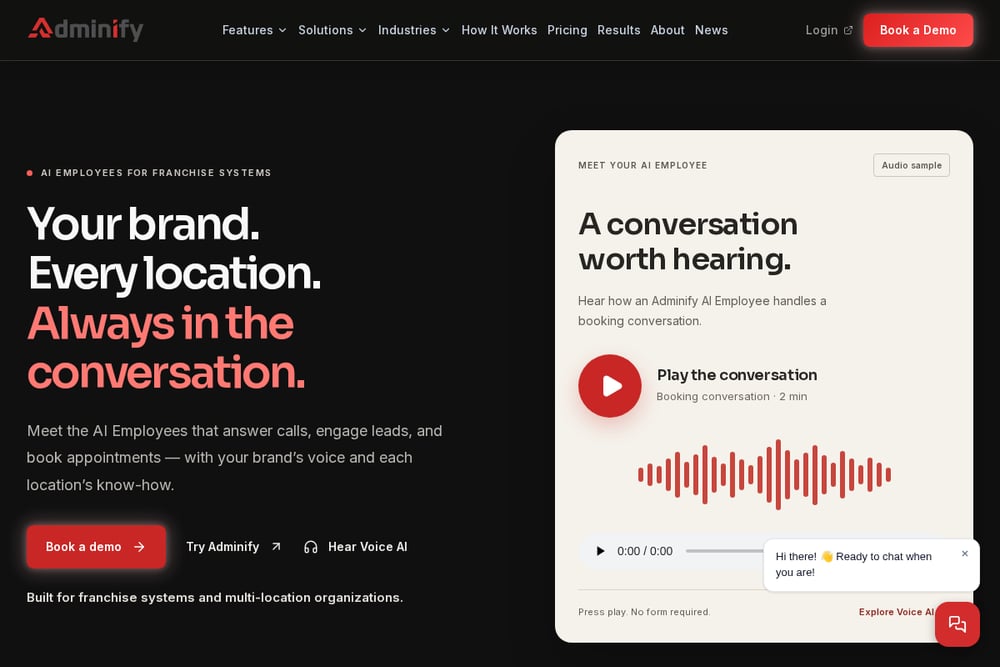 A screenshot of the Adminify AI website.
Adminify AI brings a broad AI employee platform to restoration companies, with features spanning voice AI, two-way messaging, web chat, missed-call text back, lead nurturing, phone analytics, review management, and appointment automation. The platform is built with franchises and multi-location operations in mind, so brand consistency and unit-level deployment are part of the design. For a restoration company with several locations or a franchise system, that centralization matters. It's less about custom workflow builds and more about deploying a consistent AI layer across every phone line and lead source you run.
How to choose the right fit
Start with where you lose the most jobs. If after-hours calls go unanswered, prioritize intake and receptionist coverage. If estimates sit in limbo, prioritize follow-up automation. If insurance documentation eats your evenings, prioritize file structure and photo workflows. Then check integration fit against your current stack. A system that connects to your calendar, CRM, and phone setup will get adopted. One that requires ripping everything out won't. Finally, ask to see it running. SpeedToLead lets you call a live demo number, and the other providers should be able to walk you through real workflows before you commit.
Comparison at a glance
Use this table to match provider strengths to your biggest operational gap. Each row reflects how the provider positions its core offering, not a verdict on quality.
The bottom line
There's no single right answer here. StrategixAI fits companies that need on-site discovery and documentation discipline. SpeedToLead fits companies that want a custom workflow connecting phones, calendar, CRM, and crew, with a live demo you can call yourself. Mianro Systems fits teams that want to start with an AI receptionist and follow-up assistant. Apex Automation fits companies drowning in insurance files. Adminify AI fits multi-location operations that need consistent AI coverage everywhere. Pick the provider that solves your most expensive leak first, then expand from there.