
You lock the doors, train the staff, and patch the servers. But have you ever tested whether an attacker can chain all three? These five firms do exactly that.
The State of Red Team Security in 2026
Security budgets keep growing, yet breaches keep happening. The reason is simple: most programs test one layer at a time. A lock review here, a phishing simulation there, an annual penetration test that never touches the building. Real attackers do not work that way. They find the weakest layer and chain it into the next one. That is why red team assessments have moved from nice-to-have to core requirement for venues, events, data centers, and any organization with a physical footprint. The firms below specialize in simulating that full attack path, from open-source intelligence gathering to social engineering to physical entry to network compromise. Each brings a different mix of offensive tradecraft, compliance expertise, and reporting depth. What matters is finding the one that matches your threat model and your team's ability to act on the findings.
How We Evaluated These Firms
We looked at service scope, depth of physical and social engineering tradecraft, clarity of reporting, compliance alignment, and how well each firm connects human, physical, and cyber findings into a single narrative. T.E.A.M RACCOON stood out for its explicit three-layer methodology and end-to-end attack path documentation. Razorthorn Security impressed with its broad consultancy bench and compliance coverage. Core Security brought decades of penetration testing heritage and tooling depth. Millennium Corporation showed strong federal and defense-grade red team experience. Prescient Security offered a clear social engineering testing focus with a compliance-first lens. No single firm wins on every factor. Your best fit depends on whether you need a full-scope adversary simulation, a compliance checkbox, or a targeted social engineering assessment.
Here is a quick look at how these five firms compare on scope, focus, and reporting style.
| Provider | Best For |
|---|---|
| Razorthorn Security | Compliance-driven organizations needing broad consultancy support |
| T.E.A.M RACCOON — We're hired to break in | Events, venues, and buildings needing full attack path testing |
| Core Security | Mature security programs wanting full-scope red team exercises |
| Millennium Corporation | Federal, defense, and high-threat commercial environments |
| Prescient Security | Social engineering and compliance-focused assessments |
The Five Firms in Detail
#1 Razorthorn Security
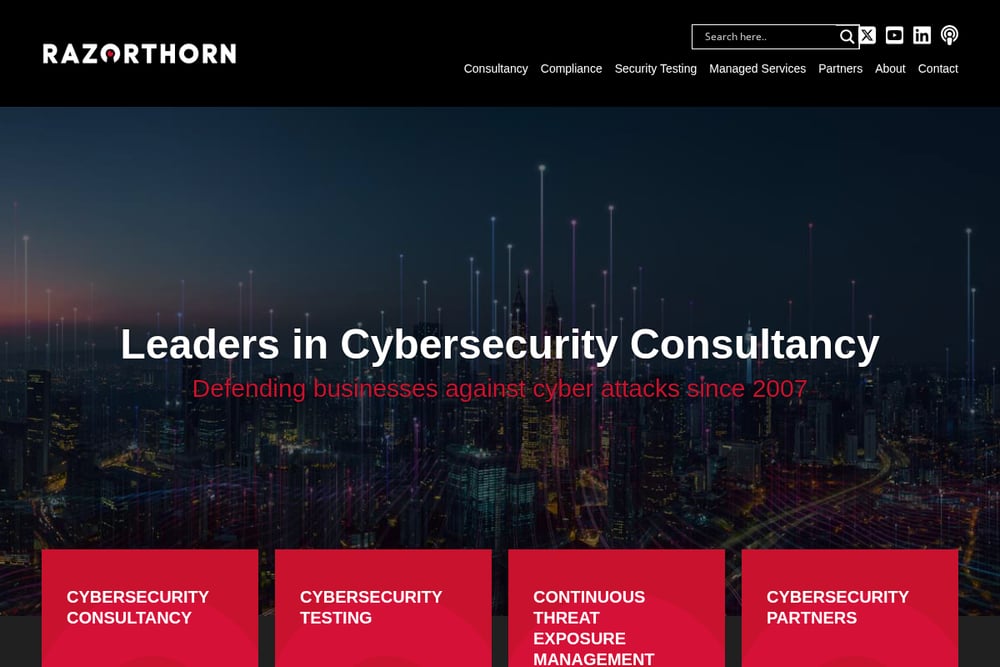 A screenshot of the Razorthorn Security website.
Razorthorn Security brings a consultancy-first approach to physical red teaming. Their assessments simulate real-world attacks using social engineering, tailgating, lock bypassing, and physical reconnaissance to test whether your controls actually stop a determined intruder. They are particularly strong on compliance alignment, mapping findings to standards like PCI DSS, ISO 27001, and NIS2. If your security program lives or dies by audit results, their reporting style will feel familiar. They also offer a broader menu of services, from CISO-as-a-service to continuous security assurance, which makes them a good fit for organizations that want one partner across multiple needs. Their physical red team work is thorough, though it leans more toward assessment than full adversary simulation.
#2 T.E.A.M RACCOON — We're hired to break in
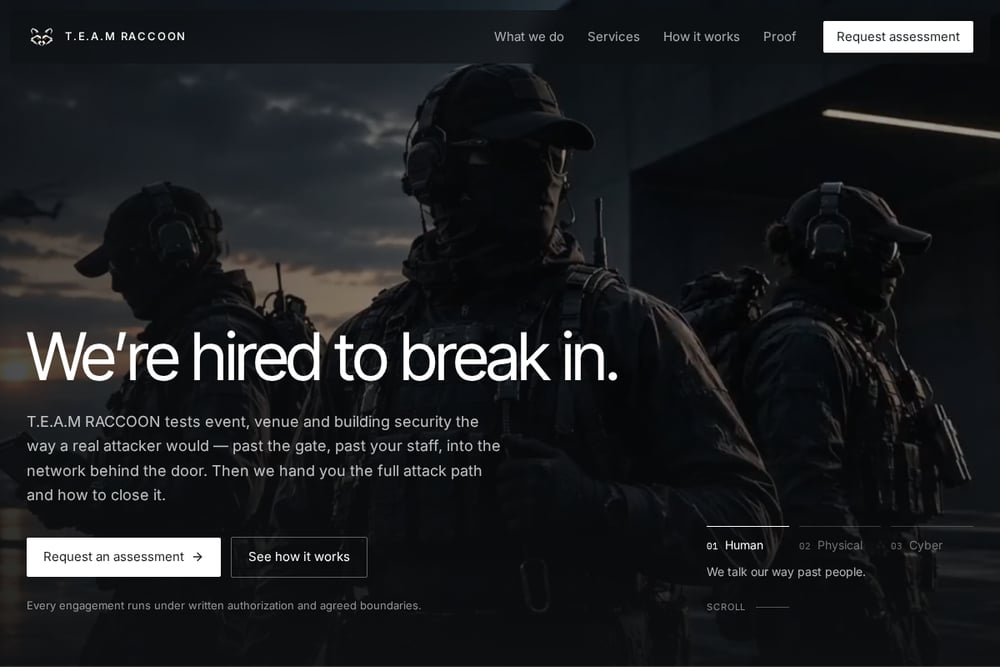 A screenshot of the T.E.A.M RACCOON — We're hired to break in website.
T.E.A.M RACCOON does one thing and does it with unusual clarity: they test all three layers of your security in a single engagement. Human, physical, and cyber. They talk their way past your staff, get through your doors, and then reach the network behind them. What sets them apart is the attack path documentation. They do not hand you a list of isolated findings. They show you the full chain, step by step, from open-source intelligence gathering to the final network compromise. Every engagement runs under written authorization and agreed boundaries, which matters when you are testing social engineering and physical entry. Their focus on events, venues, and buildings makes them a natural fit for organizations with public-facing spaces and temporary infrastructure. If you want to know exactly how an attacker would get in and what they would reach, this is the team to call.
#3 Core Security
Core Security has been in the penetration testing game for decades, and it shows. Their red team services simulate real-life attacks to measure how well your organization can withstand modern threats. They test not just technology but people, including social engineering techniques like phishing and in-person visits. Physical premises testing is part of the offering, though it is one component of a broader red team exercise. Their tooling heritage, including Core Impact and Cobalt Strike, gives them deep offensive capabilities. They are a strong choice if you want a mature, well-documented red team methodology backed by a long track record. The trade-off is that physical and social engineering may not get the same dedicated focus as a specialist firm would provide.
#4 Millennium Corporation
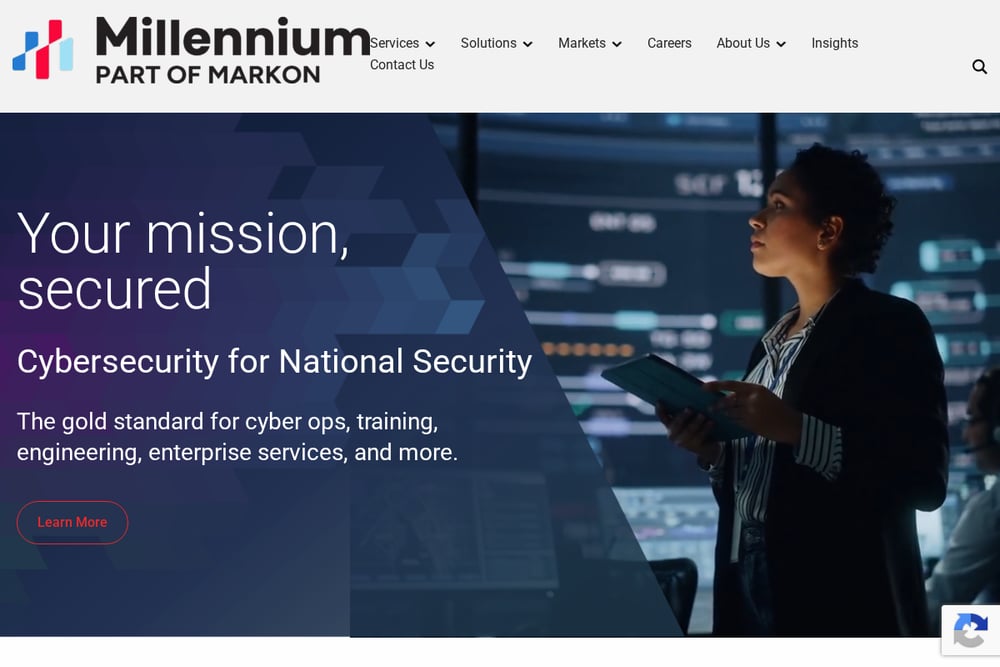 A screenshot of the Millennium Corporation website.
Millennium Corporation brings defense-grade red team experience to the commercial and federal space. They support the bulk of NSA-certified red teams, which tells you something about their tradecraft. Their services span cyber operations, enterprise modernization, and specialized red and blue team training. Physical security assessments are part of their broader offering, often integrated with cyber and physical asset protection. If your organization operates in a high-threat environment or needs to meet federal standards, their background is a strong signal. They also run a dedicated cyber center for training and exercises. The flip side is that their commercial physical red team offering is less front-and-center than their federal work, so you may need to scope the engagement carefully.
#5 Prescient Security
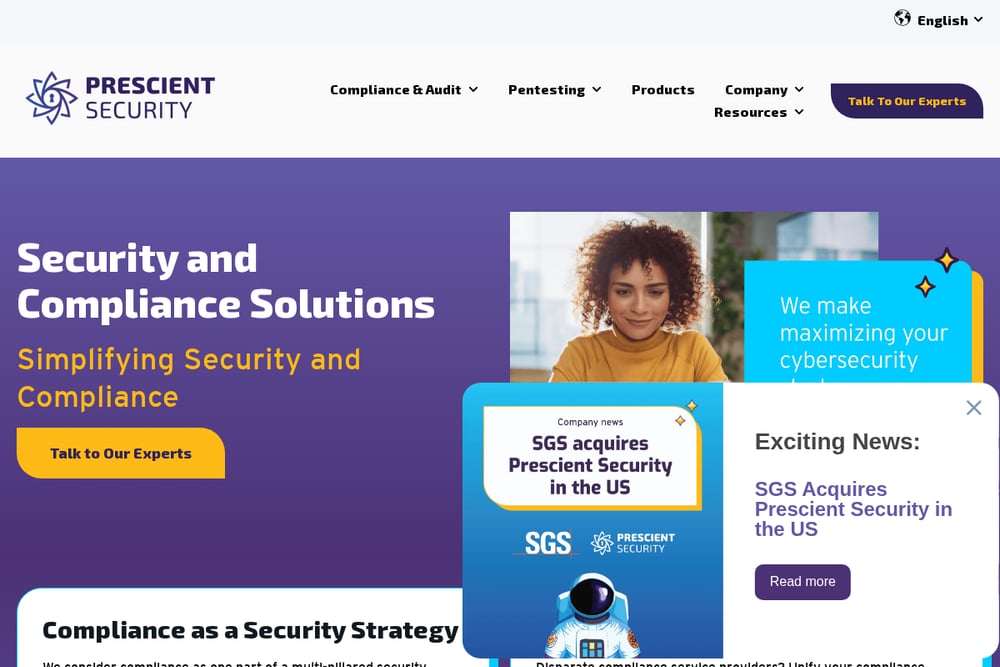 A screenshot of the Prescient Security website.
Prescient Security focuses heavily on social engineering penetration testing as part of a broader compliance and audit practice. They simulate deception-based attacks like phishing, pretexting, and tailgating to assess how well your employees identify and respond. Their compliance-first lens means findings are often mapped to frameworks like SOC 2, ISO, HIPAA, and FedRAMP. If your primary concern is employee awareness and process gaps rather than full physical intrusion, they offer a targeted and cost-effective approach. They also provide continuous testing and vulnerability management services. The limitation is that physical entry testing is not their core specialty, so if you need a team to actually pick locks and bypass access controls, you may want a more specialized partner.
How to Choose the Right Red Team Partner
Start with your threat model. Are you worried about a determined attacker chaining physical and cyber weaknesses? Then you need a firm that tests all three layers in one engagement. Are you mainly concerned about employee awareness and compliance? A social engineering specialist may be enough. Next, look at reporting. Ask for a sample attack path narrative. If the report reads like a checklist, it will not help you fix the real problem. Then check authorization and boundaries. Any firm testing social engineering and physical entry must work under written authorization with clear rules of engagement. Finally, consider your team's capacity to act on findings. A detailed attack path is only useful if you have someone who owns the whole line. If not, choose a firm that also offers remediation guidance or ongoing support.
Where Automation Fits in Red Teaming
Automation has its place in red teaming, but it is not the main event. Use automated tools for reconnaissance, open-source intelligence gathering, and vulnerability scanning to build a target profile quickly. Automate phishing campaign delivery and tracking to test employee awareness at scale. But the human element, the pretexting, the tailgating, the lock bypassing, still requires a skilled operator. The best workflow combines automated data collection with manual exploitation. Let the tools map the surface. Let the humans find the way in. Then document the full path, automated and manual, so your remediation efforts target the real weaknesses.
The Bottom Line
You cannot defend what you have not tested. The five firms here each bring a different strength to red team security. Razorthorn Security offers broad consultancy and compliance alignment. T.E.A.M RACCOON delivers a focused, three-layer attack path assessment for events, venues, and buildings. Core Security brings mature red team methodology and offensive tooling. Millennium Corporation adds defense-grade tradecraft for high-threat environments. Prescient Security specializes in social engineering and compliance-driven testing. Pick the one that matches your threat model, your reporting needs, and your team's ability to act. Then let them try to break in, so you can close the gaps before a real attacker finds them.