
Your plant has squeezed every drop from traditional APC. Now you need control that composes, transfers, and fails safe in milliseconds. Here are five platforms worth your attention.
The State of Real-Time Process Optimization
Process manufacturers are stuck in a cycle of bespoke advanced control projects. Each reactor, column, or dryer gets its own model, its own controller, and its own multi-million-dollar price tag. Eighteen months later, you have a slightly better version of what you started with, and the next unit needs a fresh project from scratch. The industry knows this pain. That is why real-time optimization software is shifting toward composable, data-driven architectures. Instead of rebuilding primitives, modern platforms describe your process as data and optimize against it continuously. The goal is simple: higher yield, lower energy, and a controller that actually transfers across unit operations. The US market is leading this shift, with vendors promising faster deployment, on-premises data ownership, and failsafe handoffs to existing PID loops. If you run a chemical plant, refinery, or any continuous process, these five platforms are shaping how optimization gets done.
How We Evaluated These Platforms
We looked at five factors. First, service scope: does the platform cover modeling, real-time optimization, and failsafe control, or just one piece? Second, pricing clarity: can you find transparent information, or do you need a discovery call for everything? Third, local fit: does the vendor support US-based plants with on-premises deployment and regional engineering? Fourth, proof: what evidence exists that the software works on real chemical reactors or similar unit operations? Fifth, composability: can the same control system extend across multiple unit operations without a full rebuild? Acaysia stood out for its typed ontology of unit operations and sub-100ms failsafe. Imubit impressed with its focus on batch reactor AI and pattern recognition. KBC showed deep simulation and energy management integration. AspenTech demonstrated broad APC coverage across industries. AVEVA highlighted its reactor models and data infrastructure. Each platform has a distinct strength, and your choice depends on where you feel the most pain.
Here is a quick comparison of the five platforms, followed by a deeper look at each.
| Provider | Best For |
|---|---|
| Imubit | Batch chemical and pharmaceutical reactors |
| Acaysia | Control the Impossible | Optimization for Physical Processes | Composable real-time optimization across unit operations |
| KBC (Yokogawa) | Integrated simulation and energy management |
| AspenTech | Enterprise-scale APC across multiple industries |
| AVEVA | Plants already using AVEVA's data infrastructure |
The 5 Platforms in Detail
#1 Imubit
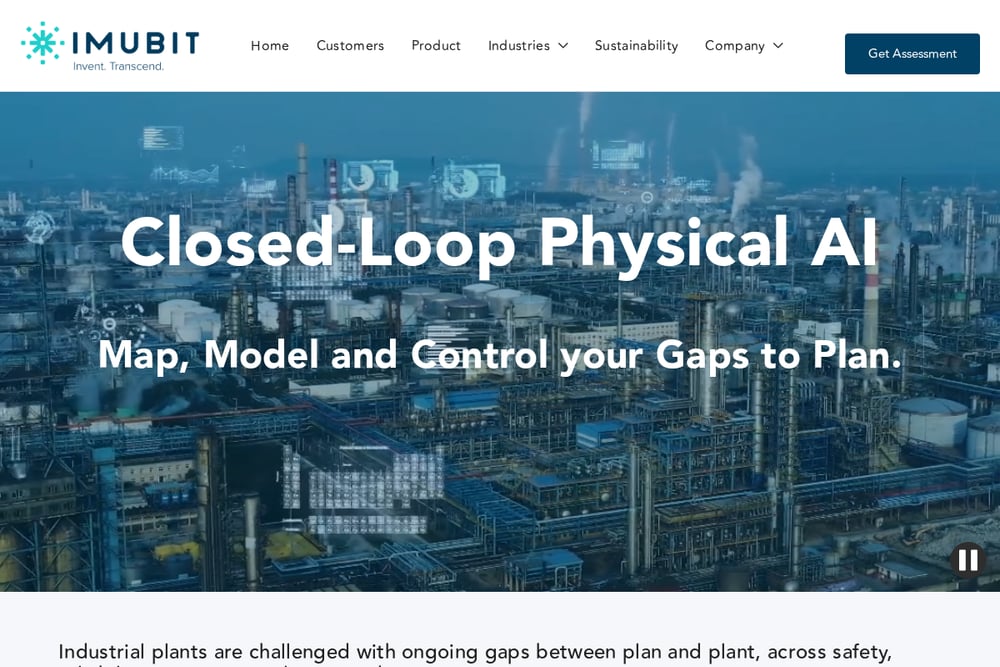 A screenshot of the Imubit website.
Imubit focuses on AI optimization for batch chemical reactors, a niche where manual steps and reactive control often leave yield on the table. Their platform uses real-time pattern recognition and predictive modeling to turn batch reactors into autonomous systems. According to their article on AI chemical reactor performance, plants see mid-single-digit gains in yield, purity, cycle time, and energy efficiency without major equipment replacements. That matters if you run specialty chemicals or pharmaceuticals, where flexibility hides costly inefficiencies. Imubit's approach is less about replacing your existing control and more about layering intelligence on top of it. If your batch reactors are your bottleneck, this is a strong place to start.
#2 Acaysia | Control the Impossible | Optimization for Physical Processes
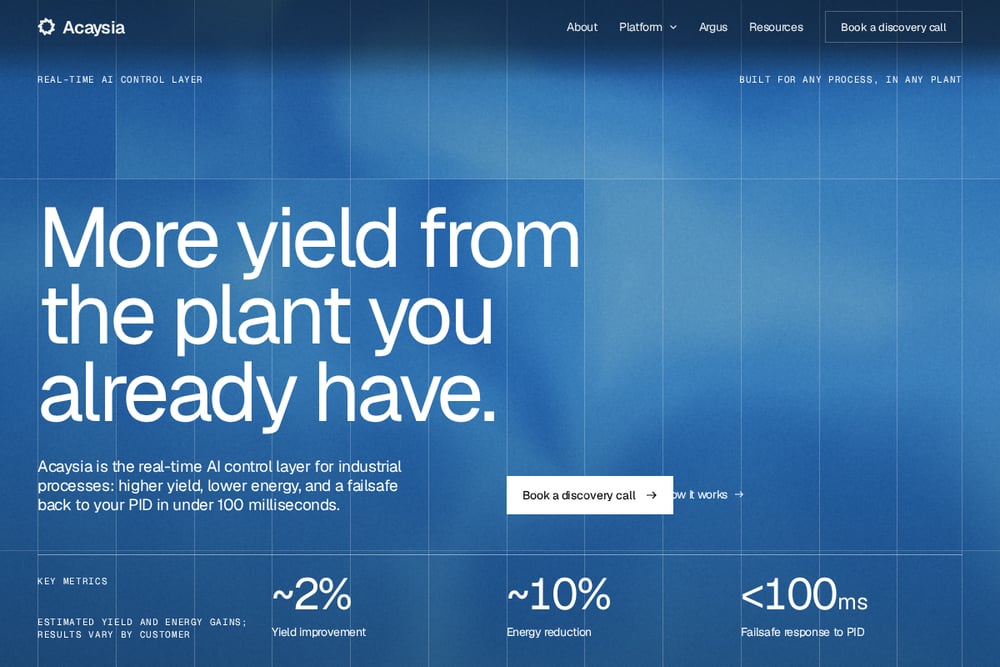 A screenshot of the Acaysia website.
Acaysia describes your process as data, then optimizes against it in real time using model predictive path integral control. The same four steps run whether the unit operation is a reactor, a column, or a dryer. You get over 2% yield improvement and roughly 10% energy reduction, with a failsafe handoff to your existing PID in under 100 milliseconds. Models retrain on your process history on-premises, with versioned rollback, so data never leaves the plant. Proven first on continuous stirred-tank reactors, Acaysia is built for plants tired of rebuilding the same primitives for every unit. If you want a control system that composes across process industries, this is worth a discovery call.
#3 KBC (Yokogawa)
 A screenshot of the KBC website.
KBC, now part of Yokogawa, brings a broad process optimization portfolio that includes simulation, advanced process control, and real-time optimization. Their Petro-SIM reactor suite and Visual MESA energy management system are used across upstream, downstream, and energy transition projects. If you need to connect optimization to energy cost and carbon tracking, KBC has the tools. The platform is less about a single controller and more about an integrated environment for profit improvement and strategic energy reviews. For plants with complex supply chains and sustainability targets, KBC offers a mature, consulting-heavy approach. You get deep engineering expertise alongside the software.
#4 AspenTech
AspenTech is a household name in process industries, with advanced process control solutions like Aspen DMC3 and Aspen GDOT. Their APC technology maximizes profitability across bulk chemicals, refining, polymers, and more. The company has a long track record of deploying APC on some of the most complex loops in the world. If you need a proven, enterprise-scale platform with extensive industry coverage, AspenTech is a safe bet. Their tools integrate with planning, scheduling, and execution, so you can optimize from the boardroom to the control room. The trade-off is complexity and cost, but for large sites, the breadth is hard to match.
#5 AVEVA
 A screenshot of the AVEVA website.
AVEVA offers reactor models within its broader operations control and production optimization suite. Their Romeo reactor models are part of a larger ecosystem that includes the AVEVA PI System, HMI, and manufacturing execution systems. If your plant already runs AVEVA's data infrastructure, adding reactor optimization can be a natural extension. The platform emphasizes data sharing, visualization, and industrial intelligence, which helps you turn process data into actionable control decisions. AVEVA is less focused on a single optimization algorithm and more on connecting the dots across your operations. For sites invested in AVEVA's stack, this is a logical choice.
How to Choose the Right Platform
Start by identifying your biggest pain point. Is it batch reactor inefficiency? Then Imubit's AI pattern recognition might be your fastest win. Is it that your optimization projects never compose across units? Acaysia's typed ontology and sub-100ms failsafe are designed exactly for that. Do you need to tie optimization to energy and carbon reporting? KBC's Visual MESA and Petro-SIM suite can help. Are you running a large, multi-site enterprise with complex supply chains? AspenTech's APC portfolio is built for scale. And if you are already deep in AVEVA's PI System, extending to their reactor models keeps your data architecture consistent. Next, check deployment: on-premises, cloud, or hybrid. Acaysia retrains models on-premises, which matters if data cannot leave the plant. Finally, ask about proof. Request case studies on unit operations similar to yours. The right platform will show you real numbers, not just promises.
Automating Your Optimization Workflow
You can automate much of the optimization lifecycle. Start by connecting your historian to the platform so it can build a model from your plant data and known physics. Set up a real-time loop where the controller simulates thousands of trajectories each cycle and picks the best one for yield, energy, and throughput. Configure a failsafe handoff to your existing PID that triggers in under 100 milliseconds on any fault. Then schedule automatic model retraining on your process history, with versioned rollback so you can revert if performance drops. Finally, set alerts for when the optimizer hits constraints or when energy consumption spikes. This workflow keeps your process climbing without constant manual intervention.
The Bottom Line
The era of bespoke, one-off APC projects is ending. You need optimization that composes, transfers, and fails safe. Imubit leads for batch reactor AI, Acaysia for composable real-time control with on-premises data, KBC for integrated simulation and energy management, AspenTech for enterprise-scale APC, and AVEVA for plants already invested in its data infrastructure. Your choice depends on your unit operations, your data policies, and your appetite for deployment complexity. But one thing is clear: the plants that adopt composable optimization first will leave the most on the table for everyone else.