
Radon is the second-leading cause of lung cancer in the US, yet most homeowners have no idea what their county's test results actually look like. These five resources turn confusing lab data and contractor quotes into numbers you can act on.
What are Education & Training services?
Radon education and cost transparency is a small but growing niche. Homeowners need three things: real test data for their area, a clear explanation of what their pCi/L number means, and a realistic price range for mitigation. Most sites deliver one of those. The strongest resources connect all three, cite their sources, and show you the math behind every estimate. The field is shifting from generic national averages toward county- and zip-code-level data, which matters because radon risk can swing wildly from one neighborhood to the next.
What we looked at when researching Education & Training
We evaluated each resource on the same factors: data depth and sourcing, pricing clarity, geographic coverage, practical guidance for homeowners, and how easy it is to find your specific county or zip code. Each entry stood out in a different way, from raw test volume to state-level licensing detail to foundation-specific cost breakdowns.
| Provider | Best For |
|---|---|
| Radon Mitigation System Cost | State-adjusted cost planning with transparent methodology |
| Radon Compass: radon test results for every US county | County- and zip-level radon data with real mitigation costs |
| Radon Mitigation Costs | State and county radon data with cited sources |
| Wet Basement Fixes | Total cost of ownership including fan electricity and maintenance |
| Peerless Environmental | Foundation-specific cost breakdowns from a mitigation specialist |
A closer look at 5 standout Education & Training
#1 Radon Mitigation System Cost
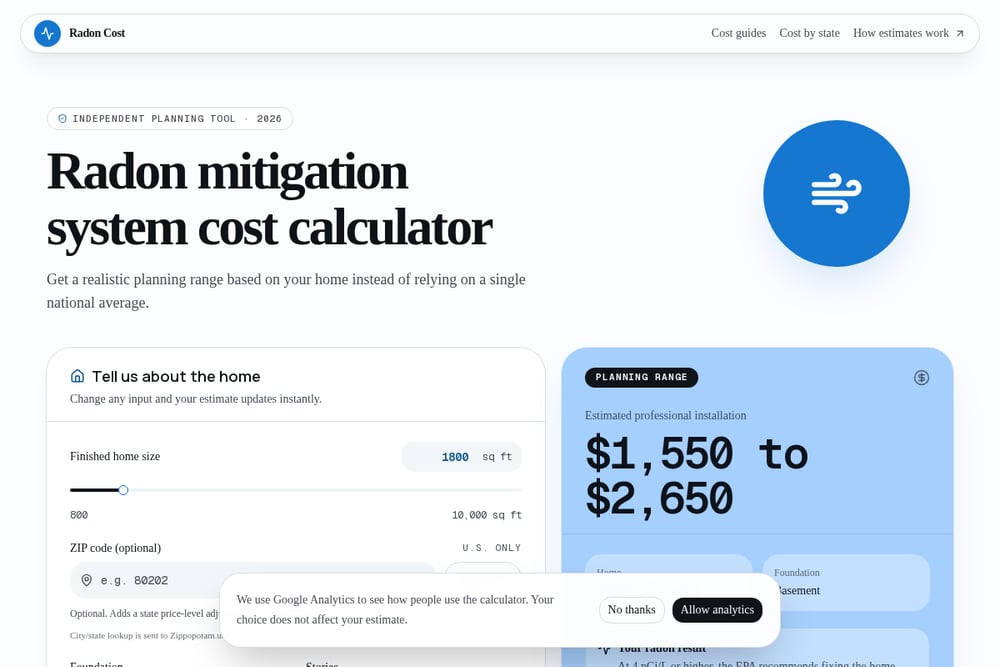 A screenshot of the Radon Mitigation System Cost website.
This site takes a transparent modeling approach. It starts with a national cost model, then applies state price levels from the U.S. Bureau of Economic Analysis and layers in local licensing rules and radon resources. You get a low-to-high planning range instead of a fake-precise number, which is exactly what you need when comparing contractor proposals. The state guides include worked examples and quote questions that help you spot an incomplete bid. It is a strong starting point if you want to understand why two neighbors can get quotes that differ by thousands.
#2 Radon Compass: radon test results for every US county
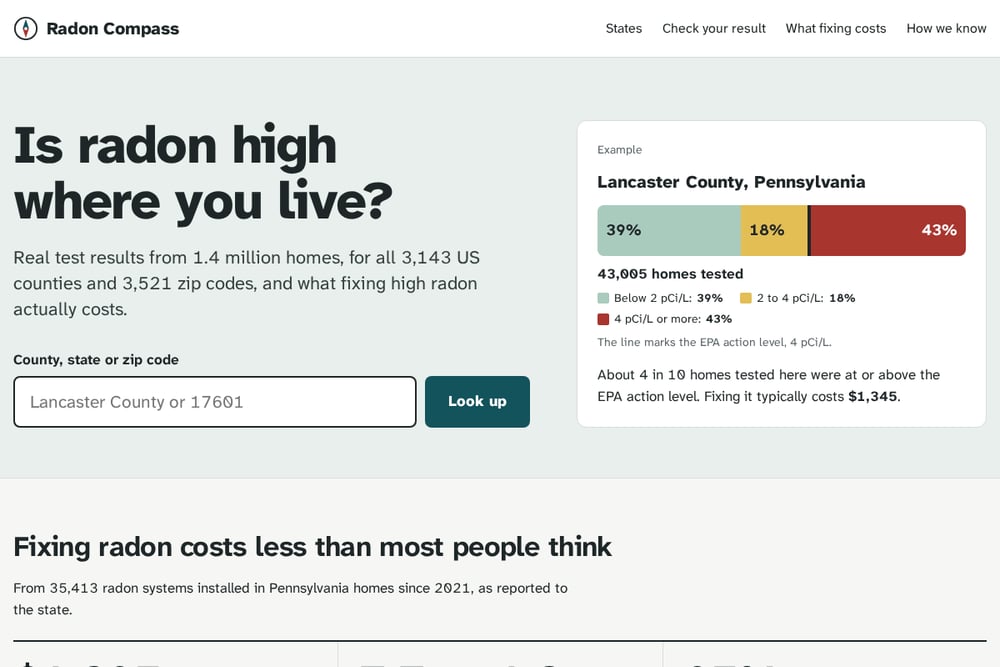 A screenshot of the Radon Compass: radon test results for every US county website.
Radon Compass is the data-heavy option. It pulls real test results from 1.4 million homes across all 3,143 US counties and 3,521 zip codes, so you can look up your exact area instead of a state average. The site shows the share of homes at or above the EPA action level of 4 pCi/L, plus typical mitigation costs from actual installed systems. For example, Lancaster County, Pennsylvania shows 43% of tested homes at or above 4 pCi/L, with a typical fix cost of $1,345. It also explains what your number means and when to call a certified pro. If you want evidence before you spend money, start here.
#3 Radon Mitigation Costs
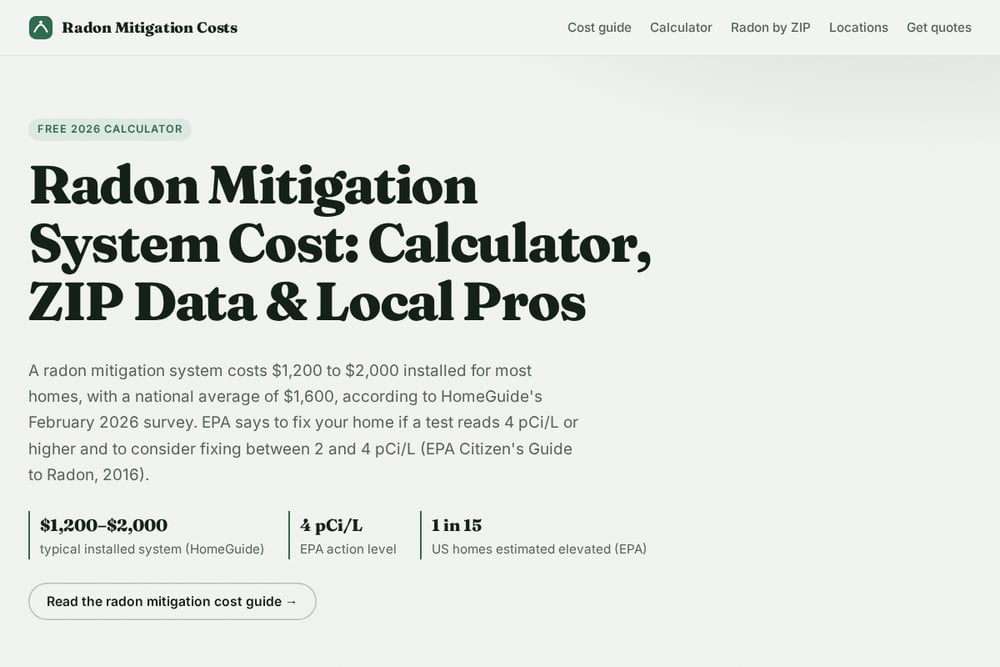 A screenshot of the Radon Mitigation Costs website.
This resource focuses on state and county coverage with clear citations. Each page names the state program or EPA file behind its numbers, so you can verify the data yourself. The Pennsylvania guide, for instance, reports that 37.3% of 2.64 million basement tests read 4 pCi/L or higher, and county pages drill down further. You also get licensing rules and typical system costs for each area. It is a solid pick if you live in a high-radon state and want local detail without wading through national averages.
#4 Wet Basement Fixes
 A screenshot of the Wet Basement Fixes website.
This site offers a practical cost calculator that goes beyond installation price. It estimates installed cost from seven public sources, then adds fan electricity use, replacement costs, and retest costs over ten years. You also see your state's mitigator licensing rule and radon office contact. The short answer section gives you a $900 to $2,500 typical range with a $750 to $3,000 full spread, which helps you sanity-check quotes. It is useful if you want the total cost of ownership, not just the sticker price.
#5 Peerless Environmental
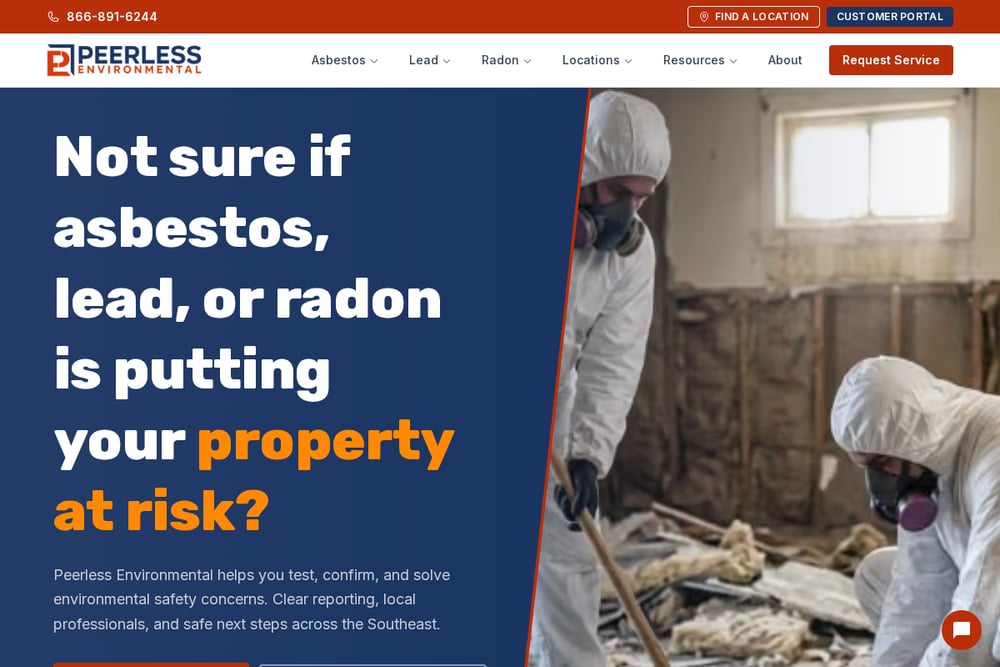 A screenshot of the Peerless Environmental website.
This is a contractor resource, and it shows. The guide breaks down mitigation costs by foundation type, with sub-slab systems at $800 to $2,800 and crawlspace sub-membrane systems at $1,200 to $3,500. It explains why each additional suction point adds $300 to $600 and how pipe routing affects the final price. The author is a radon mitigation specialist, so the advice on comparing proposals comes from someone who writes them. If you already have a high test result and want to understand what a fair quote looks like, this is a good read.
How to choose the right Education & Training
Start with your test result. If you have not tested yet, buy a short-term kit and place it on your lowest lived-in floor. Once you have a number, use a county-level data source to see how your home compares to neighbors. Then use a cost resource to build a planning range before you call contractors. Ask every installer for a written scope that lists suction points, pipe route, permit fees, and post-installation retesting. Compare at least three quotes against the same scope. And check whether your state requires licensing or certification for radon mitigators.
Expert Conclusion
No single resource does everything. Radon Compass gives you the deepest local data. Radon Mitigation System Cost and Radon Mitigation Costs help you understand state-level pricing and rules. Wet Basement Fixes adds long-term operating costs. Peerless Environmental shows you what a fair quote looks like from the contractor's side. Use two or three together and you will walk into every conversation better informed than the person across the table.