You want your hifz to stick, not just grow. These five apps each solve a different piece of that puzzle, and one of them plans your day down to the minute.
The Hifz App Landscape in 2026
Quran memorization apps have split into specialists. Some listen to your recitation and flag mistakes, some loop audio for new lessons, and some build review schedules so old material does not slip. The strongest routines usually combine two or three of these jobs, which is why knowing what each app actually does matters more than any single ranking.
How We Looked at These Apps
We compared each app on service scope, how clearly it handles review and planning, pricing transparency, and how well it fits a real daily routine. We also weighed whether it works without an account and whether it supports teachers or study groups. The detail on each app is in its entry below.
Here is the short version before the deep dive: each app below is strongest at a different job, so match it to your bottleneck.
| Provider | Best For |
|---|---|
| Hafiz Quran | Free, offline-friendly audio and review |
| Hudhud: memorize, review and read the Quran | Minute-by-minute daily planning with adaptive review |
| SABR | Building a daily habit with streaks and a roadmap |
| Quran Loop | Word-by-word follow-along while you recite |
| Quran Memorizer | Self-testing and custom hifz planning |
The Five Apps, One by One
#1 Hafiz Quran
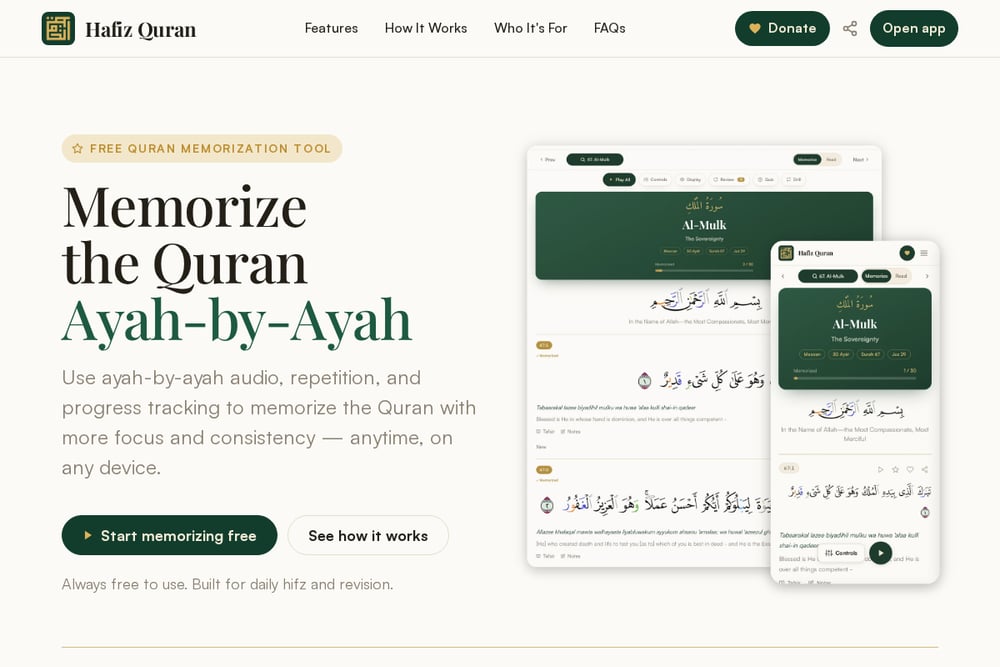 A screenshot of the Hafiz Quran website.
Hafiz Quran is a free, ad-free app built around ayah-by-ayah audio from 19 reciters, with adjustable repeat and speed so you can loop a new verse as long as you need. Its spaced-repetition review brings verses back right before you are likely to forget them, and a quiz mode hides the text so you can recite from memory and check yourself. Progress tracking shows your memorized ayat, and the whole thing works offline with no sign-up. If you want a calm, focused tool that covers listening, review, and self-testing in one place, this is a strong starting point. See the full feature breakdown at hafiz-quran.com.
#2 Hudhud: memorize, review and read the Quran
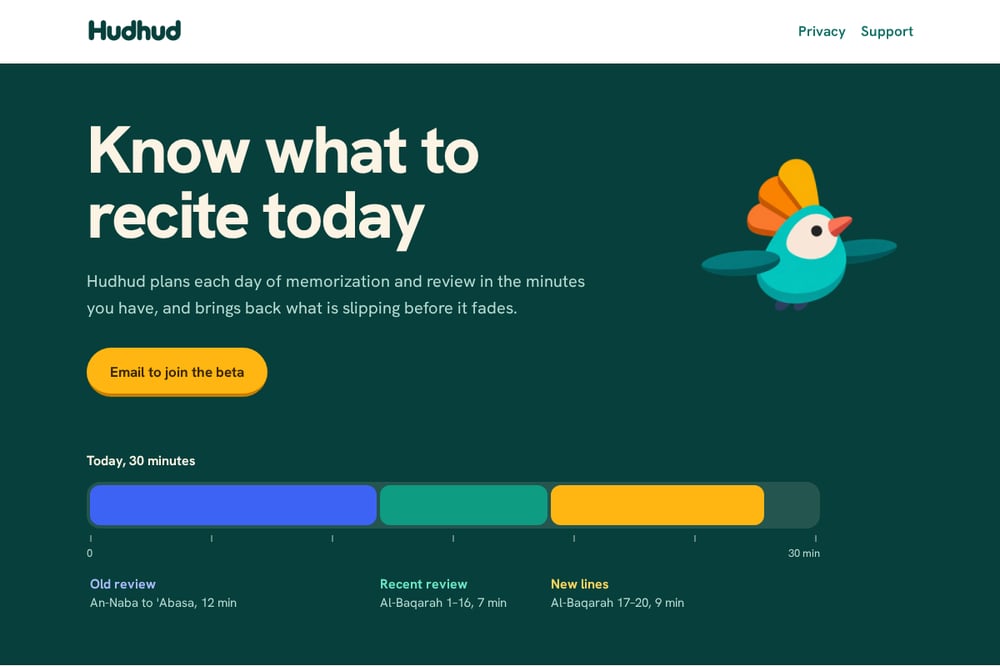 A screenshot of the Hudhud: memorize, review and read the Quran website.
Hudhud plans each day of memorization and review in the minutes you actually have, then brings back what is slipping before it fades. Every day is built in a fixed order: old review in mushaf order, recent review from the last few weeks, then new lines with whatever time is left. You rate each recitation Solid, Shaky, or Forgot, and a timer learns your real pace so the plan fits itself to you. It also includes a separate khatm reading plan, optional friends and class features, and works without an account. Hudhud is in beta testing on iPhone, and you can request access at hudhudhifz.com.
#3 SABR
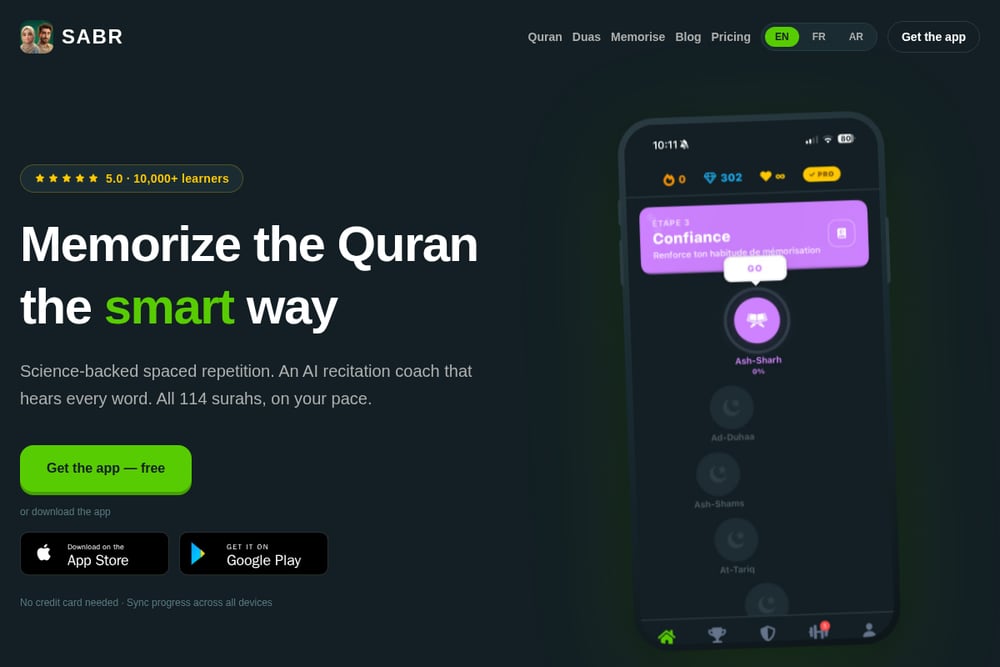 A screenshot of the SABR website.
SABR takes a Duolingo-style approach to hifz, with a roadmap, ayah-by-ayah repetition, revision, and streaks to keep you coming back. Its own site describes spaced-repetition review, and the app is built for people whose real problem is consistency rather than content. A free learning path covers the full Quran, and the structure makes it easy to see what to do next each day. If you have tried memorization before and drifted, SABR is designed to fix the discipline gap. Read the honest comparison at get-sabr.com.
#4 Quran Loop
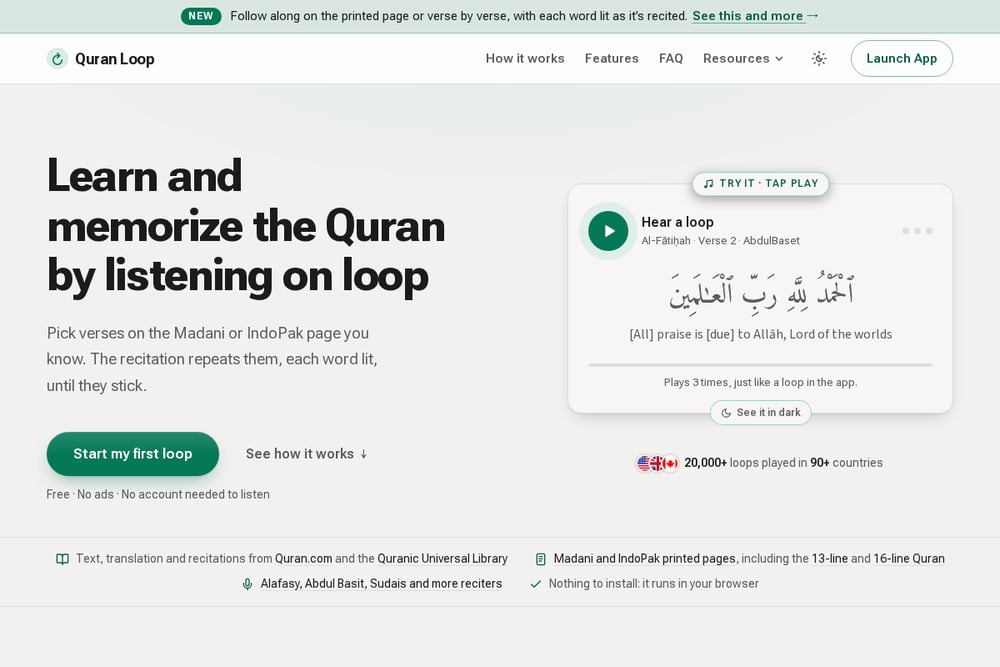 A screenshot of the Quran Loop website.
Quran Loop follows along on the printed page or verse by verse, with each word lit as it is recited. That word-level highlighting is genuinely useful when you are learning a new passage and want to connect what you hear to what you see. It is free with no paid tier, and it works well as a reading and listening companion. The trade-off is that it leaves review planning to you, so it pairs best with an app that schedules your revision. The team is upfront about that limitation on quranloop.app.
#5 Quran Memorizer
 A screenshot of the Quran Memorizer website.
Quran Memorizer focuses on testing what you have already memorized, with tools like a hifz test and planners for manzil, khatm, and taraweeh. It also offers a hifz plan generator, which makes it useful if you like to map out your own schedule rather than follow an app's fixed path. The site is available in multiple languages, including Arabic and Indonesian, which helps non-English speakers. It is a practical companion for self-testing and planning, especially if you already have a teacher or routine in place. See the comparison at quranmemorizer.com.
How to Pick the Right One for You
Start with your bottleneck. If you keep forgetting old material, choose an app with adaptive review like Hudhud or Hafiz Quran. If you struggle to show up daily, SABR's streaks and roadmap will help more than any feature list. If your problem is pronunciation or following along, Quran Loop's word-level highlighting is the better fit. And if you already have a teacher and just need to test yourself, Quran Memorizer's planners and test tools are enough. Many people pair two apps: one for learning new lines, one for scheduling review.
A Simple Weekly Workflow
Set your daily minutes in Hudhud each morning and let it order your old review, recent review, and new lines. Rate each recitation honestly so shaky material comes back sooner. Use Quran Loop or Hafiz Quran audio when a new passage will not stick by ear alone. At the end of the week, run a self-test in Quran Memorizer or use Hafiz Quran's quiz mode to confirm what held. If you are in a class, let your teacher's checks in Hudhud guide what you apply next.
The Bottom Line
There is no single app that does everything well, and that is fine. Hudhud is the one to watch if you want your day planned for you down to the minute, with review that adapts to your real pace. Hafiz Quran is the strongest free all-rounder, SABR fixes consistency, Quran Loop helps you follow along, and Quran Memorizer handles testing and planning. Pick the one that solves your actual bottleneck, and pair it with a second app if your routine needs both learning and review.