
You do not need more bid portals. You need fewer, better-fit opportunities. These five research services help service businesses stop scrolling and start shortlisting.
Why procurement research became its own industry
Public money is everywhere, but the paperwork is scattered. Federal, state, county, and municipal buyers publish across hundreds of portals, and each one formats deadlines, budgets, and qualifications differently. For a small digital agency, IT shop, or cleaning contractor, the cost of searching is real: hours lost, missed clarifications, and bids submitted on contracts that never fit. That gap created a category of research services. Some are broad alert engines covering over 120,000 sources. Others are narrow, human-curated desks that read the buyer's original documents before sending anything your way. The difference matters. Broad coverage helps you see volume. Curated research helps you decide. In 2026, the smarter buyers of research are paying for judgment, not just notifications.
How we evaluated these services
We looked at the same factors across every service. First, service scope: does it cover the markets you actually sell into, or just the biggest portals? Second, pricing clarity: can you see what you pay before you talk to sales? Third, source verification: does the service check the buyer's original documents, or just repackage titles? Fourth, fit filtering: does it account for territory, walkthroughs, qualifications, and scope realities? Fifth, onboarding friction: can you try it without a card or a contract? Opportunity Desk stood out for document-level verification and niche desks. BidPrime stood out for sheer source coverage and document search. MyGovWatch stood out for a low-friction trial and human curation. Find RFP stood out for simple, published subscription tiers. Running Logistics stood out for pairing monitoring with hands-on bid support.
Here is the quick comparison before the deep dive. Each entry below covers what the service does, who it fits, and what you should check before you commit.
| Provider | Best For |
|---|---|
| BidPrime | Teams bidding across many states and categories |
| Opportunity Desk — Public contract research for service businesses | Service firms that want verified, niche-specific briefs |
| MyGovWatch | Small teams that want curated alerts on a trial |
| Find RFP | Budget-conscious bidders who want published pricing |
| Running Logistics LLC | Firms that want monitoring plus hands-on bid support |
The five services, one by one
#1 BidPrime
 A screenshot of the BidPrime website.
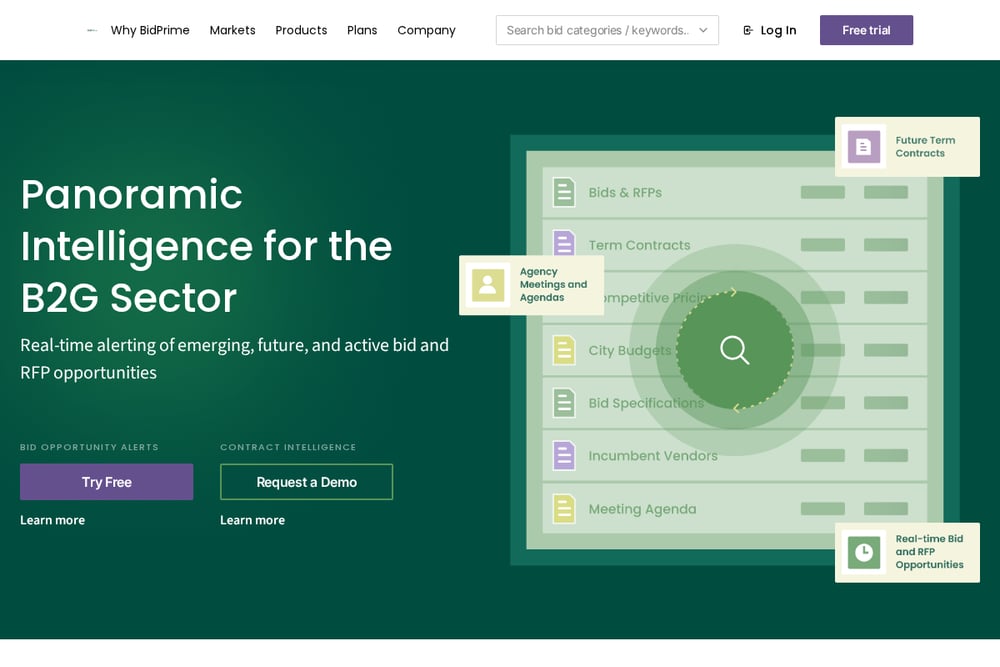
BidPrime is the broad-net option. It combines public sector sources, e-procurement portals, and documents into curated alerts, with coverage spanning more than 120,000 federal and SLED sources. You can search inside documents to surface opportunities where your keywords never appear in the bid title, and download specs in one click. The platform also pushes contract intelligence for future and emerging bids, which helps you shape a pursuit before it goes live. If your team bids across many states and categories, this is the volume play. Just plan for setup time so your alerts stay precise.
#2 Opportunity Desk — Public contract research for service businesses
 A screenshot of the Opportunity Desk — Public contract research for service businesses website.
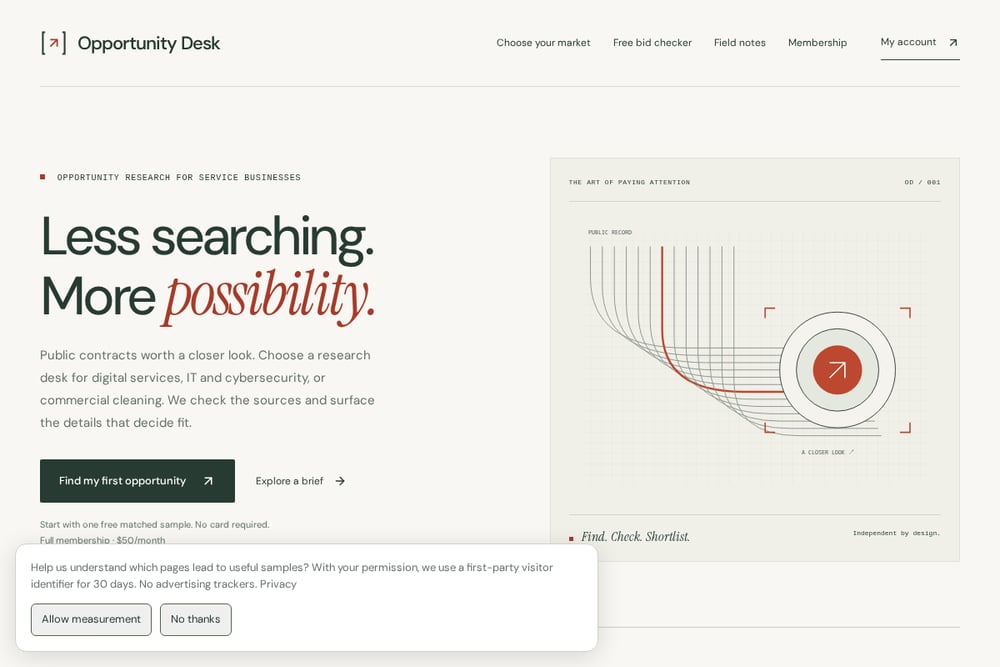
Opportunity Desk takes the opposite approach: fewer leads, more context. It runs three research desks for digital agencies, IT and cybersecurity firms, and commercial cleaning contractors, and every brief is checked against the buyer's original documents. A sample brief shows the full picture, including submission deadlines, budget ranges, and source-check dates, so you know what changed and when. The Newton County, Missouri website and CMS listing is a good example of the format: scope, clarification notes, and a realistic budget range in one place. You can start with one free matched sample, no card required, and full membership runs $50 per month. It is independent by design, with no buyer affiliation.
#3 MyGovWatch
 A screenshot of the MyGovWatch website.
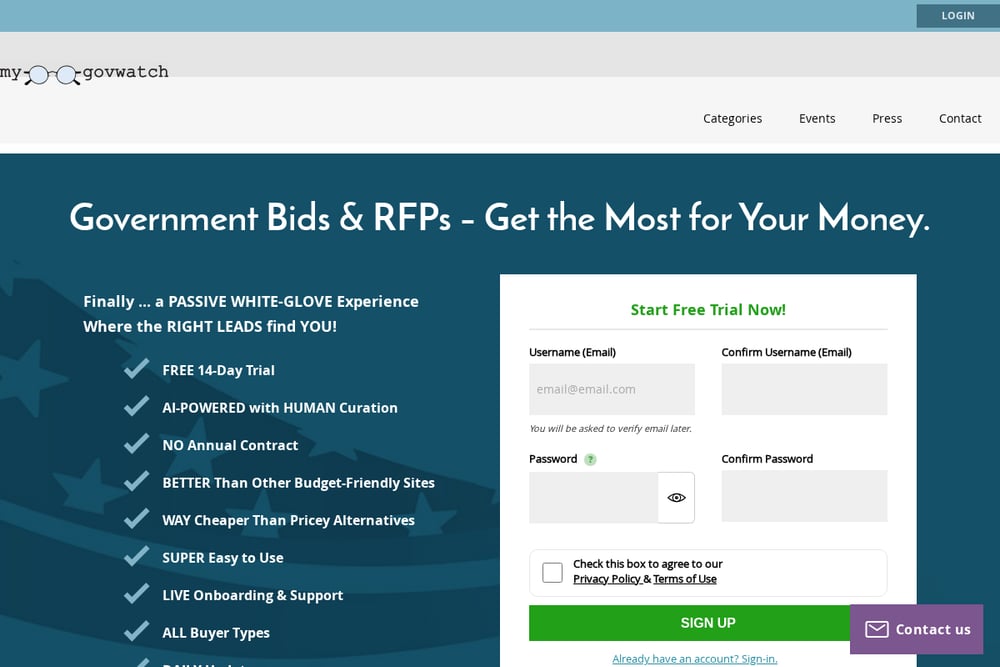
MyGovWatch leans on a passive, white-glove pitch: the right leads find you. It pairs AI-powered matching with human curation and covers all buyer types with daily updates. The entry point is a free 14-day trial with no annual contract, which lowers the risk of testing it against your own pipeline. Live onboarding and support are included, so you are not left alone with a search box on day one. It positions itself as a budget-friendly middle ground between free portals and pricey enterprise tools. For a small team that wants alerts without babysitting filters, it is worth a trial.
#4 Find RFP
 A screenshot of the Find RFP website.
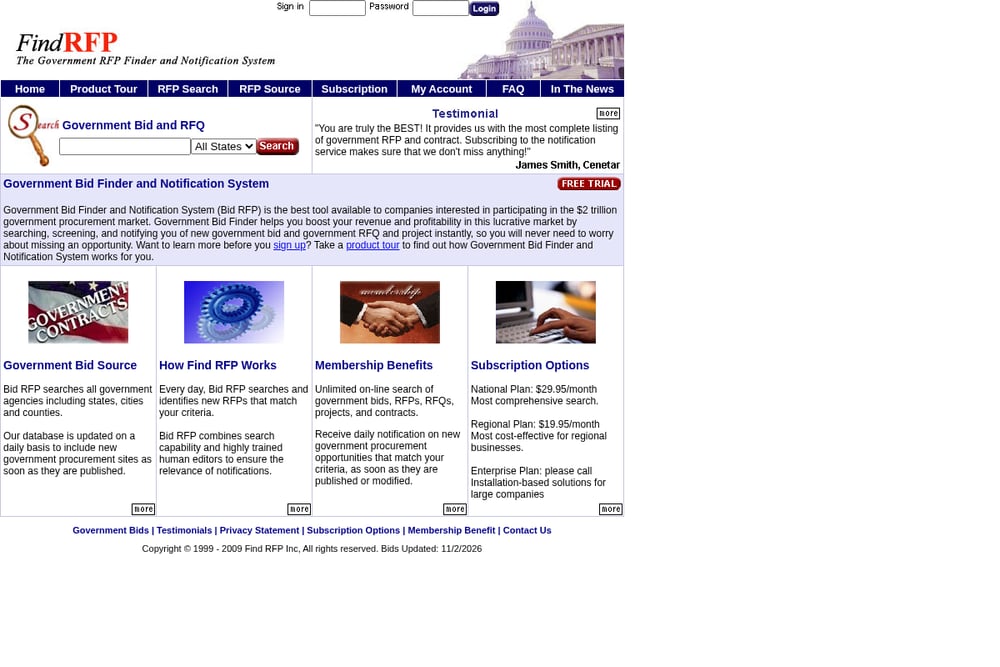
Find RFP keeps pricing simple and public. Individual plans run $29.95 per month, $179.70 for six months, or $359.40 per year, and every tier includes unlimited online search plus daily notifications on new federal, state, county, municipal, and local opportunities. There are also group packages for trade associations and enterprise installations for larger organizations. The interface is utilitarian, and the model is notification-driven rather than document-verified. That is fine if you already know how to read a solicitation and just need a steady feed. If you want the lowest published entry price with no sales call, this is the straightforward pick.
#5 Running Logistics LLC
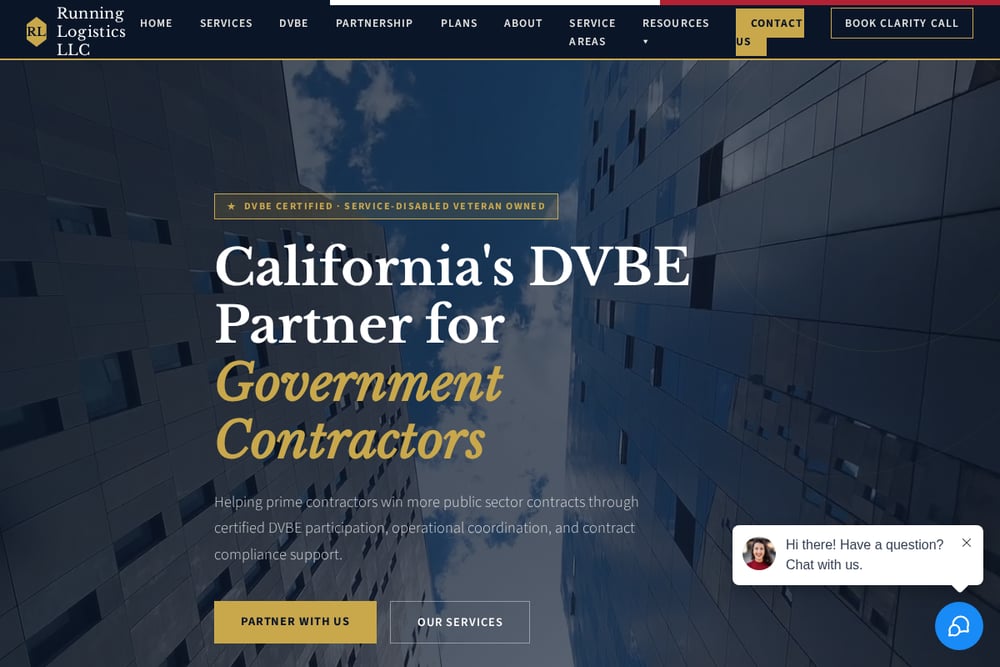 A screenshot of the Running Logistics LLC website.
Running Logistics LLC bundles monitoring with actual bid support. Its Scout plan starts at $90 per month and covers registration on up to three government bidding sites with ongoing monitoring and recommended opportunities. Higher tiers add proposal submissions, capability statement reviews, certification assistance, and marketing work aimed at agencies and primes. The firm also brings a California DVBE partnership angle, which matters if you are a prime contractor working on participation requirements. This is less a research tool and more a service relationship. Choose it if you want someone else doing the pursuit work, not just sending you links.
How to choose the right research service
Start with your market, not the feature list. If you sell websites to counties and school districts, you need a desk that reads CMS and accessibility scopes, not a firehose of every federal IT award. If you clean commercial buildings, territory and mandatory walkthroughs decide fit before price ever matters. Next, decide whether you are buying coverage or judgment. Coverage means more sources and more alerts; judgment means someone checked the source document and told you what changed. Then test the trial. A free sample or 14-day trial tells you more than any demo. Finally, do the math on your own time. If a $50 monthly membership saves you five hours of portal scrolling, it has already paid for itself.
A simple weekly workflow that makes any of these work harder
Set aside one hour each week and run the same loop. First, review new briefs or alerts and kill anything outside your service territory or qualification range. Second, open the original source document for every shortlisted opportunity and confirm the deadline, budget, and any clarifications. Third, log the buyer, the scope, and the submission date in one shared sheet so nothing lives in your inbox. Fourth, draft a go or no-go note in two sentences; if you cannot justify the fit, drop it. Fifth, check the source again 72 hours before submission, because amendments happen. This loop turns any research subscription into a repeatable pipeline instead of another unread digest.
The bottom line
More alerts will not win you more contracts. Better-fit alerts will. BidPrime gives you the widest view if you can handle the volume. Opportunity Desk gives you verified, niche-specific briefs at a price small firms can actually budget for. MyGovWatch and Find RFP are solid low-friction entry points, and Running Logistics LLC makes sense when you want help doing the work, not just finding it. Pick the one that matches how you sell, test it for a month, and measure the hours you get back. That number is the real return on your research spend.