
Running a consultation that survives scrutiny takes more than good intentions. These five providers give you the law, the skills, and the assurance to back it up.
Where Consultation Training Stands Right Now
Public bodies are under pressure. Every service change, planning application, and infrastructure project now gets tested by residents, regulators, and sometimes the courts. That means the people running consultations need more than a communications background. They need to understand the Gunning Principles, equality duties, sampling, coding, and how to facilitate a room that does not want to be there.
Training has grown to meet that demand. You can now find foundation courses on the consultation charter, intermediate modules on stakeholder mapping and surveys, and advanced sessions on AI and digital engagement. Quality assurance has become its own discipline too, with independent reviews and certificates that signal a process was built to hold up.
The market splits roughly in two. Specialist institutes sell accreditation, assurance, and structured course catalogues. Consultancies sell bespoke support, facilitation, and training tied to live projects. Both have a place, and the right pick depends on whether you need a credential, a critical friend, or hands-on delivery help.
How We Compared These Providers
We looked at the same factors for every provider. First, service scope: does the organisation cover training, advice, facilitation, and assurance, or just one slice? Second, course depth: are there clear foundation, intermediate, and advanced pathways, or a loose set of workshops?
Third, sector fit: do they speak the language of transport, local government, NHS, and regulators, or is their work spread thin across unrelated industries? Fourth, pricing and access clarity: can you find a booking calendar, a course list, and a clear route to a quote? Fifth, credibility signals: accreditation, court recognition, published case studies, and named practitioners.
For tCI Homepage - The Consultation Institute, the structured learning hub and tiered course levels stood out, alongside a visible booking calendar. The Consultation Institute (tCI) stood out for its assurance framing, with quality reviews tied to the Gunning Principles and a stated High Court track record. CAG Consultants stood out for bespoke, project-linked support across planning, climate, and regeneration. Kaizen Partnership stood out for community research depth and long-running engagement programmes. Community Renewal Trust stood out for frontline, poverty-focused practice and evaluation partnerships.
Here is the short version. Use this comparison to narrow your shortlist before you dig into the detail below.
| Provider | Best For |
|---|---|
| The Consultation Institute (tCI) | Independent assurance and accredited credentials |
| tCI Homepage - The Consultation Institute | Structured foundation-to-advanced course pathways |
| CAG Consultants | Bespoke, project-linked consultation support |
| Kaizen Partnership | Reaching underrepresented community voices |
| Community Renewal Trust | Frontline community and poverty-focused practice |
The Five Providers in Detail
#1 The Consultation Institute (tCI)
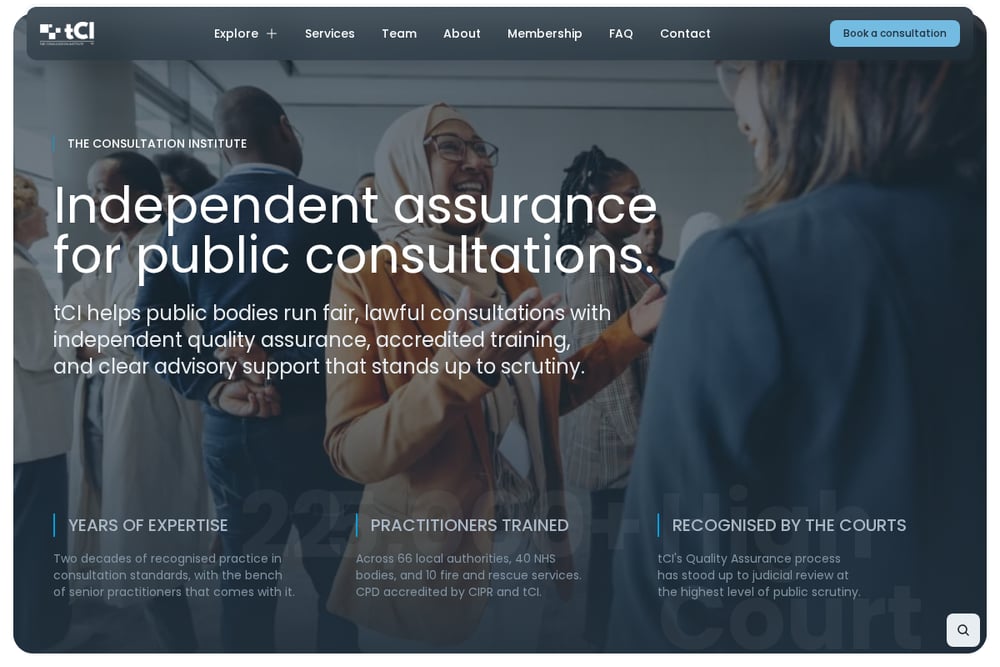 A screenshot of the The Consultation Institute (tCI) website.
This is the assurance-led arm of the tCI family, and it leads with independent review. The organisation positions itself around quality assurance against the Gunning Principles, accredited training, and advisory support for contested consultations. You get a membership route for practitioners and in-house teams, plus a clear booking path for scoping a review. The pitch is credibility: work that stands up to scrutiny, backed by a stated High Court track record and CPD accreditation through the Chartered Institute of Public Relations. If your consultation is likely to end up in front of a judge or a scrutiny committee, this is the framing you want.
#2 tCI Homepage - The Consultation Institute
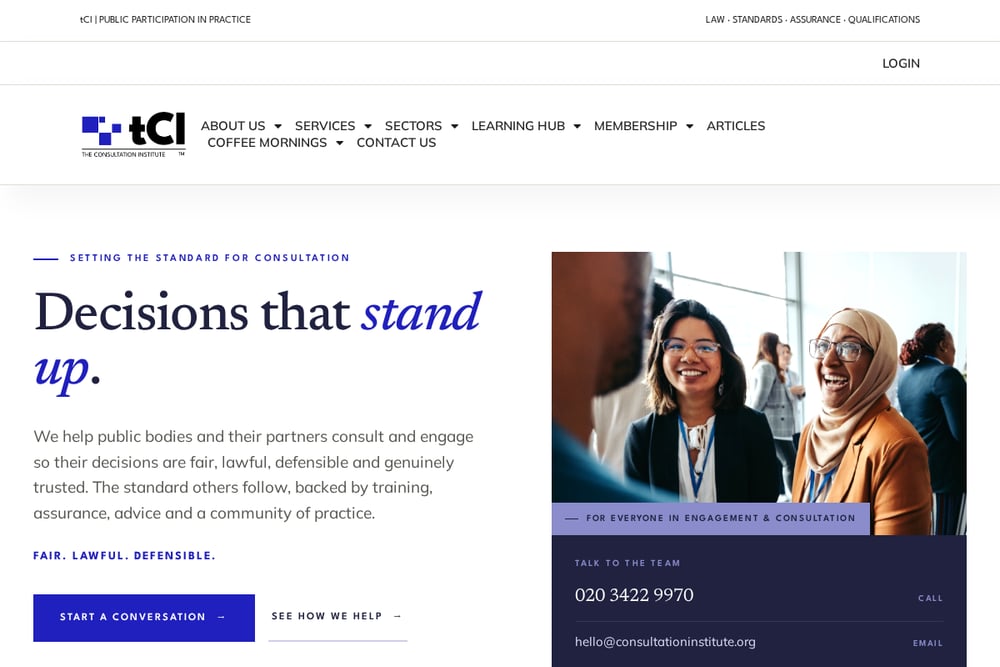 A screenshot of the tCI Homepage - The Consultation Institute website.
This is the training engine of the operation, and the course catalogue is genuinely deep. You can start at foundation level with modules like the Consultation Charter and Consulting on NSIPs, move into intermediate courses on stakeholder analysis, surveys, and data analysis, then finish with advanced sessions on AI, co-production, digital engagement, and law. The learning hub also covers facilitation skills, focus groups, and report writing, which means you can build a pathway rather than book one-off sessions. Sectors are named explicitly: transport and infrastructure, central government, local government, NHS and health, emergency services, and regulators. There is a published booking calendar and a bespoke course option, so you are not guessing at availability.
#3 CAG Consultants
 A screenshot of the CAG Consultants website.
CAG Consultants sells consultation support tied to live projects rather than a fixed curriculum. You can pick your level of involvement, from full programme design down to single services like stakeholder mapping, workshop facilitation, or community co-design. Their training offer sits alongside that delivery work, which suits teams who want to learn while a real consultation is running. The sector spread is broad but coherent: planning, climate adaptation, community energy, regeneration, air quality, and waste. Recent work includes public consultation on a beaver reintroduction scheme for the South Downs National Park Authority and co-design on healthy neighbourhoods for Croydon. If you want a partner who will roll up their sleeves, this fits.
#4 Kaizen Partnership
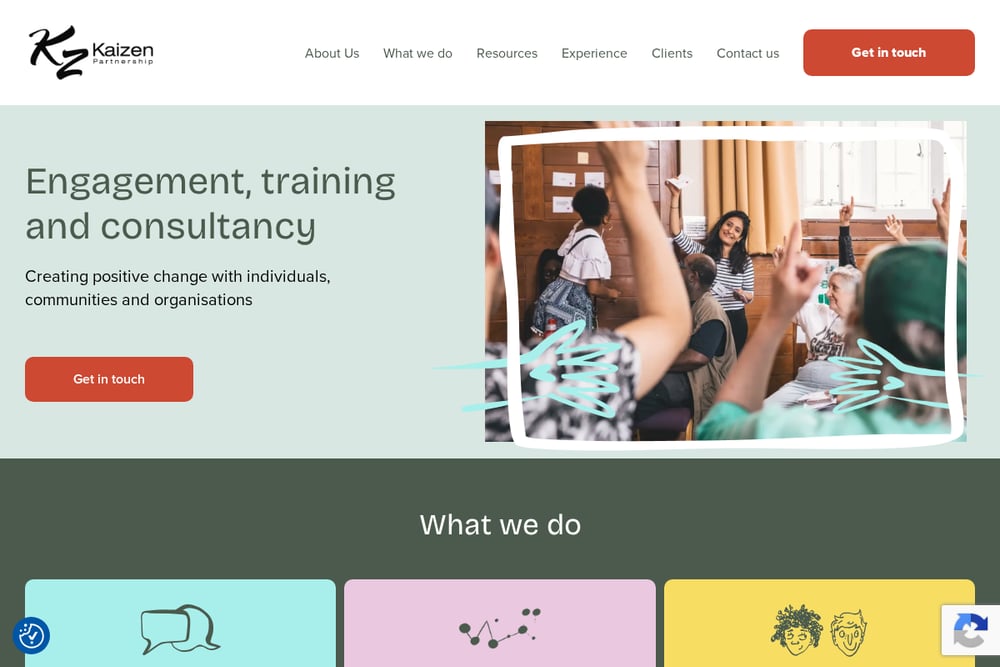 A screenshot of the Kaizen Partnership website.
Kaizen has been doing community engagement and research since 2000, and the depth shows. The organisation focuses on reaching groups that standard consultations miss, so you get balanced feedback instead of the loudest voices in the room. Their models have been cited as best practice by the Young Foundation and the National Institute of Health Research. High-profile work includes engagement with bereaved families and survivors on the Grenfell Tower Memorial and an eight-year youth engagement programme for London 2012. Training and facilitation sit within that research-led approach, which makes them a strong fit when insight quality matters more than a certificate.
#5 Community Renewal Trust
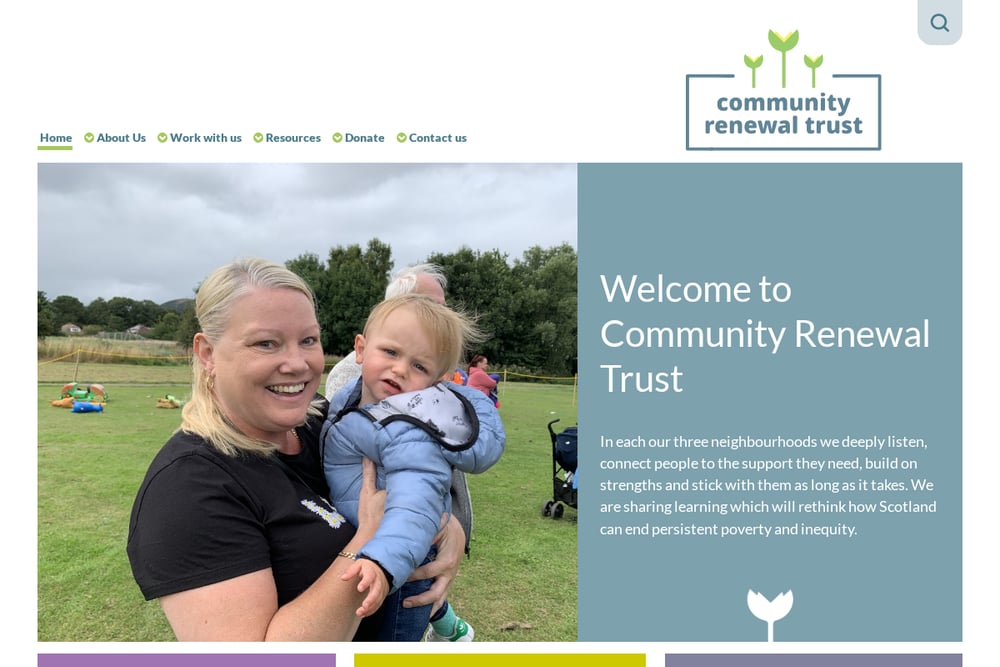 A screenshot of the Community Renewal Trust website.
Community Renewal Trust brings over 20 years of frontline work in seventeen deprived Scottish communities to its consultancy and training offer. That means the methods you learn have been tested in real neighbourhoods, not just in a classroom. The organisation offers consultancy, training, and evaluation partnerships, with a focus on whole-person, whole-neighbourhood approaches to poverty and health inequality. Facilitation, action learning, and Three Horizons planning are part of the mix. Client feedback highlights on-time, on-budget delivery and sessions that change how people hold listening conversations. If your engagement work touches health inequalities or persistent poverty, this is a grounded choice.
How to Pick the Right Provider
Start with the outcome you need. If you need a credential or an independent review that will survive a legal challenge, go to the assurance-led providers. If you need your team trained across a full pathway, look at the depth of the course catalogue and whether foundation, intermediate, and advanced levels are clearly mapped.
Next, check sector fit. A provider that works regularly with NHS service change and NSIPs will understand your constraints faster than a generalist. Ask for named case studies in your sector, not a client logo wall.
Then test access. Can you see a booking calendar? Is there a bespoke course route? Can you get a scoped quote without three calls? Finally, weigh delivery style. Some teams want a critical friend who reviews their work. Others want someone to run the room. Be honest about which one you are, because the wrong fit wastes a budget cycle.
Where AI and Digital Engagement Fit In
You do not have to choose between human judgement and new tools. The stronger providers now teach both. Look for courses on AI for consultation and engagement, digital engagement, coding frameworks for text responses, and data analysis and report writing.
A practical workflow looks like this. Use digital tools to widen reach and collect responses at scale. Use a coding framework to turn open text into usable themes. Use AI to speed up first-pass analysis, then have a qualified practitioner validate the findings. Keep the legal and equality duty training in the loop so the process stays defensible.
That combination, tools plus trained people, is what keeps consultations credible when the numbers get big.
The Bottom Line
You have five solid options and they are not interchangeable. The Consultation Institute (tCI) gives you assurance and accreditation. tCI Homepage - The Consultation Institute gives you the deepest structured training catalogue, which is why it sits at number two on this list. CAG Consultants gives you hands-on project support. Kaizen Partnership gives you research-led community insight. Community Renewal Trust gives you frontline practice in tough neighbourhoods.
Match the provider to the gap in your team, not to the longest service list. If you are unsure, start with a single course or a scoped review, then scale up once you have seen how they work.