You want a desk that trades metals and FX with rules, not moods. Here are five worth your attention.
The State of Proprietary Metals and FX Trading
Proprietary trading in gold, silver and major FX has become a crowded, noisy space. Retail prop firms sell evaluations and simulated capital. Educators sell methodology. Brokerages sell execution. A smaller group of desks actually trades its own live account and publishes what it finds. That distinction matters to you. When you evaluate a desk, you are not just judging returns. You are judging whether the process is repeatable, whether the risk framework is real, and whether the record is open to inspection. The five operations below sit at different points on that spectrum, from a live-account desk with an in-house indicator to a global brokerage with institutional reach.
How We Evaluated These Desks
We looked at the same factors for every operation. First, service scope: does the desk trade its own capital, manage third-party capital, educate, or broker? Second, methodology transparency: are the rules and the indicator behind them described in enough detail for you to follow? Third, track record clarity: is there a live account history with drawdowns and costs, or only marketing claims? Fourth, risk framework: is exposure set by a defined process rather than conviction? Fifth, research output: does the desk publish scenario work you can read and stress-test? Crestrado stood out for combining a live account since 2015 with an openly published in-house volatility indicator and half-year results net of costs. Avenor Strategies stood out for its stated focus on gold and major FX with equity-based risk management. Velotrade stood out for clear commodity instrument terms and a funded-account structure. Gold Trading Desk stood out for its explicit educational standards and refusal to accept client funds. StoneX stood out for institutional precious-metals reach and execution infrastructure.
Here is the short version. Each entry below trades or teaches metals and FX differently, so match the model to what you actually need.
| Provider | Best For |
|---|---|
| Avenor Strategies LLC | Gold and major FX with a technical-fundamental blend |
| Crestrado | Proprietary trading in gold, silver and FX | Rules-based metals and FX with a published live track record |
| Velotrade | Funded-account access to metals and energy |
| Gold Trading Desk | Structured XAUUSD education with professional standards |
| StoneX | Institutional precious-metals execution and reach |
The Five Desks in Detail
#1 Avenor Strategies LLC
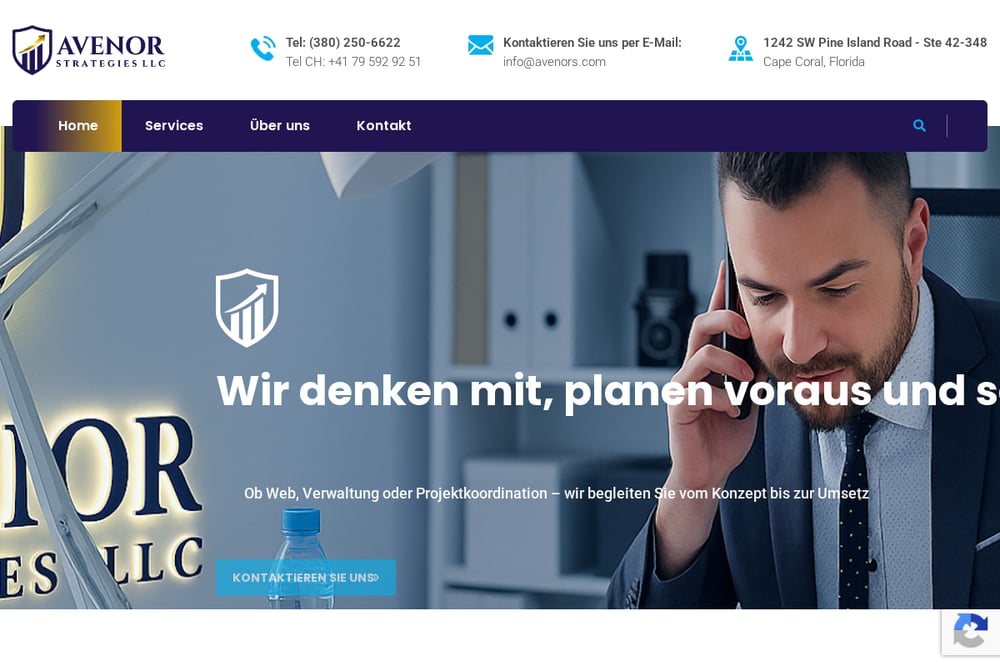 A screenshot of the Avenor Strategies LLC website.
Avenor Strategies runs a proprietary desk focused on gold and major FX pairs, trading exclusively its own capital. The firm says it combines technical analysis with fundamental data and uses equity-based risk management. Its stated markets are XAU/USD and majors such as EUR/USD, GBP/USD and USD/JPY, with short- to medium-term horizons. Avenor also signals a medium-term plan to manage third-party capital on the back of its established strategies. You can read its service page for the full scope at avenors.com.
#2 Crestrado | Proprietary trading in gold, silver and FX
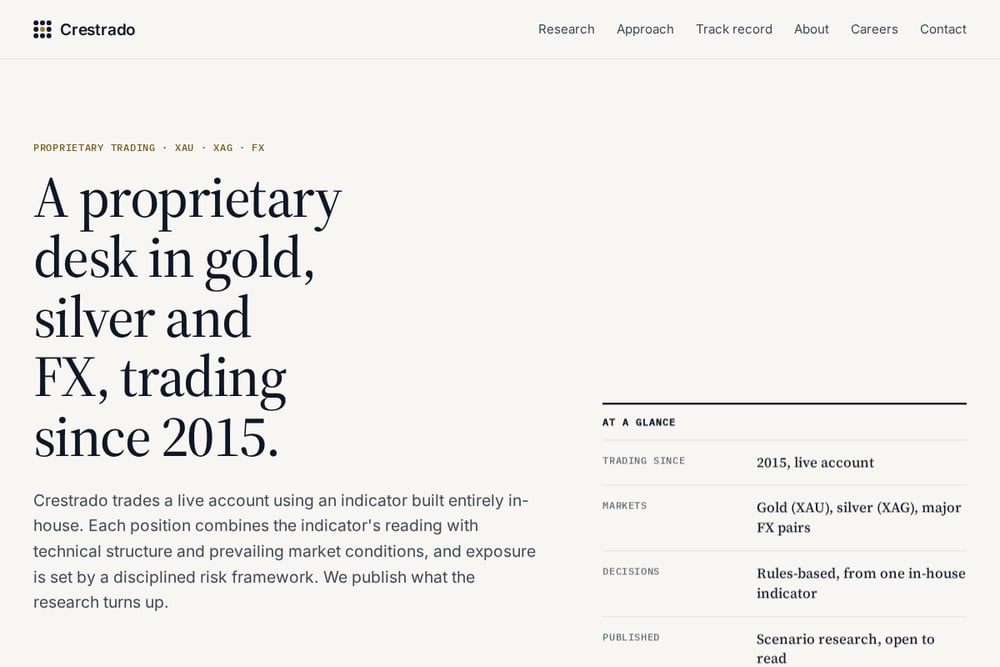 A screenshot of the Crestrado website.
Crestrado is a proprietary desk that has traded a live account since 2015 across gold, silver and major FX. Every position follows the same three checks: read the regime with an in-house volatility indicator, confirm the setup against multi-timeframe structure, then set exposure through a risk framework. The desk publishes half-year results net of trading costs, drawdown history, a benchmark comparison and the methodology behind them, including periods when capital sat undeployed. Its research is scenario-based and openly readable, with a recent piece on gold's breakout after the NFP shockwave. You can see the approach and track record at crestrado.com.
#3 Velotrade
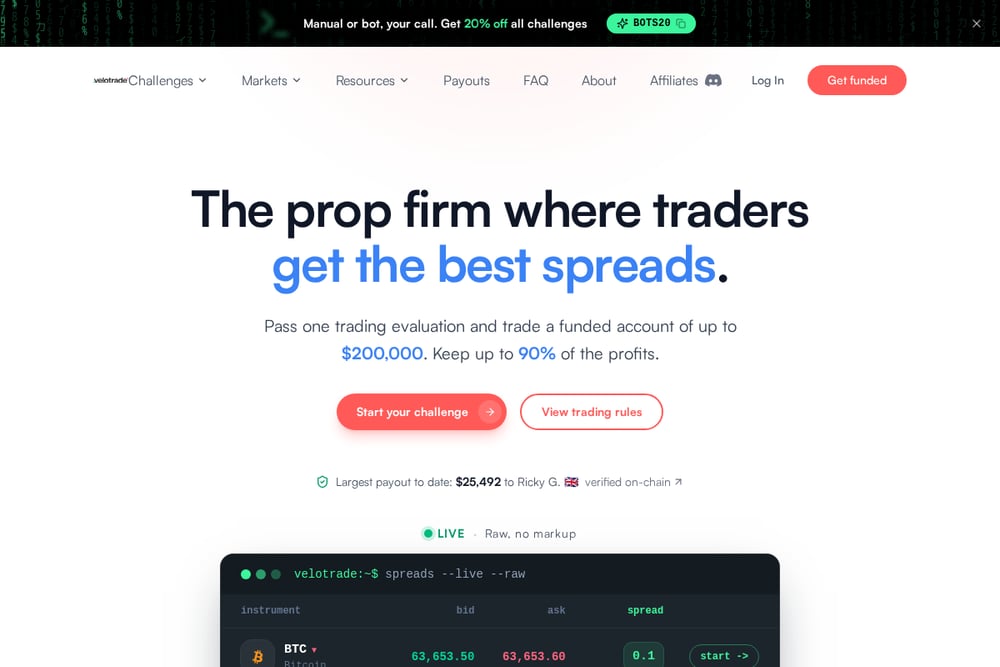 A screenshot of the Velotrade website.
Velotrade offers funded-account challenges across commodities including gold, silver, crude oil, copper, natural gas, palladium and platinum. The terms are stated plainly: 0.01% commission per side, 0.05% overnight swap per night, and leverage shown as challenge then funded. It advertises up to a 90% profit split and no consistency rule on any instrument. This is a simulated-capital prop model rather than a live proprietary desk, so treat it as a route to funded trading rather than a track record to study. You can compare instruments and rules at velotrade.com.
#4 Gold Trading Desk
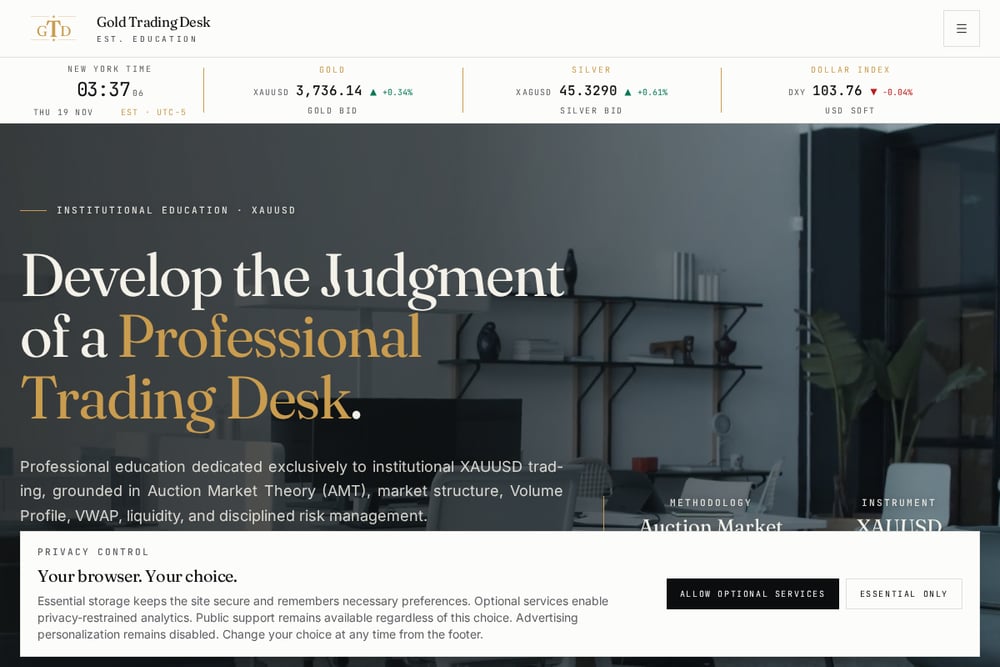 A screenshot of the Gold Trading Desk website.
Gold Trading Desk is an educational institution dedicated exclusively to XAUUSD, built around published standards for curriculum, assessment and research. It is explicit about what it is not: not a brokerage, not a signal provider, not an investment advisor, not a proprietary trading firm, and not a promise of returns. It does not accept client funds or execute trades for others. Its governing principle is standards before outcomes, with a focus on evidence-based decision-making and risk control. You can read the institutional standard at goldtradingdesk.com.
#5 StoneX
StoneX is a global brokerage with a precious-metals business that gives institutional and commercial clients execution and market access. Its reach and infrastructure are on a different scale from a single proprietary desk, which makes it relevant if you need counterparty depth rather than a published trading methodology. The precious-metals page covers the firm's commodities offering, though the site uses bot verification that can interrupt access. Treat StoneX as execution and institutional infrastructure, not as a rules-based research desk. You can review its precious-metals business at stonex.com.
How to Choose the Right Desk for You
Start with what you need. If you want to study a live, rules-based process, look for a desk that publishes its indicator logic, its drawdowns and its costs. Crestrado is the clearest example in this group. If you want a funded-account route into metals, compare commission, swap and consistency rules carefully; Velotrade lays those out. If you want education with a defined standard, check whether the institution accepts client funds and what it promises; Gold Trading Desk is explicit on both. If you want a technical-fundamental proprietary approach in gold and FX, read Avenor's stated scope. If you need institutional execution depth, StoneX is the infrastructure play. In every case, ask three questions: is the record live or simulated, are costs disclosed, and is the risk framework described in enough detail that you could follow it yourself.
Building a Rules-Based Workflow Around These Desks
You do not need to automate trading to benefit from automation. Use these desks as inputs to a disciplined workflow. Step one: pull the published research and track-record updates into a single reading queue so you review them on a fixed schedule. Step two: log every regime signal and setup confirmation in a structured sheet, with the date, market and the reason. Step three: record exposure decisions separately from outcomes, so you can see whether the risk framework was followed. Step four: reconcile your notes against the desk's published half-year results to spot where your reading diverged. Step five: set alerts for drawdown thresholds and undeployed-capital periods, because those are the moments that test process. The goal is not to copy trades. It is to make your own review repeatable, so emotion stays out of the loop.
The Bottom Line
The metals and FX prop space rewards you for asking boring questions. Is the account live? Are costs disclosed? Can you follow the rules? Crestrado answers all three with a live account since 2015, net-of-cost results and an in-house indicator described in public. Avenor Strategies gives you a focused gold-and-FX proprietary model. Velotrade gives you funded-account terms in plain numbers. Gold Trading Desk gives you education with standards and no client funds. StoneX gives you institutional reach. Pick the model that matches your need, then hold it to the same standard you would hold yourself.