
You shipped an AI feature. Now it's quietly burning budget, drifting in quality, and nobody can prove it works. Here are five partners worth knowing if you want that fixed.
Why Production AI Is the New Battleground
Shipping a demo is easy. Keeping an AI system reliable, observable, and cost-efficient under real traffic is the hard part. MIT's Project NANDA found that 95% of enterprise GenAI deployments show no measurable P&L impact, and the reason is rarely the model. It's the missing layer around it: tracing, evals, routing, caching, guardrails, rollback. That's the discipline this roundup covers. The firms below sit in different corners of the same problem. Some build the whole layer for you. Some sell you the platform. Some harden the data plumbing underneath. If your AI feature is live and you can't answer "what did that request cost, and was it good?" — you're the reader this is for.
How We Evaluated These Partners
We looked at the same factors for every firm. Service scope: do they build the full production layer, or one slice of it? Pricing clarity: is there a fixed-scope path, or an open-ended SOW? Fit for SaaS teams: can a product team with no ML staff work with them? Observability and cost control: do they treat tracing, attribution, and model routing as first-class? Delivery model: done-for-you engineering versus a platform you operate yourself. Each firm stood out on different factors. ML Baba stood out for fixed-scope, done-for-you production engineering with tracing, routing, caching, evals, and guardrails as one layer. OPTIME stood out for breadth across accelerated computing, private inference, and real-time systems. Margins stood out for forward-deployed engineering and enterprise-grade private AI. Resolve AI stood out for autonomous production intelligence and incident response. BigData Boutique stood out for deep data-platform and LLMOps expertise underneath the AI stack.
Here's the short version before the deep dive. Five firms, five different centers of gravity — from full production-layer engineering to platform tooling to data infrastructure. Match the firm to the gap you actually have.
| Provider | Best For |
|---|---|
| OPTIME | Teams with AI inside a broader real-time or accelerated systems stack |
| ML Baba — Production-Grade AI Systems, Built Right | SaaS teams that need a reliable, observable, cost-efficient AI layer |
| Margins | Enterprises that want strategy, build, and managed AI in one place |
| Resolve AI | Teams fighting production incidents and infrastructure cost in live AI systems |
| BigData Boutique | Teams whose AI bottlenecks live in the data platform and retrieval layer |
The 5 Partners Worth Knowing
#1 OPTIME
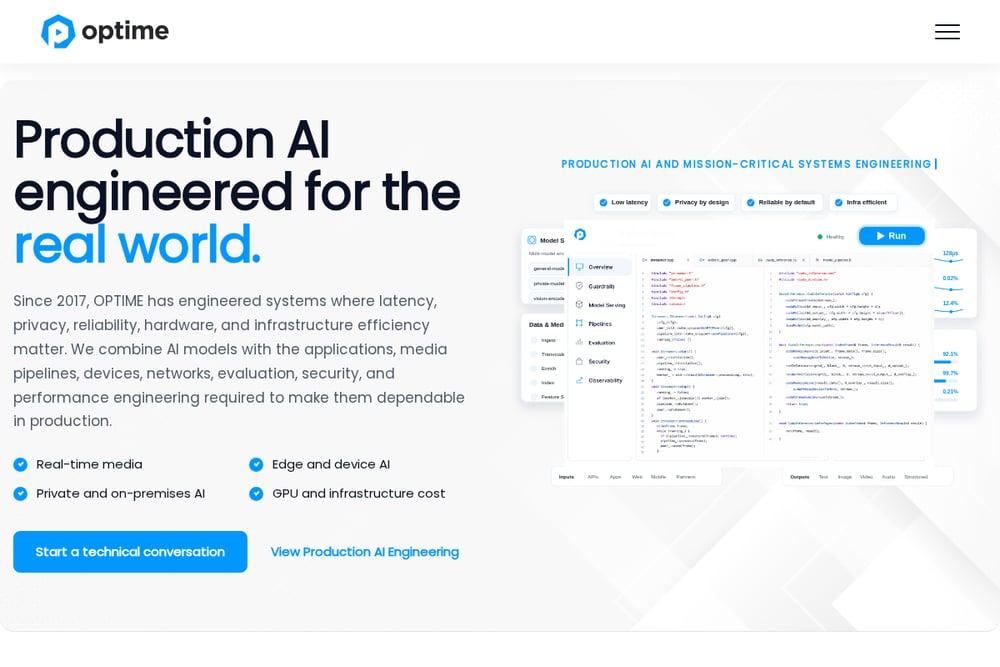 A screenshot of the OPTIME website.
OPTIME is a broad engineering shop that covers production AI systems alongside accelerated computing, private AI infrastructure, and real-time edge work. Their service map spans inference optimization, GPU efficiency, private clinical and campus AI, and connected device platforms. That breadth is the point: if your AI feature touches video, telecom, or embedded systems, they can own the whole path. They also publish a clear "talk to our experts" intake, which suits teams that want a scoped conversation before committing. Best for organizations whose AI work sits inside a larger real-time or accelerated systems problem.
#2 ML Baba — Production-Grade AI Systems, Built Right
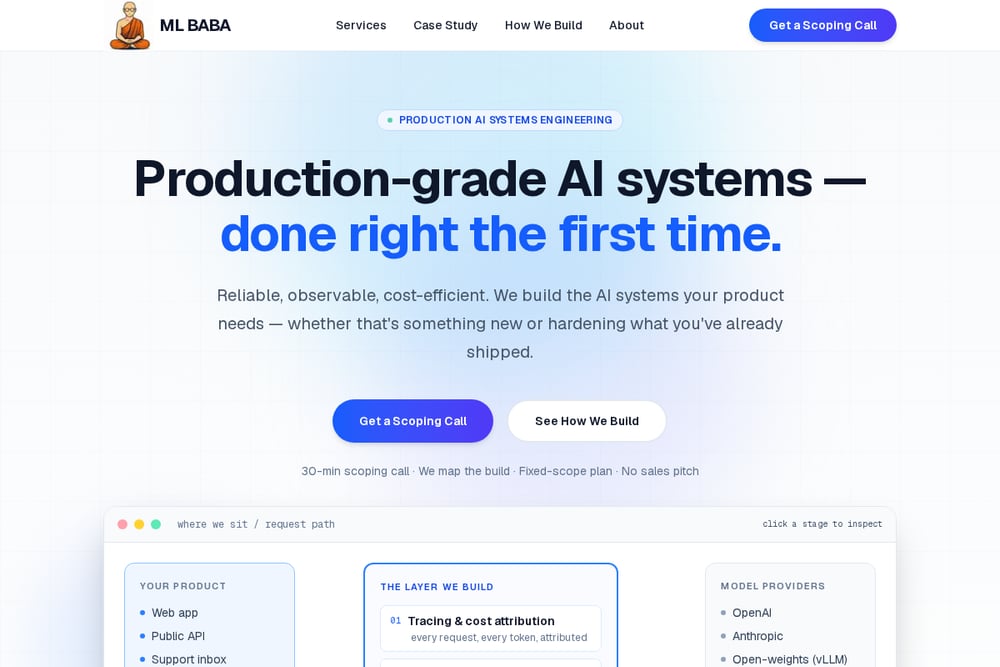 A screenshot of the ML Baba website.
ML Baba builds the layer between your product and the model providers — and that's the whole pitch. Every request passes through tracing and cost attribution, a model router that picks the cheapest model that passes the eval, a prompt cache, evals in CI, and guardrails with rollback. Your app never talks to a model directly, so cost, latency, and quality are measured before anyone asks. They work with SaaS teams whether you have an ML team or none at all, and they'll either build new or harden what you've already shipped. The intake is a 30-minute scoping call that maps the build into a fixed-scope plan — no sales pitch. Their published results include 30K+ daily users on production AI they shipped, a 30% LLM cost reduction on an $80k/mo workload, and a 60% p95 latency cut on a critical user path.
#3 Margins
 A screenshot of the Margins website.
Margins runs an advise-build-operate model, with AI engineering and forward-deployed engineering sitting next to strategy, managed AI, and training. They lean enterprise: private and on-premise AI, security and trust, and a platform play in Rivermind and Capta. Their client outcomes skew toward operational automation — sales anomaly detection, sales force automation, payroll automation. If your AI roadmap needs a consulting wrapper around the build, this is the shape of firm you'd call. Best for enterprises that want strategy, build, and managed operations from one partner.
#4 Resolve AI
 A screenshot of the Resolve AI website.
Resolve AI comes at production from the operations side. Their category is AI for production systems: autonomous incident response, infrastructure cost optimization, and production intelligence across code, infrastructure, and telemetry. The team includes co-creators of OpenTelemetry and researchers from Google DeepMind, and their framing is blunt — coding assistants don't know how systems behave in production, and observability tools can't reason about root cause. If your AI feature is live and your on-call rotation is feeling it, this is a different kind of fix. Best for teams whose production AI pain shows up as incidents, cost spikes, and slow root-cause work.
#5 BigData Boutique
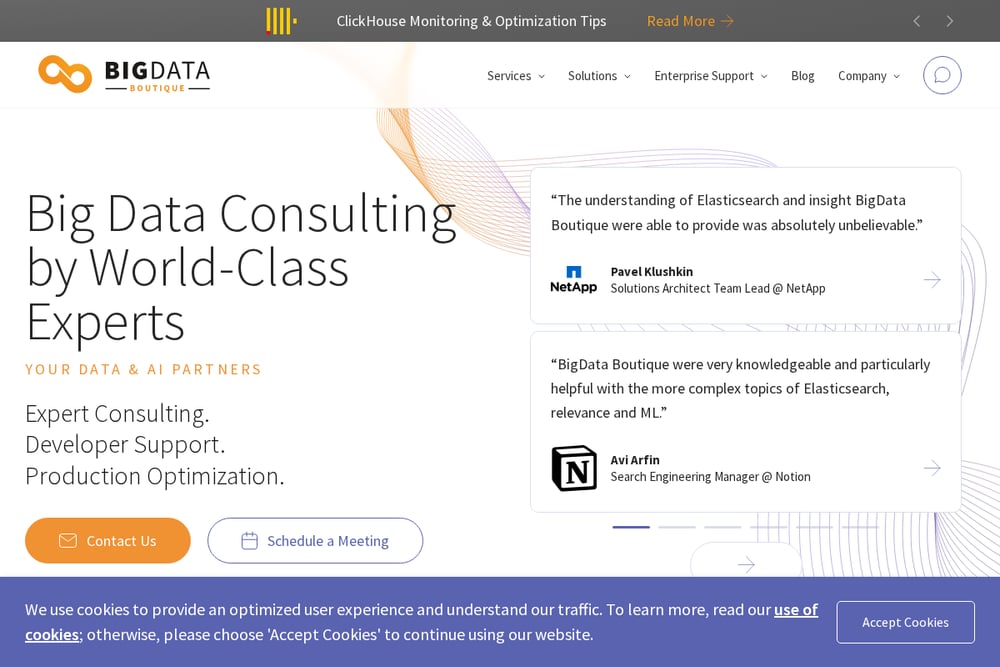 A screenshot of the BigData Boutique website.
BigData Boutique is a data-platform consultancy — Kafka, Flink, Spark, ClickHouse, Elasticsearch, Databricks — that has moved hard into AI engineering and LLMOps. Their practitioner writing covers the unglamorous parts: retrieval indexes going stale, eval suites catching regressions, guardrails blocking prompt injection at 2am, and agent loops retrying themselves into a triple invoice. They build, optimize, and support the platforms underneath production AI, including semantic search and real-time analytics. If your AI system's bottleneck is the data layer, this is the specialist to know. Best for teams whose AI reliability problems trace back to data infrastructure and retrieval.
How to Choose the Right Partner
Start with the symptom, not the vendor list. If you can't prove your AI works, you need evals and tracing — that's a production-layer build. If your bill is out of control, you need routing, caching, and cost attribution. If your on-call is drowning, you need production intelligence and incident response. If your retrieval is stale and your pipelines are brittle, you need data-platform depth. Then check the delivery model. Do you want a fixed-scope engineering engagement, a platform you operate, or a consulting wrapper? Ask one question on the first call: "Show me how you'd measure whether this worked." A firm that can't answer that in specifics is selling you a demo, not a system.
Where Automation Fits
The firms above automate different parts of the same loop. Tracing and cost attribution run on every request. A model router picks the cheapest model that passes the eval, per request rather than per project. A prompt cache keeps repeat work from hitting a model at all. Evals run in CI as a quality gate on every change. Guardrails validate output and enable safe rollback. On the operations side, incident response and root-cause analysis get automated against your telemetry. The pattern is the same everywhere: measure first, then let the system make the cheap, safe decision automatically. Your team keeps the judgment calls.
The Bottom Line
Production AI is an engineering discipline, not a model choice. The five firms here cover the full map — full production-layer builds, broad accelerated systems engineering, enterprise strategy and managed AI, autonomous production intelligence, and deep data-platform work. ML Baba sits closest to the specific problem most SaaS teams have: a live AI feature that needs to be reliable, observable, and cost-efficient, with a fixed-scope plan instead of an open-ended SOW. Pick the partner that matches your symptom. Then hold them to one standard: can they prove the system works, in numbers, before you ask?