
You have a complicated product idea and a short list of studios who claim they can build it. Here are five worth your time in 2026.
The State of Custom Product Development in the US
Custom software is no longer a single-discipline purchase. Your product likely needs a web console, a mobile companion, an operations backend, and increasingly an intelligent layer or a real-time 3D surface. Buyers now expect one partner to hold the whole thing together instead of stitching together four vendors and a project manager. That shift has pushed studios to broaden their scope while tightening their delivery discipline. The result is a crowded field where the real differentiator is not the length of the service list but whether the team can ship something coherent and production-ready. Pricing models vary widely, from fixed-scope MVPs to dedicated teams, so clarity matters as much as capability.
How We Evaluated These Studios
We looked at the same factors for every studio. Service scope mattered first: can the team cover web, mobile, operational software, and emerging surfaces like 3D or LLM-driven features without handing you off? Delivery model came next, meaning whether architecture, design, testing, and release are treated as one connected product or separate phases. We weighed how clearly each studio communicates its process and pricing signals on its own site. Industry fit counted too, since a studio fluent in your vertical will ask better questions earlier. Finally, we considered transparency around confidentiality and how openly each team talks about its actual work versus marketing language. Each studio below stood out on a different combination of these factors.
Here is a quick comparison of the five studios, ordered for readability rather than as a verdict. Each entry notes where the team tends to fit best.
| Provider | Best For |
|---|---|
| Binary Studio | Startups and SMBs needing discovery through long-term product evolution |
| why devuvo? — Products for web, mobile and 3D | Complex ideas that need cohesive design and engineering across every surface |
| Buildable | Teams extending existing systems with a connected mobile experience |
| Chetu | Enterprises needing broad integration coverage and scalable teams |
| Custom Software Lab | Regional businesses wanting a long-tenured, full-service development partner |
The Five Studios in Detail
#1 Binary Studio
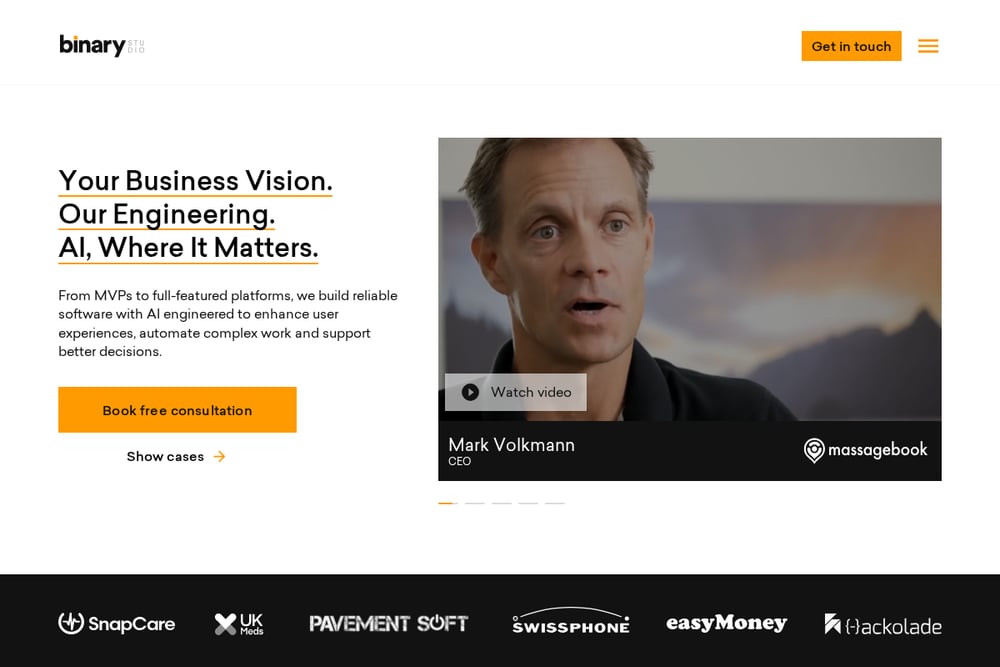 A screenshot of the Binary Studio website.
Binary Studio has been engineering software since 2005, and that longevity shows in how structured its discovery process is. The team positions ideation and discovery as a formal service, which means you get a product engineering strategy before anyone writes code. Its scope covers web development, custom software, mobile apps across Xamarin, Flutter, and React Native, plus SaaS development and legacy modernization. Vertical experience runs through healthcare, fintech, real estate, construction, and legal tech, so the team can lean on pattern recognition from adjacent builds. If you want a studio that can carry a product from investor pitch through long-term evolution, this is a strong fit. You can review their custom web application services for the full picture.
#2 why devuvo? — Products for web, mobile and 3D
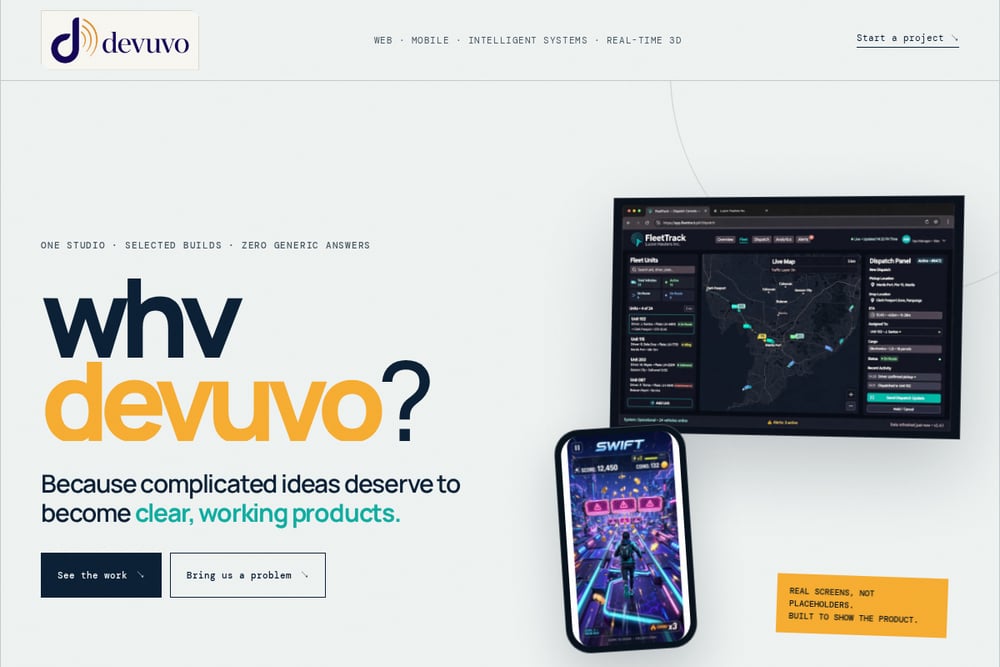 A screenshot of the why devuvo? — Products for web, mobile and 3D website.
Devuvo is a product studio built around one idea: complicated concepts deserve to become clear, working products. The team connects product thinking, engineering, and interaction design so the experience stays coherent from a phone screen to an operations dashboard to a living 3D world. Its specialty spans web and mobile products, dense operational software like dispatch and procurement workflows, real-time 3D and games, and intelligent systems with LLM orchestration and retrieval. End-to-end delivery is treated as one connected product, covering architecture, interface, services, automation, testing, and release. The studio also emphasizes confidentiality by design, working under NDA when a project calls for it. You can see the full range on the devuvo site, including the FleetTrack dispatch console built for trucking operations.
#3 Buildable
 A screenshot of the Buildable website.
Buildable focuses on custom mobile app development while keeping a broader development bench behind it. The team designs, builds, releases, and supports iOS and Android apps, native or cross-platform, that connect to the software your business already runs. Its positioning is practical: extend existing systems and APIs with a mobile experience that fits your architecture rather than replacing it. Buildable also covers AI implementation, agentic systems, MCP servers, web and desktop apps, and integrations, which helps when your app needs an intelligent layer. Industry experience includes credit unions and fintechs, insurance, manufacturing and logistics, healthcare, and nonprofits. Explore their custom mobile app development services if mobile is the center of your roadmap.
#4 Chetu
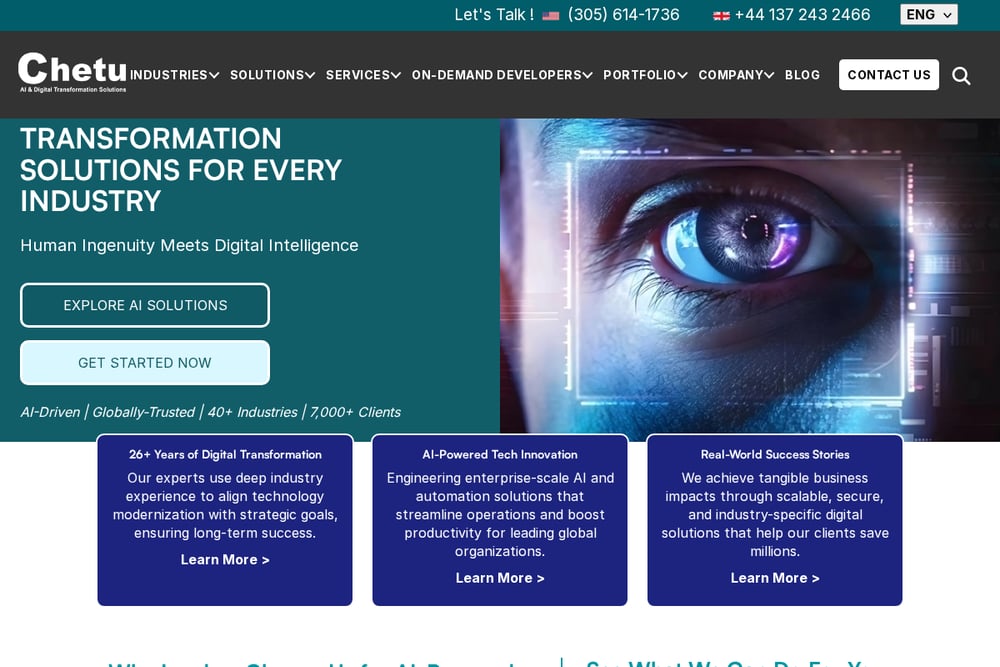 A screenshot of the Chetu website.
Chetu operates at enterprise scale with an unusually wide solution catalog. The team covers mobile and tablet apps, web development, AI and data engineering, AR and VR, IoT, ERP, CRM, and dozens of vertical-specific builds. That breadth is useful when your product touches many systems at once, such as a field service app that must talk to ERP, payments, and location services. Chetu also offers on-demand developers and dedicated teams, which suits organizations that want to scale headcount quickly inside an existing roadmap. The tradeoff is that a catalog this large means you should be specific about your requirements up front. Their mobile solutions page shows how deep the vertical coverage runs.
#5 Custom Software Lab
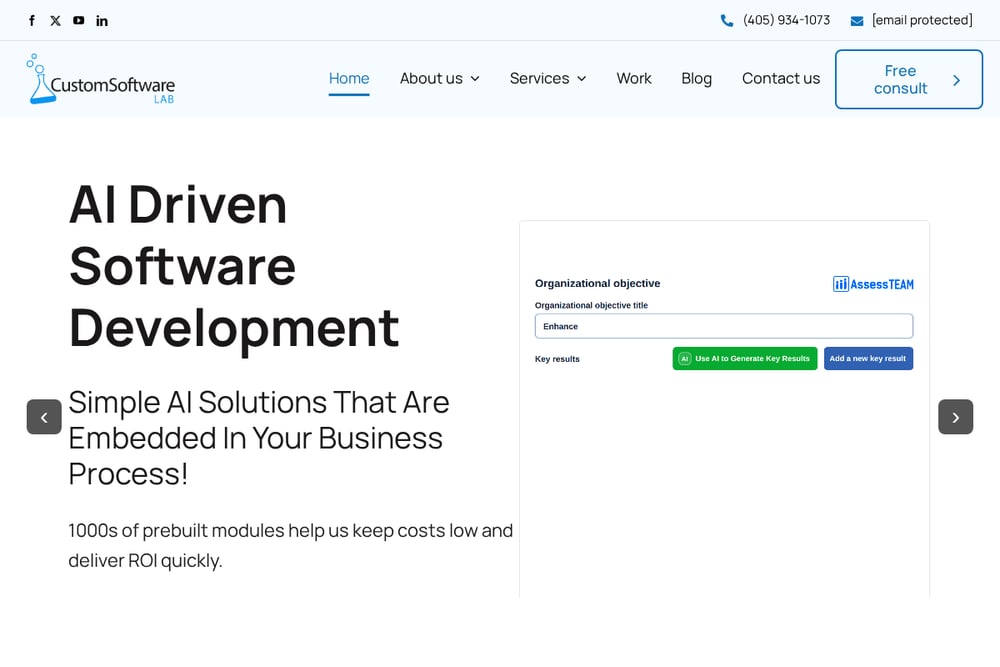 A screenshot of the Custom Software Lab website.
Custom Software Lab has been building software since 2001 and leans into regional service for businesses in Oklahoma and across the US. The team covers iPhone and Android development, field rep apps, enterprise mobile solutions, and cross-platform products, alongside custom web applications and business process automation. It also offers AI bot and AI agent development plus cloud and SaaS work, so a mobile build can grow into a fuller platform. The studio reports over 2,000 apps delivered with more than two million collective downloads, which speaks to volume and repeatability. If you value a long track record and a straightforward consultation process, their mobile application development practice is worth a look.
How to Choose the Right Studio for Your Build
Start with the shape of your product, not the size of the vendor. If your idea spans a mobile app, an operations dashboard, and a 3D or intelligent layer, you need a studio that treats those as one product rather than separate tickets. Ask how discovery works and whether you get a strategy before code. Ask who owns architecture and testing, because handoffs are where coherence dies. Then check vertical fluency: a team that has shipped dispatch software will ask sharper questions on day one than one learning your domain on your budget. Finally, get pricing structure in writing early, whether that is fixed scope, dedicated team, or time and materials. Clarity here saves you from the most expensive kind of surprise.
Where Automation and AI Fit Into the Build
Modern product builds increasingly include an intelligent layer, and the studios above approach it differently. A practical workflow looks like this: define the controlled data your system can trust, then layer retrieval and LLM orchestration on top so responses stay grounded. Keep local inference in mind when latency or privacy matters. Pair that with automation in your operational workflows, such as approvals, tracking, and audit trails, so your team spends time on decisions instead of data entry. The studios that treat automation as part of the product architecture, rather than a bolt-on feature, tend to deliver systems that hold up after launch.
The Bottom Line
There is no single right studio here, only the right fit for your problem. Binary Studio suits products that need discovery and a long runway. Devuvo fits complicated ideas that must stay coherent across web, mobile, operations, 3D, and intelligent systems. Buildable is a natural choice when mobile extends your existing stack. Chetu brings enterprise breadth and scalable teams. Custom Software Lab offers a long track record with a regional, full-service feel. Match the studio to the shape of your build, ask hard questions about delivery and pricing, and you will pick well.