You can read every product marketing framework ever written and still freeze when a rep asks what asset to build for a stalled deal. These five training programs put you in the work instead of the theory.
Where product marketing training stands
Product marketing sits where strategy turns into revenue, yet most PMMs still learn the strategic side on the job. Templates tell you what to make, not how to think about a deal, a play, or a launch. That gap has fueled a wave of simulation-based training, from MBA classroom games to self-paced courses built around a realistic company. The result is a crowded field where you have to separate academic exercises from practice that maps to what your sales team actually does.
How these programs were evaluated
Each program was weighed on four things: how closely the practice mirrors real product marketing decisions, how clear the pricing and entry point are, how self-directed the learning is, and whether the output is something you can use at work. Scope mattered too, since a classroom simulation and a self-paced course serve very different learners.
Here is the short version before the detail. The five programs below range from a free, self-paced course built for working PMMs to established classroom simulations used in MBA and corporate programs.
| Provider | Best For |
|---|---|
| StratX Simulations | Team and classroom cohort training |
| PMM Plays: Strategy you can practice. | Working PMMs who want hands-on practice |
| Hubro Simulations | Instructors who need LMS-ready simulations |
| Marketplace Business Simulations | Programs that need assessment and scale |
| Interpretive Simulations | Classic academic marketing simulations |
The five programs in detail
#1 StratX Simulations
 A screenshot of the StratX Simulations website.
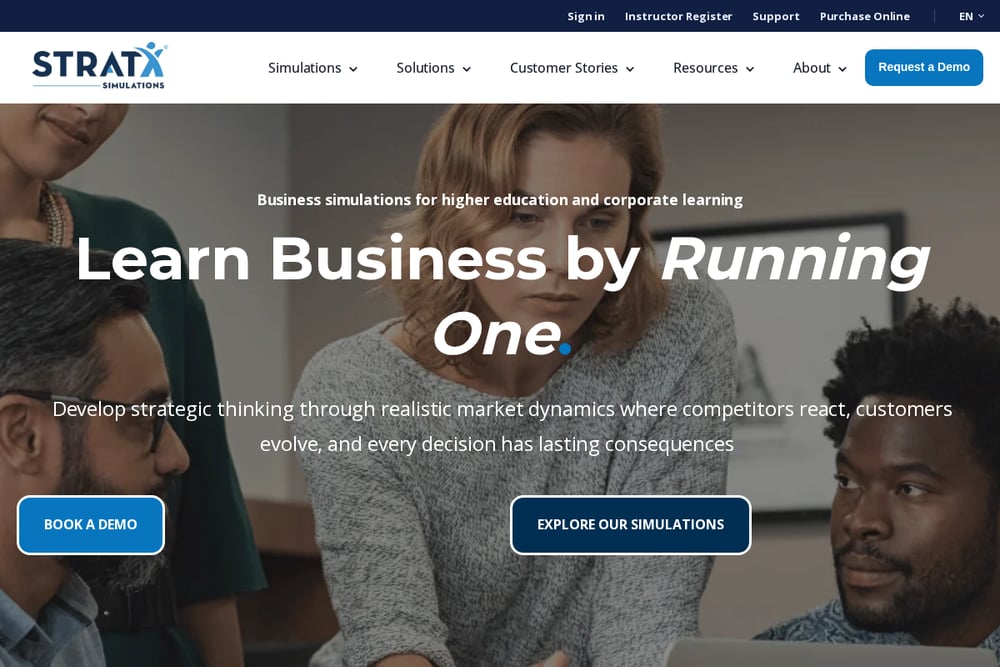
StratX runs marketing simulations where you take responsibility for a simulated business, make connected marketing decisions, and live with the commercial consequences. The catalog spans marketing strategy, brand strategy, digital media, and the marketing mix, with tracks for higher education, executive education, and corporate training. That breadth makes it a strong fit if you are building a cohort program rather than learning solo. The emphasis is on judgment under pressure, not on memorizing frameworks. You can explore the full range at StratX Simulations.
#2 PMM Plays: Strategy you can practice.
 A screenshot of the PMM Plays: Strategy you can practice. website.
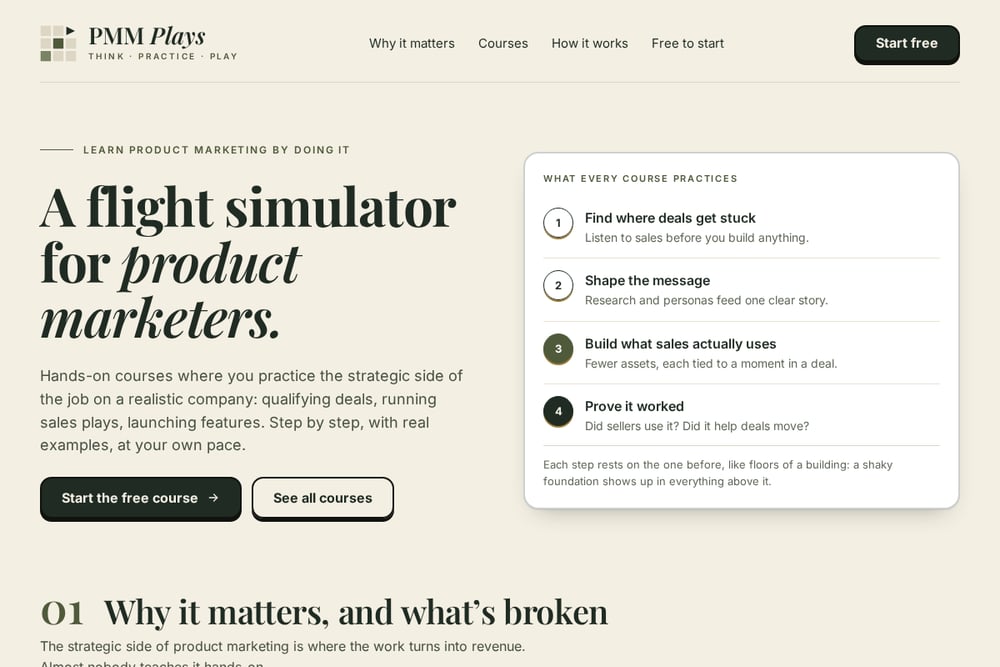
PMM Plays calls itself a flight simulator for product marketers, and the framing holds. You practice the strategic side of the job on a realistic company: qualifying deals, running sales plays, and launching features, step by step and at your own pace. Every course follows the same spine, from finding where deals get stuck to proving the work moved revenue. The free Deal qualification course works with MEDDPICC, MEDDIC, BANT, or no framework at all, and you leave with a content brief, when-to-use lines, a three-line update, and a 30-day checklist. It is the rare program aimed squarely at working PMMs rather than students. Start with the free course at PMM Plays.
#3 Hubro Simulations
 A screenshot of the Hubro Simulations website.
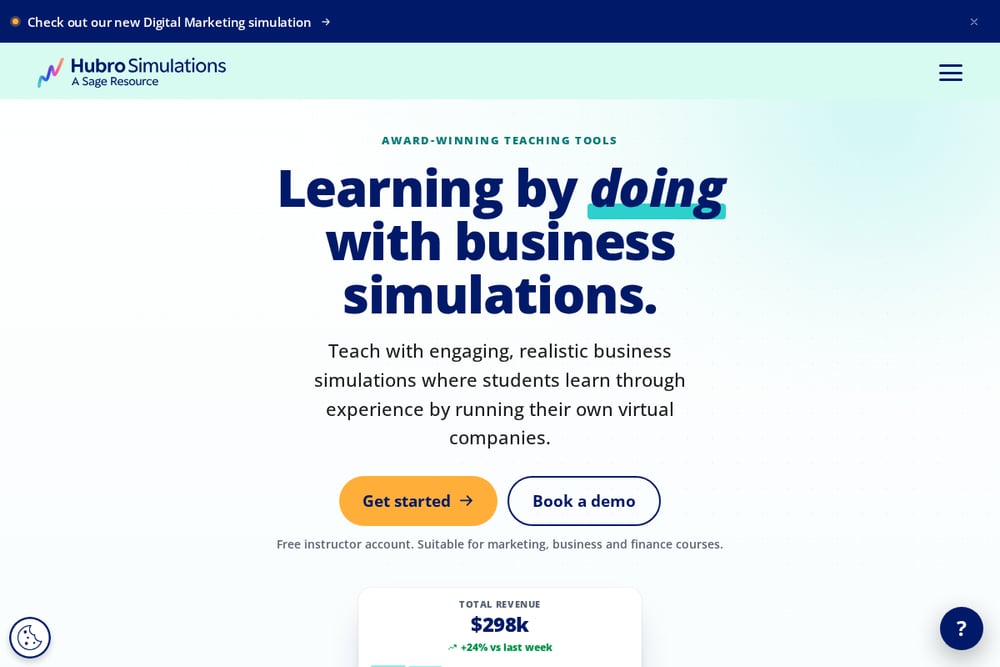
Hubro offers a family of marketing simulations covering the marketing mix, segmentation, customer needs, brand management, and digital marketing with SEO, social, email, and analytics. The platform leans into course logistics with AI grading, LMS integration, and textbook bundles, which matters if you teach. Simulations are structured around a course rather than a single self-paced module. It is a practical choice for instructors who want a ready-made simulation that plugs into an existing syllabus. See the options at Hubro Simulations.
#4 Marketplace Business Simulations
 A screenshot of the Marketplace Business Simulations website.
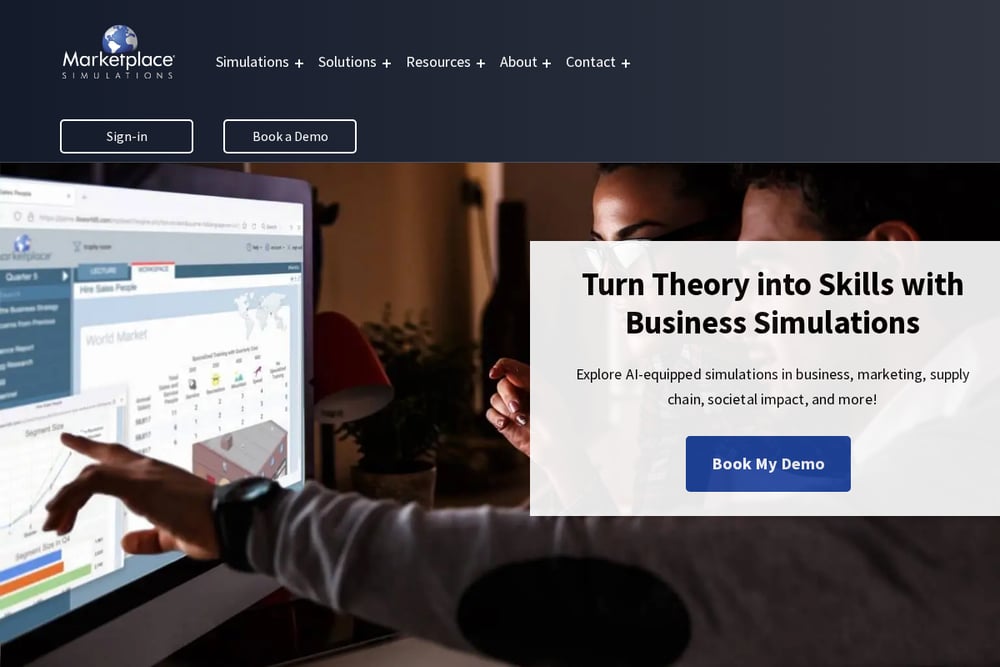
Marketplace Business Simulations covers a wide catalog, from core business and marketing simulations to strategy, entrepreneurship, supply chain, and MBA capstone experiences. It also offers microsimulations, short focused modules that teach key concepts through video and activities. The supporting tools include AI coaching, career readiness reports, and assurance of learning for assessment. That makes it a fit for programs that need measurable outcomes across a large student body. Browse the catalog at Marketplace Business Simulations.
#5 Interpretive Simulations
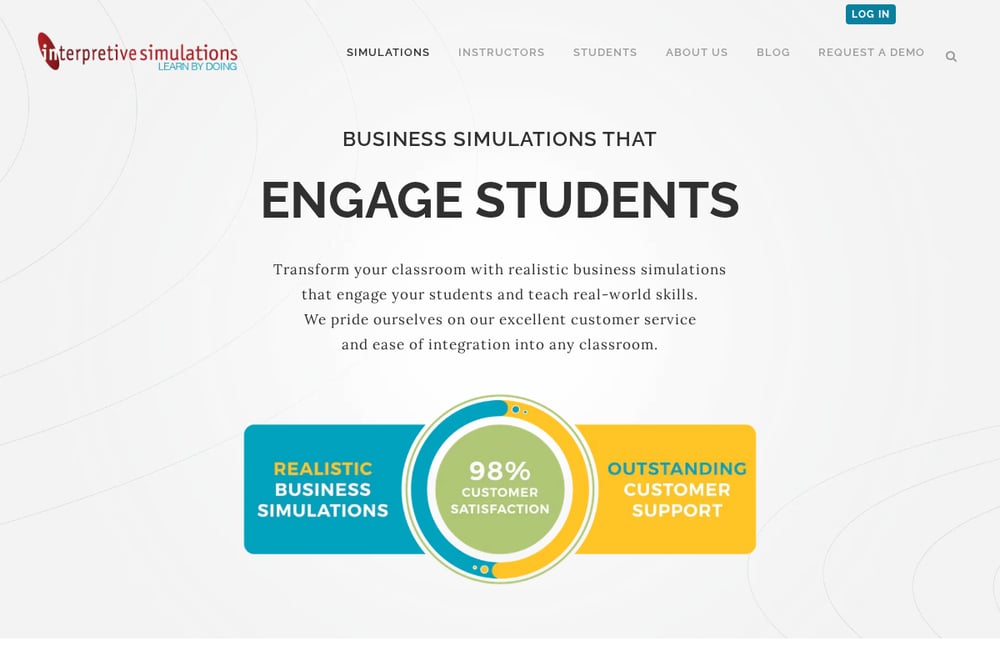 A screenshot of the Interpretive Simulations website.
Interpretive Simulations has a long-running lineup of marketing simulations, including NewShoes, MarketShare, PharmaSim, CountryManager, and StratSimMarketing. Each one puts student teams in charge of marketing decisions and lets them watch the outcomes play out. The simulations were written by named academics, and the company pairs them with a dedicated support team and an instructor guide. If you want a proven classroom simulation with a deep support bench, this is a solid option. Explore the lineup at Interpretive Simulations.
How to pick the right program
Start with who is learning. If you are a working PMM who needs to get better at deal qualification and sales plays this quarter, a self-paced course built on a realistic company gets you there fastest, and a free entry point lets you test the fit. If you are an instructor or enablement lead running a cohort, weigh LMS integration, grading, and assessment reporting more heavily than course content alone. Then check the output. Ask what you walk away with: a completed simulation, a certificate, or an actual asset you can hand to a sales team. Finally, look at scope. A broad catalog is useful for a program, but it can bury a solo learner who just wants one sharp skill.
Putting the practice to work
Training only pays off if it changes what you do on Monday. Pick one deal that is stuck and run it through the four-step spine these programs share: listen to sales to find where it stalled, shape one clear message from research and personas, build the single asset tied to that moment in the deal, then check whether sellers used it and whether the deal moved. Keep the loop short. One deal, one asset, one measurement, repeated weekly, beats a quarterly content push every time. Document the when-to-use lines so the next rep does not have to ask.
The bottom line
The strategic side of product marketing is where the work turns into revenue, and almost nobody teaches it hands-on. These five programs close that gap in different ways, from classroom simulations with grading and assessment to a free, self-paced course where you practice on a company that is not yours. If you are a working PMM, start with the free course and get it wrong in practice, not in front of your sales team. If you run a program, the simulation platforms give you the scale and reporting you need. Either way, the point is the same: think, practice, play.