You don't need tax returns to scale a rental portfolio anymore. Asset-based lenders have quietly become the backbone of investor financing, and these five desks are worth a hard look.
The New Debt Desk for Real Estate Operators
Traditional banks still underwrite the borrower. Private and commercial debt desks underwrite the property. That shift changed everything for buy-and-hold investors, flippers, and small multifamily operators. Instead of W-2s, tax returns, and debt-to-income math, these lenders look at gross rents divided by PITIA, loan-to-value, and after-repair value. The result is faster closings, entity vesting in LLCs, and leverage that banks rarely touch. DSCR rental programs now stretch to 30-year fixed terms. Bridge products fund up to 100% of purchase and rehab. Multifamily and commercial desks handle five-plus unit deals that fall between agency and hard money. The trade-off is real: rates run higher than conventional loans, and underwriting discipline varies widely from desk to desk. Your job is to match the program to the deal, not the other way around.
How We Looked at These Lenders
We evaluated each desk on the same factors: breadth of loan programs, clarity of published terms, speed and process transparency, geographic reach, and fit for real estate operators. Oak & Iron Lending stood out for its wholesale-desk model, publishing leverage, term, and credit criteria across DSCR, bridge, multifamily, and HELOC programs with no income documentation. Easy Street Capital stood out for its productized lineup, with published starting rates across fix-and-flip, rental, and construction. Ridge Street Capital stood out for state-by-state coverage pages and sample deal economics. Beltway Lending stood out for straightforward loan-size ranges, portfolio loan options, and a clear DSCR documentation list. Dominion Financial stood out for its express rental closings and DSCR price-beat guarantee. Each desk serves a different operator profile, and the right fit depends on your deal type and timeline.
Here's the quick comparison before the deep dive. Each entry below covers what the desk does, who it fits, and what to check before you call.
| Provider | Best For |
|---|---|
| Easy Street Capital | Investors who want published rates and a full product menu |
| Oak & Iron Lending, LLC. | Operators who want asset-based leverage with no income docs |
| Ridge Street Capital | Investors who want market-level pricing transparency |
| Beltway Lending | Small portfolio owners who want simple documentation |
| Dominion Financial | Rental investors who prioritize closing speed |
The Five Desks, One by One
#1 Easy Street Capital
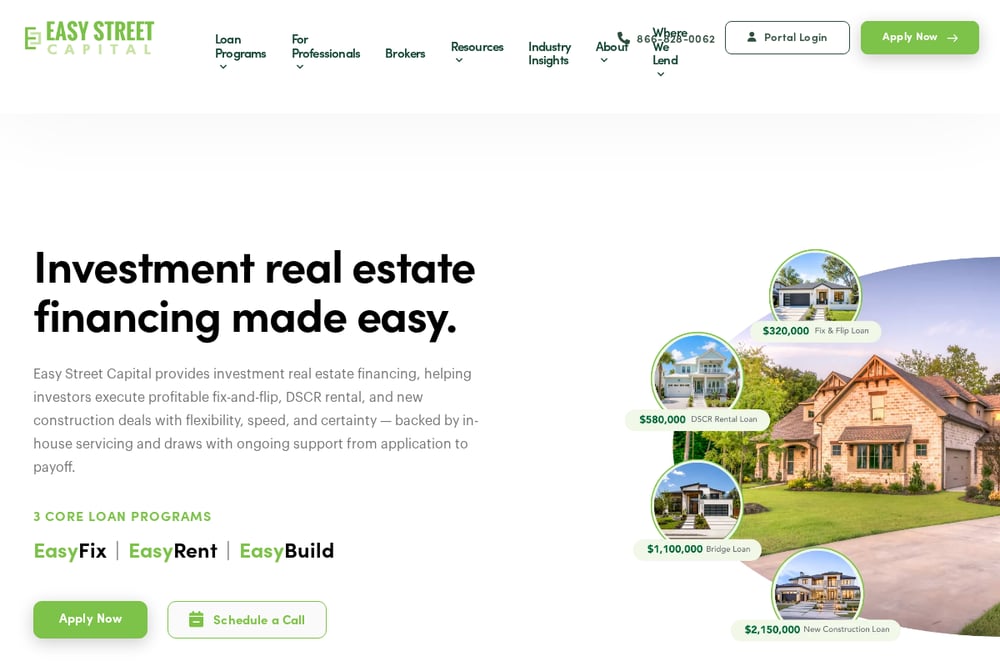 A screenshot of the Easy Street Capital website.
Easy Street Capital built its reputation on productized lending with published starting rates. Its EasyFix bridge product advertises no appraisal requirement, high leverage, and closings in as little as 24 hours, with rates starting at 8.90%. EasyRent covers long-term rental loans up to 10 units, including mixed-use and short-term rentals, with rates starting at 5.75%. EasyBuild handles new construction with 48-hour draws and first-time builder options. The desk also runs dedicated programs for BRRRR investors, STR operators, wholesalers, and referral partners. You can review the full lineup at https://easystreetcap.com/.
#2 Oak & Iron Lending, LLC.
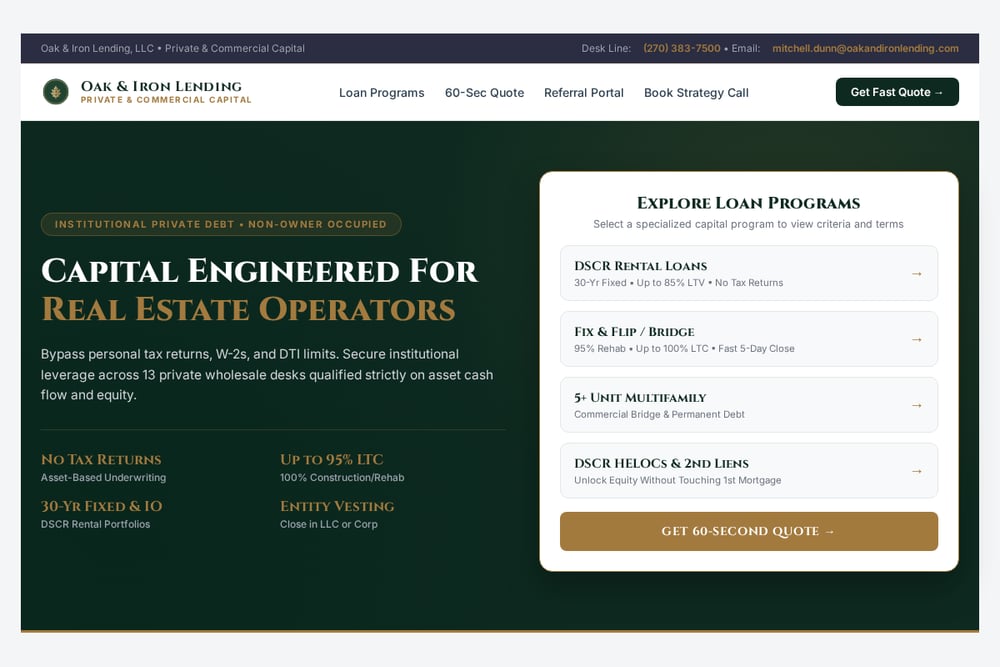 A screenshot of the Oak & Iron Lending, LLC. website.
Oak & Iron Lending runs a wholesale-style capital desk built for non-owner-occupied investors. The firm publishes its criteria openly: DSCR rental loans up to 85% LTV on purchase and 80% on refinance, 30-year fixed or 10-year interest-only terms, a 620 minimum FICO, and no W-2s or tax returns. Fix-and-flip and bridge programs reach 100% of purchase plus 100% of rehab, capped at 75% ARV, with 12-to-24-month interest-only terms and five-to-ten-day closings. Multifamily, commercial bridge and permanent debt, and DSCR HELOCs round out the menu, all vested in LLCs or corporations. The desk emphasizes asset-based underwriting across multiple private wholesale channels, which suits operators who want leverage without personal income documentation. You can explore the programs at https://oakandironlending.com/.
#3 Ridge Street Capital
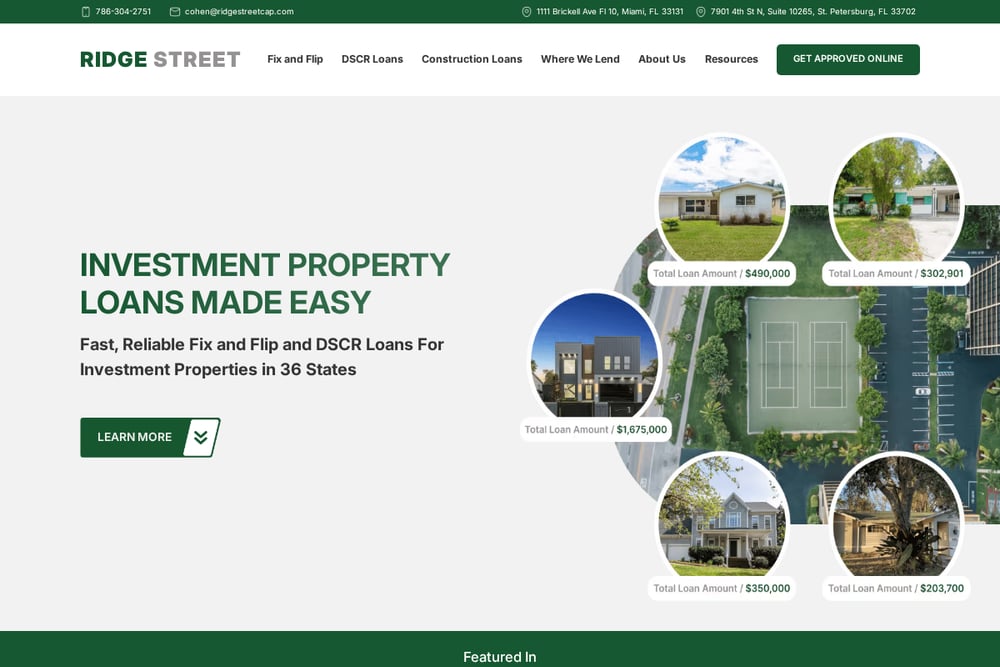 A screenshot of the Ridge Street Capital website.
Ridge Street Capital publishes location-specific lending pages that show exactly how its programs work in each market. Its Seattle page, for example, lists fix-and-flip rates from 10.5% to 11.5% with origination from 1.5%, and DSCR rates from 6.0% to 7.99% with origination from 0%. A sample deal shows $1,008,950 in financing at 87.5% of purchase plus 100% of rehab, a 10.75% rate, 2.0 points, and a 12-day close. The desk covers fix-and-flip, DSCR, Airbnb, long-term rental, and ground-up construction loans across 36 states. You can see the market pages at https://www.ridgestreetcap.com/.
#4 Beltway Lending
 A screenshot of the Beltway Lending website.
Beltway Lending keeps its program terms simple and easy to compare. DSCR rental loans run 30 or 40 years, qualify on property rent instead of income, and require only a valid ID, two months of bank statements, and a soft credit pull. Most borrowers have 660 or higher credit, with lower scores reviewed case by case. Fix-and-flip loans release rehab funds in draws as work is completed, and no experience is required. Portfolio loans let you bundle two or more rentals under one loan and one payment, with loan amounts from $75,000 to $5 million to individuals, LLCs, corporations, or trusts. You can review the programs at https://beltwaylending.com/.
#5 Dominion Financial
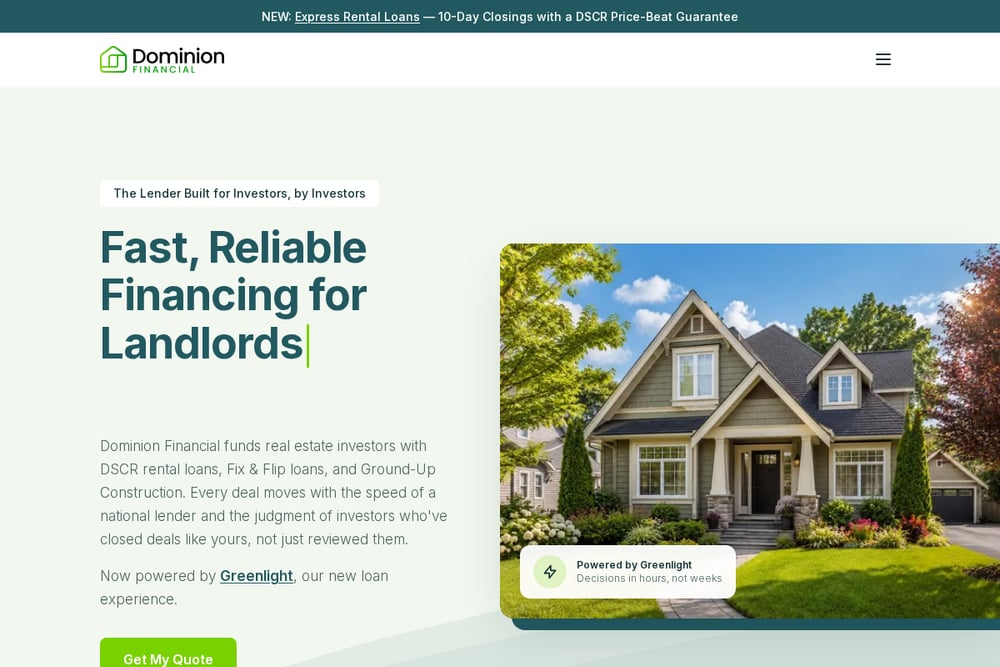 A screenshot of the Dominion Financial website.
Dominion Financial built its name on speed and competitive pricing for rental investors. Its Express Rental Loans advertise 10-day closings backed by a DSCR price-beat guarantee. The desk runs DSCR rental, fix-and-flip, multifamily bridge, and ground-up construction programs. Its educational content walks investors through market-specific math, including how ARV spreads vary by metro. That combination of fast rental execution and a full bridge and construction menu makes it a fit for operators moving between strategies. You can review the programs at https://dominionfinancial.com/.
Match the Desk to Your Deal
Start with the deal, not the lender. If you're buying a cash-flowing rental, DSCR programs are your lane, and you should compare LTV caps, term options, and minimum FICO across desks. If you're flipping, focus on leverage, rehab funding mechanics, and close times. If you're holding five-plus units, ask specifically about multifamily and commercial bridge capacity. Then check documentation requirements. Some desks want tax returns; others need only an ID, bank statements, and a soft pull. Confirm whether they lend in your state and whether they vest in an LLC. Finally, ask for a sample term sheet with rate, points, and fees before you commit. The cheapest headline rate rarely tells the whole story.
Where Automation Fits
You can streamline the borrowing process without adding staff. Use a 60-second quote form to pre-screen deals before you call. Keep a standard document packet ready: entity docs, bank statements, and property rent schedules. Build a simple spreadsheet that calculates DSCR and ARV before you submit. Route referral partners through a dedicated portal so your pipeline stays organized. Set calendar reminders for draw requests and rate-lock expirations. These small systems cut days off your closings and keep your lender conversations focused on terms, not paperwork.
The Bottom Line
Private and commercial debt desks have changed what's possible for real estate operators. You can now finance rentals, flips, and small multifamily deals on property cash flow instead of personal income. The five desks above each serve a slightly different operator, from Easy Street's published-rate product menu to Oak & Iron's wholesale asset-based model, Ridge Street's market-level transparency, Beltway's simple documentation, and Dominion's fast rental closings. Pick the one that matches your deal type, your timeline, and your documentation comfort level. Then run the numbers before you sign.