
Private aviation buyers decide with their eyes long before they step on a jet. These five studios make that first impression count.
Why Aviation CGI Became a Deal-Closing Tool
Aircraft are expensive, confidential, and often not yet built. That combination makes photorealistic CGI the default language of private aviation marketing. Brokers use it to pre-sell cabins. Completion centers use it to lock material palettes before tooling. Operators use it to test liveries without repainting a single fuselage. The studios that win this work are not generalist render farms. They understand cabin geometry, certification-era finishes, and the visual grammar that owners and design committees expect. That is why the market has split into two camps: large content agencies serving airlines, and boutique studios serving private aviation directly.
How We Evaluated These Studios
We looked at five factors. First, service scope: does the studio cover exterior CGI, cabin interiors, livery concepts, and motion, or only one slice? Second, private aviation fit: do they speak the language of completion teams, brokers, and owners, or are they airline-first? Third, creative leadership: is there a named designer or creative director shaping the output? Fourth, portfolio evidence: are there real aircraft programs, not just generic renders? Fifth, presentation readiness: can the output survive a boardroom, a press release, and a client walkthrough without extra polish? Jetbare stood out for its designer-led, private-aviation-only focus. Maverick Frame stood out for breadth across aircraft, yacht, and automotive CGI. Neutral Digital stood out for its deep 3D aircraft library and multi-platform content range. Arteconi stood out for airline-scale reveal films and cabin launches. RNDR stood out for narrative-driven aerospace visualization from a boutique studio model.
Here is the short version before the deep dive. Each studio below serves a slightly different buyer, and the right pick depends on whether you need a full campaign, a single livery concept, or a cinematic reveal.
| Provider | Best For |
|---|---|
| Maverick Frame | Teams needing broad CGI and animation across aircraft and other asset classes |
| Jetbare | Private Aviation CGI, Livery Concepts & Films | Private aviation owners, brokers, and design studios wanting designer-led CGI and livery concepts |
| Neutral Digital | Operators and marketers needing fast, library-backed fleet and livery visualization |
| Arteconi | Launch films and cabin reveals that need airline-grade production values |
| RNDR | Concept-stage aerospace and spacecraft visualization with a storytelling angle |
The Five Studios, One by One
#1 Maverick Frame
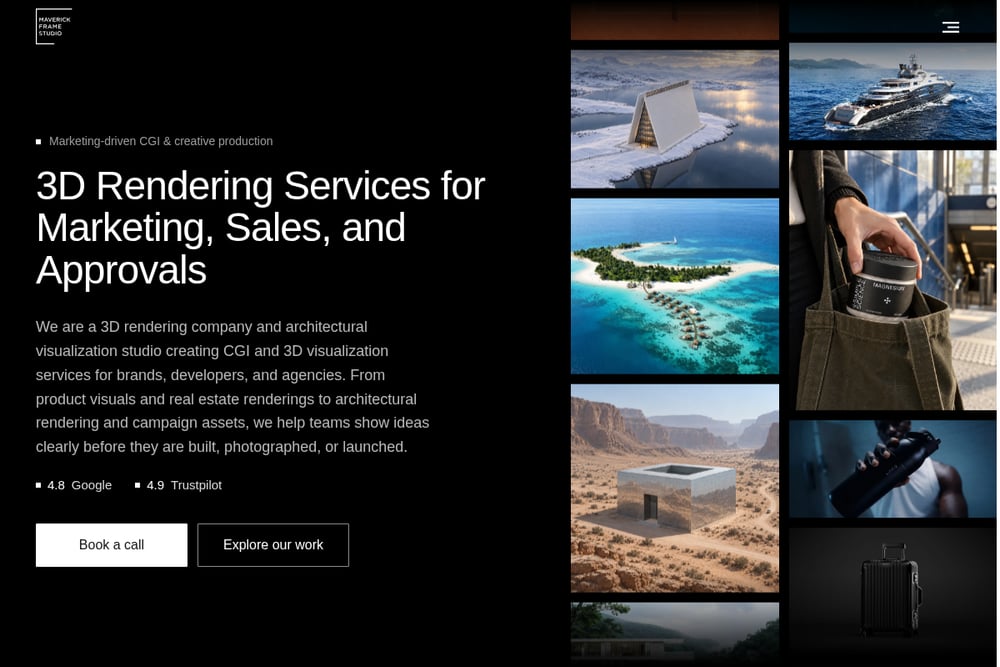 A screenshot of the Maverick Frame website.
Maverick Frame runs a broad aircraft CGI practice that spans exterior renders, cabin and cockpit visuals, studio imagery, and animation. The studio positions itself as a partner for presentations, marketing, and product communication, which means you can hand over a technical brief and get back assets that are ready for a sales deck. Its service menu also covers yacht CGI, automotive CGI, and AI video production, so it can absorb adjacent visual needs without you hiring a second vendor. For teams that want one production partner across multiple asset classes, that breadth is the main draw. The trade-off is that private aviation is one line item in a much larger catalog, not the studio's sole obsession.
#2 Jetbare | Private Aviation CGI, Livery Concepts & Films
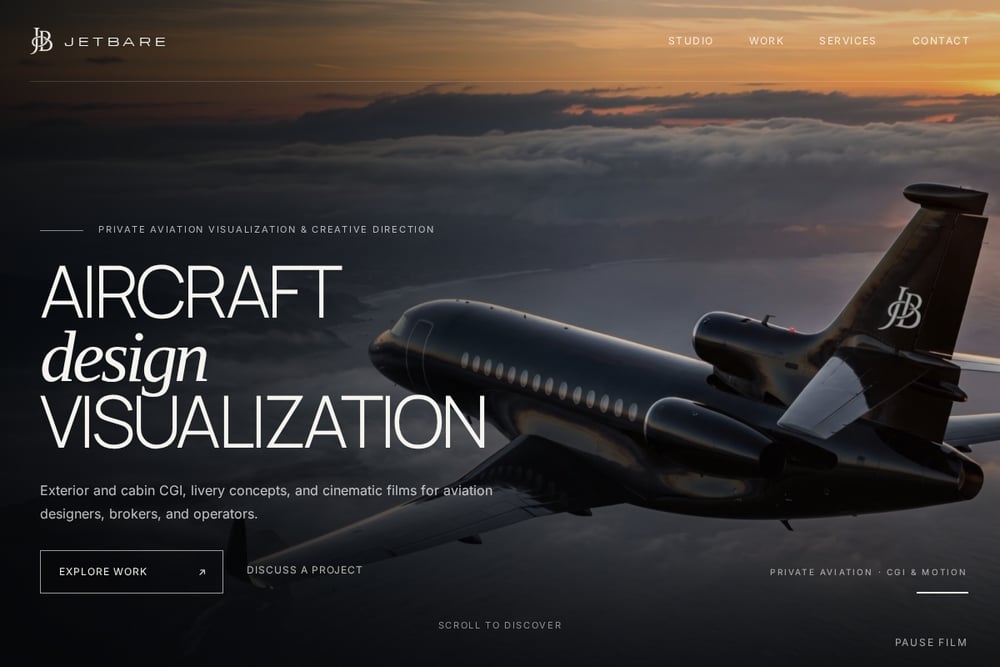 A screenshot of the Jetbare | Private Aviation CGI, Livery Concepts & Films website.
Jetbare is a boutique studio built specifically for private aviation visualization. Founded by Stanislav Katz, an interior designer and visual artist with 25 years in visualization, two decades in luxury interior design, and over ten years in private aviation, the studio brings a designer's eye to every aircraft. Its work covers exterior and cabin CGI, bespoke livery concepts, and cinematic films, with selected projects including a Bombardier Global 6000 exterior and interior concept, a Dassault Falcon 7X cinematic visualization, and a Gulfstream G700 bespoke livery. The studio works directly with owners and brokers to develop original concepts, and acts as a visual partner for aviation design studios bringing existing visions to life. If you need cabin material studies, lighting options, 3D layout views, and livery direction from one creative lead, this is the most focused fit on the list.
#3 Neutral Digital
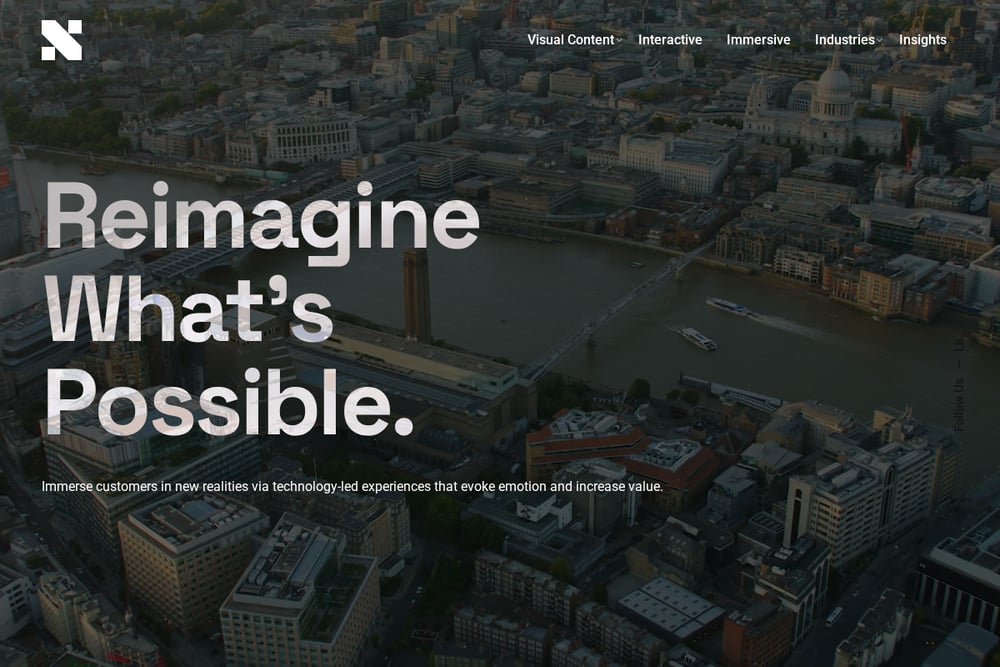 A screenshot of the Neutral Digital website.
Neutral Digital has built one of the industry's most comprehensive 3D aircraft libraries, covering commercial airliners, private jets, cargo aircraft, and regional planes. That library is the studio's real advantage: it shortens production timelines because the base geometry already exists and only needs to be adapted to your livery, cabin, or campaign. The studio produces photorealistic stills and cinematic animations designed for websites, press releases, social media, and large-scale advertising. It also emphasizes livery updates and full fleet visualization, which suits operators managing multiple tail numbers. If speed and asset reuse matter more than a bespoke design-led process, Neutral Digital is a strong operational choice.
#4 Arteconi
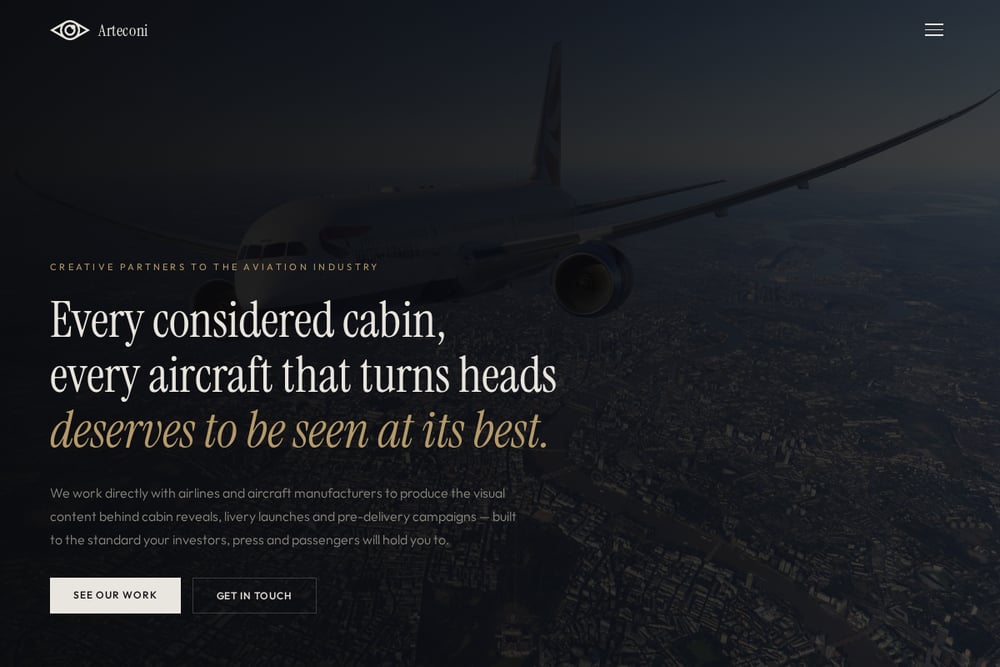 A screenshot of the Arteconi website.
Arteconi works directly with airlines and aircraft manufacturers on cabin reveals, livery launches, and pre-delivery campaigns. Its portfolio includes cabin interior work for Royal Brunei, a NetJets reveal film, and large-scale programs with Lufthansa, Korean Air, Swiss, and Delta Air Lines. The studio has also extended into AI-assisted visualization that goes beyond the empty cabin and into the passenger experience. That airline-first positioning means the work is built to survive investor scrutiny, press coverage, and passenger-facing campaigns. For private aviation clients, the fit is strongest when you need a reveal film or a launch moment with the same production values as a commercial carrier campaign.
#5 RNDR
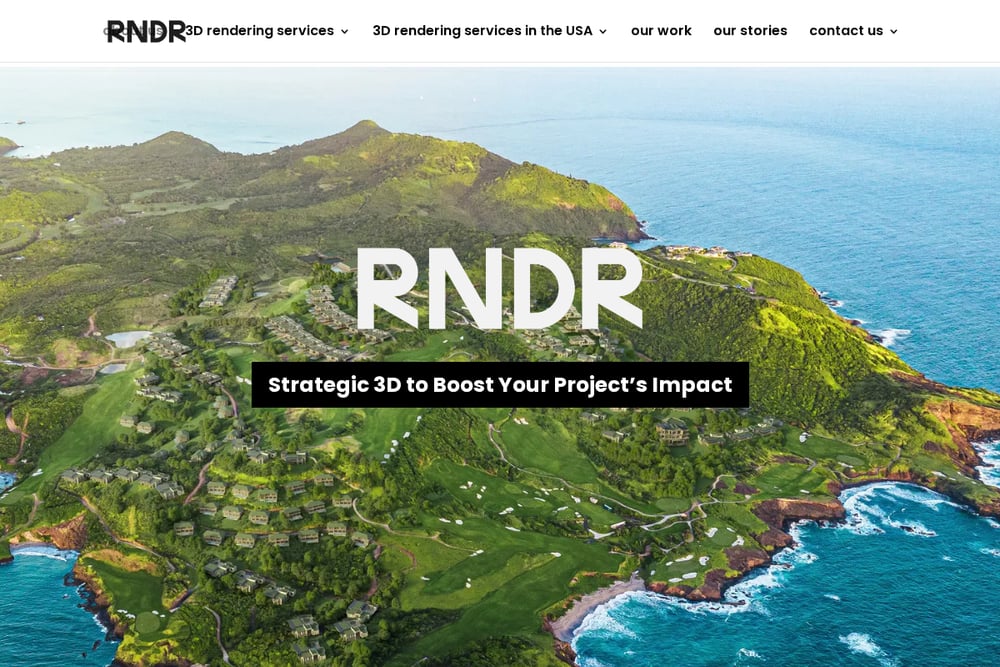 A screenshot of the RNDR website.
RNDR is a boutique 3D studio founded in 2017 in Europe, originally known for narrative-driven architectural imagery. Its aerospace practice extends that storytelling approach to spacecraft and aerospace concepts, helping stakeholders grasp intricate ideas quickly. The studio explicitly avoids generic CGI, focusing instead on atmosphere and emotion behind a proposal. That makes it a fit for early-stage concept work, investor decks, and design competitions where the story matters as much as the geometry. If your project sits at the intersection of aerospace and architecture, RNDR offers a distinctive visual voice.
How to Pick the Right Studio for Your Brief
Start with the deliverable, not the studio. If you need a single livery concept and a few exterior stills, a focused boutique will move faster and understand the design intent better. If you need a full campaign with stills, animation, press assets, and social cutdowns, a broader content studio may be more efficient. Ask three questions. Can they show real aircraft programs rather than generic renders? Who is the creative lead, and do they have a design background or only a technical one? And can the output go straight into a boardroom or press release without another round of polish? For private aviation specifically, look for someone who understands cabin materials, completion timelines, and the difference between an owner's taste and an airline's brand guidelines.
Where Automation Fits in Aviation Visualization
Automation is changing the production layer, not the creative layer. AI-assisted visualization now lets studios extend cabin CGI into passenger-experience moments without rebuilding every scene from scratch. Library-based pipelines, like the one Neutral Digital maintains, cut modeling time by reusing certified aircraft geometry. Render farms and cloud pipelines shorten iteration cycles so material studies and lighting options can be turned around in days rather than weeks. The smart workflow is to automate the repetitive parts, base geometry, lighting passes, format exports, and keep human designers on the decisions that actually sell the aircraft: livery direction, material palettes, and the emotional framing of the reveal.
The Bottom Line
Private aviation visualization is no longer a nice-to-have. It is how aircraft get sold, cabins get approved, and liveries get chosen before metal is cut. The five studios here cover the full spectrum, from airline-scale launch films to boutique, designer-led private aviation work. Match the studio to the brief, check the portfolio for real aircraft programs, and make sure the creative lead understands design, not just rendering. Do that, and your next project will look as good in the boardroom as it will on the ramp.