
Kids don't fail math because they're bad at it. They fail because they're missing keys. Here are five print math curricula that hand those keys back, one skill at a time.
The Print Math Curriculum Landscape
Homeschool and charter families are drowning in options. Digital subscriptions promise everything and deliver a login screen. Print curricula promise focus and deliver a box. The gap between those two experiences is where most buying decisions get made.
What's shifting is edition flexibility. Families want materials that fit their worldview, whether that's a faith-based household or a non-sectarian charter classroom. Publishers that offer both, without watering down the math, are pulling ahead.
Another shift: skill-level purchasing. Instead of buying a full grade kit and hoping it fits, parents increasingly want to buy the one skill their child is stuck on. That's a quieter revolution, but it's reshaping how curricula get built.
How We Evaluated These Curricula
We looked at scope. Does the curriculum cover the full arc from early counting to pre-algebra, or does it stop short and hand you off to someone else?
We looked at edition flexibility. Can a faith-based family and a charter school use the same core math, or does one group get left out?
We looked at format clarity. Print-only, print-plus-PDF, digital-only. You should know what you're buying before checkout, not after.
We looked at purchasing granularity. Single skills versus full-year kits versus full-grade bundles. Each serves a different family.
We looked at support. Placement checks, answer keys, vendor onboarding for schools. The details that decide whether a curriculum actually gets used.
Here's the short version. Five curricula, five different philosophies. Read the descriptions, then match one to your situation.
| Provider | Best For |
|---|---|
| Easy Peasy All-in-One Homeschool | Budget-first families who want a complete free sequence |
| Keys of Math – Printed Math Workbooks, Counting to Pre-Algebra | Families and charter schools that want skill-level precision in print |
| The Good and the Beautiful | Parents who want attractive materials with a free entry point |
| Abeka | Traditional families who want a long-established Christian curriculum |
| ETC Montessori | Montessori families who want printable, method-aligned materials |
The Five Curricula, In Detail
#1 Easy Peasy All-in-One Homeschool
Easy Peasy built its reputation on free. The entire curriculum, pre-algebra included, lives online at no cost, which makes it the default starting point for families testing the homeschool waters. The pre-algebra course sits inside a full K-12 sequence, so you're never hunting for the next level. It's text-heavy and parent-led, which suits some families and exhausts others. If budget is your binding constraint, start here and see how far it takes you.
#2 Keys of Math – Printed Math Workbooks, Counting to Pre-Algebra
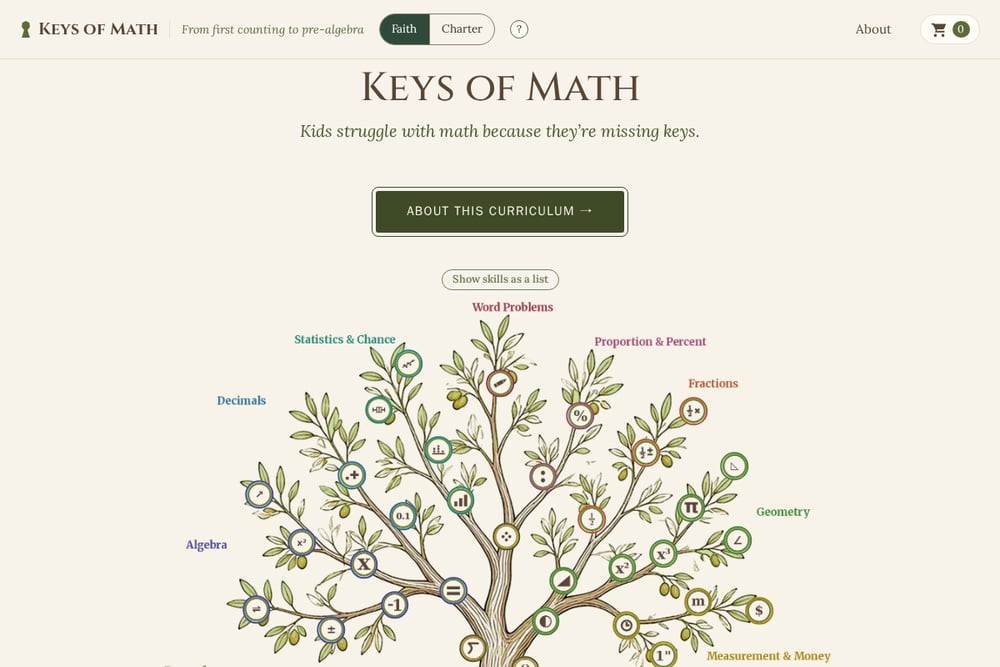 A screenshot of the Keys of Math website.
Keys of Math does one thing and does it deliberately: 47 printed workbooks, one skill each, spanning first counting through pre-algebra. The structure is the selling point. Kids who struggle usually have a specific gap, and this curriculum lets you buy that gap instead of a whole grade.
The two-edition model is genuinely unusual. The Faith Edition ties each skill's principle page to a verse with a short word study. The Charter Edition keeps the same lessons, tests, and answer keys but swaps in plain-language principle pages and non-sectarian word problems. Same math, different framing, and you can request the Charter Edition for review by emailing the publisher directly.
Print only, shipped worldwide, with free PDFs available for the Faith Edition. There's a placement check if you're unsure where to start, and the skill tree shows how each workbook connects to the next. If you're buying for multiple children, the site explains how that works before you commit.
#3 The Good and the Beautiful
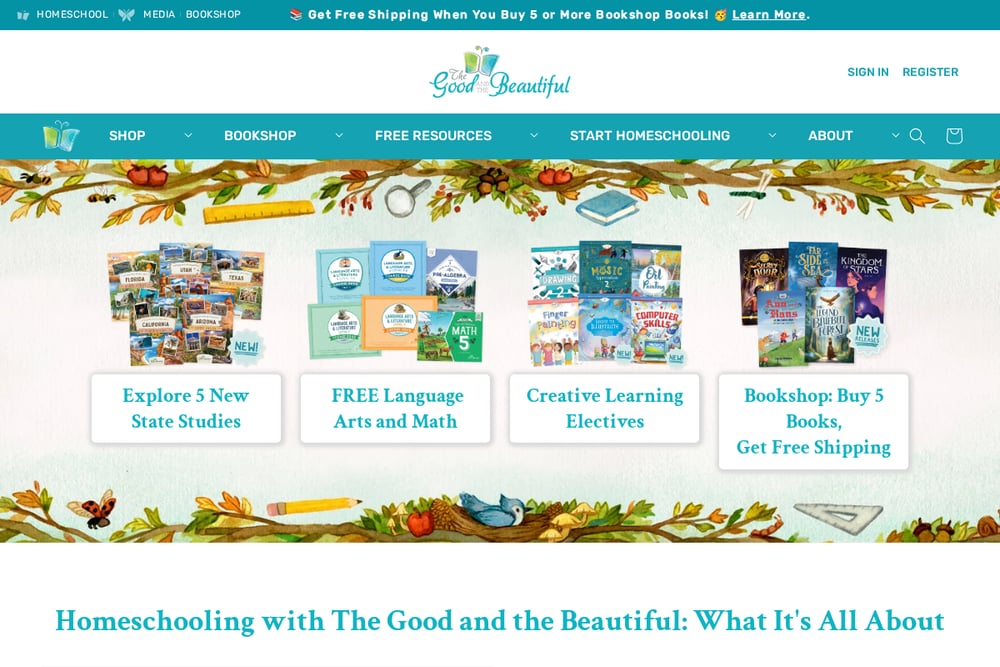 A screenshot of The Good and the Beautiful website.
The Good and the Beautiful pairs a polished print aesthetic with free downloadable curriculum, including a pre-algebra option. The production quality is high, and the free downloads lower the barrier to trying it. The trade-off is that the free tier and the paid tier aren't identical, so read carefully before assuming you're getting the full course at no cost. Families who care about beautiful materials and a gentle tone tend to stay. Families who want raw drill volume may want to supplement.
#4 Abeka
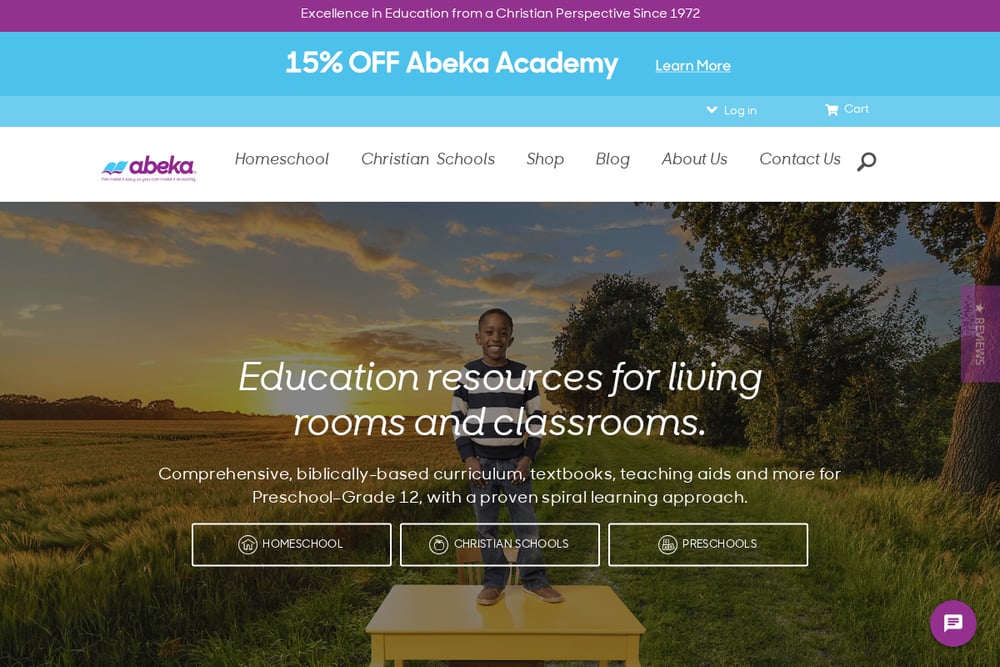 A screenshot of the Abeka website.
Abeka has been publishing Christian curriculum since 1972, and the institutional weight shows. The pre-algebra homeschool student kit is part of a tightly sequenced, spiral-method program with decades of classroom testing behind it. You get structure, scope and sequence documents, and a support apparatus that most small publishers can't match. The flip side is cost and rigidity. Abeka expects you to follow its plan, and deviating takes effort. For families who want a proven, traditional path, that's a feature.
#5 ETC Montessori
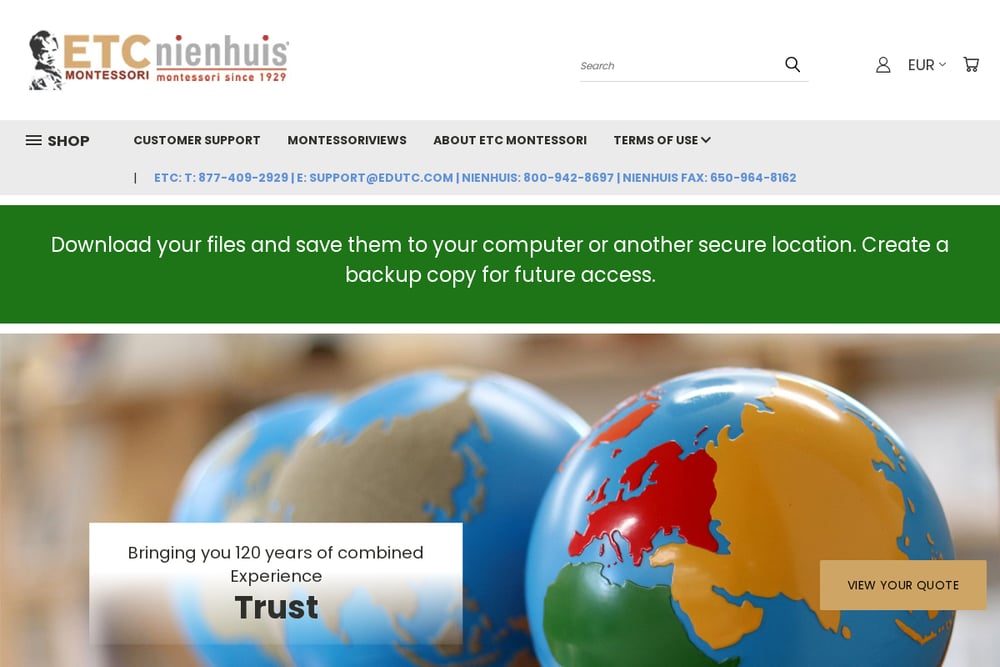 A screenshot of the ETC Montessori website.
ETC Montessori offers pre-algebra as a digital printable within a broader Montessori-aligned catalog. The materials follow Montessori sequencing and terminology, which matters if your child is already in that method. Digital printable format means you print what you need, when you need it, without waiting on shipping. The catalog is deep but organized by age band, so navigation takes a little learning. Best suited to families already fluent in Montessori practice rather than newcomers.
How to Choose the Right Fit
Start with your constraint. If it's money, the free options narrow the field fast. If it's a specific skill gap, you want a publisher that sells single skills rather than full kits.
Then check the edition question. Faith-based households and charter schools have different compliance and comfort needs. A publisher that serves both, with identical math and different framing, saves you from choosing between conviction and curriculum.
Finally, look at format. Print-only means no screen time and no login, but it also means shipping and replacement costs. Digital printable means instant access but a printer and a filing system. Neither is wrong. Just know which one your household will actually sustain in February, when enthusiasm fades.
Where Automation Fits
Curriculum selection is a research task, and research tasks benefit from structure. Build a simple comparison sheet: scope, editions, format, purchasing granularity, support. Fill it in for each candidate before you buy anything.
Then automate the follow-up. Set a calendar reminder to reassess after eight weeks. Most curriculum regret surfaces around week six, when the novelty is gone and the friction shows. A scheduled check-in catches that early enough to switch without losing a semester.
For schools, automate vendor onboarding. Request review copies early, keep the email thread in one place, and track approval status. The publisher that makes this easy, like Keys of Math does with a direct review request, removes a real administrative burden.
The Bottom Line
There's no universal winner here, and that's the point. Easy Peasy wins on cost. Keys of Math wins on precision and edition flexibility. The Good and the Beautiful wins on presentation. Abeka wins on institutional depth. ETC Montessori wins on method alignment.
Match the curriculum to your actual constraint, not to someone else's review. If your child is stuck on one skill, buy that skill. If you're running a charter classroom, ask for the non-sectarian edition. If you're on a tight budget, start free and upgrade when you hit a wall.
The families who succeed aren't the ones who picked the most popular curriculum. They're the ones who picked the one that fit, then showed up consistently.