You want to read a chart without drowning in indicators. These five price action courses each take a different route to that same goal.
Where Price Action Education Stands
Price action trading has moved from trading floors to browser tabs. Retail traders now learn structure, supply and demand, and liquidity from structured online curricula instead of weekend seminars. The result is a crowded field. Some programs are built on decades of live screen time. Others package free lessons as a funnel into paid mentorship. What separates them is how much practice sits behind the theory. A course that only shows you marked-up charts leaves you guessing when the market goes quiet. The stronger programs force you to mark charts yourself, review your decisions, and build a repeatable trade plan. That shift from watching to doing is the real dividing line in this niche.
How We Evaluated These Courses
We looked at curriculum depth first. Does the course move from chart basics to a complete trade process, or does it stop at patterns? Next, we checked practice structure. Free preview lessons, chart exercises, and review loops matter more than video length. Pricing clarity came third. You should know what is free, what is gated, and what a paid tier includes before you commit. We also weighed format fit. Some traders want short lessons they can finish in a lunch break. Others want long-form video libraries and live rooms. Finally, we considered the path forward. A good course tells you what to do after the last lesson, whether that is backtesting, journaling, or joining a community. Each entry below stood out on different factors, and your own learning style should decide which one fits.
Here is the short version before the deep dive. Each course below serves a different kind of learner, from total beginners to traders who want code-driven strategies.
| Provider | Best For |
|---|---|
| Brooks Trading Course | Traders who want exhaustive, bar-by-bar depth |
| PipsGravity Academy | Beginners who want a short-lesson, step-by-step path |
| TradingwithRayner Price Action Academy | Intermediate traders who want free, focused lessons |
| Learn To Trade The Market | Traders who prefer clean-chart, philosophy-first teaching |
| Quantra Price Action Trading Strategies | Traders who want to code and backtest price action |
The Five Courses in Detail
#1 Brooks Trading Course
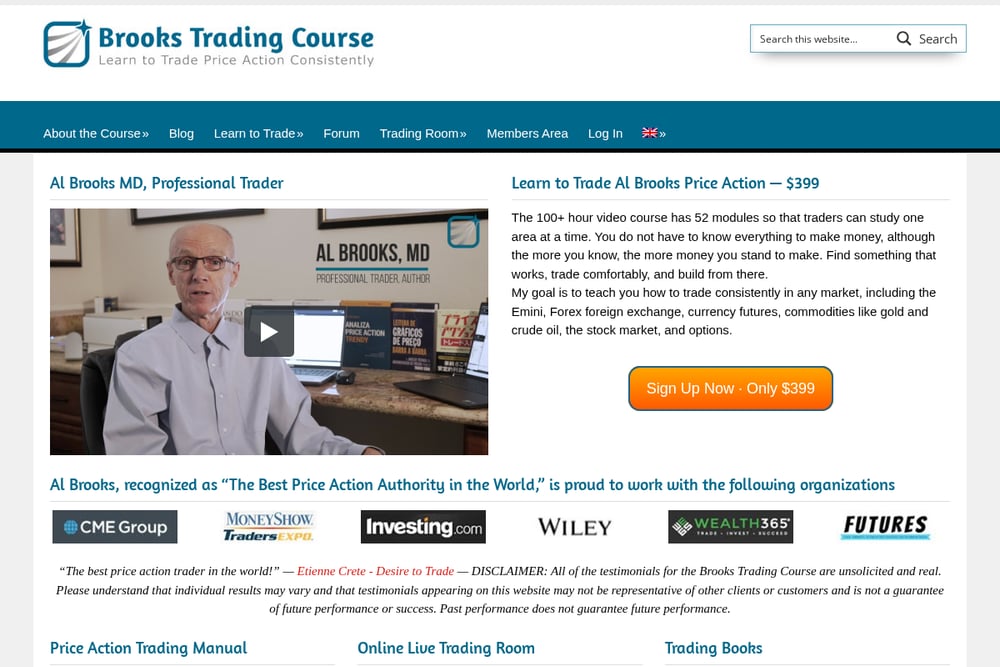 A screenshot of the Brooks Trading Course website.
Al Brooks has spent decades trading and teaching price action, and this course carries that weight. The curriculum is enormous, covering bar-by-bar reading, patterns, and the psychology of sitting through uncertainty. You get free sample videos before buying, plus a glossary and encyclopedia of chart patterns that work as reference material. The Brooks Trading Course also runs live trading rooms for US and Euro sessions, which gives you a place to watch decisions happen in real time. It suits traders who want depth over speed and are willing to invest serious hours. The tradeoff is volume. This is not a weekend course, and the material rewards repeat viewing.
#2 PipsGravity Academy
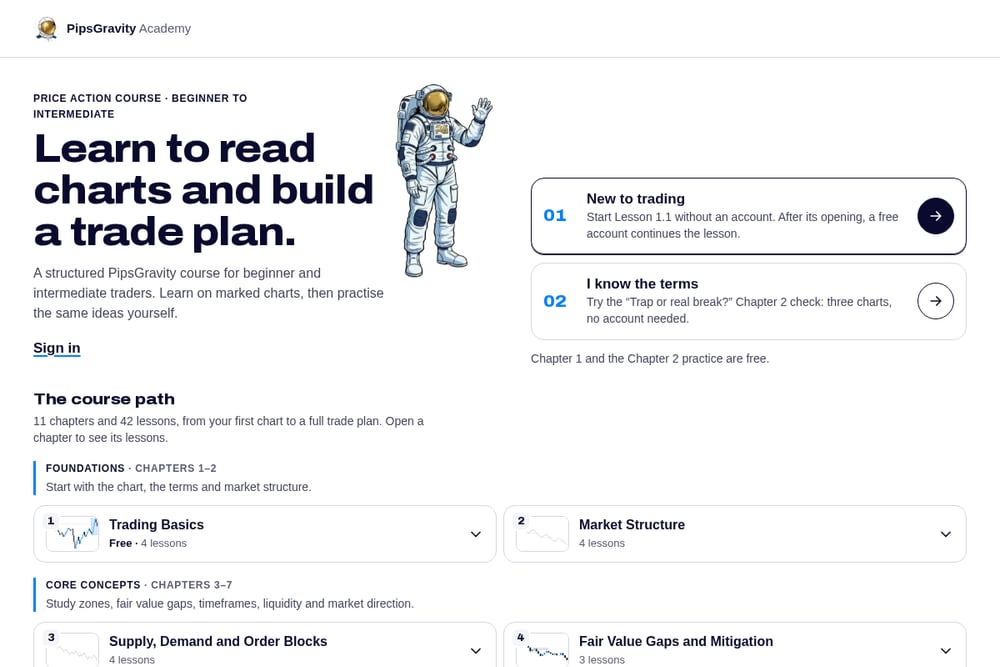 A screenshot of the PipsGravity Academy website.
PipsGravity Academy takes a structured, chapter-by-chapter approach for beginner and intermediate traders. The path runs 11 chapters and 42 lessons, starting with how to read a chart and ending with a full trade plan. Chapter 1 and the Chapter 2 practice are free, so you can test the teaching style before committing. Lessons focus on marked charts, then ask you to practise the same ideas yourself, which builds real chart-reading skill rather than passive watching. Topics move from market structure into supply and demand, fair value gaps, timeframes, liquidity, and market direction. It is a clean fit if you want short lessons and a clear sequence from fundamentals to advanced concepts.
#3 TradingwithRayner Price Action Academy
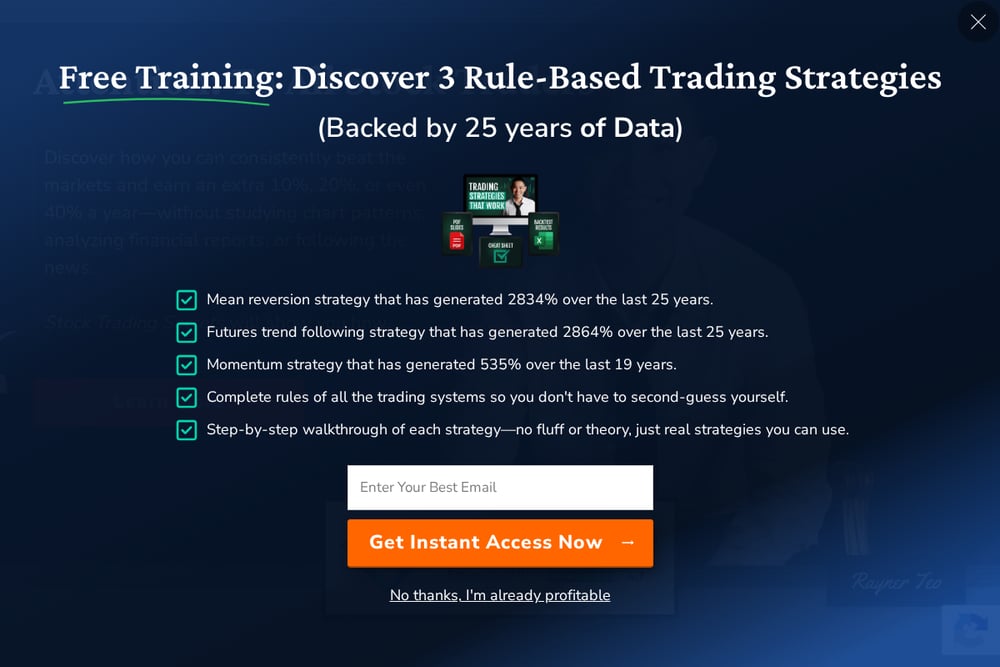 A screenshot of the TradingwithRayner website.
TradingwithRayner offers a free 18-lesson price action course aimed at intermediate traders. The lessons cover breakouts, pullbacks, support and resistance, trend reversals, and false breakout avoidance. Each lesson is built around a single practical idea, which makes the material easy to apply on your next chart session. The free tier is genuinely free, not a teaser that cuts off after two videos. You also get cheat sheets for candlestick patterns and support and resistance, useful as quick references while you practise. It works well as a supplement if you already know the basics and want sharper entry and exit thinking.
#4 Learn To Trade The Market
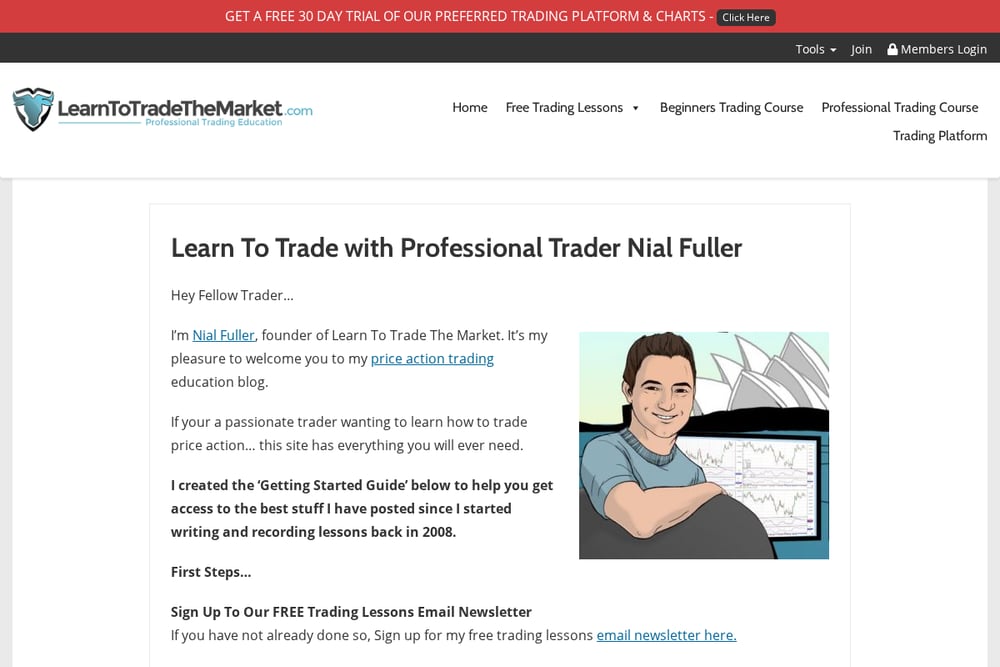 A screenshot of the Learn To Trade The Market website.
Learn To Trade The Market frames price action around stripped-down, naked charts. The free lesson library explains the definition of price action trading, how to tell messy charts from clean ones, and how to spot trending versus consolidating markets. From there, the site offers a beginners course and a professional course for traders who want to go further. The teaching leans on chart confluence and signal quality, which helps you filter out low-probability setups. You also get practical tools like a position size calculator and a trading journal tracker. It is a solid starting point if you prefer a philosophy-first approach before diving into patterns.
#5 Quantra Price Action Trading Strategies
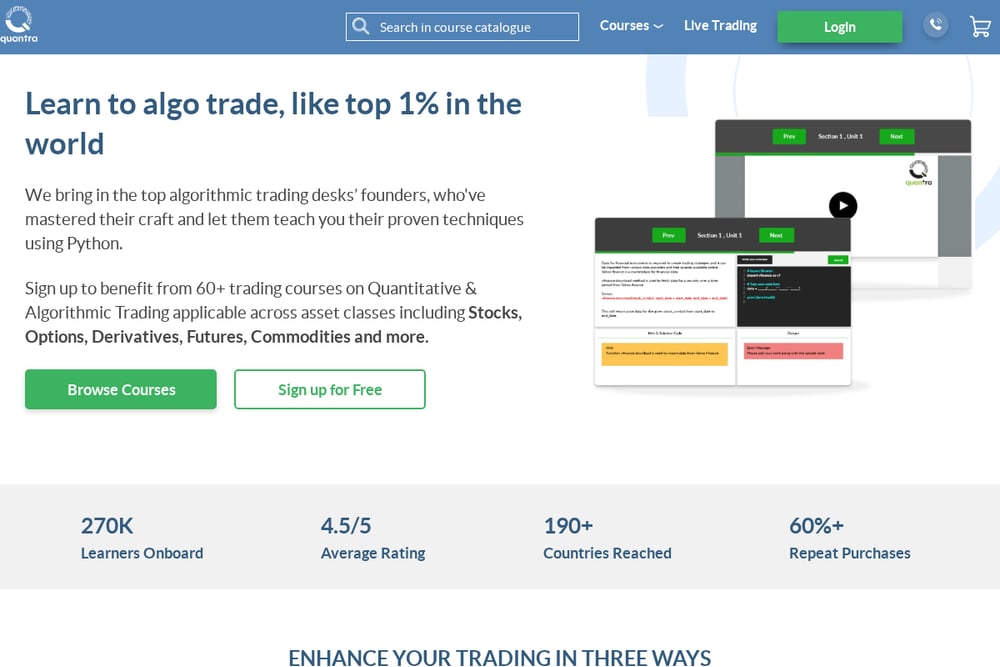 A screenshot of the Quantra website.
Quantra takes a quantitative angle on price action. The course covers double tops and bottoms, head and shoulders, pivot points, and Fibonacci retracements, then ties them to downloadable strategies and code. That makes it unusual in this group. You are not just learning to spot patterns, you are learning to test and fine-tune them. The course runs about 14 hours and sits at an intermediate level, with lifetime access once you enroll. It suits traders who are comfortable with Python or want to build that skill alongside their chart reading. If you plan to backtest ideas rather than trade purely by eye, this is the one to study.
How to Pick the Right Course for You
Start with your current level. If you have never read a chart, you need foundations before patterns. A course that opens with market structure and terms will save you months of confusion. If you already trade, look for material that sharpens entries, exits, and risk. Next, check how much practice is built in. Free preview lessons are a good sign, but chart exercises and review loops are better. Ask yourself whether you want short lessons or long video libraries. Short lessons fit busy schedules. Long libraries reward deep study but demand time you may not have. Then look at price transparency. Know what is free, what is gated, and what a paid tier adds. Finally, think about your end goal. If you want to trade by eye, pick a course heavy on marked charts. If you want to test ideas with code, pick one that teaches backtesting. Match the course to your goal, not to its marketing.
Building a Practice Loop That Sticks
A course only works if you practise between lessons. Set a simple weekly loop. Pick one concept from your current chapter, then mark three charts by hand before the next lesson. Write down your entry, stop, and target for each, even if you never place the trade. At the end of the week, review those marks against what price actually did. Keep a journal entry for every chart, noting what you saw and what you missed. Use free preview lessons to test a course before paying, and use cheat sheets as quick references during practice, not as crutches. If you are on the Quantra path, turn each pattern into a small backtest and log the results. Repeat the loop for a month and you will see your chart reading sharpen faster than any video binge can deliver.
The Bottom Line
There is no single course that fits every trader. Brooks Trading Course rewards deep study with bar-by-bar detail. PipsGravity Academy gives beginners a clean, short-lesson path from first chart to full trade plan. TradingwithRayner offers free, focused lessons for intermediates. Learn To Trade The Market teaches a clean-chart philosophy with practical tools. Quantra adds code and backtesting for the quantitatively minded. Pick the one that matches your level and your goal, then commit to the practice loop. The course is only the map. Your marked-up charts are the journey.