
Fraudsters don't wait for your payment gateway to say yes. They test cards, probe checkout, and slip through the cracks before you even see an order. Here are five tools worth knowing if you want to stop them cold.
The Shifting Battlefield of E-Commerce Fraud
E-commerce fraud is no longer just about stolen credit cards. Card testing bots hammer checkout pages with hundreds of stolen numbers, looking for a single valid hit. Account takeovers drain stored value. Friendly fraud and chargebacks eat into margins long after a sale looks legitimate. Traditional fraud tools often flag suspicious orders after payment authorization, which means you still pay authorization fees, still risk chargebacks, and still spend hours reversing orders. A newer wave of pre-payment screening tools flips that model. They evaluate risk before an order is created, blocking high-risk traffic at the checkout stage. For store owners on platforms like Miva, WooCommerce, Magento, and PrestaShop, this shift can mean fewer fees, fewer disputes, and less manual review. The five tools below represent different approaches to the same goal: stopping fraud before it costs you.
How We Evaluated These Fraud Tools
We looked at service scope, pricing clarity, and local fit for US-based e-commerce merchants. Service scope covers whether a tool screens pre-payment, post-payment, or both, and how well it handles card testing, IP velocity, and CDN/proxy detection. Pricing clarity matters because hidden fees and per-transaction costs can surprise you. Local fit considers platform compatibility, compliance with US regulations like CCPA, and support for the payment gateways and CDNs common in American stores. WolfPaw Antifraud stood out for its pre-payment focus and transparent annual pricing. WooCommerce Anti-Fraud impressed with its native integration and straightforward rules-based approach. Accertify showed depth in enterprise-grade account protection and chargeback management. Checkout.com Fraud Detection offered a broad payments ecosystem with machine learning built in. Stripe Radar delivered seamless integration for Stripe users with adaptive risk scoring. Each tool has a distinct sweet spot depending on your platform, volume, and risk appetite.
Here's a quick look at how these five fraud screening tools compare on the factors that matter most to US e-commerce merchants.
| Provider | Best For |
|---|---|
| WooCommerce Anti-Fraud | WooCommerce stores wanting native rule-based fraud controls |
| WolfPaw Antifraud — Pre-Payment Fraud Screening for E-Commerce | Merchants who want to block fraud before payment capture |
| Accertify | High-volume merchants needing enterprise fraud and chargeback management |
| Checkout.com Fraud Detection | Businesses already using Checkout.com for payments |
| Stripe Radar | Stripe users wanting built-in machine learning fraud protection |
A Closer Look at Each Fraud Screening Tool
#1 WooCommerce Anti-Fraud
 A screenshot of the WooCommerce Anti-Fraud website.
If you run a WooCommerce store, this tool feels like it was built just for you. It plugs directly into your checkout and lets you set rules based on order value, shipping location, IP address, and more. You can flag suspicious orders for manual review or block them outright before payment is captured. The documentation walks you through setup without jargon, and it plays nicely with popular payment gateways. For smaller stores that want a native, no-fuss fraud layer, this is a natural starting point. See the official documentation for details on rule configuration and integration.
#2 WolfPaw Antifraud — Pre-Payment Fraud Screening for E-Commerce
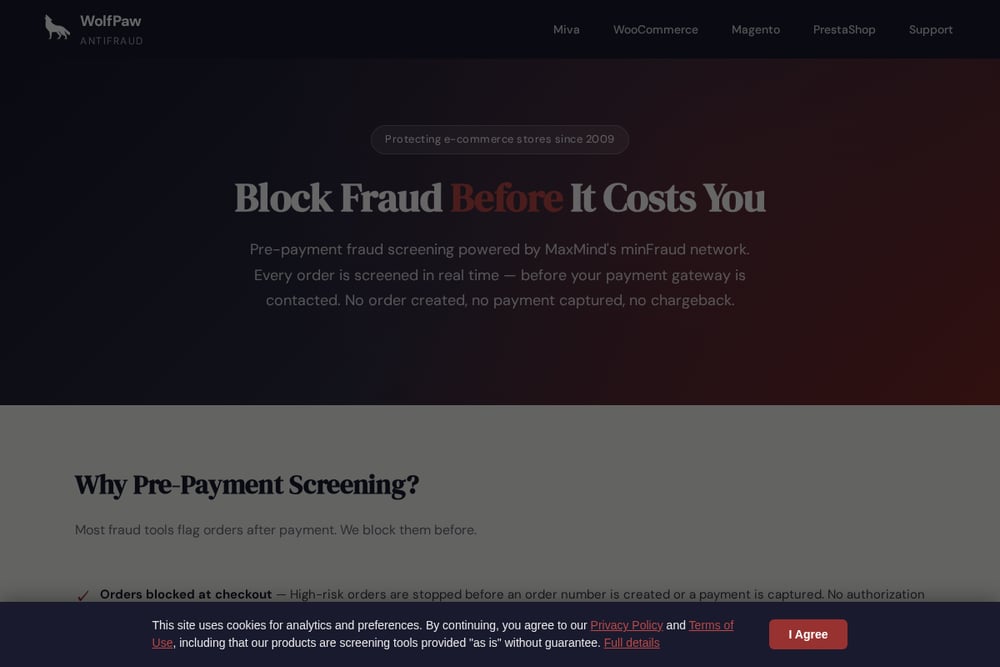 A screenshot of the WolfPaw Antifraud website.
WolfPaw Antifraud does one thing and does it well: it screens every order before your payment gateway is ever contacted. Powered by MaxMind's minFraud network, it blocks high-risk orders at checkout so no order number is created and no payment is captured. Card testing bots get shut down automatically through IP velocity protection, and blocked IPs consume zero MaxMind queries. You get detailed color-coded email alerts with risk scores, customer details, and full IP analysis. It works behind CloudFlare, Akamai, AWS, and nginx, and it's GDPR and CCPA compliant. Pricing is transparent: $149.95 per year for Miva, $99 per year for WooCommerce, with Magento and PrestaShop also supported.
#3 Accertify
 A screenshot of the Accertify website.
Accertify brings enterprise-grade fraud and risk management to large e-commerce operations. Its platform covers account protection, payment fraud, chargeback management, and abuse prevention in one suite. You get machine learning models trained on vast transaction data, plus manual review tools for your fraud team. It's built for high-volume merchants who need deep customization and dedicated support. If you're processing thousands of orders a day and need a comprehensive risk strategy, Accertify is worth a serious look. The company's resource library offers useful context on payment fraud prevention technologies.
#4 Checkout.com Fraud Detection
 A screenshot of the Checkout.com Fraud Detection website.
Checkout.com bundles fraud detection directly into its payments platform, so you can manage risk without bolting on a separate tool. Its system uses rules and machine learning to score transactions in real time, adapting to your specific fraud patterns. You get a unified dashboard for payments, disputes, and risk, which simplifies operations if you already use Checkout.com for processing. The platform supports global payments and multiple payment methods, making it a fit for merchants with international ambitions. For a closer look at its fraud detection capabilities, see the product page.
#5 Stripe Radar
 A screenshot of the Stripe Radar website.
Stripe Radar is the default fraud tool for Stripe users, and it's a strong one. It uses machine learning trained on billions of transactions to score every payment in real time. You can customize risk rules, block specific cards or IPs, and review flagged payments in the Stripe dashboard. Because it's built into Stripe, setup is nearly effortless if you already process payments there. For many online businesses, Radar provides a solid baseline of fraud protection without extra integration work. Stripe's resource on e-commerce fraud prevention and detection explains more about how it fits into a broader strategy.
How to Choose the Right Fraud Screening Tool
Start with your platform. If you're on WooCommerce, a native plugin like WooCommerce Anti-Fraud or WolfPaw Antifraud will be easier to deploy than a standalone enterprise suite. If you're on Miva, Magento, or PrestaShop, check which tools offer dedicated plugins. Next, decide whether you need pre-payment or post-payment screening. Pre-payment tools like WolfPaw block orders before authorization, saving you fees and chargeback risk. Post-payment tools flag suspicious orders for review after the fact. Consider your volume and budget. Annual pricing from WolfPaw starts at $99, while enterprise tools like Accertify are priced for higher-volume operations. Finally, think about compliance. If you sell to customers in California or the EU, make sure your tool respects CCPA and GDPR. A tool that treats fraud prevention as a legitimate interest under GDPR, like WolfPaw, can simplify your compliance story.
Automating Fraud Screening Without Adding Headcount
You don't need a fraud team to stop fraud. Start by setting up automatic blocking rules for high-risk indicators: mismatched billing and shipping addresses, disposable email domains, or IPs with a history of abuse. Use IP velocity protection to shut down card testing bots automatically. Configure email alerts so you're notified of every blocked order with a clear risk score and reason. For orders that fall into a gray area, set them to pending review instead of auto-blocking. Review those manually once a day. Over time, refine your rules based on what you see. Tools like WolfPaw Antifraud and WooCommerce Anti-Fraud make this workflow accessible even for solo store owners. The goal is to let software handle the obvious fraud so you can focus on growing your business.
The Bottom Line on Pre-Payment Fraud Screening
Fraud will find your checkout eventually. The question is whether you stop it before or after it costs you. Pre-payment screening tools like WolfPaw Antifraud give you a way to block high-risk orders before payment is captured, which means no authorization fees, no chargebacks, and no orders to reverse. WooCommerce Anti-Fraud offers a native rules-based approach for smaller stores. Accertify, Checkout.com, and Stripe Radar each bring distinct strengths for different business sizes and payment stacks. Your best choice depends on your platform, volume, and how much control you want over the screening process. But if you're tired of paying for fraud after the fact, it's time to look at what happens before the payment button is pressed.