You spent years learning medicine, yet nobody taught you to read a pay stub. These five tools help you decode every line, check the math, and see how your pay compares.
The Pay Transparency Gap in Medicine
Clinicians are among the most educated professionals in the country, but compensation literacy is rarely part of the training. Contracts are signed with little to compare against, RVU statements arrive without explanation, and asking a colleague what they earn feels taboo. That silence has a cost: missed retirement match, unexplained deduction changes, and real hourly rates that drift below market. A new category of tools is emerging to close the gap. Some are built for hospital finance departments, some for survey benchmarking, and a few are designed for you, the individual clinician, with privacy as the starting point rather than an afterthought.
How We Evaluated These Tools
We looked at five factors. First, service scope: does the tool explain your pay stub line by line, or only provide market averages? Second, privacy model: who sees your data, and can any figure be traced back to you? Third, pricing clarity: is cost visible before you commit, or buried behind a sales call? Fourth, local fit: does the comparison reflect your specialty and geography? Fifth, actionability: does the output tell you what to do next, in dollars? Each tool below stands out on different factors. Pay Stub Club leads on individual privacy and line-item clarity. TimeSmart.AI leads on employer-side audit workflow. SullivanCotter, MGMA DataDive, and AMGA Consulting lead on survey depth and institutional benchmarking. Your right choice depends on whether you are an individual clinician or part of a compensation committee.
Here is the short version. The first tool is built for you as an individual clinician. The next four are built for organizations, but their data and methodology still matter to anyone negotiating a contract.
| Provider | Best For |
|---|---|
| TimeSmart.AI | Employer-side payroll audit planning |
| Pay Stub Club | Individual clinicians who want private, line-by-line pay clarity |
| SullivanCotter | Hospital and health system compensation benchmarking |
| MGMA DataDive | Practice managers and administrators who need broad market data |
| AMGA Consulting | Medical groups setting compensation strategy |
The Five Tools in Detail
#1 TimeSmart.AI
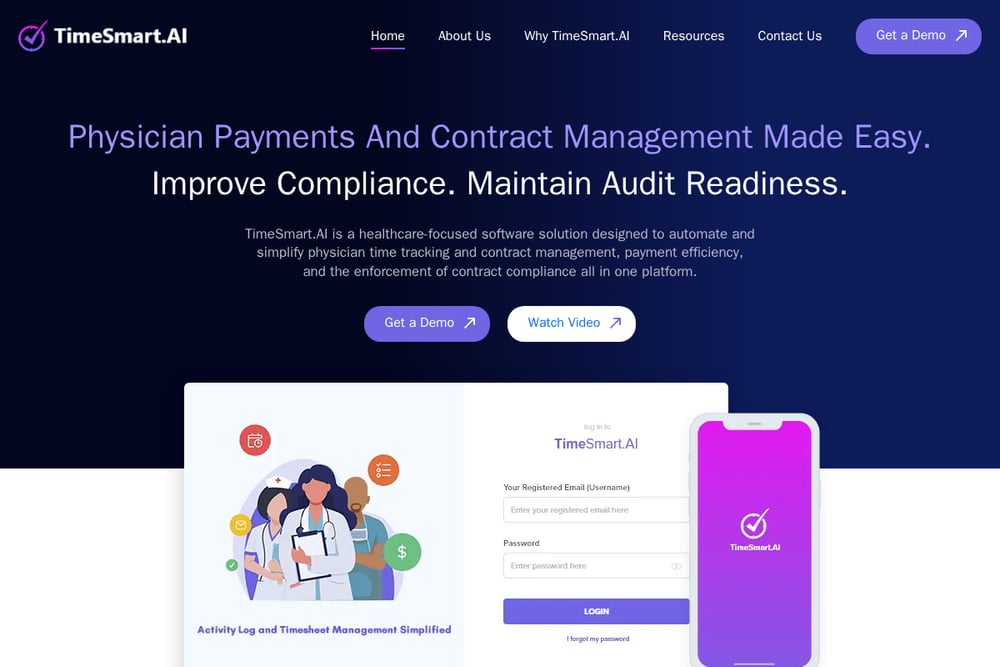 A screenshot of the TimeSmart.AI website.
TimeSmart.AI approaches physician compensation from the employer side, with a structured payroll audit roadmap for clinician payments. The workflow walks a finance or compliance team through scoping the audit, reviewing policies, gathering payroll and invoice data, analyzing controls, and engaging external auditors. It is a process framework more than a consumer product, and it assumes you have access to organizational payroll records. For a clinician, it is useful reading because it shows you what a well-run audit should catch. For a practice manager, it is a practical checklist. See the full guide at https://timesmart.ai/physician-compensation-payroll-audits-for-clinicians/.
#2 Pay Stub Club
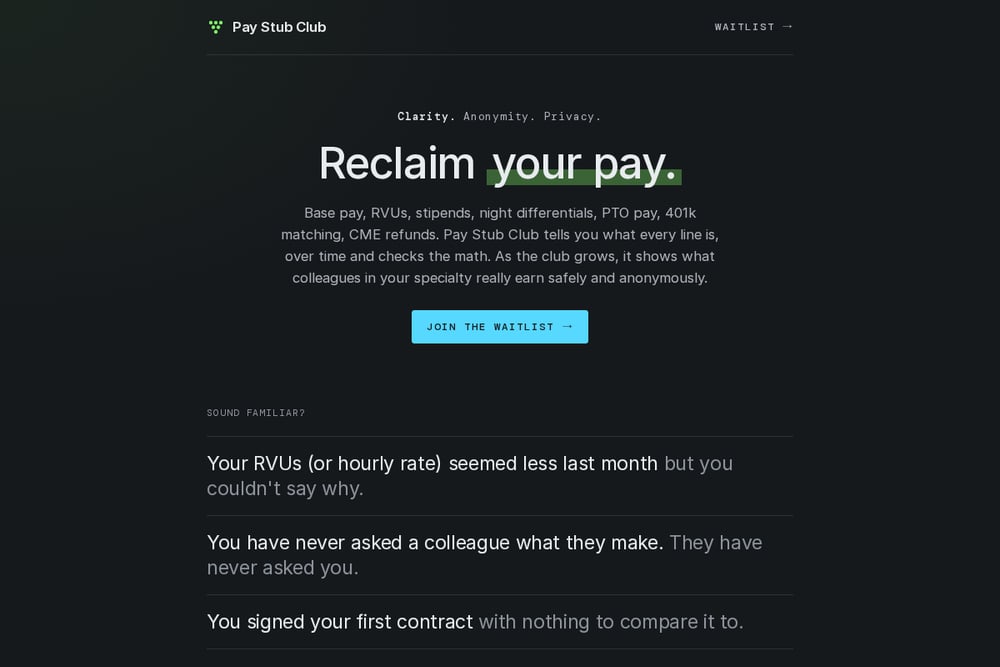 A screenshot of the Pay Stub Club website.
Pay Stub Club is the only tool on this list built for you as an individual clinician rather than for your employer. It is a waitlist-only members' club for physicians, PAs, and ARNPs that explains every line on your pay stub, from base pay and RVUs to stipends, night differentials, PTO pay, 401k matching, and CME refunds. It rechecks the math on taxes and deductions against current tables, flags retirement match money you may be leaving behind in dollars, and compares your real hourly rate to government benchmarks. The privacy model is the differentiator: your pay stub never leaves your device, your identity is a club name, shared figures are rounded into ranges, and no comparison opens until at least ten colleagues are in the group. As the club grows, it shows how your pay sits among peers in your specialty without anyone knowing which number is yours. Join the waitlist at https://paystubclub.com/.
#3 SullivanCotter
 A screenshot of the SullivanCotter website.
SullivanCotter is a long-established compensation consulting firm with a physician compensation and productivity survey used widely by hospitals and health systems. Its Benchmark360 tool benchmarks physician and APP compensation and productivity, and the firm also advises on fair market value and commercial reasonableness. If you sit on a compensation committee or are negotiating a hospital-employed contract, this is the kind of data your employer is likely using on the other side of the table. It is not a consumer product, and pricing is not published. Start with the survey overview at https://sullivancotter.com/surveys/physician-compensation-and-productivity-survey.
#4 MGMA DataDive
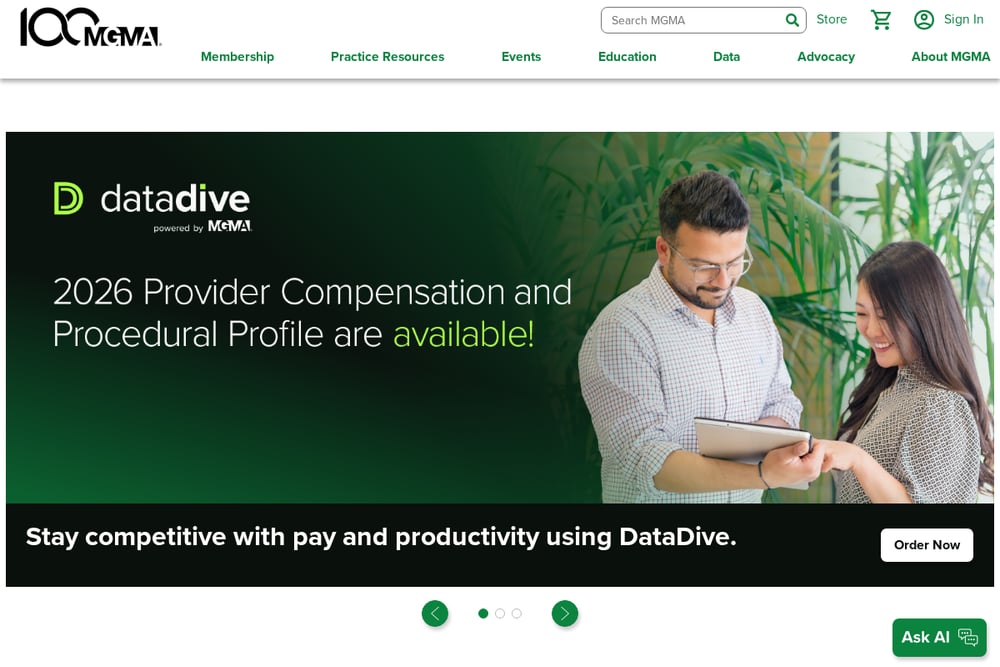 A screenshot of the MGMA DataDive website.
MGMA DataDive Provider Compensation is one of the most cited benchmarking datasets in medical practice management. It gives you provider compensation data across specialties and is backed by MGMA's broader library of operations, finance, and staffing resources. The strength here is breadth and institutional credibility: when a practice administrator says a number is market, DataDive is often the source. Access typically runs through MGMA membership or a data subscription, so it is an organizational purchase rather than a personal one. Explore the provider compensation data at https://www.mgma.com/datadive/provider-compensation.
#5 AMGA Consulting
 A screenshot of the AMGA Consulting website.
AMGA Consulting publishes the Medical Group Compensation and Productivity Survey, a benchmark with four decades of history. The 2026 edition draws on data from nearly 188,000 providers and 1,800 executives across 451 medical groups, covering 181 physician and advanced practice clinician specialties plus 145 APC subspecialties. That depth makes it a serious reference for medical groups setting compensation strategy. Like the other survey providers here, it is sold to organizations, not individuals, and members receive discounts. See the survey details at https://amga.org/amgaconsulting/our-data/medical-group-comp-productivity.
How to Choose the Right Tool for You
Start with one question: are you the clinician, or the organization? If you are an individual physician, PA, or ARNP, you need a tool that reads your own pay stub and protects your identity. That points to Pay Stub Club, especially if you have ever wondered why last month's RVU check came in lower or whether you are maxing your employer match. If you are a practice manager, a compensation committee member, or a hospital finance lead, the survey providers and audit frameworks are your lane. SullivanCotter, MGMA DataDive, and AMGA Consulting give you institutional benchmarks. TimeSmart.AI gives you an audit process. Many clinicians end up using both an individual tool and an institutional benchmark: one to check your own stub, the other to understand the market your employer is pricing against.
A Simple Workflow You Can Run This Month
Pull your most recent pay stub and your contract. Use an individual tool like Pay Stub Club to separate base, productivity, stipends, and differentials, then verify the tax and deduction math against current tables. Check your retirement contribution against your employer match and note any gap in dollars. Calculate your real hourly rate including extras, then compare it to the government benchmark for your area and role. If you are in a group practice, pull the relevant specialty benchmark from a survey provider before your next compensation review. Keep a simple folder with each stub and your notes, so a pattern becomes visible over two or three pay periods. That is the whole system: decode, verify, compare, document.
The Bottom Line
Pay transparency in medicine is improving, but it is still split between tools built for institutions and tools built for people. The survey providers give you the market view your employer already has. TimeSmart.AI gives organizations an audit roadmap. Pay Stub Club is the one that starts with you, your stub, and your privacy, and it is the natural first step if you have never asked a colleague what they make. Start there, then layer in benchmark data as your questions get bigger. Your pay stub should not be a mystery, and it does not have to be.